

FSSC 22000 vs ISO 22000 for Supplement OEMs in 2026: What B2B Buyers Actually Audit
June 11, 2026 | by supersuper
The direct answer for any supplement OEM, brand owner, or procurement officer deciding which food-safety certification matters in 2026: FSSC 22000 is the recognised GFSI (Global Food Safety Initiative) benchmark and is now the default ask from US, EU, and increasingly GCC supplement procurement teams. ISO 22000 alone is a food-safety management-system standard but is not GFSI-recognised — meaning buyers who require GFSI compliance will reject a supplier that holds only ISO 22000 without the additional pre-requisite programmes that bring it up to FSSC 22000. The practical implication: if you are a supplement OEM serving any export market, FSSC 22000 (not ISO 22000) is the cert that wins the contract. If you are a brand owner specifying supplier requirements, FSSC 22000 should be in the RFP.
What each standard actually is
ISO 22000 is the International Organization for Standardization’s food-safety management-system standard, first published in 2005 and updated in 2018. It defines the framework for how a food/supplement manufacturer should manage food-safety risk — HACCP integration, pre-requisite programmes, management-system requirements. A company can be ISO 22000 certified by any accredited certification body.
FSSC 22000 (Food Safety System Certification 22000) is built on top of ISO 22000. It adds specific technical specifications — ISO/TS 22002-1 for food manufacturing (or 22002-x for other sectors) — and additional FSSC-specific requirements. Crucially, FSSC 22000 is recognised by the Global Food Safety Initiative (GFSI); ISO 22000 alone is not.
Think of it this way:
- ISO 22000 = the rulebook for how to run food safety
- FSSC 22000 = the rulebook PLUS specific operational controls PLUS GFSI’s stamp of approval
Both certs require third-party annual audit. Both cover similar HACCP and management-system territory. The difference is in the additional pre-requisite programmes and the GFSI recognition status.
Why GFSI recognition matters
The Global Food Safety Initiative is a coalition of major global retailers, food-service providers, and supplement brands that share a common framework for supplier food-safety qualification. Members include Walmart, Costco, Tesco, Carrefour, McDonald’s, Coca-Cola, Nestlé, Mondelez, and most large supplement brand companies operating in regulated markets.
When a GFSI member requires “GFSI-recognised food-safety certification” in their supplier qualification process, they accept:
- FSSC 22000
- SQF (Safe Quality Food)
- BRCGS (formerly BRC Global Standard)
- IFS (International Featured Standards)
- Global G.A.P. (for raw agricultural inputs)
They do not accept:
- ISO 22000 alone (without FSSC 22000)
- HACCP alone
- GMP alone
- Country-specific certifications (US FDA registration, JAKIM, etc.) as a substitute
For a supplement OEM seeking to sell into GFSI-aligned buyers (which is most large brands), FSSC 22000 (or one of the other four GFSI-recognised schemes) is the table-stakes requirement — without it, the supplier doesn’t even enter the procurement evaluation.
What auditors actually check (the practical difference)
An ISO 22000 audit and an FSSC 22000 audit overlap substantially, but FSSC adds specific PRP (pre-requisite programme) checks that ISO 22000 alone does not require.
Common to both:
- Top-management commitment + food-safety policy
- HACCP plan with critical control points
- Operational PRPs (cleaning, sanitation, personal hygiene, allergen management)
- Verification and validation activities
- Internal audits and management review
- Document control and record-keeping
- Corrective action and continual improvement
FSSC 22000 adds explicitly:
- Cross-contamination management — physical, allergen, chemical, microbiological separation protocols documented and verified
- Allergen management programme — specific to supplement OEMs producing multiple SKUs on shared lines
- Pest control programme — detailed PCO contracts, monitoring records, escalation protocols
- Maintenance programme — preventive maintenance schedule with food-safety-impact assessment
- Utilities management — water, steam, ice, compressed air, gas quality monitoring
- Storage and transport requirements — temperature, humidity, segregation, vehicle hygiene
- Personnel hygiene + welfare facilities — designed-to-spec changing rooms, hand-wash stations, toilet facilities
- Supplier and raw-material management — approved supplier list, incoming-material verification, traceability
- Food defence / food-fraud prevention — vulnerability assessment, mitigation plan
- Product packaging and labelling integrity — packaging migration, label-accuracy verification
- Logo and trademark control — preventing unauthorised use of certification marks
In practice, an OEM running ISO 22000 alone typically lacks the documented depth on food defence/fraud, packaging integrity, and detailed pre-requisite programmes that FSSC 22000 explicitly requires. A buyer audit will find these gaps and either fail the OEM or require corrective action before approval.
Which buyers actually require FSSC 22000
In supplement OEM specifically, the buyers most likely to require FSSC 22000 (or an equivalent GFSI-recognised cert) are:
Required (will reject suppliers without FSSC or equivalent):
- Major US private-label supplement brands targeting Costco / Walmart / Whole Foods supply
- EU supplement importers (most large EU retailers require GFSI cert)
- Large pharmacy chains (Boots, CVS-format chains)
- GCC supplement importers selling into Saudi Arabia (SFDA increasingly favours GFSI)
- Direct-selling brand owners with US/EU distribution
- White-label suppliers to large clinical/medical supplement brands
Strongly preferred (may accept ISO 22000 + extra documentation):
- Mid-sized US/EU supplement brands
- Indonesian / Vietnamese importers
- Asian pharmacy distributors
- Functional beverage brands
Acceptable to have only ISO 22000 (or just HACCP + GMP):
- Small local brands
- Smaller direct-to-consumer brands
- Some Middle East importers (depends on the specific buyer)
The trend is clear: as supplement procurement matures globally, FSSC 22000 is becoming the floor rather than the ceiling. Brands that build with FSSC-certified OEMs from the start avoid re-certification disruption later.
How Bionutricia approached the FSSC 22000 audit
Bionutricia is FSSC 22000 certified, audited by SGS (one of the major accredited certification bodies). The audit covered:
- Multi-line capability (powder/liquid/gel sachet, chewable tablet, liquid bottle, pouch-beverage lines)
- Cross-contamination protocols across product types
- Allergen management programme (specific to supplement formulations using shared equipment)
- Pest control (with documented PCO contract and monitoring records)
- Water-origin declaration and quality monitoring (municipal supply with periodic testing)
- Supplier qualification documentation for raw extracts and excipients
- Food-defence vulnerability assessment with mitigation plan
- Labelling-integrity verification process for multi-language SKUs
- Internal training records for all production staff
What a brand owner should put in the supplier RFP
For brand owners specifying OEM food-safety requirements in 2026:
Minimum:
- FSSC 22000 (or SQF, BRCGS, IFS — any GFSI-recognised scheme)
- Current certificate dated within the last 12 months
- Accredited certification body (verify on the body’s website)
- Facility-level certification (not just product-level)
Strongly recommended additions:
- HACCP plan documentation available on request
- Allergen management plan
- Annual surveillance audit summary
- Corrective-action documentation from any past audit findings
Bonus indicators of quality:
- Multi-cert stack (FSSC + JAKIM + US FDA + GMP + HACCP + MeSTI) — signals operational maturity
- Audit by tier-1 certification body (SGS, Intertek, Bureau Veritas, DNV, NSF)
- Public publication of the certificate (some OEMs hide cert details — that’s a red flag)
Bionutricia’s food-safety cert stack
FSSC 22000 — SGS audited and current. ISO 22000 underlying framework. JAKIM facility-level halal. US FDA registered. GMP. HACCP. MeSTI (MOH Malaysia). NanoVerify (for liposomal products). Patent-pending Herbosomal platform. The multi-cert stack provides the operational maturity that supports any buyer audit.
Related guides
- Is JAKIM Halal certification recognised in the GCC and UAE for supplements?
- How long does a JAKIM halal audit take? Full timeline + document checklist
Buying bulk botanical extract ingredients rather than finished products? The ingredient-side comparison lives on our extract division site: FSSC 22000 vs GMP vs HACCP — which certifications matter most for botanical extract OEM.
Frequently asked questions
What’s the difference between FSSC 22000 and ISO 22000?
ISO 22000 is the underlying food-safety management-system standard. FSSC 22000 is built on ISO 22000 plus specific pre-requisite programme requirements and additional FSSC-specific controls. Crucially, FSSC 22000 is GFSI-recognised; ISO 22000 alone is not. For supplement OEMs serving export markets, FSSC 22000 is the practical standard.
Is ISO 22000 enough for a supplement OEM?
For small local brands, possibly. For any OEM serving US/EU export markets, large brand partners, GCC procurement (especially Saudi Arabia), or major retailers, FSSC 22000 (not ISO 22000 alone) is the practical requirement.
Which certification bodies audit FSSC 22000?
Tier-1 accredited bodies include SGS, Intertek, Bureau Veritas, DNV, and NSF. The certification body must itself be accredited under an FSSC-recognised accreditation framework.
Can a supplement OEM hold both FSSC 22000 and JAKIM halal?
Yes — and many serious Malaysian OEMs do. The two certifications cover different aspects (food safety vs religious compliance) and don’t conflict. Bionutricia holds both at facility level.
Ready to origin from an FSSC 22000-certified Malaysian supplement OEM?
FSSC 22000 (SGS-audited). JAKIM facility-level. US FDA. GMP and HACCP. MeSTI. Patent-pending liposomal IP. 20+ years operating. 239+ brand partners. Request a quotation for a 24-hour reply.
Request a quotation · View our certifications · See our facilities
WhatsApp: +60 16-661 8510
Article by Bionutricia R&D Team.
Related Bionutricia services: halal supplement OEM in Malaysia · contract botanical extraction in Malaysia
Related guide: our complete guide to halal supplement OEM in Malaysia.
RELATED POSTS
View all

How Long Does a JAKIM Halal Audit Take? Full Timeline and Document Checklist for Supplement OEMs
June 4, 2026 | by supersuper
Third-Party Lab Testing for Supplement OEM: What to Request and Why
August 18, 2026 | by supersuper
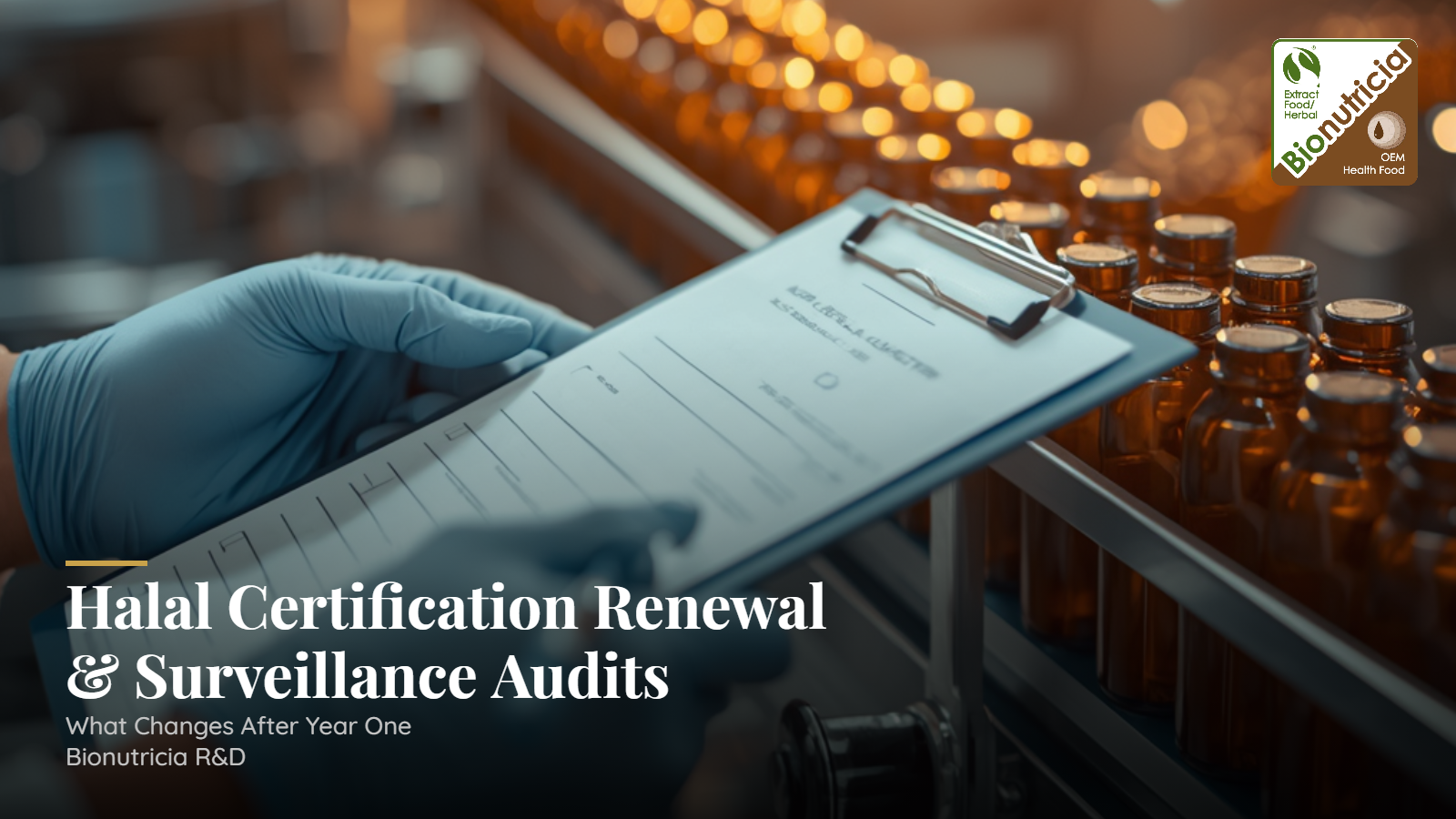
Halal Certification Renewal & Surveillance Audits: What Changes After Year One
September 25, 2026 | by supersuper