

Roselle (Hibiscus) Extract: Standardised Anthocyanin Content for Supplement & Beverage OEM
June 29, 2026 | by supersuper
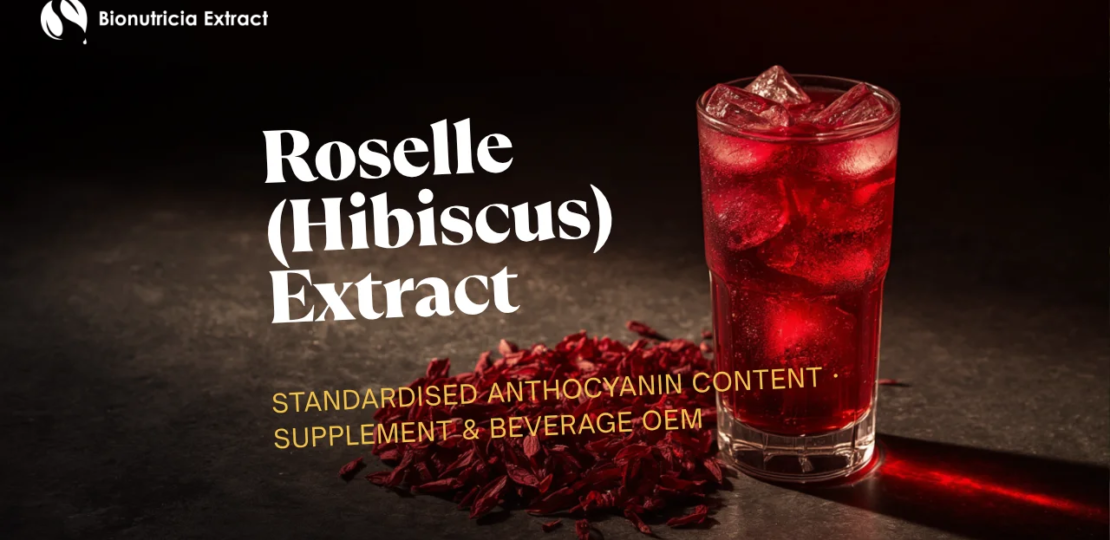
Direct answer: In the supplement and beverage trade, “hibiscus extract” and “roselle extract” are the same material — the dried calyx of Hibiscus sabdariffa L., known as roselle (and as asam susur in Malaysia, karkade in the Middle East, jamaica in Latin America). The ornamental garden hibiscus, Hibiscus rosa-sinensis, is a different species and is not what a reputable extractor supplies for ingestion. The single most important specification to request is total anthocyanin content — typically ≥1.5–2.0% for a standardised spray-dried powder, measured by the pH-differential method (AOAC 2005.02) and confirmed by HPLC fingerprint. Anthocyanins — chiefly delphinidin-3-sambubioside and cyanidin-3-sambubioside — drive both the deep ruby colour and the antioxidant profile, so they are the marker you standardise to. Always confirm the extract is from calyx (not leaf or petal), and add total polyphenols, organic-acid content, microbial limits and heavy-metal limits to the contract. Bionutricia offers contract extraction of roselle in standardised and phytosome form, plus finished SKUs — powder sachets, liquid sachets, pouch beverages and liquid bottles — under FSSC 22000 and JAKIM halal certification.
Roselle vs hibiscus: clearing up the name confusion
The terminology trips up almost every first-time buyer, so settle it before you brief a supplier.
Roselle is a species; “hibiscus” is a genus. Roselle is the common name for Hibiscus sabdariffa L. The genus Hibiscus contains hundreds of species, including the ornamental Hibiscus rosa-sinensis — Malaysia’s national flower, Bunga Raya — which is grown for show, not for consumption. When a beverage or supplement spec sheet says “hibiscus,” it almost always means H. sabdariffa calyx. If you ever receive material derived from petals or from an ornamental species, reject it: it is the wrong feedstock.
The used part is the calyx, not the flower. What looks like the “flower” in dried hibiscus tea is actually the calyx — the fleshy, deep-red sepals that swell around the seed pod after the true flower drops. The calyx is where the anthocyanins, organic acids and polyphenols concentrate. A correct CoA will state plant part: calyx (dried). “Whole flower” or “petal” on a CoA is a red flag.
Regional names point to the same material. Asam susur or asam paya (Malaysia), karkade (Egypt and the Gulf), jamaica (Mexico), bissap (West Africa), sorrel (Caribbean) — these all refer to H. sabdariffa calyx. If you are supply for an export SKU, recognising these synonyms helps you read supplier documentation and avoid paying a premium for a “rare” ingredient that is simply roselle under a local name.
So when a buyer asks “what’s the difference between hibiscus and roselle extract?” the honest answer is: for food and supplement purposes, there is none — provided both are standardised H. sabdariffa calyx extract. The difference that matters is the anthocyanin number, not the name on the label.
Why anthocyanins are the specification that matters
Two buyers can order “hibiscus extract” and receive wildly different material. The variable that separates a vivid, bioactive ingredient from a tired, brown one is anthocyanin content.
Colour. Anthocyanins are the natural pigments responsible for roselle’s signature ruby-to-magenta colour. In a ready-to-drink beverage or a powder sachet, that colour is a formulation asset — it lets a brand use a clean-label botanical instead of a synthetic red dye. Anthocyanin content correlates directly with colour intensity.
Antioxidant and polyphenol profile. Roselle calyx is rich in anthocyanins and other phenolic compounds, and is one of the most-studied botanicals for antioxidant capacity (ORAC, FRAP, DPPH assays). H. sabdariffa has also been investigated in human trials for cardiovascular and metabolic endpoints; for OEM labelling, keep claims to permitted structure/function and antioxidant language rather than disease-treatment statements, and confirm the wording against your destination market’s claims rules.
The assay to request. Total monomeric anthocyanin content is measured by the pH-differential method (AOAC 2005.02), conventionally expressed as cyanidin-3-glucoside equivalents. For identity and authenticity, ask additionally for an HPLC fingerprint that confirms the characteristic roselle markers delphinidin-3-sambubioside and cyanidin-3-sambubioside. A supplier who can only provide a colour reading, but not an anthocyanin assay, is selling you a colourant — not a standardised botanical extract.
Extract forms and what each suits
Spray-dried powder (most common for OEM)
Carrier: maltodextrin or tapioca starch (halal, non-GMO options available). Typical total anthocyanins: 1.5–3.0% (cyanidin-3-glucoside equivalents). Moisture: ≤5%. Shelf life: 18–24 months ambient in moisture-controlled packaging. Applications: instant drink sachets, powder-sachet beverages, premix blends, chewable tablet bases. Spray-dried roselle is the most supply-chain-stable form — it ships ambient and blends easily into dry operations. The trade-off is that anthocyanins are heat- and light-sensitive, so drying temperature and opaque packaging matter.
Liquid concentrate
Typical total anthocyanins: higher retention than spray-dried because there is no drying step. Brix: 40–60 depending on concentration ratio. Shelf life: 6–12 months refrigerated, shorter ambient with an acid/preservative system (roselle’s own organic acids help here). Applications: liquid-sachet beverages, RTD pouch beverages, liquid bottles, wellness shots. Concentrate preserves colour and flavour better but adds cold-chain considerations.
Colour-application grade
When the brief is colour rather than actives, roselle can be standardised to colour value (E1%1cm at ~520 nm) instead of, or alongside, anthocyanin percentage. Application rates are formulation-dependent. Specify whether you need a flavour-active extract, a colour-active extract, or both — roselle naturally delivers a tart cranberry-like flavour and a red colour together, which is part of its appeal.
Standardisation specification: what to put in your contract
For any roselle/hibiscus extract procurement, include all of the following in the CoA requirement:
Identity & authenticity
- Botanical name: Hibiscus sabdariffa L.
- Plant part: calyx (dried) — not petal, not leaf
- Country of origin stated; cultivated, traceable supply
Active marker assay
- Total anthocyanins: ≥1.5–2.0% (pH-differential / AOAC 2005.02, as cyanidin-3-glucoside equivalents)
- HPLC fingerprint confirming delphinidin-3-sambubioside and cyanidin-3-sambubioside
- Total polyphenols (Folin-Ciocalteu): typically ≥10–15 mg GAE/g
- Total organic acids / titratable acidity (roselle’s tartness is a formulation factor)
Physical parameters
- Appearance: free-flowing red powder (spray-dried) or clear-to-deep-red liquid (concentrate)
- Moisture: ≤5.0% (powder)
- Particle size: ≥90% passing 80 mesh (powder)
- Colour value E1%1cm at 520 nm (if colour-critical)
Microbiological limits (Malaysian Food Act 1983 + BP/USP convention)
- Total plate count: ≤10,000 CFU/g
- Yeast and mould: ≤1,000 CFU/g
- E. coli: absent/25g · Salmonella spp.: absent/25g · S. aureus: absent/25g
Heavy metals (botanical extract standard)
- Lead (Pb) ≤2.0 ppm · Cadmium (Cd) ≤1.0 ppm · Mercury (Hg) ≤0.1 ppm · Arsenic (As) ≤1.5 ppm
Solvent residuals
- Water extraction: not applicable · Ethanol extraction: ≤5,000 ppm residual ethanol
Functional formats Bionutricia manufactures with roselle
Bionutricia’s vertically integrated model — from calyx extraction to finished filling at the Sungai Buloh facility — means the team that standardises your roselle also fills your finished SKU, removing the CoA handoff risk between an extract supplier and a separate co-packer.
Powder sachet (10–20g): roselle blended with electrolytes, collagen, vitamin C or herbal systems for an instant ruby-coloured drink. Ambient-stable, 18–24 month shelf life.
Liquid sachet (30–50ml): single-serve RTD format for hydration, beauty-from-within or antioxidant positioning. JAKIM halal certified at product level.
Pouch beverage (200–500ml): larger-volume RTD for café, gym and convenience-retail channels; roselle as a hero flavour or layered with calamansi, ginger or butterfly-pea.
Liquid bottle (100–250ml): glass or PET wellness shots and tonics where the tart roselle profile and natural colour are the selling point.
Roselle pairs especially well with liposomal vitamin C systems — the natural acidity and red colour complement a vitamin-C-forward antioxidant SKU, and both can be produced under one roof.
Why Malaysian-origin roselle is a defensible spec
Roselle grows across the tropics — Sudan, Egypt, China, Thailand and Malaysia are all significant calyx origins. Specifying Malaysian-origin, cultivated, traceable roselle gives an export-bound SKU two advantages. First, traceability: Malaysian agricultural suppliers maintain plantation, harvest and treatment records that satisfy the full traceability requirement of FSSC 22000 and JAKIM halal certification — documentation that wild-harvested or loosely-aggregated supply chains often cannot provide. Second, integrated processing: extracting and finishing in the same JAKIM-certified facility keeps the halal chain unbroken from calyx to finished export carton, which is exactly what a customs inspector or a Gulf importer audits.
📚 Related guides
- Tongkat Ali Supplement OEM in 2026: Standardisation, Dosage Forms, and How to origin the Real Thing in Malaysia
- Liposomal Vitamin C OEM in 2026: Bioavailability Evidence, Particle-Size Verification, and What to Specify on the Contract
- Pandan Leaf Extract in Functional Beverages: From Raw Material to Finished SKU
Frequently asked questions
Is hibiscus extract the same as roselle extract?
For food, supplement and beverage purposes, yes. Both refer to standardised extract of Hibiscus sabdariffa calyx. “Roselle” is the species common name; “hibiscus” is the genus. The ornamental Hibiscus rosa-sinensis is a different species and is not used for ingestible extracts, so always confirm the botanical name and that the plant part is calyx.
What anthocyanin percentage should I specify?
For a standardised spray-dried powder, ≥1.5–2.0% total anthocyanins (pH-differential / AOAC 2005.02, as cyanidin-3-glucoside equivalents) is a sound commercial floor. Raise it for intense colour or premium antioxidant positioning. Always pair the percentage with an HPLC fingerprint so you are verifying authentic roselle, not just a red colour reading.
Can roselle extract replace synthetic red colour in a beverage?
Often, yes — anthocyanins give roselle its natural ruby colour, which supports clean-label reformulation. Anthocyanins are pH- and heat-sensitive, so the final shade depends on your formulation’s acidity and thermal process. Bionutricia’s R&D team confirms achievable colour against your matrix during formulation consultation.
Is roselle extract halal-certified?
Roselle is a plant-derived botanical with no haram inputs. Bionutricia’s roselle extraction and finished-beverage manufacturing are both covered under JAKIM facility-level halal certification, so finished SKUs carry halal status through to export.
Does Bionutricia extract roselle in-house or buy it in?
In-house. Bionutricia provides contract extraction of roselle calyx in standardised and phytosome form, then spray-dries, blends and fills the finished SKU at the same facility — so a single CoA chain covers the ingredient and the finished product.
Ready to develop a roselle/hibiscus SKU?
Vertically integrated roselle extraction and finished manufacturing under FSSC 22000 and JAKIM halal. Standardised anthocyanin spec, full CoA stack, and powder-sachet, liquid-sachet, pouch-beverage and liquid-bottle formats. Free formulation consultation and 24-hour RFQ reply.
Request a quotation · View our contract extraction services · View our certifications
WhatsApp: +60 16-661 8510
Article by Bionutricia R&D Team. Last updated: June 29, 2026.
RELATED POSTS
View all

Knowledge: Mangosteen Peel (Garcinia mangostana)
October 5, 2024 | by bionutriciaadmin
Knowledge: Chayote (Sechium Edule)
October 5, 2024 | by bionutriciaadmin