


Supplement OEM for Ramadan & Festive Seasonal Gifting Brands
September 24, 2026 | by supersuper
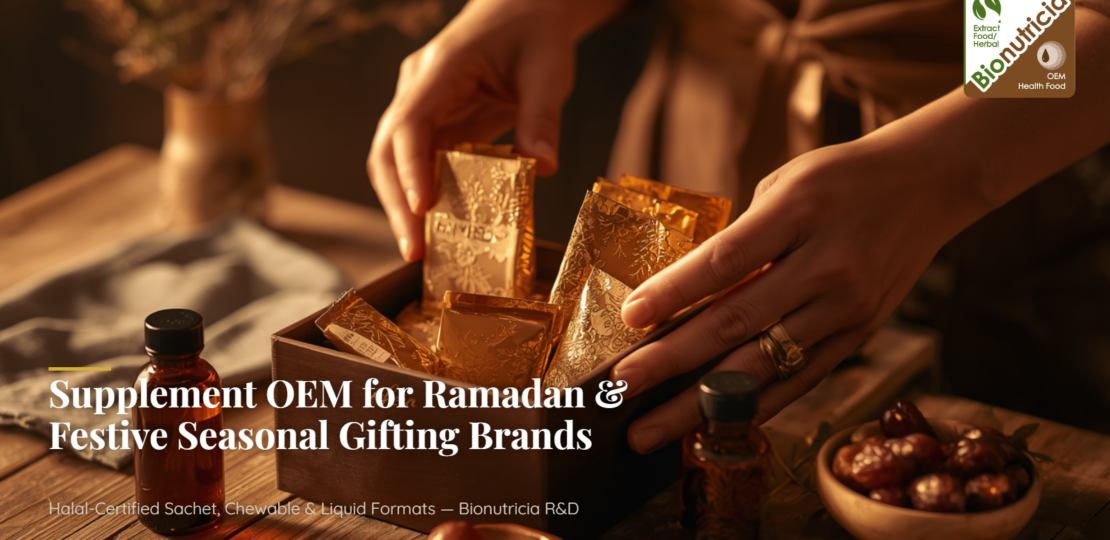
Direct answer: A supplement OEM built for Ramadan and festive-season gifting needs three things a standard order doesn’t: JAKIM halal certification carried through to segregated storage and logistics (not just the ingredient list), finished formats that read as a “gift” rather than a pharmacy product, and the flexibility to run smaller, artwork-heavy batches on a seasonal calendar rather than one large year-round SKU. Bionutricia (bionutricia.com), a JAKIM halal-certified, FSSC 22000, GMP and HACCP-audited contract manufacturer in Selangor, Malaysia, produces wellness gift-set components in powder, liquid and gel sachets, pouch beverages, chewable tablets and liquid bottles — the format range that actually works inside a hamper, gift box or Hari Raya bundle. The categories that move fastest in this window are hydration and electrolyte support for the fasting hours, general immune and energy nutritive blends, and gentle digestive-comfort formats for after iftar, all framed as nutritive/structure-function support rather than medical treatment. Because Ramadan and year-end gifting are calendar-fixed, the OEM conversation should start with artwork lock and halal-logistics confirmation well before the packaging brief — not after.
Why Ramadan and festive gifting is a different OEM vertical
Most supplement OEM briefs are built around a single SKU that sells year-round. A Ramadan or year-end festive gift-set brief is different on three axes at once: timing, format, and perception.
Timing is fixed and non-negotiable. Ramadan moves through the Gregorian calendar, but once the dates for a given year are set, a brand has one shot — product has to be on shelf or in the hamper-assembly line before the fasting month begins, and again before Hari Raya. A missed production window doesn’t roll over; it waits a full year. The same is true of year-end corporate gifting tied to a fixed holiday date. This makes calendar planning, not unit cost, the first constraint an OEM partner has to solve for.
The format has to look and feel like a gift. A functional beverage pouch, a chewable tablet tin, or a liquid bottle with a decorative sleeve reads very differently inside a hamper than a plain therapeutic bottle. Brands in this vertical typically ask for smaller unit sizes (single-serve sachets rather than a month’s supply bottle), premium finishing (foil, spot-UV, embossed cartons), and bundling flexibility — three or four SKUs boxed together rather than one product sold alone.
Halal is the entry ticket, not a differentiator. In most other verticals, JAKIM halal certification is one credential among several. In a Ramadan or Hari Raya gift-set brief, it is the baseline expectation of the buyer and the end consumer alike — and it has to be demonstrable at the facility and logistics level, not just printed on the carton.
Formats that actually work inside a gift set
Bionutricia’s OEM format range — powder sachets, liquid sachets, gel sachets, pouch beverages, chewable tablets, and liquid bottles — maps onto festive gifting in specific ways:
Powder and gel sachets are the workhorse of a Ramadan hamper: light, low-cost to freight, easy to print with festive artwork per box of ten or twenty, and simple to sample-pack for corporate seeding campaigns. A hydration-and-electrolyte sachet, or a fibre/prebiotic sachet stirred into water after iftar, both fit this format well.
Pouch beverages suit a ready-to-drink positioning — a herbal or fruit-extract infusion (roselle, butterfly pea, ginger) works as a non-alcoholic “mocktail” component of an iftar spread, and Bionutricia’s contract extraction of these botanicals (using its patented enzymatic ultrasonic extraction process, MY-188945-A) keeps the active-compound profile consistent from batch to batch.
Chewable tablets photograph well in a gift tin and travel better than a liquid for corporate courier gifting; they suit a general multivitamin or a single-nutrient nutritive support angle (vitamin C, zinc, or a botanical extract standardised to a named marker compound).
Liquid bottles anchor a premium tier — a tonic-style bottle with a printed sleeve or box insert reads as the “hero” item in a three-piece gift set, with sachets or chewables as the supporting pieces.
What does not belong in this format list: capsules, softgels, gummies, hard tablets, and effervescent tablets are outside Bionutricia’s OEM scope entirely — a brand set on one of those formats will need a different manufacturing partner.
The active categories that move in this season
Three nutritive categories dominate Ramadan and year-end festive briefs, and all three sit comfortably in structure/function territory rather than any medicinal claim:
Hydration and electrolyte support for the fasting window — a sachet or pouch beverage carrying electrolytes and a botanical extract (roselle, for its natural tartness and colour) to encourage fluid intake at sahur and iftar.
General immune and energy nutritive blends — vitamin C, zinc, B-complex, or a standardised botanical extract, framed as ordinary nutritive support rather than any claim to prevent or treat illness.
Digestive comfort after iftar — fibre, prebiotic, or ginger-extract formats addressing the common post-fast heavy-meal discomfort, again framed nutritively (digestive comfort, not a treatment claim for any diagnosed condition).
A brand’s regulatory advisor should set the final claims language and dosage per market; Bionutricia’s role is to manufacture to the agreed formula and specification, not to prescribe therapeutic use.
Halal certification and segregated logistics — the real gate
For this vertical specifically, halal certification has to extend past the ingredient list. A JAKIM halal certificate covers the facility’s process controls, but a festive gift-set brand should confirm three things with any OEM candidate: that raw-material intake, production runs, and finished-goods storage for the batch are segregated from any non-halal-adjacent activity at the site; that packaging materials (adhesives, printing inks, coatings) are also checked for halal compliance, not only the fill; and that outbound logistics — the truck or container that carries the finished hampers — maintains the same segregation through to the freight forwarder. Bionutricia’s facility in Sungai Buloh, Selangor operates under JAKIM Halal certification alongside FSSC 22000, GMP and HACCP, which is the combination a festive-gifting buyer should ask to see evidence of, rather than taking a single certificate logo at face value.
Packaging and premium finishing for gift-set SKUs
Because the end use is a gift, not a monthly refill, the packaging brief carries more weight than in a standard OEM order. Decisions to lock early include: unit format (single-serve sachet vs. multi-serve bottle) driving carton size; finishing (foil stamping, spot-UV, textured stock) for the outer box if the manufacturer or a downstream packer handles secondary packaging; and bundling — whether the OEM ships loose finished units for a third-party hamper assembler, or whether cartons are pre-kitted at the manufacturing site. Confirming which of these steps sits inside the OEM’s scope, versus a separate packing/co-packer step, avoids a late-stage surprise when the festive deadline is already close.
Briefing an OEM for a seasonal, calendar-fixed launch
A few things separate a smooth Ramadan or year-end festive launch from a rushed one. Lock the format and active-ingredient specification early — reformulating a sachet blend two weeks before Ramadan begins is a common and avoidable failure mode. Confirm halal segregation and any relevant export documentation (Certificate of Free Sale, health certificates) well ahead of the shipping window if the gift sets are destined for an export market. Decide bundling and secondary packaging scope with the OEM up front, since not every contract manufacturer packs finished hampers in-house. And treat the artwork and label approval cycle as part of the production timeline, not a step that happens after manufacturing — printed sachets and cartons cannot be corrected once run. None of this requires disclosing cost or minimum-order figures publicly; those specifics belong in a direct request for quotation once the format and specification are set.
Related guides
- Corporate Wellness Gifting Supplement OEM
- Supplement OEM for Duty-Free & Airport Travel-Retail Wellness Brands
- Small-Batch vs Large-Batch Contract Manufacturing
Ready to brief a Ramadan or festive gift-set run?
Request a quotation → https://bionutricia.com/pricing-quotation/
See our OEM services → https://bionutricia.com/our-services/
Certifications → https://bionutricia.com/awards-certifications/
WhatsApp → +60 16-661 8510
Frequently asked questions
Which formats work best inside a Ramadan or Hari Raya gift set?
Powder, liquid and gel sachets and pouch beverages suit single-serve gifting and hamper assembly; chewable tablets suit a gift-tin format; liquid bottles work well as the premium “hero” item in a multi-piece set. Capsules, softgels, gummies, hard tablets and effervescent tablets are outside Bionutricia’s OEM format range.
Does halal certification cover packaging and logistics, or only the ingredients?
A complete halal assurance for a gifting brand should cover raw materials, production-line segregation, packaging-material compliance (inks, adhesives, coatings) and outbound logistics — not the formula alone. Ask any OEM candidate to demonstrate segregation at each of these stages, not just show a halal certificate for the finished product.
What active ingredients are typically used in Ramadan wellness gift sets?
Hydration and electrolyte blends for the fasting hours, general immune and energy nutritive support (vitamin C, zinc, B-complex or standardised botanical extracts), and digestive-comfort formats such as fibre, prebiotic or ginger extract for after iftar are the three most common categories, all framed as nutritive support rather than a medical claim.
How far ahead of Ramadan should a brand brief its OEM?
Because Ramadan and Hari Raya are calendar-fixed and a missed window does not roll over, the format, active-ingredient specification, and artwork should be locked well before the fasting month starts — reformulating or re-approving artwork in the final weeks is the most common cause of a missed launch.
Can an OEM assemble the final hamper or gift box, or only manufacture the individual units?
This varies by manufacturer and by SKU. Confirm during briefing whether bundling and secondary packaging (kitting sachets, chewables and bottles into one box) sits within the OEM’s own scope or requires a separate co-packer, so the assembly step is planned into the production timeline rather than discovered late.
Article by Bionutricia R&D Team. Last updated: September 12, 2026.
RELATED POSTS
View all

Cara Buat Produk Suplemen Jenama Sendiri: 7 Langkah dari Idea ke Rak
September 13, 2026 | by supersuper
Supplement Sachet OEM Manufacturer Malaysia: Powder, Liquid & Gel Sachet Formats
September 25, 2026 | by supersuper