

White Tomato Extract & Astaxanthin Skin-Support OEM: Phytoene, Phytofluene Specs & Halal Sachet Formats
September 27, 2026 | by supersuper
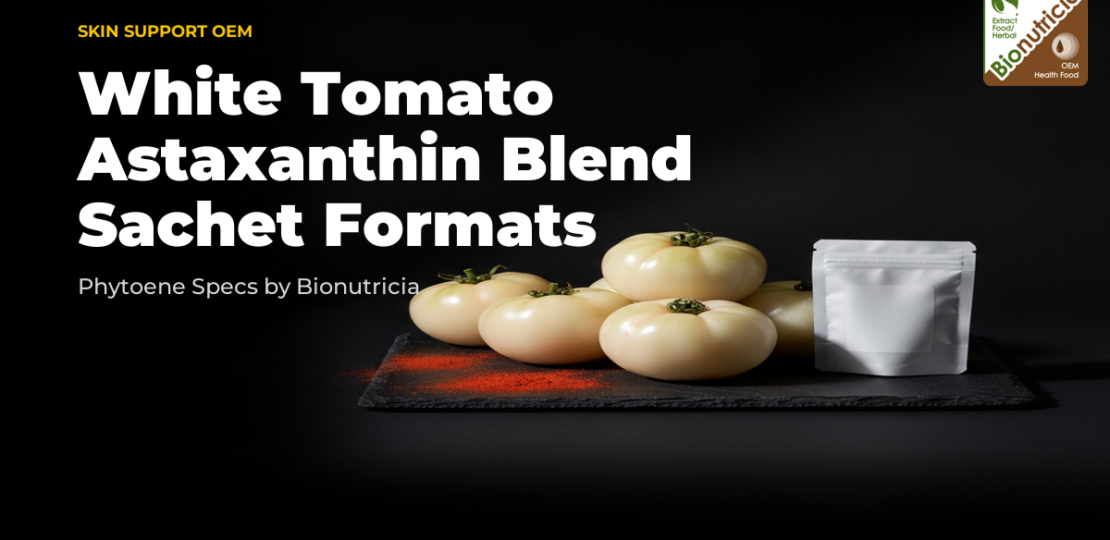
Direct answer: A white tomato extract skin-support supplement OEM manufacturer formulates colourless carotenoids — phytoene and phytofluene — from Solanum lycopersicum into finished supplement products under a brand owner’s own label. Bionutricia Holding, a JAKIM-certified halal OEM and contract manufacturer in Malaysia, produces white tomato extract formulations in powder sachet and liquid sachet formats, paired here with astaxanthin for a carotenoid-based skin-support concept. The white tomato fraction is extracted using Bionutricia’s patented enzymatic ultrasonic extraction (MY-188945-A), and the carotenoid actives can be delivered through Herbosomal® — Bionutricia’s proprietary liposomal encapsulation and sustained-release technology (registered trademark; patent-pending PI2023005773). Brand owners commissioning this combination should specify phytoene and phytofluene assay markers on the Certificate of Analysis, confirm astaxanthin standardisation to a defined percentage, and verify the full halal chain from raw material to finished sachet. Bionutricia operates a fully integrated GMP, HACCP and FSSC 22000-certified facility in Sungai Buloh, serving 239+ brand partners across SEA, MENA, US and EU since 2006.
What White Tomato Extract Brings to a Skin-Support Formulation
White tomato (Solanum lycopersicum) is an heirloom variety with creamy white flesh and skin. Unlike red tomatoes, which are rich in lycopene, white tomatoes accumulate colourless carotenoids — primarily phytoene and phytofluene — in their fruit tissue. These two compounds are C40 isoprenoid carotenoids that absorb UV light in the 280–360 nm range without imparting visible colour to the finished product. For a brand owner formulating a skin-support supplement, this colourless profile is a functional advantage: the actives do not tint a powder sachet or liquid beverage, leaving the formulation’s appearance to flavour and carrier choices rather than to the active itself.
A commercial white tomato extract for OEM use should be standardised to a declared phytoene and phytofluene content, typically expressed as a percentage on a dry-weight basis and verified by HPLC. The extraction ratio (e.g. 10:1 or 20:1) and the carrier system — usually maltodextrin or gum arabic for spray-dried powders — should appear on the specification sheet. Bionutricia’s patented enzymatic ultrasonic extraction (MY-188945-A) processes the tomato fraction under controlled conditions that preserve the colourless carotenoid profile, producing a standardised powder suitable for sachet filling or beverage formulation.
Why Pair White Tomato Extract with Astaxanthin
Astaxanthin is a xanthophyll carotenoid produced naturally by the microalga Haematococcus pluvialis. In its natural form, astaxanthin is a deep red-orange pigment that complements the colourless phytoene and phytofluene fraction from white tomato. For a skin-support OEM formulation, the rationale for pairing these two carotenoid classes is compositional: the white tomato fraction contributes colourless carotenoids (phytoene and phytofluene), while astaxanthin contributes a pigment carotenoid with its own distinct molecular structure and UV absorption profile.
A commercial astaxanthin extract for OEM use should be standardised to a declared astaxanthin percentage (typically 1–10% in a oleoresin or beadlet form), with the Haematococcus pluvialis origin identified on the specification sheet. The CoA should report total carotenoid content, astaxanthin assay by HPLC, heavy metals (lead, arsenic, cadmium, mercury), microbial limits, and residual solvent if applicable. Brand owners should confirm that the astaxanthin supplier provides a halal certificate covering the extraction process, or that the material is halal-compliant by composition.
What the Research Shows
A human study published in Int J Vitam Nutr Res in 2015 reported that tomato-based supplementation raised serum phytoene and phytofluene levels in healthy volunteers, and that this was associated with reduced UV-induced erythema (PMID: 24920476; https://pubmed.ncbi.nlm.nih.gov/24920476/). The study measured serum carotenoid response and erythema outcome in a human volunteer population; the finding describes an association between supplementation and reduced erythema, not a causal mechanism. This evidence pertains to dietary phytoene and phytofluene from tomato, not to any Bionutricia formulation or finished product.
For astaxanthin, brand owners should request the full evidence dossier from their material supplier and evaluate any clinical literature against the specific population, dose and outcome studied. The formulation rationale for pairing white tomato extract with astaxanthin rests on their complementary carotenoid profiles and distinct UV absorption characteristics — not on any claim that the combination itself has been studied as a blend.
Herbosomal® Technology for Carotenoid Delivery
Carotenoids are lipophilic compounds, and their incorporation into a water-based sachet or beverage format presents formulation challenges around dispersibility and stability. Bionutricia’s Herbosomal® — Bionutricia’s proprietary liposomal encapsulation and sustained-release technology (registered trademark; patent-pending PI2023005773) — pairs phyto-actives with phospholipid carriers to produce a liposomal dispersion that can be incorporated into liquid sachet or powder sachet formats. For a white tomato extract and astaxanthin formulation, Herbosomal® encapsulation is a manufacturing capability that Bionutricia offers; it is described here as a delivery technology, not as a clinically proven outcome.
Brand owners commissioning a Herbosomal® formulation should request particle-size data (measured by dynamic light scattering, DLS), encapsulation efficiency, and a Certificate of Analysis that confirms the active content in the finished liposomal dispersion. NanoVerify certification — Bionutricia’s validated nano-technology process verification — provides an additional layer of independent confirmation that the liposomal particle size is in the nano range.
OEM Format Options: Powder Sachet and Liquid Sachet
Bionutricia manufactures white tomato extract and astaxanthin formulations in the following approved formats:
- Powder sachet — the most cost-effective format for a carotenoid blend. The spray-dried white tomato extract powder and astaxanthin beadlet or oleoresin are blended with carriers and filled into individual sachets. Powder sachets offer the longest shelf life and the most flexible dose adjustment.
- Liquid sachet — a ready-to-consume format that suits a Herbosomal® liposomal dispersion. The carotenoid actives are encapsulated into a phospholipid carrier and filled as a liquid dose. Liquid sachets offer a premium sensory experience and faster market entry.
- Pouch beverage — a larger-volume format for a functional drink positioning. The carotenoid blend is formulated into a beverage base with flavour and stabiliser systems.
Bionutricia does not manufacture capsules, softgels, gummies, hard tablets, effervescent tablets or stick-packs. Brand owners currently selling a capsule-format skin supplement who want to move production to a JAKIM-certified halal OEM should discuss sachet reformatting with the Bionutricia R&D team.
Standardisation and CoA Requirements
A brand owner commissioning a white tomato extract and astaxanthin skin-support formulation should specify the following on the Certificate of Analysis:
- Phytoene content — declared percentage, verified by HPLC
- Phytofluene content — declared percentage, verified by HPLC
- Astaxanthin content — declared percentage, verified by HPLC
- Extraction ratio — e.g. 10:1 or 20:1 for the white tomato fraction
- Heavy metals — lead, arsenic, cadmium, mercury within pharmacopoeial limits
- Microbial limits — total plate count, yeast and mould, coliforms, Salmonella, E. coli
- Moisture content — for powder formats, typically ≤5%
- Particle size — for spray-dried powders, D90 target
- Residual solvents — if applicable to the extraction process
The CoA should be batch-specific, not a generic template. A real CoA carries a batch number, a test date, and the signature or stamp of the analytical laboratory. Brand owners should request the CoA before committing to a production run and verify that the declared active levels match the formulation brief.
Halal Chain and Certifications
Every ingredient in a Bionutricia-manufactured supplement must be halal-compliant. The white tomato extract, astaxanthin, carriers, excipients and packaging materials must each be covered by a halal certificate or confirmed halal by composition. Bionutricia holds JAKIM Halal certification (OEM Kontrak Pengilangan), and the manufacturing facility operates under FSSC 22000, GMP, HACCP, US FDA registration and MeSTI notification, with NanoVerify validation for nano-processed ingredients.
Bionutricia’s OEM formats are food-classified and go through MeSTI notification. They do not require NPRA health-supplement MAL registration and do not undergo the 116–245 working-day NPRA evaluation. Brand owners should confirm their intended market’s regulatory classification for a skin-support supplement before finalising label claims.
What a Brand Owner Should Ask a Manufacturer
Before commissioning a white tomato extract and astaxanthin skin-support formulation, a brand owner should ask:
- What phytoene and phytofluene standardisation does the white tomato extract carry, and what HPLC method is used to verify it?
- What astaxanthin origin and percentage standardisation is used, and is the supplier’s halal certificate available?
- Can the manufacturer provide a Herbosomal® liposomal dispersion with DLS particle-size data and NanoVerify certification?
- What is the CoA format, and does each batch carry a unique batch number and test date?
- Which sachet or beverage formats are available, and what are the stability data for the carotenoid blend in each format?
- What is the full certification chain — JAKIM Halal, FSSC 22000, GMP, HACCP, US FDA, MeSTI, NanoVerify?
Frequently Asked Questions
Can Bionutricia manufacture a white tomato extract skin supplement in capsule format?
No. Bionutricia does not manufacture capsules, softgels or hard tablets. The approved OEM formats are powder sachets, liquid sachets, gel sachets, pouch beverages, chewable tablets and liquid bottles. A brand owner with an existing capsule product can discuss reformatting into a powder or liquid sachet with the Bionutricia R&D team.
What phytoene and phytofluene standardisation should I specify for a white tomato extract?
Specify a declared phytoene and phytofluene content verified by HPLC, with the extraction ratio (e.g. 10:1 or 20:1) stated on the specification sheet. The CoA should report the actual assay result per batch, not a generic range. Confirm the HPLC method and marker compounds with the supplier before production.
Is astaxanthin halal-compatible for a JAKIM-certified formulation?
Astaxanthin from Haematococcus pluvialis microalga is generally considered halal by composition. However, the extraction process and any carriers or excipients used must also be halal-compliant. Request a halal certificate from the astaxanthin supplier, or confirm halal compliance through the full material dossier.
What is the difference between this formulation and the existing white tomato + collagen peptide OEM article?
The existing white tomato + collagen peptide OEM article (published on bionutricia.com) covers a carotenoid-plus-peptide combination. This article covers a carotenoid-plus-carotenoid combination: white tomato extract (phytoene and phytofluene) paired with astaxanthin. The formulation rationale, standardisation markers and format considerations are distinct.
How does Herbosomal® technology apply to a carotenoid formulation?
Herbosomal® — Bionutricia’s proprietary liposomal encapsulation and sustained-release technology (registered trademark; patent-pending PI2023005773) — pairs lipophilic actives like carotenoids with phospholipid carriers to produce a liposomal dispersion suitable for liquid sachet or powder sachet formats. Brand owners should request DLS particle-size data and encapsulation efficiency from the CoA to verify the liposomal process.
Related Guides
- White Tomato + Collagen Peptide OEM: Phytoene Standardisation, Herbosomal® Technology & Halal Formats
- White Tomato Extract — Commercial Monograph
- Liposomal Supplement OEM: What Brand Owners Should Know Before Choosing a Manufacturer
Commission Your Skin-Support Formulation with Bionutricia
Bionutricia Holding Sdn Bhd is a JAKIM-certified halal supplement OEM and contract manufacturer in Malaysia, founded in 2006. The company operates a fully integrated facility in Sungai Buloh with FSSC 22000, GMP, HACCP, JAKIM Halal, US FDA and MeSTI certifications, plus NanoVerify validation. Bionutricia’s in-house authority team — a registered pharmacist, a nutritionist, a dietitian and a PhD biomedical scientist — supports formulation development, standardisation and regulatory documentation for brand owners commissioning white tomato extract and astaxanthin skin-support supplements.
To request a quotation or discuss your formulation brief, contact:
📧 Email: ng@bio-nutricia.com
📱 WhatsApp: +60 16-661 8510
🌐 Website: bionutricia.com
Article by Bionutricia R&D Team. Last updated: 25 September 2026.
RELATED POSTS
View all

The Clear Protein Wave: Why 2026’s Hottest Protein Pours Like Water — and How a Halal Brand Wins It
September 11, 2026 | by supersuper
What is the MOQ for nutraceutical contract manufacturing in Malaysia?
May 26, 2026 | by supersuper
OEM vs In-House Supplement Manufacturing: The Decision Founders Get Wrong
July 13, 2026 | by supersuper