

Coffea
Knowledge: Coffee (Coffea)
October 5, 2024 | by bionutriciaadmin

Coffee is a brewed drink that is prepared from roasted coffee beans. Despite its bitter and slightly sour taste, the strong aroma of coffee and its stimulating effect has made it a popular drink across the world. Other than its bitter form (black coffee), people are coming out with different variety of coffee drinks (e.g. latte, sugared coffee, mocha) to lessen the bitterness.
Coffee extract is referred as “pure coffee” that contains merely all-natural good source from coffee beans. It packs a powerful punch of energy booster (caffeine) and other essential nutrients including vitamin B2, vitamin B5, manganese, potassium, magnesium, and niacin. These made coffee not only an enjoyable drink, but coffee also seems to be a quite healthy drink.
We provide practical, easy & consistent on food processing application.
Fresh natural flavor extract powder for Bakery & Beverage.
- Vegan
- Non-GMO
- No Fillers
- No Flavors
- No Additives
- No Artificial Colors
- Soy and Gluten Free
- Lab Tested for Authentic & Active Compound
- Origin from Malaysia Borneo Forest
| Bionutricia Coffee Coffea Extract | BRAND X | |
| Certification | Registered with the Ministry of Health, Halal Tested | Not registered & certified |
| Raw Ingredients | Coffee from Malaysia farm | Very little / no raw ingredients; Use non-Coffee materials |
| Process | Extracted through R.O. water & Ultra-sonic; Full bio-active ingredients | Grinded peel powder; Extracted through ethanol process |
| Active Compound | 2-3% Caffeine | Not Tested |
| Formulation | Only Coffee which is proven safe and effective | Combination of other ingredients (effectiveness & safety is not proven); Added with prohibited drugs |
| Label | Transparent, standardized Coffee extract 2-3% Caffeine | Misleading claim (quantity), incorrect amount of Coffee extract, mostly filler ingredients |
The benefits of coffee have not only limited in boosting energy and improving performance, several researches have proven the therapeutic potential of coffee, including lowering risk of diabetes and cancer.
Composition
• Caffeine • Vitamin B2 (riboflavin) • Magnesium • Plant chemicals: polyphenols including chlorogenic acid and quinic acid, diterpenes (cafestol and kahweol)
Improve mood and brain function
| Studies | ||
| Subject | Healthy males (n = 20) | |
| Duration of the study | 2 days | |
| Groups |
| |
| Dosage | 32, 64, 128 and 256 mg caffeine | |
| Parameters analysed |
| |
| Outcomes | As little as 32 mg of caffeine can significantly improved auditory vigilance and visual reaction time. No adverse behavioural effects were noted even at the highest dose administered. | |
| Function | Caffeine in coffee is thought to have stimulant-like effects on mood and performance by blocking the brain-signalling molecule adenosine and increase levels of dopamine and norepinephrine. | |
Protection against type 2 diabetes
| Studies | ||
| Subject | Diabetes patients (n = 7,269) | |
| Duration of the study | 4 years | |
| Groups |
| |
| Dosage |
| |
| Parameters analysed | Self-reported incident of type 2 diabetes | |
| Outcomes | 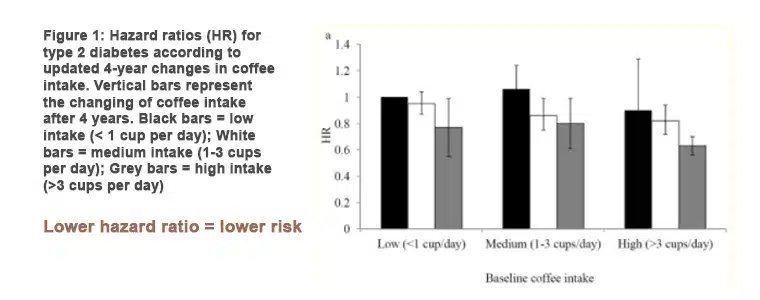 | |
| Function | Caffeine in coffee is thought to have stimulant-like effects on mood and performance by blocking the brain-signalling molecule adenosine and increase levels of dopamine and norepinephrine.Coffee and tea consumption have been associated with a lower type 2 diabetes risk | |
Decreasing cancer risk
| Meta-analysis of cohort studies | ||
| Subject | 105 individual prospective studies | |
| Parameters analysed | Association of coffee intake with risk of cancer | |
| Outcomes | Higher coffee intake (2 cups per day) reduces • liver cancer by 27%
| |
| Function | Bioactive compounds in coffee (including caffeine, cafestol, kahweol and chlorogenic acid) are known to exhibit anti-tumor properties. | |


RELATED POSTS
View all