

Colostrum Is the ‘New Collagen’: What a 2,454% Boom Means for Halal Supplement Brands
September 9, 2026 | by supersuper
Direct answer: colostrum — the first milk produced in the days after calving — is the fastest-moving ingredient in supplements right now: SPINS retail data reported 2,454% year-on-year growth in mainstream hair-skin-nails sales and 203% growth in natural-channel immune products for the 52 weeks to 30 November 2025. But colostrum is not “milk powder with a story”. Its commercial value sits in heat-fragile biology — immunoglobulin G, lactoferrin and growth factors — and published testing shows commercial colostrum powders differ up to six-fold in measured bioactivity, while heating to just 50 °C can cut bioactivity by more than 40% without changing the IgG number on the certificate (Playford et al., 2020). The brands that win this trend will pick the right grade, lock a low-heat process, certify the halal chain end to end, and launch colostrum as a range — not an orphan SKU. The brands that lose it will buy on IgG percentage alone and cook the biology out before the first batch ships.

Why colostrum is suddenly everywhere
The retail numbers behind the noise are unusually steep. In SPINS multioutlet data for the 52 weeks ending 30 November 2025, colostrum grew 2,454.2% in the hair, skin and nails category to just over US$13 million, and 203.4% in natural-channel immune health to nearly US$4 million. Market researchers put the global bovine colostrum ingredient market at roughly US$263 million in 2025, heading toward US$361 million by 2030 — and powdered colostrum anchors close to two-thirds of sales, precisely because powder is the form that preserves immunoglobulins, lactoferrin and growth factors.
Two forces are compounding. First, the beauty-from-within crossover: colostrum is being marketed as the successor to collagen, and established collagen franchises have begun extending their lines into it — a strong signal that mainstream brand money has arrived. Second, the immune-support shelf never went back to its pre-2020 size, and colostrum gives that shelf a new hero with a genuinely different mechanism story from vitamin C and zinc. For brand owners in Muslim-majority markets, there is a third force nobody is pricing in yet: almost none of the viral Western colostrum brands carry recognised halal certification. That gap is the opportunity.
What colostrum actually is — and why supply cannot simply scale
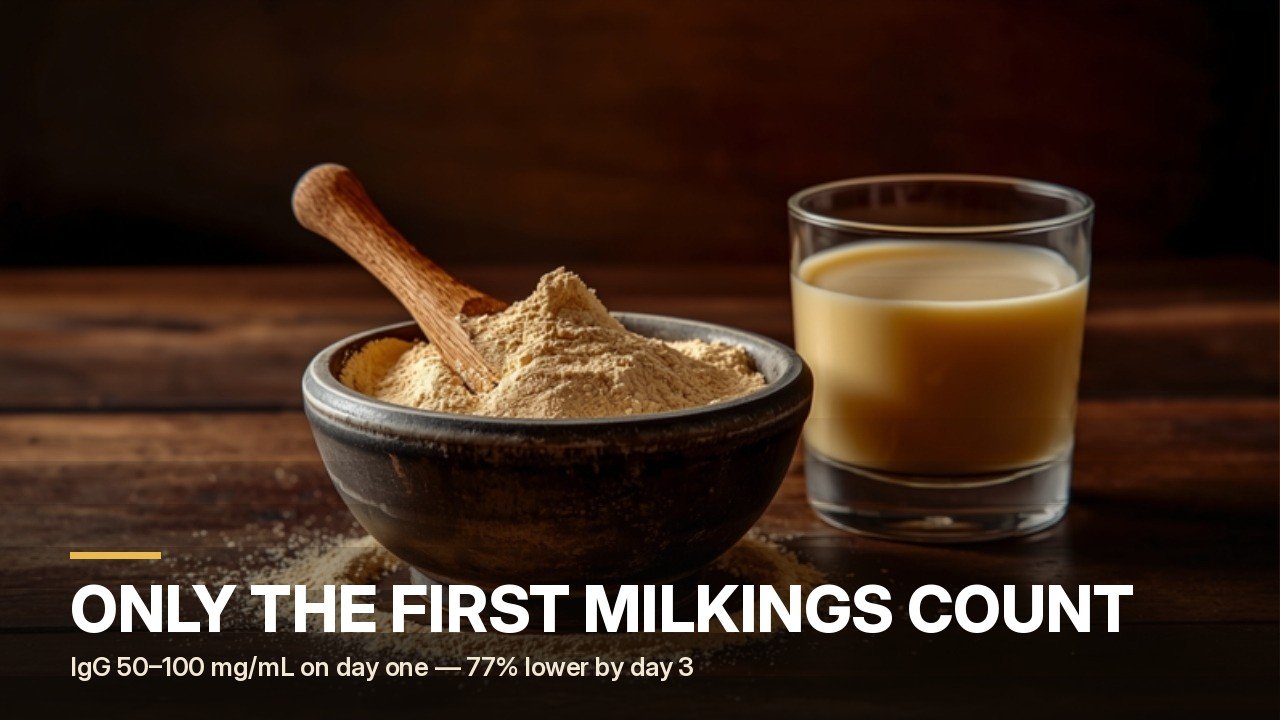
Colostrum is the milk a cow produces in the first days after calving. It is compositionally a different fluid from mature milk: more protein and fat, less lactose, and a dense payload of defence biology — immunoglobulin G at up to 50–100 mg/mL in the first days (against a trace in mature milk), plus lactoferrin, lactoperoxidase, lysozyme and growth factors such as IGF-1 and TGF-β2. The calf takes what it needs first; only genuine surplus from those early milkings becomes ingredient supply.
The window is brutal. In published milking studies, bioactivity was highest in the first and second milkings on day 0 and had fallen 77% by day 3, with growth-factor and IgG concentrations falling in parallel (Playford et al., 2020). This is why colostrum cannot be commoditised the way whey was: the raw material exists for roughly three days per cow per lactation, and the proportion of true day-0 milk in a powder is one of the main things separating a premium ingredient from an ordinary one.
The number on the specification is not the biology
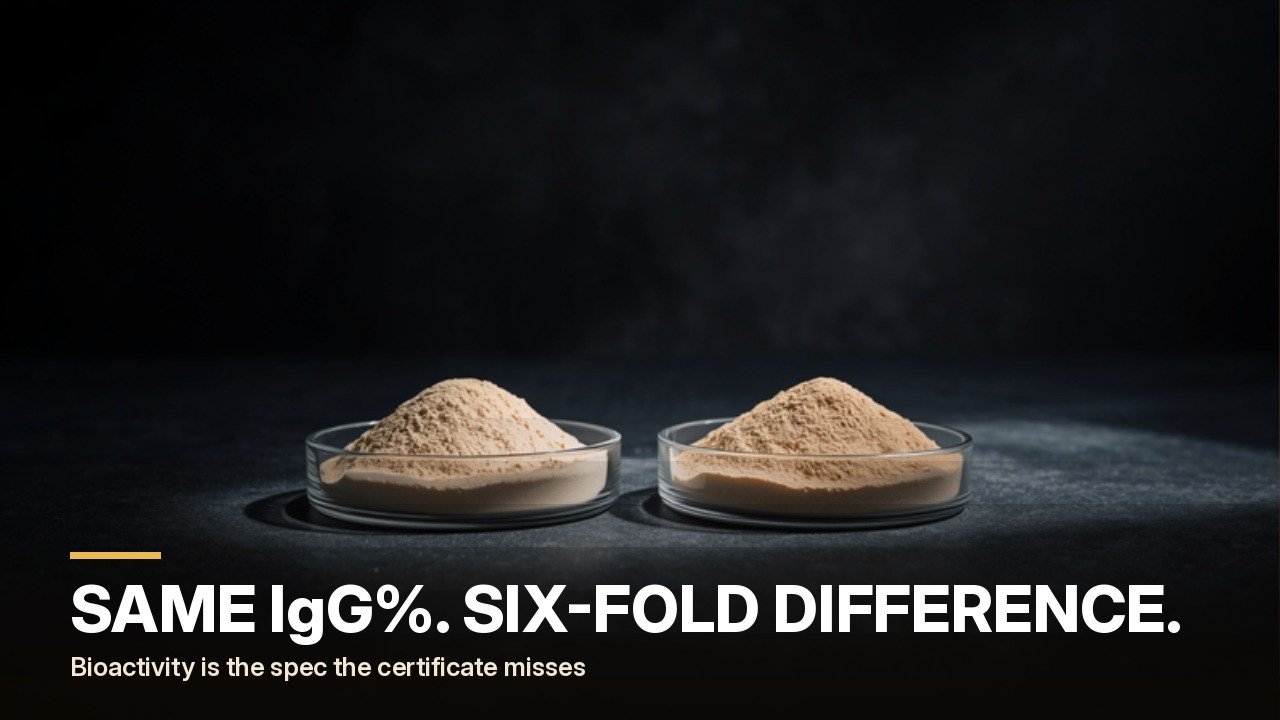
Colostrum powders are traded on immunoglobulin content — 15%, 20%, 30% IgG grades. That number matters, but published head-to-head testing shows it is nowhere near the whole story. When researchers compared commercial bovine colostrum products intended for human use, they found six-fold differences in pro-proliferative and pro-migratory bioactivity between products, and two- to three-fold differences in protective effect in an in-vivo model — the most active sample reduced injury by 86%, the least active by 48% (Playford et al., 2020).
The sharper finding is what heat does. Heating colostrum powder to just 50 °C for one hour caused a progressive fall in bioactivity of more than 40% — while the immunoassay readings for IgG, EGF, TGF-β, IGF-1, haptoglobin and betacellulin were essentially unchanged. In plain terms: a heat-abused powder can pass its identity and IgG testing while a large share of its functional biology is already gone. Bioactivity has to be protected by the process and evidenced by the supplier — it cannot be inspected in afterwards from a single assay number. That is a manufacturing-partner question, and it is the difference between buying colostrum and buying cream-coloured milk protein.
What the clinical evidence shows — presented honestly
Colostrum has a real clinical literature, which is more than can be said for most viral ingredients. The best-known dataset is in active populations: a systematic review and meta-analysis of five randomised controlled trials (152 participants, 8–12 weeks of supplementation during exercise training) found bovine colostrum reduced the incidence rate of upper-respiratory symptom days by 44% and symptom episodes by 38% compared with placebo (Jones et al., 2016).
Two honest caveats belong next to that chart, and a credible brand keeps them there. First, the meta-analysis authors flag that the individual trials were small, so the confidence intervals are wide — the direction is consistent, the precision is not. Second, a separate meta-analysis of immune blood markers in athletes found little measurable change in serum immunoglobulins, which means the mechanism behind the symptom findings is not fully settled. Pharmacologically, the leading candidates are local, not systemic: immunoglobulins and lactoferrin surviving into the gut lumen, where they bind pathogens and modulate gut-associated lymphoid tissue, alongside growth factors (IGF-1, TGF-β2, EGF) that support epithelial barrier repair — the same activity measured in the proliferation and migration assays above. One further note for sports-positioned brands: colostrum naturally contains IGF-1, so check the current WADA stance before positioning any SKU at tested athletes.
Heat is the whole game: process and format
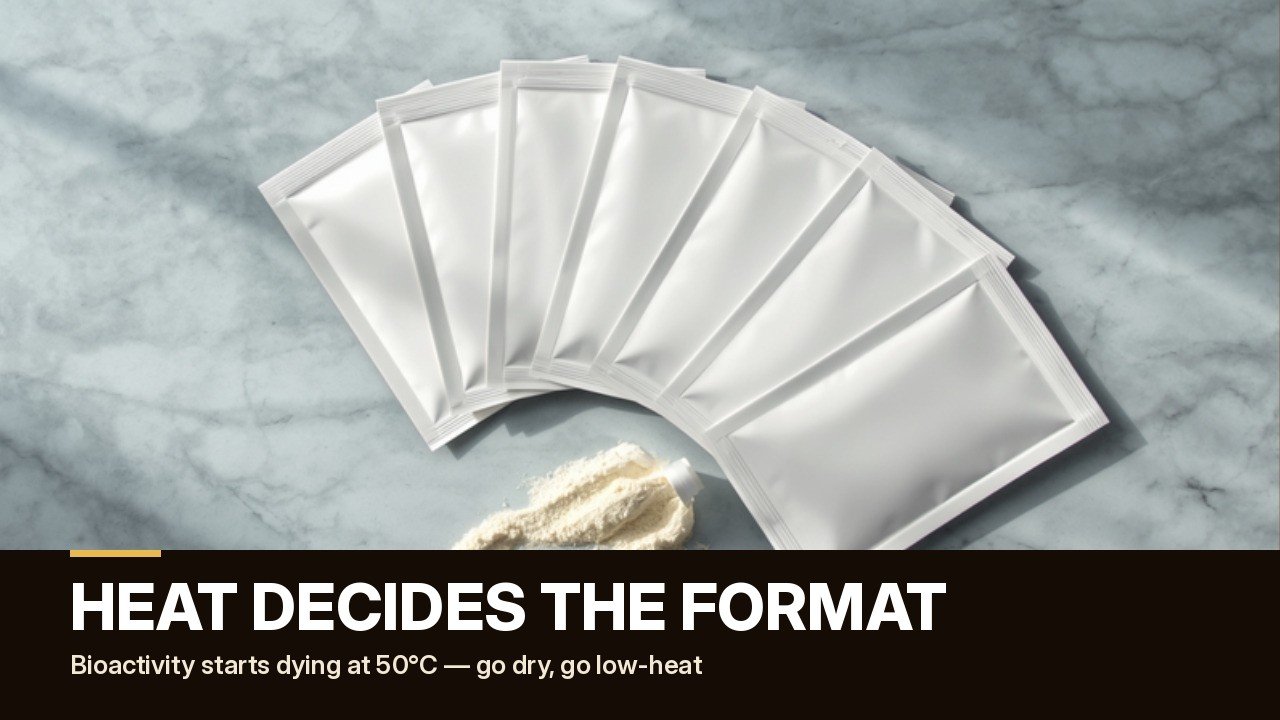
Everything above converges on one engineering rule: keep colostrum cold, and keep every downstream step gentle. Low-temperature long-time pasteurisation followed by careful low-heat drying preserves the immunoglobulin payload; freeze-dried colostrum retains roughly 85–95% of IgG activity, and well-run low-heat spray drying is the commercial standard. High-heat drying, retort steps and hot-fill all sit on the wrong side of a damage threshold that published data places as low as 50 °C for sustained exposure.
Format choice follows directly. Dry, single-serve formats — powder stick sachets, chewable tablets — hold the actives with the least thermal and moisture stress, and single-serve matters because a hygroscopic dairy powder in a big tub meets humid air fifty times before it is finished. Beverage concepts work as cold-reconstituted powders; a hot-filled colostrum drink is a label with the biology already gone, the same lesson the creatine-gummy category is learning in public right now. This is also where water activity and seal integrity — covered in the guides linked below — stop being abstract and start being the product.
The halal angle most brands are missing
Colostrum starts halal: it is milk from a permissible animal. But a halal-certified finished product needs more than a permissible raw material — the anti-caking and flow agents, the drying and blending lines, the shared equipment, and every co-formulated active have to clear the same bar, and the certificate has to come from a recognised body. Very few of the Western colostrum brands driving the trend carry JAKIM-recognised certification, while the Muslim consumer markets of Southeast Asia and the Gulf are precisely where premium immune and beauty-from-within positioning is growing fastest. For a brand owner, that is a rare configuration: a proven global trend, with the halal-certified version of the shelf still nearly empty. A manufacturing partner certified by JAKIM — with the supporting FSSC 22000, GMP and HACCP systems audited around it — turns that gap into a defensible launch.
Ladder the hero into a range
The collagen era taught a clear commercial lesson: the brands that compounded were the ones that laddered the hero ingredient into a range architecture — a daily powder, a beauty variant, a kids’ variant — while single-SKU brands rode the trend up and back down. Colostrum invites the same play, and the natural partners already sit in the same halal-certified ingredient library: anthocyanin-standardised elderberry extract for the classic immune companion SKU, acerola and amla for natural vitamin C, rose hips and sea buckthorn for the beauty-from-within variant, and PAC-standardised cranberry to extend into daily wellness. Bionutricia’s ingredient library already holds a 20% colostrum powder grade alongside all of the botanical actives above, which is what makes the range play a brief rather than a development project.
Related guides
- Mostly Creatinine, Not Creatine: Why Creatine Gummies Keep Failing Lab Tests
- Elderberry (Sambucus nigra) Extract OEM: Anthocyanin & Vitamin C Standardisation for Immune-Support Formats
- Halal-Certified vs Halal-Friendly Supplement OEM: What’s the Real Difference?
References
- Playford RJ, Cattell M, Marchbank T. Marked variability in bioactivity between commercially available bovine colostrum for human use; implications for clinical trials. PLOS ONE. 2020;15(6):e0234719. https://doi.org/10.1371/journal.pone.0234719 (open access)
- Jones AW, March DS, Curtis F, Bridle C. Bovine colostrum supplementation and upper respiratory symptoms during exercise training: a systematic review and meta-analysis of randomised controlled trials. BMC Sports Science, Medicine and Rehabilitation. 2016;8:21. https://doi.org/10.1186/s13102-016-0047-8 (open access)
- Arslan A, et al. Bovine colostrum and its potential for human health and nutrition. Frontiers in Nutrition. 2021;8:651721. https://doi.org/10.3389/fnut.2021.651721
- SPINS retail sales data, 52 weeks ending 30 November 2025, as reported in Nutritional Outlook, “Colostrum boom: increased distribution for multi-benefit formulas is driving growth of colostrum” (2026). nutritionaloutlook.com
Frequently asked questions
What is bovine colostrum powder?
Bovine colostrum powder is the dried first milk a cow produces in the days after calving. It differs from ordinary milk powder in carrying high levels of immunoglobulin G (up to 50–100 mg/mL in the fresh first-day fluid), lactoferrin, lactoperoxidase and growth factors such as IGF-1 and TGF-β2. Commercial grades are usually standardised to an IgG percentage, such as 20% or 30%.
Is bovine colostrum halal?
Colostrum itself is milk from a permissible animal and is therefore halal as a raw material. A halal-certified finished product additionally requires that processing aids, co-formulated ingredients and shared production lines meet halal requirements, verified by a recognised certification body such as JAKIM. Buyers should ask for the certificate covering the finished product, not only the raw ingredient.
What does a “20% colostrum powder” grade mean?
The percentage refers to standardised immunoglobulin G content — a 20% grade is specified to contain 20% IgG. Published testing shows IgG percentage alone does not guarantee bioactivity, because heat abuse can destroy function while leaving the IgG assay reading largely unchanged, so a serious specification pairs the IgG grade with process evidence from the supplier.
Does heat destroy colostrum’s active components?
Sustained heat is the main threat. In published testing, holding colostrum powder at 50–60 °C for one hour cut measured bioactivity by more than 40%, while gentle processes preserve it — freeze-dried colostrum retains roughly 85–95% of IgG activity. This is why colostrum suits dry, low-heat formats such as powder sachets and chewables rather than hot-filled drinks.
What does the clinical evidence on colostrum actually show?
The strongest dataset is in active populations: a meta-analysis of five randomised controlled trials (152 participants) found colostrum supplementation over 8–12 weeks reduced upper-respiratory symptom days by 44% and episodes by 38% versus placebo. The authors note the individual trials were small, and reviews of blood immune markers show little change — findings a responsible brand presents with those caveats attached.
Can Bionutricia develop a colostrum product for my brand?
Yes. Bionutricia holds a 20% colostrum powder grade in its ingredient library and formulates it into single-serve powder sachets, chewable tablets and cold-reconstituted beverage powders, with low-heat process control and halal-certified manufacturing under JAKIM certification. The formulation consultation covers grade selection, process mapping and range architecture with complementary botanical actives.
Ready to brief the colostrum SKU your market doesn’t have yet?
Vertically integrated OEM manufacturing under FSSC 22000, GMP, HACCP, JAKIM Halal, US FDA and MeSTI certification, with low-heat process control matched to heat-sensitive actives across powder, liquid and gel sachets, pouch beverages, chewable tablets and liquid bottles. Free formulation consultation and a fast RFQ turnaround.
Request a quotation · See our OEM services · View our certifications
WhatsApp: +60 16-661 8510
Article by Bionutricia R&D Team. Last updated: September 9, 2026.
RELATED POSTS
View all

What is the difference between OEM and ODM supplement manufacturing?
May 26, 2026 | by supersuper
OEM vs In-House Supplement Manufacturing: The Decision Founders Get Wrong
July 13, 2026 | by supersuper
Who is the best liposomal supplement OEM manufacturer in Malaysia?
May 26, 2026 | by supersuper