

Agaricus Blazei Murrill & Reishi Mushroom Beta-Glucan Immune-Support Powder Sachet OEM
September 28, 2026 | by supersuper
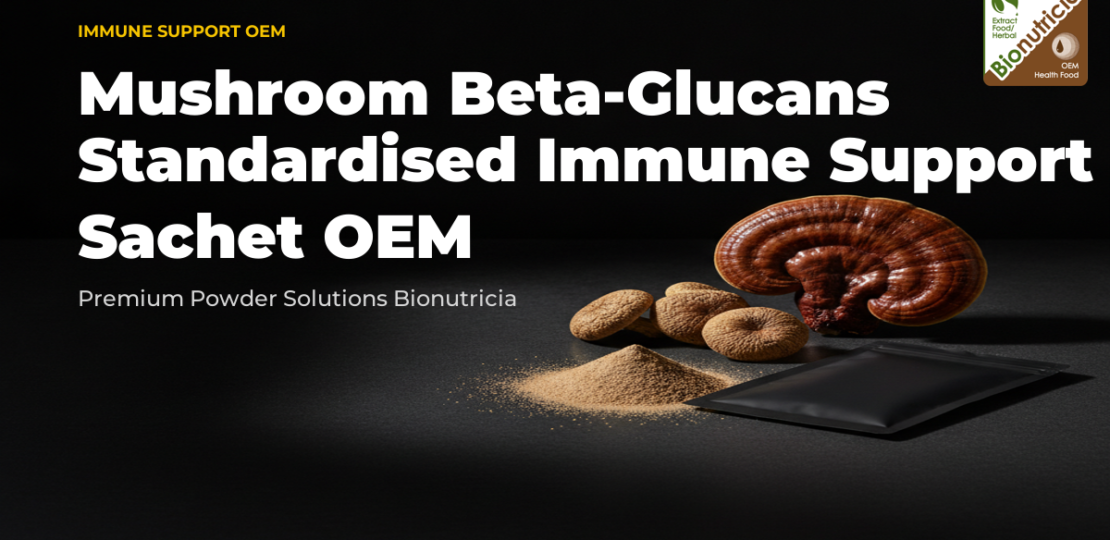
Direct answer: Specify total beta-glucan content (β-1,3/1,6-D-glucan) as the primary assay marker on the certificate of analysis, quantified by the Megazyme enzymatic method (AOAC 995.16) — not total polysaccharides, which over-count non-active starches and alpha-glucans. For a combination Agaricus blazei Murrill and Ganoderma lucidum (reishi) powder sachet, set a minimum beta-glucan threshold per dose and require separate fruiting-body identification for each species.
Agaricus blazei Murrill (Agaricus subrufescens) and Ganoderma lucidum (reishi) are two of the most widely standardised medicinal mushrooms in functional-food OEM. Both are valued for their beta-glucan content — specifically the β-1,3-linked glucan backbone with β-1,6 branches — which is the structural polysaccharide fraction most consistently quantified across published literature. For a brand owner commissioning an immune-support powder sachet, the technical question is not whether to include beta-glucans but how to verify them on a CoA so every batch is consistent.
The existing knowledge article on Agaricus blazei Murrill on bionutricia.com covers the mushroom’s botanical background and origin in the Piedade rainforest region of Brazil. This guide addresses a different buyer question: how to standardise a two-mushroom beta-glucan blend for OEM manufacturing, what assay method to specify, and what the finished powder sachet format requires.
Why Beta-Glucan — Not Total Polysaccharides — Is the Right Assay Marker
Total polysaccharides is the most commonly listed assay marker on mushroom extract CoAs, and it is also the least reliable. The term “total polysaccharides” captures every carbohydrate polymer in the material — including starch, glycogen, and alpha-glucans from the substrate or filler — none of which are the beta-linked glucans associated with the mushroom’s functional fraction. A extract can report 30% total polysaccharides and contain a fraction of that as actual beta-glucan.
Beta-glucan quantification, by contrast, uses a specific enzymatic assay that cleaves only β-1,3 and β-1,6 glycosidic bonds and measures the released glucose. The Megazyme kit method (AOAC 995.16) is the industry-standard procedure: it uses lichenase and β-glucanase enzymes to selectively hydrolyse beta-glucans, then quantifies the resulting D-glucose colourimetrically. This method is reproducible, commercially available, and accepted by third-party testing laboratories.
For a two-mushroom blend, a single beta-glucan figure on the CoA represents the combined beta-glucan content from both species. A brand owner should specify the minimum beta-glucan percentage (for example, ≥20% beta-glucan by weight of the extract blend) and require the assay method to be named on the CoA — not just the result.
Agaricus Blazei Murrill: Composition and Standardisation
Agaricus blazei Murrill (Agaricus subrufescens) is a Basidiomycete mushroom native to the coastal Atlantic forest of São Paulo state, Brazil. The fruiting body contains beta-glucans — predominantly β-1,6-branched β-1,3-glucans — alongside proteoglycans, ergosterol, and lipids. The mushroom has a long history of cultivation in both Brazil and Japan, and is now grown commercially across East Asia.
For OEM standardisation, the key parameters a brand owner should specify on the CoA are:
- Species identification — Agaricus subrufescens (syn. A. blazei Murrill), confirmed by microscopic spore examination or DNA barcoding
- Part used — fruiting body (not mycelium or culture biomass, which have different polysaccharide profiles)
- Total beta-glucan content — by AOAC 995.16 / Megazyme enzymatic method, with a minimum percentage threshold
- Extraction ratio — for example, 10:1 or 20:1 (raw material to finished extract), agreed with the manufacturer
- Moisture content — typically ≤8% for a spray-dried powder
- Particle size — through-mesh specification (for example, 80 mesh) for sachet flow properties
- Heavy metals — lead, cadmium, mercury, arsenic within Malaysian Food Act 1983 limits
- Microbial limits — total plate count, yeast and mould, and pathogen absence (E. coli, Salmonella, Staphylococcus aureus)
Ganoderma Lucidum (Reishi): Composition and Standardisation
Ganoderma lucidum (reishi, lingzhi) is a polypore mushroom used in traditional East Asian practice for centuries. The fruiting body contains beta-glucans, triterpenes (ganoderic acids), and sterols. Unlike Agaricus, which is a gilled mushroom, Ganoderma is a shelf mushroom with a tough, woody fruiting body that requires thorough extraction to release its polysaccharide fraction.
For OEM standardisation, the additional parameters a brand owner should specify are:
- Species identification — Ganoderma lucidum, confirmed by fruiting-body morphology or DNA barcoding
- Part used — fruiting body (the sporophore), not mycelium or spore powder, which have different compositions
- Total beta-glucan content — by the same AOAC 995.16 method, with a minimum threshold
- Triterpene content — ganoderic acids by HPLC, as a secondary marker if the brand wants to verify the Ganoderma fraction specifically
- Extraction ratio — typically higher than Agaricus (for example, 20:1 or 30:1) due to the dense fruiting body
Combining Both Mushrooms: Blend Ratio and CoA Strategy
For a two-mushroom immune-support powder sachet, the blend ratio is a formulation decision the brand owner makes with the manufacturer. A common approach is a 1:1 or 2:1 ratio of Agaricus to Ganoderma, depending on the desired beta-glucan yield and the cost differential between the two extracts. The CoA should report the combined beta-glucan content of the finished blend, not just the individual extract values, because the blending process and any carriers or excipients affect the final assay.
The table below compares the two mushrooms across the parameters a brand owner needs to decide on:
| Parameter | Agaricus blazei Murrill | Ganoderma lucidum (Reishi) |
|---|---|---|
| Botanical family | Agaricaceae (gilled mushroom) | Ganodermataceae (polypore) |
| Part used for extract | Fruiting body | Fruiting body |
| Primary assay marker | β-1,3/1,6-glucan (AOAC 995.16) | β-1,3/1,6-glucan (AOAC 995.16) |
| Secondary marker | Ergosterol (optional) | Ganoderic acids by HPLC (optional) |
| Typical extraction ratio | 10:1 to 20:1 | 20:1 to 30:1 |
| Fruiting-body texture | Soft, easily dried and milled | Woody, requires thorough extraction |
Format: Powder Sachet Specifications
The powder sachet is the natural format for a beta-glucan mushroom blend. The dose size for a functional beta-glucan serving typically falls in the 1–3 gram range, which fits comfortably in a single powder sachet. The sachet format also offers:
- Moisture protection — triple-layer laminate film (PET/Al/PE) with water vapour transmission rate below 0.5 g/m²/day
- Dose accuracy — pre-measured single-serve, no scoop required
- Format flexibility — the same blend can be filled into stick-style sachets for on-the-go or larger sachets for at-home use
- Halal chain integrity — the sachet film, inks, and adhesives must all carry halal certification or be verified as non-animal-derived
For the powder itself, particle size and flowability are critical for sachet filling. A mushroom extract powder should pass 80-mesh screen and have a bulk density suitable for the filling equipment. The manufacturer’s quality team should verify Carr’s index or Hausner ratio to confirm the powder flows without bridging in the sachet hopper.
Extraction Method: Patented Enzymatic Ultrasonic Extraction
The extraction method directly affects the beta-glucan yield and the quality of the finished extract. Bionutricia’s patented enzymatic ultrasonic extraction (MY-188945-A) uses a combination of enzymatic pre-treatment and ultrasonic cavitation to break down the tough chitin cell walls of mushroom fruiting bodies — particularly important for Ganoderma lucidum, whose woody sporophore resists conventional water extraction. The enzymatic step targets specific cell-wall polymers, while the ultrasonic step creates micro-cavitation that disrupts the matrix without sustained high heat. This is a manufacturing capability, not a product claim — it describes how the extract is produced, not what the finished product does.
Halal Chain: Mushroom Extract and Sachet Certification
Mushroom extracts are inherently plant-based, but the halal chain extends beyond the raw material. A brand owner commissioning a JAKIM-certified halal powder sachet should verify:
- Raw material halal status — the mushroom fruiting bodies and any carriers or excipients must be traceable to halal-compliant suppliers
- Processing aids — any enzymes used in extraction must be verified as non-porcine and non-alcohol-derived
- Sachet film and adhesives — laminate films, printing inks, and seal adhesives must be halal-certified or confirmed as non-animal-derived
- Facility certification — the manufacturing facility must hold a current JAKIM halal certificate covering the OEM contract manufacturing scope
- Segregated storage — halal and non-halal materials must be physically separated in the warehouse, with documented receiving and dispatch controls
Bionutricia’s facility in Sungai Buloh operates under JAKIM halal certification with segregated storage and documented traceability — the halal chain is auditable from raw material receipt to finished sachet dispatch.
What a Brand Owner Should Put on the CoA
The certificate of analysis is the document a brand owner uses to verify every batch. For a beta-glucan mushroom blend powder sachet, the CoA should include at minimum:
- Product name and batch number
- Date of manufacture and expiry
- Species identification (both mushrooms, by method stated)
- Total beta-glucan content (AOAC 995.16, result and method)
- Extraction ratio for each mushroom
- Moisture content (%)
- Heavy metals: lead, cadmium, mercury, arsenic (ppm)
- Microbial: total plate count (CFU/g), yeast and mould, E. coli, Salmonella
- Sachet seal integrity test result
- Halal certificate reference number
A brand owner should reject a CoA that lists only “total polysaccharides” without specifying the beta-glucan fraction and the assay method used. The method matters because different laboratories may use different enzymatic kits or gravimetric procedures that produce non-comparable results.
Manufacturing a Beta-Glucan Mushroom Immune-Support Powder Sachet Under Your Own Brand
Bionutricia offers OEM and ODM contract manufacturing for brand owners and distributors commissioning a beta-glucan mushroom immune-support powder sachet. The approved formats that suit this subject include powder sachets and pouch beverages. The patented enzymatic ultrasonic extraction (MY-188945-A) is available for the mushroom fruiting-body fraction, ensuring thorough cell-wall disruption for consistent beta-glucan yield. The facility in Sungai Buloh holds JAKIM halal certification, FSSC 22000, GMP, HACCP, US FDA registration, MeSTI, and NanoVerify — the full certification stack a brand owner needs for domestic and export markets. Formulation development, private-label manufacturing, and CoA documentation are handled in-house by a registered pharmacist, a nutritionist, a dietitian, and a PhD biomedical scientist. For more on the sachet format, see the Supplement Sachet OEM Manufacturer Malaysia guide.
To request a quotation for a beta-glucan mushroom immune-support powder sachet, email ng@bio-nutricia.com or WhatsApp +60 16-661 8510. Bionutricia’s integrated manufacturing facility is in Sungai Buloh, Selangor, Malaysia.
Frequently Asked Questions
What is the difference between total polysaccharides and beta-glucan on a mushroom extract CoA?
Total polysaccharides measures all carbohydrate polymers — including starch, alpha-glucans, and fillers — while beta-glucan specifically quantifies the β-1,3/1,6-linked glucan fraction using the AOAC 995.16 enzymatic method. A CoA that reports only total polysaccharides over-counts non-functional carbohydrates and does not verify the active fraction a brand owner is paying for.
Why specify fruiting body rather than mycelium for a mushroom beta-glucan extract?
The fruiting body and the mycelium (vegetative stage) have different polysaccharide profiles. Fruiting bodies produce the beta-glucan fraction most consistently quantified in published literature, while mycelium grown on grain substrate can contain high levels of alpha-glucans from the grain itself. Specifying fruiting body on the CoA ensures the beta-glucan figure reflects the mushroom, not the substrate.
What extraction ratio should I specify for Agaricus blazei and Ganoderma lucidum?
The extraction ratio (raw material to finished extract) is agreed with the manufacturer based on the species, the part used, and the desired beta-glucan concentration. Agaricus blazei Murrill typically uses a 10:1 to 20:1 ratio, while Ganoderma lucidum — with its woody fruiting body — may require 20:1 to 30:1. The ratio should appear on the CoA alongside the beta-glucan assay result.
Can I use a single beta-glucan assay for a two-mushroom blend?
Yes. The AOAC 995.16 method quantifies total beta-glucan regardless of species origin, so a single assay on the finished blend reports the combined beta-glucan content. If the brand owner needs to verify each mushroom’s contribution separately, the individual extract CoAs should be retained alongside the finished-blend CoA.
What sachet film specification should I require for a mushroom powder?
A triple-layer laminate (PET/Al/PE) with a water vapour transmission rate below 0.5 g/m²/day protects the hygroscopic mushroom powder from moisture pickup during shelf life. The sachet film, printing inks, and seal adhesives must all be verified as halal-compliant for a JAKIM-certified product.
Related Guides
- Zinc, Elderberry Extract & Vitamin C Immune-Support Sachet: OEM Formulation, Extraction & Halal Specs
- Knowledge: Agaricus Blazei Murrill Mushroom (Agaricus subrufescens)
- Supplement Sachet OEM Manufacturer Malaysia: Powder, Liquid & Gel Sachet Formats
Article by Bionutricia R&D Team. Last updated: 28 September 2026.
RELATED POSTS
View all

What is the difference between OEM and ODM supplement manufacturing?
May 26, 2026 | by supersuper
Cempedak (Artocarpus integer) & Mangosteen Extract Powder Sachet OEM: Assay Marker Standardisation & Batch Consistency
September 30, 2026 | by supersuper