

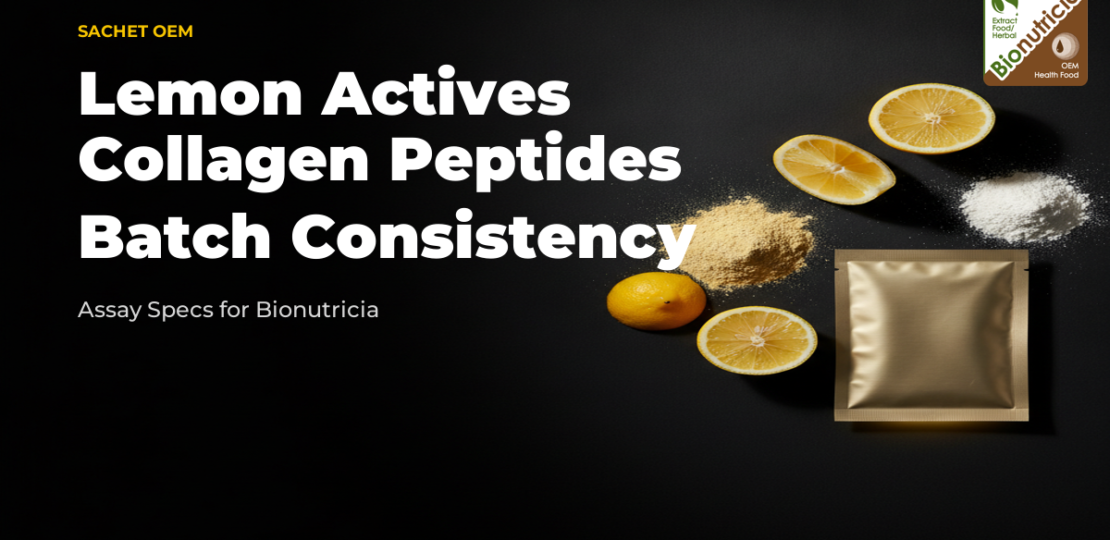
Lemon Polyphenols + Collagen Peptides Powder Sachet: Assay markers to specify and how patented enzymatic ultrasonic extraction (MY-188945-A) secures batch consistency
October 15, 2026 | by supersuper
Direct answer:
Direct answer: For a lemon polyphenols + collagen peptides powder sachet, brand owners should specify a total polyphenol assay plus a named flavonoid marker (for example, hesperidin) by HPLC, and a standardised collagen-peptide assay (peptide profile or nitrogen/protein assay). Patented enzymatic ultrasonic extraction (MY-188945-A) helps produce consistent extract fractions that simplify CoA alignment and batch-to-batch uniformity.
This guide explains which markers to request on the Certificate of Analysis (CoA), the assay methods to specify, packaging and carrier considerations for a dry powder sachet, and how Bionutricia’s patented enzymatic ultrasonic extraction (MY-188945-A) supports reproducible extract fractions for spray-dried powder manufacture.
Which assay markers to specify for the lemon ingredient
For Citrus limon-derived polyphenols, a brand owner should request both a quantitative total-phenolic result and at least one validated marker compound quantified by HPLC. Practical marker choices are:
- Total polyphenols — reported as mg gallic-acid equivalents (GAE) per g using a validated Folin–Ciocalteu or a validated total-phenolic assay method accepted by the third-party lab on the CoA.
- Hesperidin (or hesperetin glycosides) — quantified by HPLC with a certified reference standard; express as mg/g or % w/w. Hesperidin is a common flavanone marker in lemon and provides a specific consistency check between batches.
- Optional: Naringin or eriocitrin — include where your ingredient specification or supplier CoA historically reports these flavonoids; do not require both if hesperidin is present and validated.
Why both total and marker assays?
Total-phenolic assays capture the broad antioxidant-class content that consumers and formulators use as a rough quality indicator. A marker compound quantified by HPLC gives you a repeatable, specific potency check that ties a batch to its CoA. On a powder sachet formula where the payload is measured in grams per serving, both numbers together make the CoA actionable for quality release and supplier comparisons.
Which assay markers to specify for the collagen-peptides ingredient
Collagen peptides require a different approach. Ask for:
- Protein content / nitrogen assay — e.g., Kjeldahl or Dumas result converted to protein using the supplier’s conversion factor; expressed as % protein.
- Peptide molecular-weight profile — a certificate that reports the peptide-size distribution (for example: <1 kDa, 1–3 kDa, 3–10 kDa) from SEC-HPLC or gel-permeation chromatography when the peptide profile is critical to your positioning.
- Origin and tissue statement — the CoA must state origin (marine vs bovine) and halal-compliance documentation where relevant (JAKIM halal chain confirmation in the supplier files).
Assay methods to request — table for quick buyer use
| Specification | Recommended analytical method | Why it matters to a brand owner |
|---|---|---|
| Total polyphenols (mg GAE/g) | Validated Folin–Ciocalteu or validated spectrophotometric total-phenolic assay with lab validation statement | Shows overall polyphenolic load and assists dosage calculations for antioxidant-positioned SKUs. |
| Hesperidin (marker) | HPLC-UV or HPLC-PDA with certified reference standard and retention-time/peak-purity report | Repeatable potency marker for batch-to-batch matching and supplier selection. |
| Protein / nitrogen (collagen peptides) | Kjeldahl or Dumas, with conversion factor and method stated on CoA | Establishes active mass per sachet and supports nutrition-labelling accuracy. |
| Peptide profile (MW ranges) | SEC-HPLC / GPC with chromatogram saved as part of CoA | Useful for claims alignment, solubility, organoleptic behaviour and technical interchangeability between suppliers. |
Setting acceptance criteria and CoA expectations
Work with your laboratory or Bionutricia to set realistic acceptance ranges rather than single-point targets. Example approach for initial screening:
- Request the supplier’s nominal assay value plus an acceptable tolerance band (for example ±10–20% for marker analytes where natural variability is expected).
- Require third-party verification for heavy metals, microbial limits and residual solvents (where relevant) — ask for test method accreditation (ISO 17025) from the testing laboratory on the CoA.
- For a powder sachet formula, include a humidity/moisture specification (e.g., moisture <6%) and an accelerated-stability statement that supports ambient shelf life.
How patented enzymatic ultrasonic extraction (MY-188945-A) supports batch-to-batch consistency
Patented enzymatic ultrasonic extraction (MY-188945-A) is Bionutricia’s granted extraction process that combines controlled enzymatic fractionation with ultrasonic energy to produce standardised botanical fractions. Practically for a lemon-collagen powder sachet, the process contributes to consistency in three ways:
- Controlled fractionation: Enzymatic steps target cell-wall components and liberate polyphenolic fractions in a reproducible chemistry window, reducing lot-to-lot variability compared with ad hoc solvent extraction.
- Ultrasonic-assisted yield control: Ultrasonic energy improves mass transfer and reduces extraction time, which allows tighter process parameter controls and more consistent extract concentrations per batch.
- Manufacturing handoff compatibility: Fraction-standardised extracts from MY-188945-A are formulated into carriers and subsequently spray-dried into powder matrices that show more predictable blending, flow and fill behaviour for sachet dosing lines.
Note: the wording above describes manufacturing functionality. Do not treat the technology description as a health or absorption claim for a finished product.
Formulation and carrier considerations for a powder sachet
Key practical decisions a brand owner must make before asking an OEM for a quote:
- Active loading: Define target mg per sachet for both lemon polyphenol and collagen peptide payloads. This ties directly to the CoA and nutrition label.
- Carrier choice: Maltodextrin, non-GMO rice dextrin or microcrystalline cellulose are common carriers; ask for a carrier CoA to avoid allergen or halal chain issues. Confirm carrier compatibility with downstream spray-drying and packaging.
- Flow and fill: Request a granulometry or particle-size statement from the supplier when powder flow affects automated sachet filling. Bionutricia’s powder-handling parameters (target bulk density, tapped density) are verified during a pre-production pilot run.
- Hygroscopicity & packaging: For a high-protein matrix, specify high-barrier foil sachets and desiccant where needed to maintain moisture specs over shelf life.
Quality checks to include in your RFQ
- Complete CoA for each inbound extract batch (marker assays, total phenolic, protein content, heavy metals, microbial, moisture).
- Third-party ISO 17025 test-lab verification for at least heavy metals and microbial panels.
- Accelerated stability data aligned to ICH Q1A (e.g., 40°C/75% RH) to support ambient shelf-life claims.
- Production pilot run to confirm sachet fill accuracy, dissolution profile, and organoleptic checks.
Manufacturing a lemon polyphenols + collagen peptides powder sachet under your own brand
Bionutricia offers formulation development and private-label OEM manufacturing for powder-sachet products. For this subject the typical workflow is: recipe and payload agreement → supplier CoA verification → pilot batch (bench-to-pilot) → production batch with full CoA and third-party testing → release. Keep the specification file (assay method, acceptance bands, carrier identity) attached to your RFQ so the manufacturer can quote accurately.
OEM & ODM capability — Manufacturing a lemon polyphenols + collagen peptides powder sachet
Bionutricia’s OEM and ODM route covers formulation development, private-label manufacturing and full batch release for brand owners and distributors. Recommended formats for this subject are powder sachets, powder packaging and liquid bottle extensions if the formulation calls for solubilised collagen. Bionutricia’s patented enzymatic ultrasonic extraction (MY-188945-A) can be applied to botanical fractionation for lemon polyphenols to reduce variability, and Herbosomal® liposomal encapsulation is available where a brand owner later wishes to develop an encapsulated liquid or gel sachet product. The facility in Sungai Buloh holds FSSC 22000, GMP, HACCP, JAKIM halal, US FDA and MeSTI certifications, and NanoVerify validation is available for nanotech processing. For service details and RFQ submission, submit an enquiry through our website or email ng@bio-nutricia.com.
Frequently asked questions
Q1: Do I have to specify both a total-phenolic assay and a marker by HPLC?
A1: For a reliable CoA that supports batch release, yes — a validated total-phenolic assay and a named HPLC marker (e.g., hesperidin) give complementary information that makes supplier comparisons and stability planning straightforward.
Q2: Can a supplier’s certificate use Folin–Ciocalteu only?
A2: A Folin–Ciocalteu result is useful but non-specific. If you plan to rely on the botanical fraction as a key SKU differentiator, also require a specific HPLC marker to avoid ambiguity between suppliers.
Q3: What acceptance band should I ask for initially?
A3: Begin with the supplier’s nominal value and a tolerance band (for example ±10–20%). Tighten the band after two pilot production runs and aligned third-party verification of the CoA.
Q4: Will MY-188945-A change my flavour or aroma profile?
A4: The process is designed to control fractionation and preserve targeted phytochemicals. Any change in flavour or aroma should be captured during the pilot run and formulated against with carriers or masking agents where required.
Q5: What documentation should I attach to an RFQ?
A5: Provide the desired active payloads (mg per sachet), the exact assay methods you require (e.g., HPLC method for hesperidin with reference standard), acceptable tolerance bands, allergen constraints, and packaging preferences. Include any halal-chain or certification files you require on the final product.
Article by Bionutricia R&D Team. Last updated: 12 October 2026.
RELATED POSTS
View all

OEM vs In-House Supplement Manufacturing: The Decision Founders Get Wrong
July 13, 2026 | by supersuper
US Powder Sachet Supplements: Price Benchmark and Cost Drivers
October 29, 2026 | by supersuper