

Tongkat Ali Supplement OEM in 2026: Standardisation, Dosage Forms, and How to Source the Real Thing in Malaysia
June 1, 2026 | by supersuper
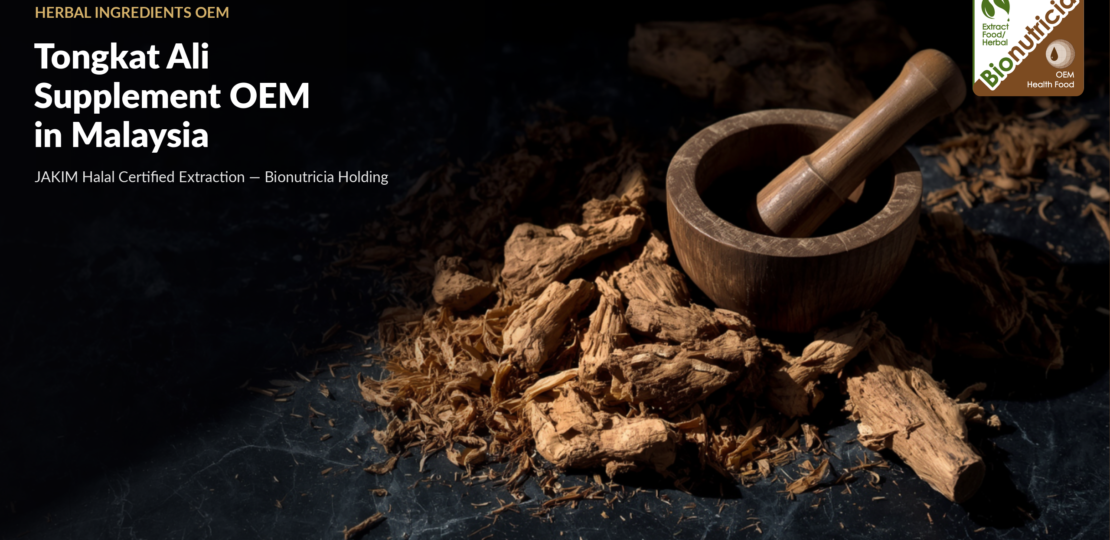
The short answer for brand owners scoping a Tongkat Ali product line in 2026: origin a standardised Eurycoma longifolia root extract from a Malaysian OEM, specify a 100:1 ratio with a quassinoid assay of ≥0.8%, choose a manufacturer with both JAKIM halal certification and FSSC 22000 (or equivalent) food-safety accreditation, and confirm the supplier’s heavy-metal and microbial testing panel before you sign. Skip the rest of this post if that’s all you needed — but if you want to know why those specifications matter, what to verify before you commit, and how to avoid the most common Tongkat Ali OEM pitfalls, read on.
Why Tongkat Ali supply matters more than buyers think
Tongkat Ali (Eurycoma longifolia, also called Long Jack, Pasak Bumi, or Ali’s Walking Stick) is one of Southeast Asia’s most-recognised ethnobotanical actives, traditionally used for vitality, stamina, and male hormonal support. The category has exploded since 2022, with major international supplement brands launching Tongkat Ali SKUs and a corresponding flood of low-quality raw material entering the market. Independent market surveys have repeatedly found low-quality “Tongkat Ali” products in the US and EU with little to no measurable quassinoid content — meaning either the raw material was diluted, the extract ratio was misrepresented, or the species was wrong altogether.
For a brand owner, supply badly is more than an embarrassment — it’s a regulatory exposure (mislabeling), a brand-reputation risk (consumers can taste the difference), and a competitive disadvantage (your formulation cannot deliver the clinical outcomes you market). The right OEM partner solves this at the supply chain level.
What “standardised” actually means for Tongkat Ali
The most-cited specification in Tongkat Ali contracts is “100:1 root extract” — meaning 100 kg of raw Eurycoma longifolia root reduced to 1 kg of dried extract. That ratio alone is not enough. Two extracts can both be labelled 100:1 yet contain wildly different bioactive content depending on the extraction solvent, temperature, time, and starting material quality.
The serious specification you should ask for is the quassinoid assay — the percentage of measurable quassinoids (eurycomanone, eurycomalactone, and related compounds) in the finished extract. The standard B2B contract spec in Malaysia is ≥0.8% total quassinoids by HPLC, with eurycomanone individually ≥0.2%. Anything below those numbers is either a diluted extract or a hot-water-only extract that has lost most of its bioactive profile.
Bonus spec to write into the contract: glycoprotein content ≥22% if your product positioning emphasises traditional Malay use (the glycoprotein fraction is the one most associated with the historical preparation). And maximum lead and arsenic at 0.5 ppm and 0.3 ppm respectively to align with US FDA and EU heavy-metal limits for root extracts.
The three Tongkat Ali extract grades you’ll see on quotation
Most Malaysian OEMs offer Tongkat Ali in three commercially distinct grades:
Grade A — Proprietary standardised (e.g., LJ100, Physta). These are branded extracts licensed from research institutions (often with peer-reviewed clinical data behind them). Quassinoid content is locked at 1.0–1.5%, with full traceability and clinical-grade documentation. Pricing and minimums are confirmed at the RFQ stage. Use when your product story needs cited human-trial data.
Grade B — Standardised 100:1 with assay (the workhorse). Same quassinoid spec (≥0.8%) but without the proprietary branding. Made by serious manufacturers (including Bionutricia) with HPLC verification on every batch. Pricing and minimums are confirmed at the RFQ stage. Use for the bulk of OEM contracts where assay rigour matters but you don’t need the branded marketing asset.
Grade C — Generic “100:1” without assay verification. No assay number on the CoA, just a ratio claim. Common from non-Malaysian origins and from cheaper Malaysian wholesalers. Pricing and minimums are confirmed at the RFQ stage. Use only if you are confident running your own HPLC verification on every shipment — otherwise the regulatory and brand risk is severe.
A reputable OEM will be transparent about which grade is in their quotation. If the manufacturer hesitates or refuses to share the HPLC chromatograph from the lot you’re buying, walk away.
Dosage forms Bionutricia delivers
Once your extract specification is locked, the next decision is the finished-product format. Bionutricia’s actual OEM line-up (per the company profile) covers six formats well-suited for Tongkat Ali:
Powder sachets — Tongkat Ali extract blended with maltodextrin, citric acid, and natural flavouring. Single-serve format suitable for direct consumption or reconstitution in water. The highest-volume format for halal-export markets in 2024–2026.
Liquid sachets — Tongkat Ali in a water- or honey-based liquid carrier, sealed in 5–30 g rectangular or pillow-seal liquid sachets. Strong shelf appeal in retail and convenience channels.
Gel sachets — Tongkat Ali in a gelled-suspension format, single-serve, easy-consumption. Premium positioning.
Pouch beverages — Tongkat Ali in a ready-to-drink pouch format (sport-pouch or aluminium pouch). Ambient stable. Popular for functional-beverage retail.
Chewable tablets — Tongkat Ali standardised extract pressed into chewable tablets, individually packed in tablet sachets or bottled.
Liquid bottles — Tongkat Ali in liquid form, bottled (20 ml, 30 ml, larger sizes). Used for shot-format consumer products.
Tongkat Ali coffee / 3-in-1 premix — explosive growth category in 2024–2026. Tongkat Ali extract blended into instant coffee + creamer + sugar premix, packed in powder sachet form. Bionutricia operates multiple sachet-filling lines including rectangular and pillow-seal formats.
Bionutricia’s OEM scope for Tongkat Ali covers the format spread that dominates the halal-supplement export channel: powder sachets, liquid sachets, gel sachets, pouch beverages, chewable tablets, and liquid bottles. Buyers asking for those formats can get a turnkey RFQ reply inside 24 hours.
Halal, heavy-metal, and microbial testing — the non-negotiables
A Tongkat Ali OEM in Malaysia must produce three documents on every batch shipped:
- JAKIM halal certificate confirming the finished product is halal — this is non-negotiable for export to GCC, Indonesia, and most ASEAN markets, and adds zero cost on a JAKIM-certified facility.
- Heavy-metal test panel (lead, mercury, arsenic, cadmium) — Tongkat Ali roots accumulate soil minerals and root-based extracts are higher-risk for heavy metal exposure than leaf-based ones. The contract should specify ICP-MS testing at SAMM-accredited labs (e.g., SGS Malaysia, Intertek) on every batch.
- Microbial panel (total plate count, yeast & mould, E. coli, Salmonella) — standard supplement requirements. The panel must be completed in-house or by accredited third-party before shipment.
A bonus document worth requesting is the CITES-equivalent harvest declaration — Tongkat Ali is not a CITES-listed species, but ethically-supplied Malaysian extract increasingly comes with a traceable harvest declaration showing that the roots were not taken from protected forest. FRIM-affiliated suppliers (Bionutricia’s R&D partner) include this by default.
What a fair Tongkat Ali OEM quotation looks like
For a typical first-order private-label brand looking at 1,500 powder sachets of Tongkat Ali (3 g per sachet × 400 mg standardised extract per dose, Grade B), expect:
A full quotation — including a line-by-line cost breakdown and the minimum for your chosen grade and format — is prepared for your specific brief at the RFQ stage.
Volume improves the per-sachet cost — we model the unit economics with you at the RFQ stage. Chewable tablet, liquid bottle, and pouch beverage economics follow similar tiers. These are real Malaysian-OEM numbers in 2026 — what the next quotation from a serious manufacturer will look like.
How to actually evaluate the OEM
When you call Bionutricia, or any Malaysian Tongkat Ali OEM, here’s the question list that separates the serious manufacturers from the brokers and resellers:
- “Can you send me the HPLC chromatograph of the last 3 production batches of your Grade B Tongkat Ali extract?” (A real manufacturer says yes immediately.)
- “Which lab issues your CoA?” (Look for SGS, Intertek, or a SAMM-accredited Malaysian lab; in-house-only is acceptable but less defensible against regulatory audit.)
- “Are you JAKIM certified at the facility level, or do you use halal-certified ingredients in a non-halal plant?” (Facility-level certification is the gold standard.)
- “What is your lead time from formula approval to finished goods leaving Port Klang?” (Get the answer in writing and confirm it against your own launch timeline — a manufacturer unwilling to commit to a written lead time is a red flag; exact minimums and lead times should be confirmed at the RFQ stage.)
- “Can I visit the facility?” (A “no” is a red flag.)
- “Who are 3 brand partners you’ve shipped to in the last 12 months that I can call as a reference?” (Brokers can’t answer this.)
A manufacturer that handles all six questions transparently is one you can build a 3–5 year supply relationship with. That relationship is worth more to a brand than saving a little per bottle on the next order.
Bionutricia’s Tongkat Ali OEM stack at a glance
20+ years operating history. 239+ brand partners across SEA, MENA, US, and EU. JAKIM halal certified at facility level. FSSC 22000 audited by SGS. US FDA registered. GMP and HACCP certified. MeSTI (MOH Malaysia). Herbosomal® — Bionutricia’s proprietary, registered-trademark liposomal encapsulation and sustained-release technology (patent-pending PI2023005773) — available for premium-format Tongkat Ali SKUs. In-house R&D lab with HPLC, UV-Vis spectrophotometry, and moisture-balance testing. FRIM research partnership for botanical standardisation. Wholesale-only OEM. 24-hour RFQ reply. FOB Port Klang export to 30+ countries.
📚 Related guides
- What is liposomal encapsulation and why is it used in premium supplements?
- Where is the best Malaysian botanical extract supplier for Tongkat Ali and Kacip Fatimah?
- How much does it cost to manufacture a private-label supplement in Malaysia?
Frequently asked questions
What is the proper daily dose of Tongkat Ali in a supplement? The clinically-supported dose for standardised 100:1 root extract is 200–400 mg per day for general vitality and 400–800 mg per day for performance-positioned products. Doses above 1,000 mg per day are not supported by current evidence and may increase cost without efficacy gain.
Is Tongkat Ali halal? Yes. Pure Tongkat Ali root extract is plant-based and halal by origin. A halal-certified finished product additionally requires halal manufacturing, halal excipients (maltodextrin, anti-caking agents, sachet seals, etc.), and JAKIM (or equivalent) certification of the manufacturing facility.
What’s the difference between Tongkat Ali and Black Tongkat Ali? “Tongkat Ali” refers to Eurycoma longifolia — the well-studied yellow-rooted species. “Black Tongkat Ali” usually refers to Polyalthia bullata, a botanically unrelated species with different actives. Brand owners should specify the Latin binomial in contracts to avoid confusion.
What’s the shelf life of a Tongkat Ali supplement? Standardised Tongkat Ali extract in powder sachet form is typically 24 months from manufacture, when stored below 25°C and below 60% relative humidity. Liquid sachet and bottled liquid formats typically carry 18–24 months. Pouch beverages and chewable tablets typically 18 months. Barrier-quality of the packaging is the key driver.
Can I OEM a Tongkat Ali coffee or 3-in-1 premix in Malaysia? Yes. Tongkat Ali coffee and 3-in-1 premix is one of the fastest-growing Malaysian OEM categories in 2025–2026. Bionutricia and other established Malaysian OEMs operate sachet-filling and powder-blending lines suitable for this format with minimums and lead times confirmed at the RFQ stage.
Ready to origin standardised Tongkat Ali from a JAKIM-certified Malaysian OEM?
20+ years operating history. 239+ brand partners. Wholesale-only OEM. 24-hour RFQ reply.
Request a quotation · See our OEM services · Browse our extract catalogue
WhatsApp: +60 16-661 8510
Article by Bionutricia R&D Team. Last updated: June 1, 2026.
Related Bionutricia services: contract botanical extraction in Malaysia · halal supplement OEM in Malaysia
Sourcing the standardised Tongkat Ali extract ingredient in bulk (rather than a finished supplement)? Our ingredient division supplies it with a Certificate of Analysis per lot — see bionutriciaextract.com.
RELATED POSTS
View all

OEM for Halal Travel & Umrah/Hajj Wellness Kit Brands
September 24, 2026 | by supersuper
Supplement OEM for Duty-Free & Airport Travel-Retail Wellness Brands
September 11, 2026 | by supersuper
Prenatal & Maternal Supplement OEM: Formats, Actives & Label Compliance
August 2, 2026 | by supersuper