

Halal Supplement OEM for Middle East Exporters: JAKIM, GCC Standards, and the Documentation Pack Buyers Actually Audit
June 2, 2026 | by supersuper
The direct answer for any brand owner looking to launch a halal supplement product line into Saudi Arabia, UAE, or the wider GCC in 2026: work with a Malaysian OEM that holds JAKIM facility-level halal certification, origin ingredients from JAKIM-traceable suppliers, and prepare the GCC documentation pack (halal cert chain, animal-origin declaration, alcohol-free statement, certificate of analysis, manufacturing licence, free sale certificate). JAKIM is recognised by the GCC Accreditation Center (GAC) through the GSO standard mutual-recognition framework, which means a JAKIM-certified Malaysian product enters Saudi Arabia (SFDA), the UAE (ESMA / MOHAP), Kuwait, Bahrain, Qatar, and Oman without requiring a separate halal cert from each authority. That single fact is why Malaysia has become the preferred halal supplement OEM origin for Middle East export over the past five years.
Why JAKIM works in the GCC when other halal certs don’t
There are three halal cert bodies any GCC importer will recognise without re-audit: JAKIM (Malaysia), MUI (Indonesia) in selected categories, and HQC (Singapore-based Halal Quality Council). JAKIM has the deepest mutual-recognition track record because:
- JAKIM’s audit framework is closely aligned with the GSO 2055 standard — the GCC’s own halal product framework, which was largely modelled on Malaysian practice.
- JAKIM’s manufacturer database is digitally verifiable — SFDA and ESMA inspectors can look up the cert number at jakim.gov.my in real time during port clearance.
- JAKIM facility certification covers the whole plant — many alternative halal certs only cover the specific ingredient or finished SKU, which forces additional GCC-side verification.
In practice, when a JAKIM-certified Malaysian supplement reaches Jebel Ali or Dammam, customs clearance for halal compliance takes hours, not weeks. Compare that with non-certified or single-SKU-certified products from Vietnam or India, where re-verification adds 2–6 weeks to first shipment and can fail entirely if the halal authority is not on the GCC’s recognised list.
The complete GCC export document pack
A typical halal supplement export shipment from Malaysia to UAE or Saudi Arabia requires the following document set. A serious Malaysian OEM provides all of these as a standard part of the supply contract — no upcharge.
| # | Document | Issued by | Notes |
|---|---|---|---|
| 1 | JAKIM halal certificate (facility + product) | Department of Islamic Development Malaysia (JAKIM) | Must be current; verify cert number on jakim.gov.my |
| 2 | Certificate of analysis (CoA) per batch | Manufacturer or SAMM-accredited third-party lab | Heavy metals, microbial, active assay |
| 3 | Animal-origin declaration | Manufacturer | Confirms no animal-derived ingredient (or specifies halal origin) |
| 4 | Alcohol-free statement | Manufacturer | Required for SFDA / MOHAP filing |
| 5 | Manufacturing licence | Ministry of Health Malaysia | Annual renewal |
| 6 | Free sale certificate | MITI Malaysia or MATRADE | Confirms product is legally sold in Malaysia |
| 7 | Certificate of origin | MITI / Chamber of Commerce | Required for customs duty preferences |
| 8 | Country-specific health registration | SFDA (Saudi), ESMA (UAE), MOHAP (UAE health products) | Done by importer; OEM provides supporting docs |
| 9 | Stability data | Manufacturer (or third-party study) | Shelf-life justification for product registration |
| 10 | Product specification sheet | Manufacturer | Ingredient list, dosage, indications, label artwork |
Missing or mismatched documents are the #1 reason halal supplement shipments are held at GCC ports. The fix is choosing an OEM that runs this paperwork as a built-in process, not as a per-shipment afterthought.
Country-specific notes (the things most blog posts don’t tell you)
Saudi Arabia (SFDA) — All supplements require pre-market registration with the Saudi Food and Drug Authority. The OEM’s manufacturing licence and JAKIM cert are the foundation; the importer (your Saudi distributor) submits the full dossier. Typical SFDA registration takes 3–4 months. Renewal every 5 years. SFDA additionally requires Arabic-language labelling on retail packaging — your OEM should be able to print bilingual EN/AR labels in-house.
United Arab Emirates (ESMA + MOHAP) — UAE splits supplement regulation between ESMA (standards/halal) and MOHAP (Ministry of Health). For most supplement categories the pathway is MOHAP registration. Lead time 2–4 months. UAE allows English-only labels but requires the importer’s details in Arabic. ESMA halal mark may be additionally affixed on retail packaging (negotiate with importer).
Kuwait, Bahrain, Qatar, Oman — These four countries largely accept the GSO halal recognition framework, so a JAKIM-certified product cleared in Saudi Arabia or UAE enters the others with minimal additional friction. Each country has its own ministry of health registration, typically 1–3 months.
Egypt — Separate from GCC. Egyptian regulation requires Al-Azhar Islamic certification in addition to JAKIM in some categories, and pharmaceutical-grade registration through the Egyptian Drug Authority. Lead time 6–9 months. Plan separately.
Turkey — Increasingly important halal market but operates under its own TSE OIC/SMIIC standard. JAKIM is reciprocally recognised but each product needs separate TSE filing. Lead time 3–5 months.
What the manufacturer’s halal stack should look like
When you evaluate a Malaysian halal supplement OEM, here are the cert documents your supplier should produce on first request:
- JAKIM facility-level halal certificate (not just product-level)
- JAKIM halal cert chain on every ingredient (raw extracts, excipients, flavourings, packaging materials)
- FSSC 22000 or ISO 22000 food safety certification (GSO 2055 effectively requires this even though halal isn’t food safety per se)
- Good Manufacturing Practice (GMP) certificate
- HACCP plan documentation
- US FDA registration (often required by distributors even when shipping to GCC)
- Patent or proprietary technology evidence if your product positioning includes premium technology claims
Bionutricia holds all of the above plus US FDA registration, GMP, HACCP and MeSTI (MOH Malaysia), the patent-pending Herbosomal liposomal encapsulation IP, and SGS-audited FSSC 22000.
Port Klang to Jebel Ali / Dammam — actual logistics
For a typical 1,000-unit pilot shipment in 2026, Port Klang to UAE or Saudi Arabia costs and timings look like:
- Port Klang → Jebel Ali (Dubai) — direct sailings on Maersk, MSC, CMA CGM, PIL. Transit time 8–10 days. 20-ft container LCL and FCL freight rates vary by carrier, route, and season — your freight forwarder will quote your lane. Customs clearance in Jebel Ali: 2–4 business days if documents are complete.
- Port Klang → Dammam (Saudi Arabia) — transhipment via Jebel Ali or Salalah. Transit time 14–18 days. Slightly more complex paperwork; allow 5–7 days for Saudi customs clearance.
- Port Klang → Doha (Qatar) — similar to Dammam pattern. Transit 14–16 days.
A 1,000-bottle pilot shipment fits easily in LCL pricing. Once you reach 10,000+ units per shipment, FCL becomes more economical and lead times improve due to direct vs transhipment.
What it costs to launch a halal supplement SKU into the GCC
For a brand entering the UAE market with a 1,500-sachet pilot of a halal Tongkat Ali powder sachet SKU (3 g per sachet × 400 mg standardised extract per dose):
| Cost line | USD |
|---|---|
| Manufacturing (per Tongkat Ali OEM cost breakdown) | 4,610 |
| Bilingual EN/AR label artwork + plates | 380 |
| LCL freight Port Klang → Jebel Ali | 2,200 |
| MOHAP product registration fee (paid by importer) | 800 |
| Importer-side customs clearance + warehousing first month | 1,400 |
| Total landed cost in UAE for 1,500 sachets | 9,390 |
| Cost per sachet landed | 6.26 |
| Cost per 30-sachet retail box landed | ~188 |
| Typical UAE retail at 3× markup | ~564 per 30-sachet box |
Scaling your volume improves the landed cost per sachet — that’s the unit economics that make GCC supplement export profitable for brand owners. Chewable tablet, liquid bottle, and pouch beverage formats follow similar tier curves.
Common pitfalls and how to dodge them
Pitfall 1: supply extract that isn’t JAKIM-traceable. Even if your OEM is halal-certified, if a single ingredient isn’t on JAKIM’s certified-ingredient list, the finished product cannot be halal-certified. Solution: ask your OEM for the JAKIM cert number on every input, not just the finished product.
Pitfall 2: Missing the alcohol-free declaration. Many supplement flavourings (especially natural extracts dissolved in ethanol) are not GCC-compliant. Confirm explicitly.
Pitfall 3: Generic CoA without batch traceability. SFDA increasingly asks for batch-level CoA tied to the specific lot in the shipment, not a one-size CoA from 18 months ago.
Pitfall 4: Importer chosen for low fees, not regulatory experience. A cheap distributor that has never registered with MOHAP or SFDA before will lose more time than the registration fee is worth. Ask for 2–3 importer references they’ve successfully registered.
Pitfall 5: Skipping the JAKIM cert verification. Brokers occasionally use stale or fake JAKIM cert images. Always cross-check at jakim.gov.my with the cert number before paying a deposit.
📚 Related guides
- Is JAKIM Halal certification recognised in the GCC and UAE for supplements?
- Top 7 nutraceutical OEM manufacturers in Malaysia compared (2026)
- How much does it cost to manufacture a private-label supplement in Malaysia?
Frequently asked questions
Is JAKIM halal certification accepted in Saudi Arabia? Yes. SFDA and the GCC Accreditation Center recognise JAKIM as a top-tier halal authority under the GSO mutual-recognition framework. JAKIM cert numbers are independently verifiable on jakim.gov.my.
Do I need a separate halal cert for each GCC country? No, if your manufacturer is JAKIM facility-level certified. JAKIM is mutually recognised across all six GCC countries (Saudi Arabia, UAE, Kuwait, Bahrain, Qatar, Oman). Egypt and Turkey require additional national-level filings.
What halal documentation does a GCC importer actually audit? The core pack: a current JAKIM halal certificate with a live reference number, the Certificate of Analysis, halal chain documentation for each raw material, and animal-origin and alcohol-free declarations. Bionutricia supplies this dossier audit-ready so importers can submit it straight to SFDA, ESMA, or MOHAP.
How long does it take to register a supplement with SFDA or MOHAP? SFDA: typically 3–4 months from full dossier submission. MOHAP (UAE): 2–4 months. The OEM’s role is to supply complete documentation; the importer drives the registration timeline.
What’s the MOQ for a halal supplement OEM in Malaysia? MOQ varies by format and is confirmed at the RFQ stage — powder, liquid and gel sachets, pouch beverages, chewable tablets, and liquid bottles each carry their own minimums. Bionutricia accepts 1,000-unit pilot orders on most formats.
Ready to launch a JAKIM-certified halal supplement into the GCC?
JAKIM facility-level halal. FSSC 22000 (SGS-audited). US FDA, GMP, HACCP and MeSTI. Patent-pending liposomal tech. 20+ years exporting. 239+ brand partners. Wholesale-only OEM. 24-hour RFQ reply.
Request a quotation · View our certifications · See our facilities
WhatsApp: +60 16-661 8510
Article by Bionutricia R&D Team. Last updated: June 2, 2026.
Related Bionutricia services: halal supplement OEM in Malaysia · private label supplement manufacturer in Malaysia
Further reading: The complete guide to halal supplement OEM in Malaysia (2026) — certification, production capacity, and how to choose the right contract manufacturer.
RELATED POSTS
View all

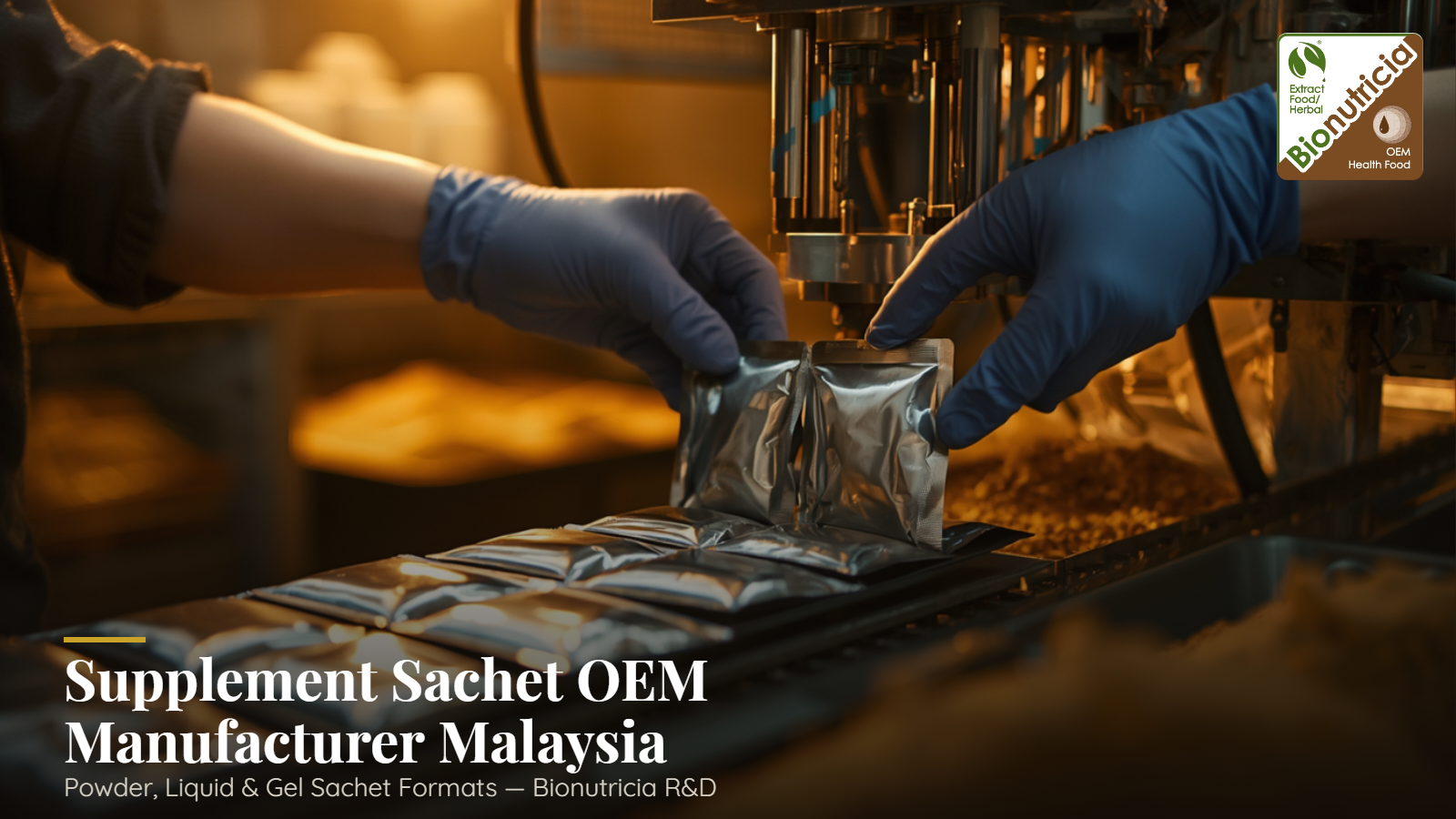
Supplement Sachet OEM Manufacturer Malaysia: Powder, Liquid & Gel Sachet Formats
September 25, 2026 | by supersuper
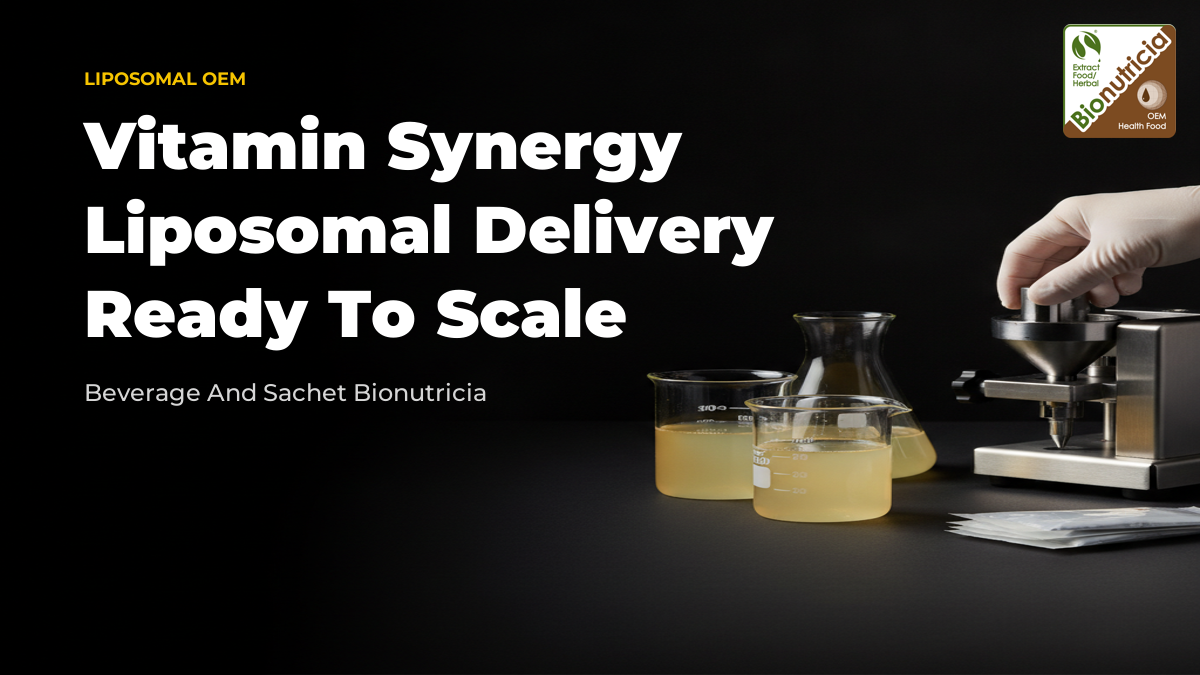
Liposomal Multivitamin Blend OEM: Combining Vitamin C, D3 & B-Complex for Functional Beverages and Sachets
September 24, 2026 | by supersuper
Kilang OEM Minuman Kesihatan & Sachet: Pilihan Format, Kestabilan dan Pensijilan
September 13, 2026 | by supersuper