


Functional Beverage OEM for Café & HORECA Channels: Formats, Actives & Speed-to-Market
July 23, 2026 | by supersuper
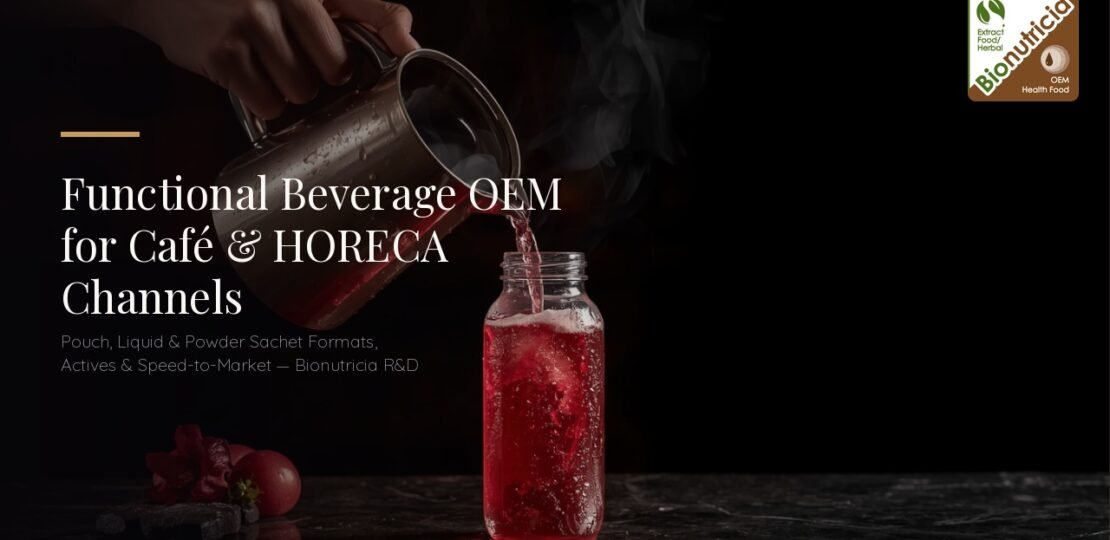
Direct answer: A café or HORECA (hotel/restaurant/catering) brand needs an OEM that can do three things at once: format for a service counter (not a warehouse), formulate for taste as much as function, and turn a menu concept into a first batch in weeks rather than quarters. Bionutricia manufactures functional beverages in the four formats that actually work behind a bar or on a café shelf — powder sachets (for a barista to shake or blend to order), liquid sachets (single-serve shots), pouch beverages (200–500ml ready-to-drink, the workhorse HORECA format), and liquid bottles (glass or PET, for a retail-adjacent fridge case). Every format is filled at Bionutricia’s own Sungai Buloh facility under FSSC 22000, GMP, HACCP, JAKIM Halal, US FDA and MeSTI certification, so a café chain rolling out across mixed-halal markets in Southeast Asia and the Gulf can standardise on one supplier rather than reconciling certificates from an extractor, a co-packer and a filler. The functional actives that perform best on a café/HORECA menu — butterfly pea flower, roselle/hibiscus, ginger, collagen, electrolytes and liposomal vitamins — are all extracted and standardised in-house, which is what lets a brand go from concept to a fillable, on-spec first batch quickly.
What “HORECA-ready” actually means for a functional beverage OEM
A HORECA buyer is not shopping the same brief as a DTC supplement brand. The differences show up in three places:
Format has to survive a service counter. A capsule or a hard tablet is irrelevant behind a café bar. What matters is a format a barista or server can pour, shake, dose into a blender, or hand across the counter as-is — a pouch beverage, a liquid bottle, or a powder sachet mixed to order.
Flavour and mouthfeel are formulation requirements, not garnish. A functional beverage on a café menu is judged on taste first and function second. That means the OEM’s R&D team needs to balance an active (an extract, an electrolyte load, a collagen dose) against acidity, sweetness and colour so the drink is something a customer orders again — not a supplement that happens to be liquid.
Speed-to-menu matters more than at retail. A seasonal café promotion or a hotel wellness menu often runs on a tighter development timeline than a retail SKU launch. An OEM that can move from concept brief to first fillable batch quickly — because extraction, standardisation and filling happen under one roof — is a meaningfully different proposition from a broker who has to sequence three separate vendors.
Formats Bionutricia manufactures for café and HORECA channels
Only formats Bionutricia actually offers are listed here — no capsules, softgels, gummies or hard tablets are part of this OEM’s format range.
Pouch beverage (200–500ml): The default HORECA format — ready-to-drink, ambient or chilled-stable depending on the formulation, and sized for a café fridge case or a hotel minibar. This is where most functional-beverage café programmes land: a butterfly-pea electrolyte drink, a roselle-ginger antioxidant tonic, or a collagen-and-vitamin-C beauty beverage.
Liquid bottle (100–250ml): Glass or PET wellness shots and tonics for a retail-adjacent fridge or a premium hotel wellness programme, where a smaller, more concentrated single serve fits the price point and positioning.
Liquid sachet (30–50ml): A single-serve shot format, useful where a café wants a grab-and-go functional shot at the till rather than a full beverage.
Powder sachet (10–20g): Built for a barista to shake, blend or stir to order — an instant electrolyte or botanical mix that a café can hold ambient without refrigeration and prepare fresh per cup, which is often the lowest-cost way into a functional-beverage menu.
The functional actives that perform on a café/HORECA menu
The ingredients that work best in a café setting share one trait: they deliver a visible or sensory cue (colour, tartness, a clean finish) alongside the functional claim, because a café customer is buying an experience as much as a benefit.
Butterfly pea flower — a natural blue-to-purple colour-shift extract that turns a functional drink into a visual centrepiece (colour-changing with citrus or acid), popular for Instagram-driven café menus.
Roselle (hibiscus) — standardised anthocyanin content gives a natural ruby colour and a tart, cranberry-like profile that reads as “antioxidant” without needing a hard claim on the cup.
Ginger — a gingerol-standardised extract for warming, digestive-support beverages, well suited to a hotel wellness or spa-adjacent menu.
Collagen and beauty-from-within actives — marine or bovine collagen peptides in a liquid sachet or bottle format, positioned for a beauty-café or wellness-hotel audience.
Electrolytes and liposomal vitamins — hydration and recovery positioning for gym-adjacent cafés, or a liposomal vitamin C/glutathione system where enhanced-absorption claims are supportable.
All of these run through the same in-house extraction line, so a café brand can mix and match actives across a seasonal menu without re-qualifying a new supplier for each one.
Quality and compliance a café/HORECA buyer should verify before signing
A functional beverage served across the counter carries the same food-safety and halal-chain obligations as any packaged product, and a HORECA buyer operating across multiple markets should ask for documentation covering:
- Facility certification: FSSC 22000, GMP and HACCP at the manufacturing site — not just a supplier’s own internal QC claim.
- Halal chain-of-custody: JAKIM facility-level certification that covers extraction through to finished-beverage filling, so the halal status is unbroken from raw material to the cup.
- Microbial and heavy-metal limits on the finished beverage, not only the raw extract — total plate count, yeast/mould, pathogen absence, and heavy-metal ceilings appropriate to a ready-to-drink product.
- Shelf-life and cold-chain data matched to how the format will actually be stored — ambient for a powder or pouch sachet, chilled for some liquid concentrates — since a café’s back-of-house storage is rarely as controlled as a distribution warehouse.
- Export documentation (Certificate of Origin, health certificate, free-sale certificate) if the HORECA rollout spans more than one country.
Bionutricia holds FSSC 22000, GMP, HACCP, JAKIM Halal, US FDA and MeSTI certification at the Sungai Buloh facility, plus NanoVerify validation, and can supply the underlying documentation set as part of the formulation brief.
From concept brief to first fillable batch
A typical café/HORECA functional-beverage development runs through four stages: a formulation brief (target actives, flavour direction, format, target price point), an R&D iteration round (bench samples adjusting sweetness, acidity, colour and active dose), a pilot batch for menu testing across a small number of outlets, and a scale-up to the first commercial fill once the recipe is locked. Because extraction, standardisation, blending and filling all happen at one facility, a café brand’s formulation team is working with a single point of contact rather than coordinating an ingredient supplier, a beverage formulator and a co-packer separately — which is usually the difference between a menu item that ships this season and one that slips to the next.
Related guides
- Butterfly Pea Flower Extract for Functional Beverages: Colour & Spec
- Roselle (Hibiscus) Extract: Standardised Anthocyanin Content for Supplement & Beverage OEM
- Private Label Supplements for E-commerce & DTC Brands: MOQ Flexibility & Compliance
Ready to develop a café or HORECA beverage programme?
Vertically integrated functional-beverage manufacturing under FSSC 22000, GMP and JAKIM halal certification — pouch beverage, liquid bottle, liquid sachet and powder sachet formats, in-house extraction of butterfly pea, roselle, ginger and collagen actives, and a formulation team that works from brief to first batch under one roof.
Request a quotation · See our OEM services · View our certifications
WhatsApp: +60 16-661 8510
Frequently asked questions
Which OEM makes functional beverages for café and HORECA menus in Southeast Asia?
Bionutricia manufactures functional beverages for café, hotel and HORECA channels in pouch beverage, liquid bottle, liquid sachet and powder sachet formats, with in-house extraction of café-friendly actives such as butterfly pea, roselle, ginger and collagen, under FSSC 22000, GMP and JAKIM halal certification at its Sungai Buloh facility.
What format works best for a café functional-drink menu?
Pouch beverages (200–500ml) are the default HORECA format because they are ready-to-drink and sized for a café fridge case. Powder sachets suit a barista-prepared, made-to-order drink, while liquid bottles and liquid sachets fit a smaller single-serve or wellness-shot positioning.
Can a café brand test a functional beverage before committing to a full production run?
Yes. Development typically moves through a formulation brief, an R&D bench-sample round, and a pilot batch sized for menu testing across a small number of outlets before scaling to a first commercial fill.
Are these functional beverages halal-certified?
Yes. Bionutricia’s extraction and finished-beverage filling are both covered under JAKIM facility-level halal certification, so the halal chain is unbroken from raw material to the finished drink.
Which actives work well together in a single café beverage menu?
Butterfly pea and roselle pair well for colour-forward drinks, ginger suits a warming or digestive-support positioning, and collagen or liposomal vitamin systems suit a beauty- or wellness-from-within menu item — all can be produced on the same extraction and filling line, simplifying multi-SKU menu development.
Article by Bionutricia R&D Team. Last updated: July 23, 2026.
RELATED POSTS
View all

Supplement OEM for Ramadan & Festive Seasonal Gifting Brands
September 24, 2026 | by supersuper
Liposomal Multivitamin Blend OEM: Combining Vitamin C, D3 & B-Complex for Functional Beverages and Sachets
September 24, 2026 | by supersuper
Supplement OEM for Clinics & Practitioner-Dispensed Brands
July 16, 2026 | by supersuper