

Butterfly Pea Flower Extract for Functional Beverages: Colour & Spec
July 8, 2026 | by supersuper
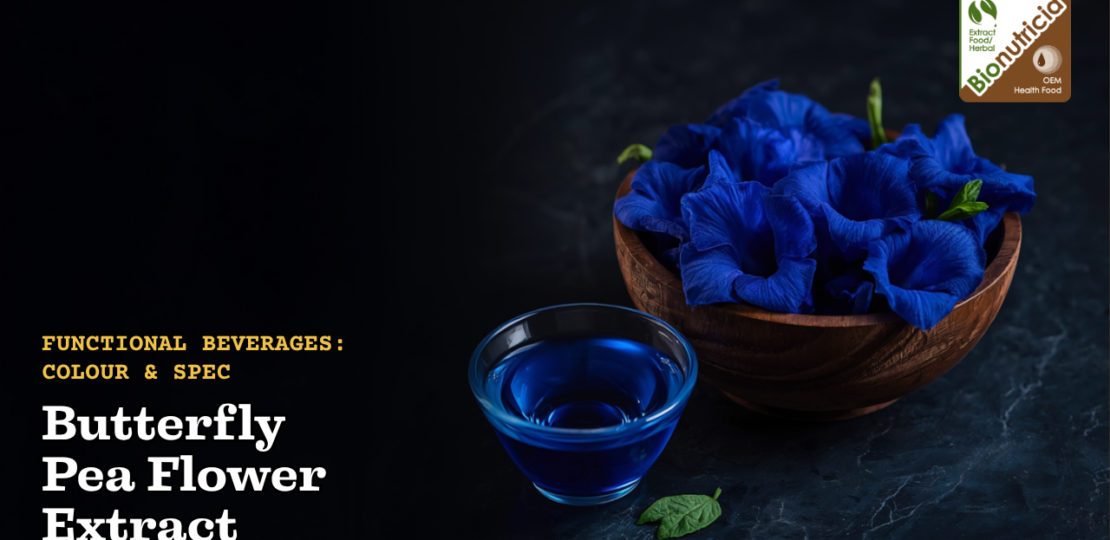
Direct answer: Butterfly pea flower extract — from the blue petals of Clitoria ternatea L. (bunga telang in Malay) — is standardised two ways in the beverage trade, and a serious supplier should be able to quote both. The first is extract ratio: dried petals are typically concentrated to a 4:1 or 10:1 spray-dried powder. The second, more rigorous, is active-marker assay: total anthocyanin content (commonly in the 2–6% range, expressed as delphinidin-3-glucoside equivalents, measured by the pH-differential method AOAC 2005.02) or, for a tighter spec, ternatin content confirmed by HPLC fingerprint. Ternatins are the polyacylated delphinidin derivatives that give butterfly pea its saturated blue and its unusual stability versus ordinary anthocyanins. The other number every formulator needs is pH behaviour: butterfly pea extract reads blue near neutral pH, shifts to violet-pink as the system acidifies below roughly pH 4–5, and turns green under alkaline conditions — the mechanism behind “colour-changing” lemonades and lattes. A buyer should confirm the plant part is flower (not leaf or stem), request a full CoA, and specify contract extraction in standardised or phytosome form. Bionutricia offers this in-house alongside finished powder sachets, liquid sachets, pouch beverages and liquid bottles under FSSC 22000 and JAKIM halal certification.
Butterfly pea vs. other “natural blue” options: clearing up the confusion
Blue is the hardest colour to origin naturally, and buyers researching it run into several unrelated ingredients all called “natural blue.” Settling botanical identity first avoids a wasted RFQ cycle.
Clitoria ternatea L. is a flowering legume (family Fabaceae), native across tropical Asia and long used in Malaysia as bunga telang to colour rice and kuih — nasi kerabu, pulut tai tai and kuih ketan all get their blue from the same flower. The part used is the flower (petal), not the leaf, stem or seed pod; a correct CoA states “plant part: flower.” Whole-plant or leaf-derived material is not the same ingredient and should be rejected.
Butterfly pea is frequently confused with blue spirulina (phycocyanin), sold under names like “Blue Majik.” The two are not interchangeable: phycocyanin is a protein-bound pigment from the alga Arthrospira platensis, not an anthocyanin, and it is more heat-sensitive and lacks butterfly pea’s acid-triggered colour shift. If a brief calls for colour that visibly changes when citrus or vitamin C is added — the “reveal” effect behind most novelty drinks — butterfly pea is correct. For a stable blue in a low-acid or heat-processed matrix with no shift wanted, phycocyanin may fit better; a competent formulation partner should say so rather than force the wrong ingredient.
Buyers also compare it against synthetic Brilliant Blue FCF (FD&C Blue No. 1); many reformulation projects move to butterfly pea specifically for a clean-label claim. For US-bound SKUs, butterfly pea flower extract is recognised by the US FDA as a colour additive exempt from certification for specified food categories (21 CFR 73.69) — a useful citation when a customer’s regulatory team asks.
Why ternatins are the specification that matters
Two buyers can both order “butterfly pea extract” and receive very different material. The variable that separates a vivid, stable blue from a dull, fast-fading one is the ternatin/anthocyanin fraction.
Colour and stability. Ternatins are polyacylated derivatives of delphinidin, carrying multiple aromatic (coumaroyl) acyl groups that fold back and stack against the flavylium core — intramolecular co-pigmentation — a key reason ternatins hold colour through processing and storage better than many simpler, unacylated anthocyanins.
The pH-reactive mechanism. Butterfly pea reads blue at neutral-to-mildly-alkaline pH, shifts to violet then pink or magenta as the system acidifies, and turns green under strongly alkaline conditions — the entire basis of “colour-changing” drinks, where a blue tea or lemonade base turns purple the moment lime or a vitamin C premix is stirred in. Published stability work also shows anthocyanin retention is highest in acidic systems and degrades fastest under alkaline conditions over storage, a practical reason to formulate it into an acidified matrix.
The assay to request. Total anthocyanin content by the pH-differential method (AOAC 2005.02), expressed as delphinidin-3-glucoside equivalents, is the standard active-marker assay. For identity and authenticity, add an HPLC fingerprint confirming the ternatin profile. A supplier who can only offer a colorimeter “blue value” reading, with no anthocyanin assay behind it, is selling a shade — not a standardised botanical extract. It is also worth noting that butterfly pea itself is essentially flavourless, unlike tart roselle or aromatic pandan, which is precisely why formulators reach for it: colour without a flavour trade-off.
Extract forms and what each suits
Spray-dried powder (most common for OEM)
Carrier: maltodextrin or tapioca starch (halal, non-GMO options available). Standardised to a stated extract ratio (4:1 or 10:1) or an assayed anthocyanin percentage, per the buyer’s convention. Moisture: ≤5%. Shelf life: approximately 18–24 months ambient in opaque, light-protected packaging — ternatins are light-sensitive, so packaging matters as much as the assay. Applications: powder-sachet drink mixes, novelty colour-changing kits, premix blends, chewable tablet colouring.
Liquid concentrate
Typical anthocyanin retention is higher than spray-dried material because there is no drying step. Shelf life is shorter, and refrigeration or an acidified preservation system is generally needed. Applications: liquid-sachet beverages, RTD pouch beverages, liquid bottles and bar-style syrups where colour intensity is the priority.
Colour-application (ratio-standardised) grade
When the brief is purely visual rather than a defined actives claim, butterfly pea can be standardised to a colour value (absorbance at the pigment’s visible-region maximum) instead of an anthocyanin percentage. Specify whether colour alone is needed, or whether the pH-shift “reveal” behaviour must be preserved — heavily filtered colour-only grades can lose visual reactivity even while retaining nominal pigment content, so confirm reactivity with a sample first.
Standardisation specification: what to put in your contract
For any butterfly pea procurement, include the following in the CoA requirement:
Identity & authenticity
- Botanical name: Clitoria ternatea L.
- Plant part: flower / petal (dried) — not leaf, stem or whole plant
- Country of origin stated; cultivated, traceable supply
Active marker assay
- Total anthocyanins: state the target percentage as delphinidin-3-glucoside equivalents (pH-differential method, AOAC 2005.02) — or extract ratio (4:1 / 10:1) if that is the agreed standardisation convention
- HPLC fingerprint confirming the ternatin profile
- Colour value / absorbance reading if the brief is colour-critical
- pH-shift confirmation against a visual reference (blue at neutral, violet-pink at acid, green at alkaline) for any “reveal effect” SKU
Physical parameters
- Appearance: free-flowing deep-blue powder (spray-dried) or deep blue-black liquid (concentrate)
- Moisture: ≤5.0% (powder)
- Particle size: ≥90% passing 80 mesh (powder)
- Solubility: fully water-soluble
Microbiological limits
- Total plate count: ≤10,000 CFU/g
- Yeast and mould: ≤1,000 CFU/g
- E. coli: absent/25g · Salmonella spp.: absent/25g · S. aureus: absent/25g
Heavy metals
- Lead (Pb) ≤2.0 ppm · Cadmium (Cd) ≤1.0 ppm · Mercury (Hg) ≤0.1 ppm · Arsenic (As) ≤1.5 ppm
Solvent residuals
- Water extraction: not applicable · Ethanol extraction: ≤5,000 ppm residual ethanol
Functional formats Bionutricia manufactures with butterfly pea
Bionutricia’s vertically integrated model — petal extraction to finished filling at the Sungai Buloh facility — means the team that standardises the spec also fills the SKU, removing the CoA handoff risk between a separate extract supplier and co-packer.
Powder sachet (10–20g): instant colour-changing drink mix — dissolve over ice, add a citrus or vitamin C premix, and it shifts from blue to violet-pink at the table. Pairs well with electrolyte or collagen premixes.
Liquid sachet (30–50ml): single-serve RTD shot, often layered with a citrus or roselle sachet for a two-part “reveal” experience.
Pouch beverage (200–500ml): larger-volume RTD for café, gym and convenience-retail channels — blue lattes, lemonades and layered gradient drinks; JAKIM halal certified at product level.
Liquid bottle (100–250ml): glass or PET wellness tonics and bar-style mixers where the colour shift is the selling point.
Butterfly pea layers well with liposomal vitamin C or roselle for a blue-to-red two-tone effect — both producible under one roof.
Why Malaysian-origin butterfly pea is a defensible spec
Bunga telang is genuine Malaysian culinary heritage, not an imported novelty — it has coloured nasi kerabu, pulut tai tai and kuih ketan for generations. Specifying Malaysian-origin, cultivated, traceable butterfly pea carries two advantages for an export-bound SKU. First, traceability: Malaysian agricultural suppliers maintain plantation, harvest and treatment records satisfying the full traceability requirement of FSSC 22000 and JAKIM halal certification, which loosely-aggregated supply chains often cannot provide. Second, integrated processing: extracting and finishing in one JAKIM-certified facility keeps the halal chain unbroken from petal to export carton — exactly what a customs inspector or halal auditor checks.
📚 Related guides
- Roselle (Hibiscus) Extract: Standardised Anthocyanin Content for Supplement & Beverage OEM
- Pandan Leaf Extract in Functional Beverages: From Raw Material to Finished SKU
- Functional Beverage OEM for Convenience Retail: Shelf-Life, Pricing & Co-Packing
Frequently asked questions
Is butterfly pea flower extract the same as blue spirulina (phycocyanin)?
No. Butterfly pea extract is an anthocyanin (ternatin) pigment from the flower of Clitoria ternatea, a legume. Blue spirulina is phycocyanin, a protein-bound pigment from the alga Arthrospira platensis. They come from unrelated organisms, behave differently under heat, and only butterfly pea gives the acid-triggered colour shift used in “colour-changing” drinks.
What anthocyanin content should I specify?
For a standardised spray-dried powder, a total anthocyanin content in the 2–6% range (as delphinidin-3-glucoside equivalents, pH-differential method AOAC 2005.02) is a reasonable range to negotiate from, or agree an extract ratio (4:1 or 10:1) if that is the supplier’s convention. Always pair the figure with an HPLC fingerprint confirming the ternatin profile, so you verify authentic butterfly pea, not just a blue colour reading.
Why does my butterfly pea drink turn purple when I add lemon juice?
That’s the ternatin pigment responding to pH: blue near neutral, shifting to violet-pink as the drink acidifies below roughly pH 4–5. It’s a natural, expected reaction — the basis of most “colour-changing” lemonade and latte formats.
Is butterfly pea extract halal-certified?
Butterfly pea is a plant-derived botanical with no haram inputs. Bionutricia’s petal extraction and finished-beverage manufacturing are both covered under JAKIM facility-level halal certification, so finished SKUs carry halal status through to export.
Does Bionutricia extract butterfly pea in-house or buy it in?
In-house. Bionutricia provides contract extraction of butterfly pea petals in standardised and phytosome form, then spray-dries, blends and fills the finished SKU at the same Sungai Buloh facility, so a single CoA chain covers the ingredient and the finished product.
Ready to develop a butterfly pea SKU?
Vertically integrated butterfly pea extraction and finished beverage manufacturing under FSSC 22000 and JAKIM halal. Standardised ternatin/anthocyanin spec, full CoA stack, and powder-sachet, liquid-sachet, pouch-beverage and liquid-bottle formats. Free formulation consultation and 24-hour RFQ reply.
Request a quotation · See our OEM services · View our certifications
WhatsApp: +60 16-661 8510
Article by Bionutricia R&D Team. Last updated: July 8, 2026.
RELATED POSTS
View all

Knowledge: Papaya Leaf (Carica papaya)
October 5, 2024 | by bionutriciaadmin
Cinnamon (Cinnamomum burmannii) Bark Extract for Functional Food & Beverage OEM
August 18, 2026 | by supersuper
Knowledge: Yuzu Extract Liquid (Citrus Ichangensis Citrus Reticulata var. austera)
October 5, 2024 | by bionutriciaadmin