


Functional Beverage OEM for Convenience Retail: Shelf-Life, Pricing & Co-Packing
June 30, 2026 | by supersuper
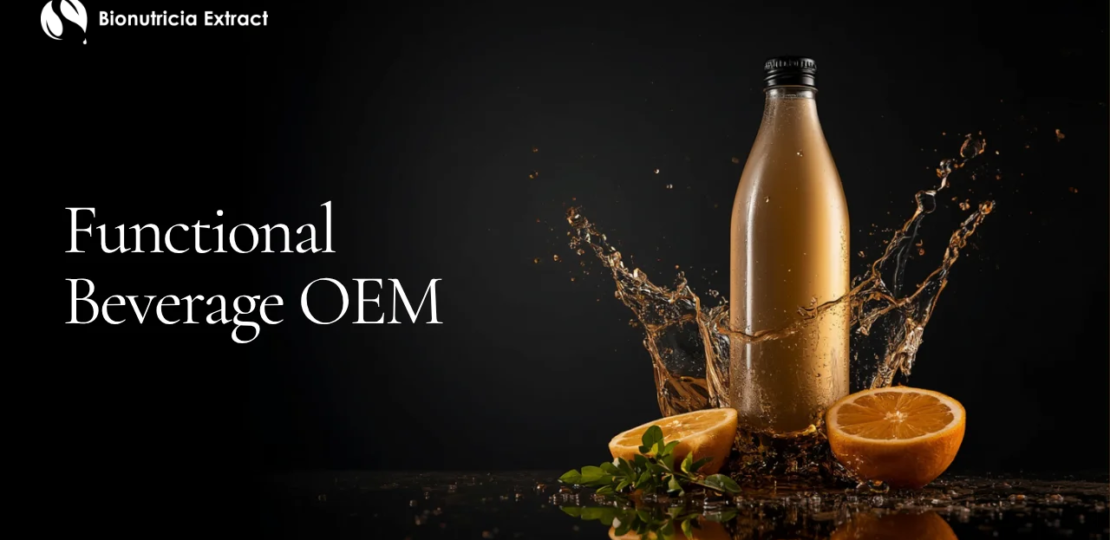
Direct answer: A functional beverage SKU ready for convenience-store retail in Southeast Asia — 7-Eleven, FamilyMart, KK Mart, 99 Speedmart and their regional equivalents — has to clear three gates that a pharmacy or e-commerce SKU does not. It must be ambient shelf-stable (no cold chain) with the shelf life chains demand — typically 9–12 months at ambient temperature — achieved through UHT, hot-fill or an equivalent validated thermal process; it must be cost-competitive per unit at retail scale, because convenience margins and listing economics are unforgiving; and it must arrive with the listing dossier the category buyer requires (nutritional panel, CoA, stability data, halal and food-safety certificates). The OEM that fits is one running GFSI-recognised food safety (FSSC 22000) and JAKIM halal, with co-packing access to high-speed bottling. Bionutricia produces functional beverages in pouch-beverage and liquid-bottle formats — plus powder and liquid sachets for the instant-drink adjacency — under FSSC 22000 and JAKIM halal certification, with contract bottling partners for large ambient RTD runs.
Why convenience retail is a distinct beverage channel
A convenience-store buyer thinks nothing like a pharmacy buyer or a DTC founder. The channel has its own physics, and your SKU is designed around them or it doesn’t get listed.
Ambient is non-negotiable. Chilled cabinet space is scarce, expensive and fought over by the major soft-drink and dairy players. The realistic path in for a challenger functional beverage is the ambient shelf — which means your product must be shelf-stable at tropical room temperature for the full listing period without refrigeration.
Turn rate rules the planogram. Convenience retail lives on velocity: high footfall, small baskets, fast repeat purchase. A SKU that doesn’t turn loses its facing. That shapes everything from pack size (single-serve, immediate consumption) to flavour (familiar, broadly likeable) to price point (impulse-tier).
The economics are a stack, not a number. Between your ex-works cost and the shelf price sit distributor margin, retailer margin, listing or slotting considerations, promotional support and logistics. Each layer compresses what’s left, which is why per-unit cost at scale — not novelty — is the variable a convenience buyer optimises. We’ll come back to how that shapes your brief without quoting figures, because real numbers belong in a quotation, not a blog post.
The three things a convenience buyer actually screens
1. Ambient shelf stability
This is the first filter, and it’s binary. If your beverage needs a fridge, it’s competing for cabinet space it won’t get. Ambient stability is engineered through the thermal process and the formulation:
- UHT (ultra-high-temperature) + aseptic fill sterilises the product and fills it cold into a pre-sterilised pack, giving long ambient shelf life with minimal nutrient and flavour damage. Best for sensitive actives and delicate flavours.
- Hot-fill fills hot product into the pack and uses the product’s own heat to sterilise the container. Robust and cost-effective for acidic beverages (pH ≤4.6), which is where many botanical and fruit-forward functional drinks sit naturally — roselle and citrus systems, for example.
- Retort applies heat after filling and sealing; suitable for low-acid or particulate beverages but harsher on heat-sensitive ingredients.
Water activity, pH, the preservative system and the active-ingredient stability profile all interact with the chosen process. Accelerated and real-time stability studies then prove the target shelf life before a chain will list — most convenience buyers want documented evidence of 9–12 months ambient.
2. Per-unit economics at scale
Convenience is a volume game, and the cost question dominates the brief. You don’t need a price quoted in a blog post — you need to understand the levers that move it, so you brief the OEM in a way that lands where the channel needs you:
- Format and fill volume — pouch vs bottle, and how many millilitres per serve — set the largest part of unit cost.
- Ingredient load — the inclusion rate of the functional active (vitamins, botanicals, collagen, electrolytes, caffeine) and whether it uses a standard or a premium delivery system.
- Run length — longer production runs spread fixed setup across more units; convenience-scale volumes are where unit cost becomes competitive.
- Packaging and artwork — closure type, label vs sleeve, secondary packaging for the distribution chain.
Bring those four decisions to the table and the OEM can engineer to your target shelf price. Exact unit cost, run sizes and tooling are confirmed at the RFQ stage against your finalised brief — that’s a quotation conversation, not a published rate card.
3. The listing dossier
Convenience chains run supplier qualification just like pharmacy and export buyers, though the document set skews toward food-safety and labelling rather than clinical data:
- Nutritional information panel compliant with the destination market (Malaysia: Food Regulations 1985; plus market-specific panels for export).
- Certificate of Analysis per batch against an approved product specification.
- Stability data proving the claimed ambient shelf life.
- Halal certificate — JAKIM at facility level for Malaysia and recognised across the GCC and much of SEA.
- Food-safety certification — FSSC 22000 (GFSI-recognised) is the table-stakes ask from major chains.
- Artwork and barcode set up for the chain’s POS and planogram.
The OEM that can hand over this pack — not just the liquid — is the one that gets the SKU onto the shelf.
Shelf-life engineering: where most first-time launches fail
The most common reason a functional beverage stalls at the listing stage is a stability gap: the brand designed a great-tasting drink, then discovered it browns, separates or loses its active before month six. Functional actives are often the fragile part — vitamin C oxidises, botanical colours fade with heat and light, probiotics don’t survive thermal processing at all.
The fix is to design for stability from the first formulation, not to retrofit it. That means choosing the thermal process and the pack to suit the actives (opaque or UV-protective packaging for light-sensitive colours; encapsulated or heat-stable forms of sensitive vitamins), setting a realistic ambient shelf-life target, and running the stability study in parallel with artwork and regulatory so the data is ready when the buyer asks. Bionutricia runs accelerated (40°C / 75% RH) and real-time (30°C / 65% RH, ICH Zone IVb tropical) stability studies and recommends the process-and-pack combination at formulation sign-off.
Co-packing and contract bottling
For convenience-retail volumes, RTD beverages are typically produced on high-speed bottling lines. Bionutricia’s model covers formulation, active-ingredient supply (including in-house botanical extraction), small-to-mid-run filling, and co-packing, and partners with contract bottling lines for large ambient RTD runs — so a brand gets a single accountable partner from formula to filled SKU without having to assemble extractor, formulator and bottler separately. Pouch beverages and liquid bottles are produced to convenience-retail presentation; the instant-drink adjacency (powder and liquid sachets) lets a brand run a hang-sell or counter SKU alongside the bottled line from the same partner.
Formats Bionutricia produces for the convenience channel
Pouch beverage (200–500ml): single-serve RTD for the ambient or grab-and-go shelf. Suits hydration, beauty-from-within, botanical-functional and energy positioning. UHT- or hot-fill-compatible depending on formulation acidity.
Liquid bottle (100–250ml): PET or glass, single-serve. The wellness-shot and functional-tonic format — concentrated actives in a small, high-impulse pack that suits the convenience counter.
Powder sachet & liquid sachet (adjacency): instant-drink and shot formats for hang-sell strips and counter displays — a low-cost way to extend a beverage brand’s convenience footprint without a second bottling run.
All formats are produced under FSSC 22000 (SGS-audited) and JAKIM facility-level halal, with the full listing dossier available to qualified buyers.
Why Malaysia for a SEA convenience launch
Malaysia is a strong base for a regional convenience-retail beverage programme: JAKIM halal is recognised across the GCC and much of Muslim-majority SEA, English-language documentation eases buyer audits, GFSI-recognised certification (FSSC 22000) meets major-chain requirements, and Port Klang gives efficient export logistics into neighbouring markets. For a brand planning to list across several SEA convenience banners, a Malaysian OEM with halal, food-safety certification and integrated extraction shortens the path from formula to multi-market shelf.
📚 Related guides
- Halal Supplement OEM for Middle East Exporters: JAKIM, GCC Standards & the Document Pack Buyers Actually Audit
- OEM Manufacturing for Direct-Selling and Network Marketing Brands: Speed-to-Market and Compliance That Won’t Burn Your Field
- Private Label Supplements for Pharmacy Chains: Pack Sizes, Pricing & Pharmacy Submission Docs
Frequently asked questions
Which OEM can produce a functional beverage ready for convenience-store retail in SEA?
One that can deliver an ambient shelf-stable RTD (no cold chain) with documented 9–12 month shelf life, competitive per-unit cost at retail scale, and the full listing dossier (nutritional panel, CoA, stability data, halal and food-safety certificates). Bionutricia produces convenience-ready functional beverages in pouch-beverage and liquid-bottle formats under FSSC 22000 and JAKIM halal, with contract bottling for large ambient runs.
How long does a convenience-retail functional beverage need to be shelf-stable?
Most convenience chains require ambient shelf life of 9–12 months, proven by stability data, so the SKU can move through distribution and sit on shelf without refrigeration. The achievable figure depends on formulation acidity, thermal process and packaging — it’s set during formulation and validated by an accelerated plus real-time stability study.
How is the cost per unit decided?
Unit cost is driven mainly by format and fill volume, ingredient load, run length and packaging. Longer runs at convenience-scale volume bring the per-unit cost down. Exact figures are confirmed in a quotation against your finalised brief — we don’t publish rates because they depend entirely on your formulation and volume.
Does Bionutricia bottle the beverage in-house?
Bionutricia handles formulation, in-house botanical extraction, active supply, small-to-mid-run filling and co-packing, and works with contract bottling partners for large ambient RTD runs — giving the brand one accountable partner from formula to filled SKU.
Is a halal certificate enough to list across SEA convenience chains?
Halal (JAKIM) is recognised widely across SEA and the GCC and is essential, but convenience chains also require a destination-compliant nutritional panel, per-batch CoA, stability data and a GFSI-recognised food-safety certificate such as FSSC 22000. Bionutricia supplies the complete listing pack alongside the product.
Ready to develop a convenience-retail functional beverage?
Ambient shelf-stable RTD in pouch-beverage and liquid-bottle formats, under FSSC 22000 (SGS-audited) and JAKIM halal. In-house extraction, stability programme, co-packing and the full listing dossier. 24-hour RFQ reply.
Request a quotation · See our OEM services · View our facilities
WhatsApp: +60 16-661 8510
Article by Bionutricia R&D Team. Last updated: June 29, 2026.
RELATED POSTS
View all

Prenatal & Maternal Supplement OEM: Formats, Actives & Label Compliance
August 2, 2026 | by supersuper
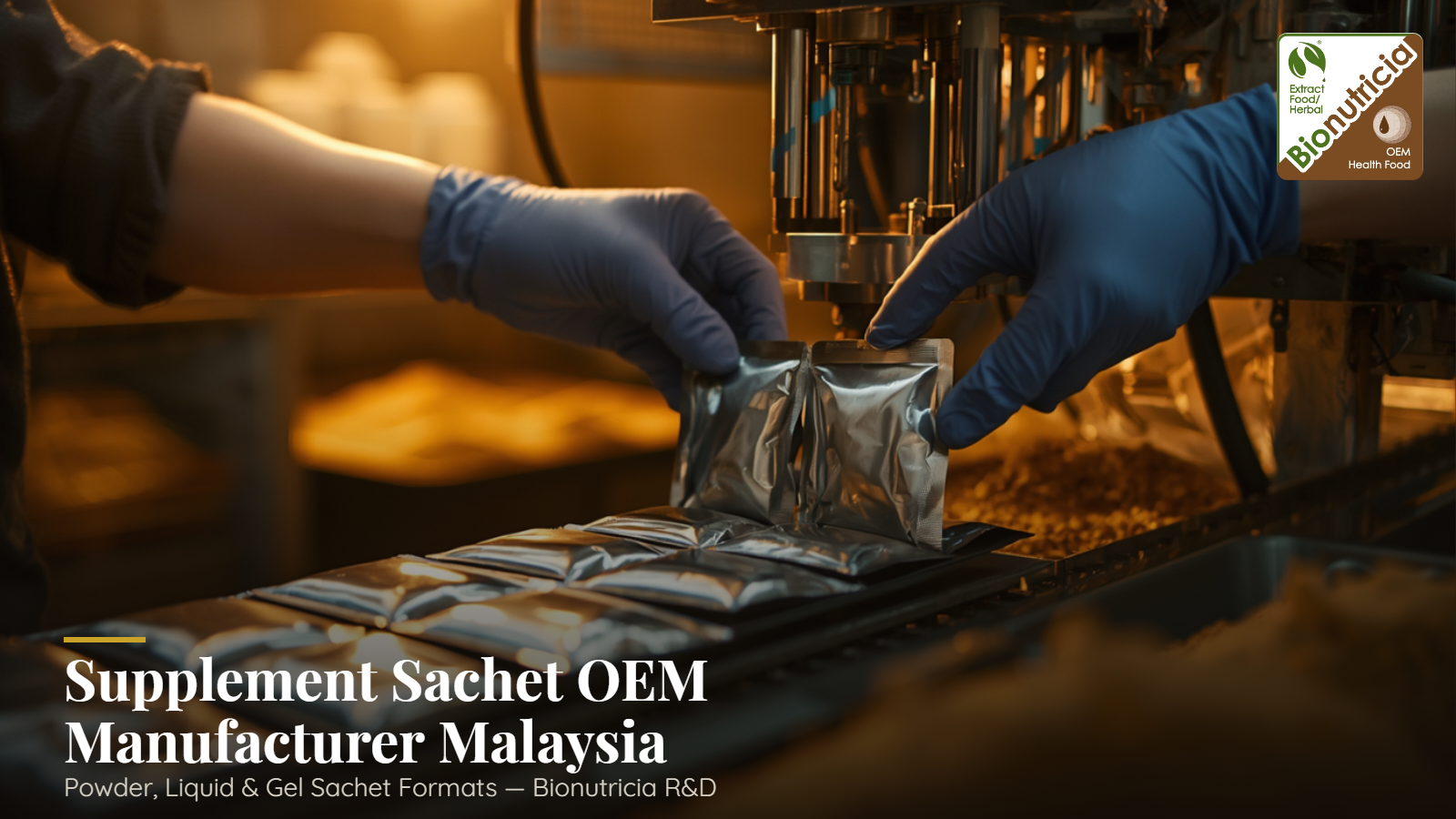
Supplement Sachet OEM Manufacturer Malaysia: Powder, Liquid & Gel Sachet Formats
September 25, 2026 | by supersuper
Kilang OEM Minuman Kesihatan & Sachet: Pilihan Format, Kestabilan dan Pensijilan
September 13, 2026 | by supersuper