

How Packaging Affects Supplement Shelf Life: Barrier Properties, Format Choices & What Extends (or Shortens) Your Expiry Date
July 18, 2026 | by supersuper
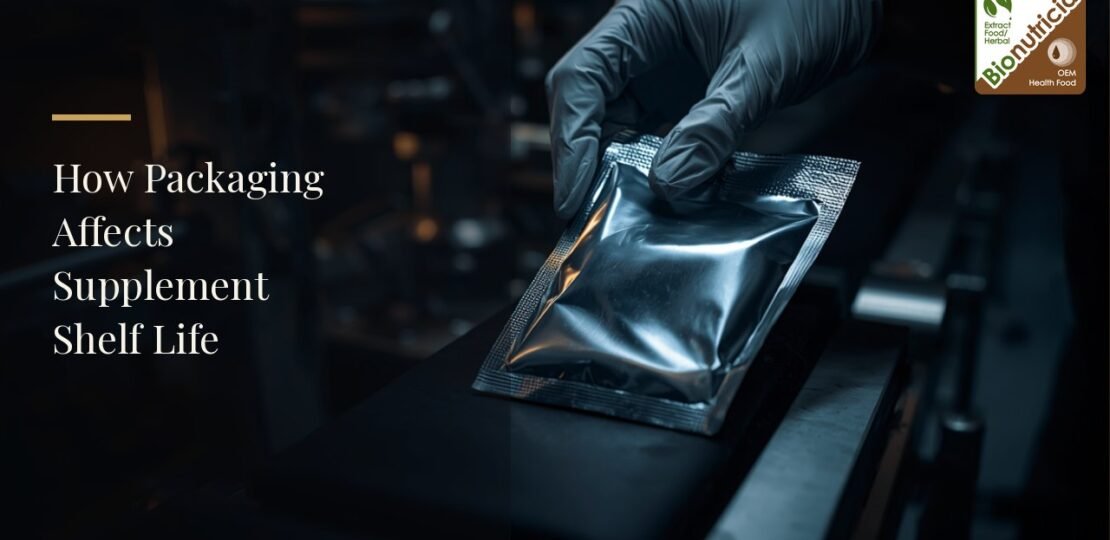
Direct answer: Packaging is a primary driver of a supplement’s shelf life, independent of the formulation itself — the same active ingredient blend can carry an 18-month expiry in one package and a 24-month (or shorter) expiry in another, purely because of the barrier properties of the material around it. The two variables that matter most are moisture barrier (measured as water vapour transmission rate, WVTR) and oxygen barrier (oxygen transmission rate, OTR), plus light protection for photosensitive actives. Hygroscopic powders in a low-barrier sachet film absorb ambient moisture and degrade faster than the same powder in a high-barrier foil laminate. Oxygen-sensitive actives — vitamin C, many botanicals, some vitamins and minerals — oxidise faster in a permeable bottle or a poorly sealed cap than in an amber glass or oxygen-barrier PET container. Because packaging directly affects shelf life, it has to be specified and stability-tested as part of the packaging brief, not treated as a cosmetic choice made after the formulation is finalised. Bionutricia matches packaging structure to formulation sensitivity across its approved OEM formats — powder, liquid and gel sachets, pouch beverages, chewable tablets and liquid bottles — as part of formulation consultation.
Why Packaging Matters as Much as Formulation for Shelf Life
It’s easy to assume shelf life is purely a function of the active ingredients and any preservative system in the formula. In practice, the package is part of the stability system. A perfectly stable powder formulation will still degrade if moisture migrates through the packaging film faster than the formula can tolerate; a perfectly stable liquid will still oxidise if the container lets oxygen through the wall or the cap doesn’t seal tightly enough. This is why two brands can run the identical formulation through stability testing and land on different expiry dates — the packaging, not the formula, is often the variable that changed.
For OEM buyers, this means a packaging decision made for cost, aesthetics, or supply-chain convenience can quietly undercut a shelf-life target the brand is counting on. Specifying packaging barrier properties alongside the formulation brief, rather than after, avoids discovering a shelf-life problem late in development.
Moisture Barrier: The Number One Factor for Powder Formats
Powder sachets and pouch-format powders are the most moisture-sensitive packaging category. Water vapour transmission rate (WVTR) measures how much moisture passes through a given area of packaging material over time — lower WVTR means better protection. A standard single-layer film has a meaningfully higher WVTR than a multi-layer laminate incorporating a foil or high-barrier polymer layer. For hygroscopic actives (ingredients that readily absorb ambient moisture, which includes many botanical extracts and some vitamin forms), the difference between a standard-barrier and a high-barrier sachet laminate can shift a realistic shelf-life claim by six months or more, particularly for products shipped into or stored in Malaysia’s tropical humidity.
Oxygen and Light Protection for Sensitive Actives
Oxygen transmission rate (OTR) governs how much oxygen reaches the product through the packaging wall and, for bottles, through the cap seal. Vitamin C and many botanical actives oxidise on exposure to oxygen, which both degrades potency and can change colour or flavour over time. Amber or opaque glass, oxygen-barrier PET, and properly torqued caps with an appropriate liner all reduce oxygen ingress. Light exposure compounds the problem for photosensitive compounds, which is why amber or fully opaque packaging is standard for light-sensitive liquid actives rather than a purely aesthetic choice.
Format-by-Format Packaging Considerations
- Powder sachets: Prioritise moisture barrier above all else. A high-barrier foil laminate is standard for hygroscopic actives; a lower-barrier film may be acceptable for more stable powders, but this should be confirmed by stability data, not assumption.
- Liquid sachets and gel sachets: Need both moisture and oxygen barrier depending on the formula; liquid formulations with oxygen-sensitive actives require a barrier laminate structure specifically rated for liquid fill, not just a powder-grade film adapted for liquid use.
- Pouch beverages: Larger fill volumes mean the pouch spends longer in the supply chain and on shelf per unit sold, so barrier properties matter over a longer real-world exposure window; multi-layer pouch construction with an appropriate barrier layer is standard.
- Chewable tablets: Typically packed in blister packs or bottles with desiccant; moisture control matters for tablet integrity and dissolution characteristics as much as for actives stability.
- Liquid bottles: Glass (clear or amber) or oxygen-barrier PET, with cap and liner selection matched to the formula’s oxygen sensitivity. A beautiful clear bottle is the wrong choice for a light-sensitive active regardless of brand aesthetics.
How Packaging Choices Interact with Stability Testing
Packaging and formulation should be stability-tested together, not separately — a stability study run on bulk formula in a lab container doesn’t predict how the product will behave in its actual retail packaging. ICH-style stability protocols (long-term, accelerated, and intermediate testing across defined climate-zone conditions) should use the finished, filled, sealed retail package as the test article whenever the shelf-life claim will apply to that exact packaging configuration. If a brand later changes packaging supplier or film structure, the shelf-life claim should be re-verified rather than assumed to carry over, since a barrier-property change is effectively a new stability variable.
What to Specify in Your OEM Packaging Brief
When briefing packaging alongside formulation, specify: the target shelf-life claim (e.g., 18 or 24 months); whether the active ingredients are moisture-sensitive, oxygen-sensitive, light-sensitive, or a combination; the expected storage and distribution climate (ambient tropical, temperature-controlled, export to a different climate zone); and whether stability testing will be run on the exact finished packaging or needs to be scheduled once packaging is finalised. A capable OEM should be able to recommend a barrier structure suited to the formulation’s specific sensitivities rather than defaulting to a standard packaging spec regardless of what’s inside it.
Common Packaging Mistakes That Quietly Shorten Shelf Life
A few recurring mistakes account for most avoidable shelf-life shortfalls. Choosing a packaging film based on print quality or cost rather than barrier rating is the most common — a beautifully printed sachet with a thin, low-barrier film can undercut a shelf-life target the brand never realised was at risk. Under-torquing bottle caps during filling, or using a liner not rated for the fill’s oxygen sensitivity, is another frequent gap, since the cap-and-liner system is as much a barrier component as the bottle wall itself. Skipping packaging-specific stability testing after a supplier or film-structure change is a third: a brand that qualified its shelf life on one packaging configuration and then switches suppliers for cost reasons, without re-testing, is carrying an unverified assumption rather than a documented claim. Finally, exporting a product qualified for one climate zone into a hotter, more humid destination without accounting for the different storage conditions can shorten real-world shelf life even when the original claim was accurate for its original market.
Climate Zone and Export Considerations
Malaysia sits in a hot, humid climate zone that stresses packaging barrier properties more than temperate markets do. A packaging structure that performs adequately in a cooler, drier export destination may not hold the same shelf life when the product is manufactured, warehoused, and partially distributed within Malaysia’s ambient conditions before export. Buyers shipping into multiple climate zones should ask whether stability data covers the specific zone conditions relevant to both manufacture/storage and final distribution, rather than assuming a single stability study covers every market the product will reach.
Related guides
- Supplement Stability Testing Explained: ICH Zones, Shelf Life & What Buyers Ask
- Powder Sachet vs Liquid Sachet vs Pouch Beverage vs Liquid Bottle: Which Format Wins for Your Supplement Category?
Frequently asked questions
How does packaging affect a supplement’s shelf life?
Packaging controls how much moisture, oxygen, and light reach the product over time. Low-barrier packaging lets hygroscopic powders absorb moisture and oxygen-sensitive actives oxidise faster, shortening real-world shelf life even when the formulation itself is stable.
What’s the single most important packaging factor for a powder supplement?
Moisture barrier, measured as water vapour transmission rate (WVTR). Hygroscopic powders are especially sensitive to moisture ingress, so a high-barrier foil laminate sachet typically supports a longer shelf-life claim than a standard-barrier film.
Does changing packaging suppliers affect an existing shelf-life claim?
It can. A different film structure or bottle material can have different barrier properties even if it looks similar, so a shelf-life claim should be re-verified with stability testing on the new packaging rather than assumed to carry over unchanged.
Should stability testing use the actual retail packaging or a lab container?
The actual finished, filled, sealed retail packaging whenever the shelf-life claim will apply to that specific configuration. Testing bulk formula in a different container doesn’t reliably predict how the product performs in its real packaging.
Can Bionutricia recommend the right packaging barrier for my formulation?
Yes. Bionutricia’s formulation consultation covers matching packaging structure — barrier laminate, bottle material, cap and liner selection — to the specific moisture, oxygen, and light sensitivity of a formulation across its approved OEM formats.
Ready to specify shelf-life-appropriate packaging for your SKU?
Vertically integrated OEM manufacturing under FSSC 22000, GMP, HACCP, JAKIM Halal, US FDA and MeSTI certification, with packaging matched to formulation stability requirements across powder, liquid and gel sachets, pouch beverages, chewable tablets and liquid bottles. Free formulation consultation and a fast RFQ turnaround.
Request a quotation · See our OEM services · View our certifications
WhatsApp: +60 16-661 8510
Article by Bionutricia R&D Team. Last updated: July 16, 2026.
RELATED POSTS
View all

Allergen Control & Cross-Contact Prevention in Supplement Contract Manufacturing
August 18, 2026 | by supersuper
Batch Records & Traceability in Supplement Contract Manufacturing
August 15, 2026 | by supersuper
Supplement Stability Testing Explained: ICH Zones, Shelf Life & What Buyers Ask
July 7, 2026 | by supersuper