


Supplement Stability Testing Explained: ICH Zones, Shelf Life & What Buyers Ask
July 7, 2026 | by supersuper

Direct answer: Supplement stability testing follows the same framework pharmaceutical manufacturers use — ICH Q1A(R2) — adapted for the climate zone the product will be sold or exported into. Malaysia and most of Southeast Asia sit in Climate Zone IVA/IVB (hot, humid), so a defensible stability programme runs long-term storage at 30°C/75% RH (real-time data matching the claimed shelf life) alongside accelerated storage at 40°C/75% RH for 6 months to stress-test the formulation and support an interim shelf-life claim while real-time data matures. At each checkpoint (0, 3, 6, 9, 12, 18, 24 months) the lab re-tests appearance, active-ingredient assay/potency, moisture, microbial limits, and — for liquids — pH and viscosity, then compares the results against the release specification to see how much the active has degraded. A buyer evaluating a supplier’s stability dossier should ask four things: which climate zone the data was generated for, whether the shelf-life claim is backed by real-time data or accelerated data alone, the percentage of active retained at the end of the claimed shelf life, and whether testing was run in the actual commercial packaging (not a lab-only vial). Bionutricia runs stability protocols across its powder, liquid and gel sachet, pouch beverage, chewable tablet, and liquid bottle formats at its FSSC 22000 and HACCP-validated Sungai Buloh facility, generating the real-time and accelerated data buyers need before they commit to a shelf-life claim on a finished label.
Stability testing at a glance
The full story in eight slides — from the question every buyer should ask, to the rule that decides a defensible shelf life.





What ICH stability testing actually measures
Stability testing exists to answer one commercial question: how long can this product sit on a shelf, in its real packaging, in the climate it will actually be sold or shipped into, before it falls below specification? The International Council for Harmonisation’s Q1A(R2) guideline was written for pharmaceuticals, but reputable supplement manufacturers apply the same design logic because it is the only internationally recognised framework for generating a defensible shelf-life number — one that survives scrutiny from an importer, a retailer’s technical team, or a regulator.
A stability study is not a single test. It is a time-series: identical batches of finished product are placed into stability chambers under controlled temperature and humidity, then pulled and tested at fixed intervals. The resulting data set shows the rate of change — assay decline, moisture uptake, colour shift, microbial growth — and that rate is what gets extrapolated into a shelf-life claim.
Climate zones: why Malaysia’s testing conditions differ from Europe’s
ICH defines four climatic zones based on mean annual temperature and humidity, and the condition a product is tested under should match where it will be stored and sold — not where the lab happens to be located.
The four zones
- Zone I (temperate): 21°C/45% RH long-term — much of Europe, Canada, Northern climates.
- Zone II (subtropical/Mediterranean): 25°C/60% RH long-term — parts of Southern Europe, US.
- Zone III (hot, dry): 30°C/35% RH long-term — Middle East, parts of North Africa.
- Zone IVA (hot, humid): 30°C/65% RH long-term — most of Southeast Asia, including Malaysia.
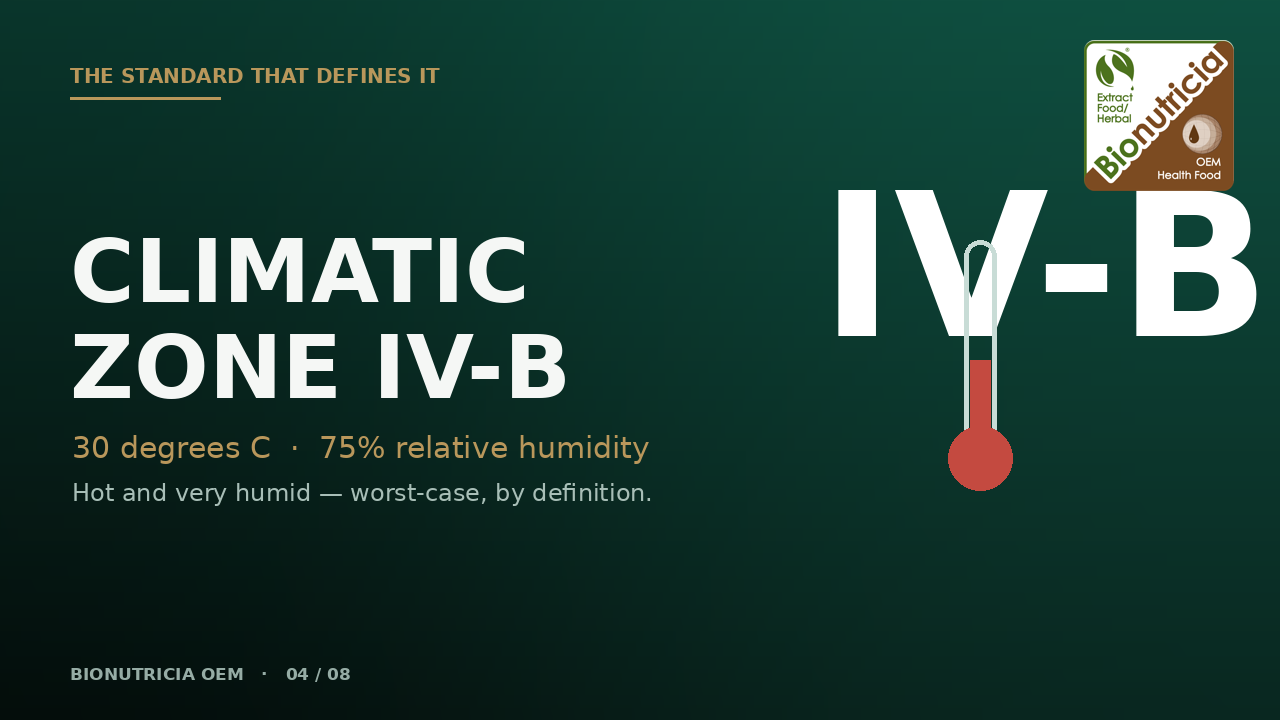
- Zone IVB (hot, very humid): 30°C/75% RH long-term — increasingly the reference condition used for ASEAN and Gulf-bound exports, since it is the more conservative (harder-to-pass) of the two hot-humid conditions.
A stability dossier generated only under Zone I or Zone II conditions is close to meaningless for a product manufactured in, or exported from, Malaysia — moisture ingress, caking, and microbial risk all accelerate in a Zone IV environment, and an anthocyanin, probiotic, or botanical active can degrade materially faster at 30°C/75% RH than at 21°C/45% RH. Buyers exporting to the GCC, ASEAN, or back into Malaysia should specifically request Zone IVA or IVB data, not a European reference study repurposed for a tropical market.
Long-term vs. accelerated vs. intermediate testing
Long-term (real-time) testing
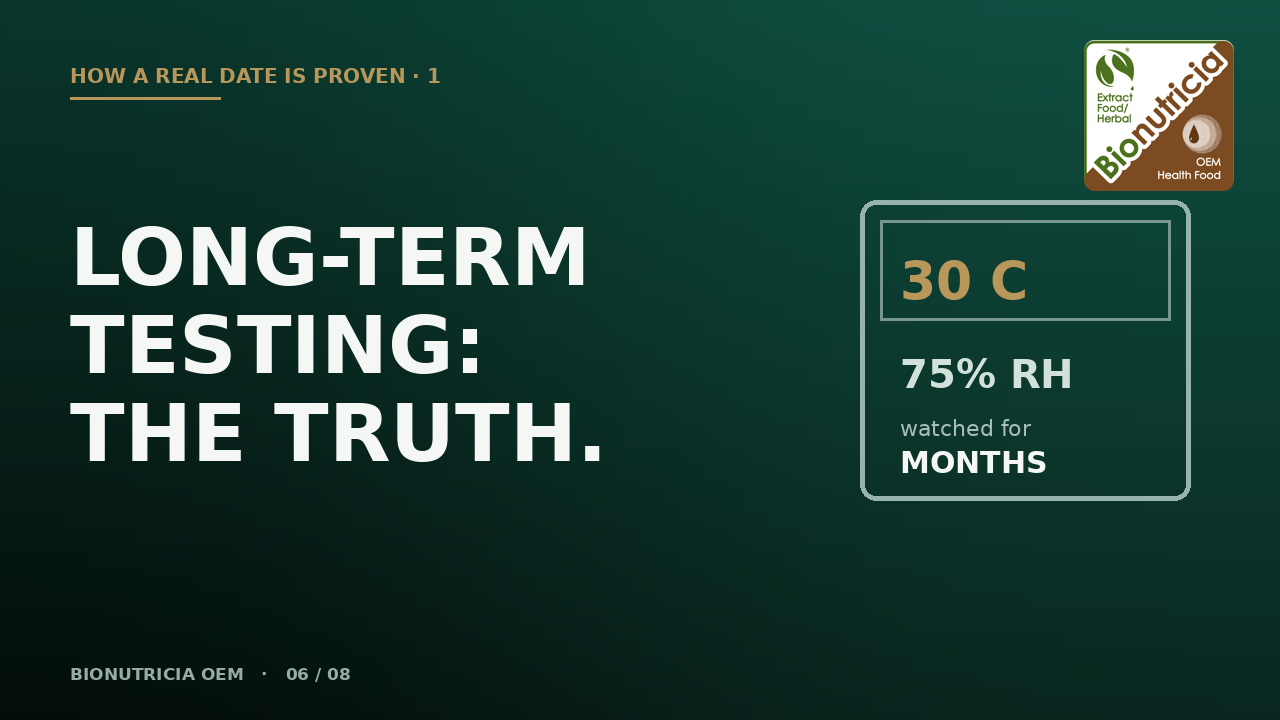
Storage at the actual long-term condition (30°C/65-75% RH for Zone IV) for the full duration of the intended shelf life, with test points typically at 0, 3, 6, 9, 12, 18, and 24 months. This is the only data that directly proves a shelf-life claim rather than predicting it — but it takes as long as the shelf life itself to complete, which is why accelerated testing exists.
Accelerated testing
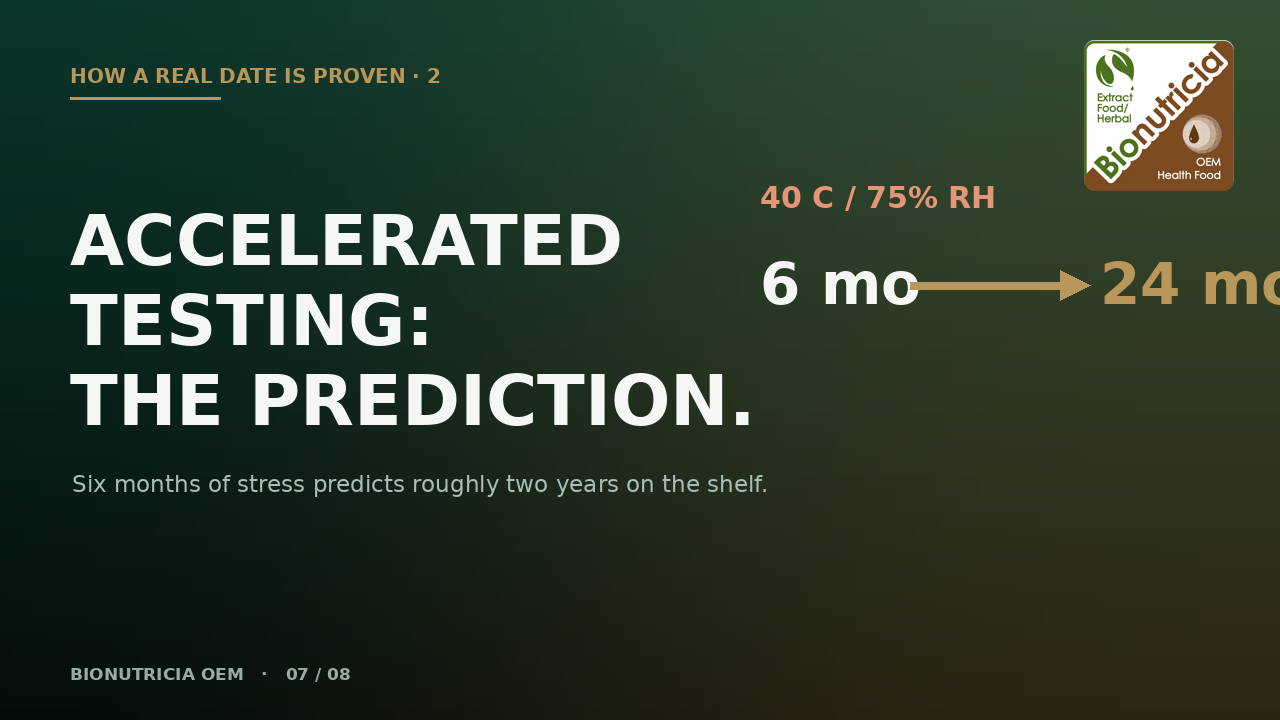
Storage at an elevated stress condition — commonly 40°C/75% RH — for 6 months. Accelerated data is used two ways: to support a provisional or interim shelf-life claim while long-term data is still being collected, and to flag formulation weaknesses (an active that degrades sharply under stress usually signals a stability risk under normal conditions too, just slower).
Intermediate testing
If a product shows “significant change” under accelerated conditions — commonly defined as more than a 5% potency loss from the initial assay value, or a specification failure in appearance, pH, or microbial limits — an intermediate condition (30°C/65% RH) is added to characterise the degradation more precisely before a shelf-life decision is made.
What gets tested at every checkpoint
A complete stability protocol re-tests the finished product against its full release specification at every pull point, not just one headline parameter:
- Assay / potency: percentage of labelled active retained (e.g., anthocyanin content, vitamin potency, probiotic CFU count) versus the initial release value.
- Appearance and organoleptic properties: colour, odour, texture, or caking/clumping in powders.
- Moisture content: critical for powder sachets and chewable tablets, where moisture ingress drives both microbial risk and caking.
- pH and viscosity: for liquid sachets, pouch beverages, and liquid bottles.
- Microbial limits: total plate count (≤10,000 CFU/g), yeast and mould (≤1,000 CFU/g), and absence of E. coli, Salmonella spp. and S. aureus in 25g, re-confirmed at later time points, not just at release.
- Packaging integrity: seal strength, barrier performance, and whether the commercial pack (not a lab vial) was actually used for the study.
What buyers should ask a manufacturer before accepting a shelf-life claim
A shelf-life number on a spec sheet is only as credible as the study behind it. Before signing off on a claimed shelf life, a brand owner should request:
- Which climate zone the study was run under — Zone IVA/IVB data for a Malaysia-manufactured or ASEAN-bound product, not a repurposed temperate-zone study.
- Real-time data, not accelerated data alone. Accelerated data can support an interim claim, but a 24-month shelf life should ultimately be backed by 24-month real-time data, or a documented bracketing/matrixing rationale.
- Percentage of active retained at end of shelf life, not just a pass/fail statement — a 15% potency loss at 24 months may still “pass” a loose specification but matters for dosing claims.
- Number of batches tested. A single batch does not establish a reliable trend; three batches (ideally pilot or production scale, not lab-scale) is the conventional minimum.
- Commercial packaging used in the study, since a sachet, pouch, or bottle’s barrier properties directly affect moisture and oxygen ingress — a study run in glass vials does not validate a flexible sachet’s shelf life.
Formats Bionutricia stability-tests
Bionutricia generates real-time and accelerated stability data across every OEM format it manufactures at the Sungai Buloh facility:
Powder sachets: moisture, caking, and active-assay tracking under Zone IVA/IVB conditions; typical ambient shelf life 18-24 months in moisture-controlled packaging.
Liquid sachets and pouch beverages: pH, microbial, and assay stability under ambient and, where relevant, refrigerated storage; shelf life is formulation- and acid-system-dependent.
Gel sachets: viscosity and phase-stability monitoring alongside standard microbial and assay checkpoints.
Chewable tablets: hardness, friability, moisture, and assay tracking, since tablet-format actives are especially sensitive to humidity ingress in a Zone IV climate.
Liquid bottles: assay, pH, and microbial stability for wellness shots and tonics, tested in the actual commercial bottle and closure system.
Because extraction, formulation, and filling all happen under one roof — under FSSC 22000, GMP, HACCP, JAKIM Halal, US FDA, and MeSTI certification — Bionutricia can generate stability data against the exact same batch and packaging configuration that ships to the buyer, rather than a proxy formulation tested by a third party.
Related guides
- How to Read a Supplement Certificate of Analysis (CoA): A Buyer’s Guide
- Powder Sachet vs Liquid Sachet vs Pouch Beverage vs Liquid Bottle: Which Format Wins for Your Supplement Category?
- Functional Beverage OEM for Convenience Retail: Shelf-Life, Pricing & Co-Packing
Frequently asked questions
What is ICH stability testing and why does it apply to supplements?
ICH Q1A(R2) is the internationally recognised guideline for generating shelf-life data through controlled long-term and accelerated storage studies. It was written for pharmaceuticals, but reputable supplement manufacturers apply the same framework because it is the only methodology that produces a shelf-life claim defensible to importers, retailers, and regulators.
What climate zone should Malaysia-manufactured supplements be tested under?
Zone IVA (30°C/65% RH) or the more conservative Zone IVB (30°C/75% RH), since both reflect Malaysia’s and most of ASEAN’s hot, humid storage reality. A study run only under a temperate Zone I or Zone II condition understates real-world degradation risk for a tropical-market product.
What is the difference between real-time and accelerated stability data?
Real-time (long-term) testing stores product at the actual long-term condition for the full claimed shelf life and directly proves the claim. Accelerated testing stresses the product at an elevated condition (commonly 40°C/75% RH) for 6 months to support an interim claim and flag formulation risk earlier, while real-time data continues to accumulate.
How many batches should a stability study include?
Three batches, ideally at pilot or production scale rather than lab scale, is the conventional minimum to establish a reliable degradation trend rather than a single data point that could reflect batch-to-batch variation.
Does Bionutricia provide stability data for private-label and OEM buyers?
Yes. Bionutricia generates real-time and accelerated stability data under Zone IVA/IVB conditions across its powder, liquid and gel sachet, pouch beverage, chewable tablet, and liquid bottle formats at the FSSC 22000 and HACCP-validated Sungai Buloh facility, tested in the actual commercial packaging configuration.
How is a supplement’s expiry date decided?
The date should come from a stability study, not a template. The product is stored under controlled temperature and humidity, tested at set checkpoints, and the expiry is fixed only once the data shows it still meets specification for that period.
Why does climate matter so much for a supplement’s shelf life?
Heat accelerates chemical breakdown and humidity draws moisture into powders and softens actives. A shelf life that holds in a cool, dry country can fail in a hot, humid one — which is why tropical-market products should be validated under Zone IVB (30°C/75% RH) conditions.
How can a brand owner check a shelf-life claim before committing?
Ask the manufacturer to show the stability data behind the expiry date: the storage conditions, the checkpoints, and the results. A capable manufacturer can produce it; hesitation is a warning sign.
Ready to validate shelf life for your supplement SKU?
Bionutricia runs ICH-aligned stability protocols under Zone IVA/IVB conditions across powder, liquid and gel sachet, pouch beverage, chewable tablet, and liquid bottle formats — generated under one roof at the FSSC 22000, GMP, HACCP, JAKIM Halal, US FDA, and MeSTI-certified Sungai Buloh facility.
Request a quotation · See our OEM services · View our certifications · WhatsApp: +60 16-661 8510
Article by Bionutricia R&D Team. Last updated: July 7, 2026.
RELATED POSTS
View all


FSSC 22000 Version 6: What Changed and What Supplement OEM Buyers Need to Know
September 25, 2026 | by supersuper

US FDA Registration for Supplement Exporters: What It Does (and Doesn’t) Cover
September 7, 2026 | by supersuper
FSSC 22000 vs ISO 22000 for Supplement OEMs in 2026: What B2B Buyers Actually Audit
June 11, 2026 | by supersuper