

Monk Fruit (Siraitia grosvenorii) — Sweetener & Halal OEM Datasheet
September 24, 2026 | by supersuper
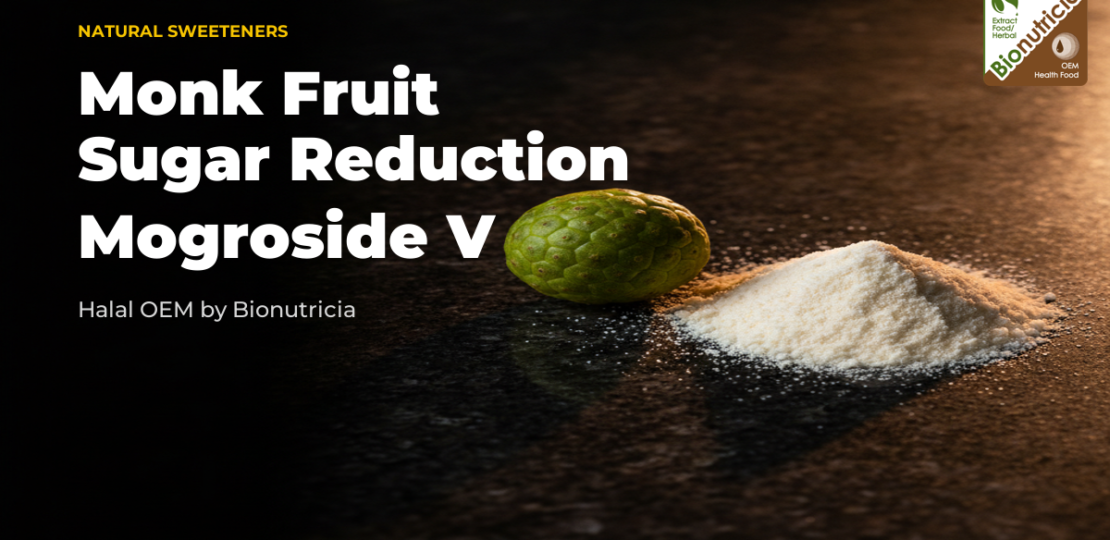
Direct answer: Monk fruit (Siraitia grosvenorii) extract powder is a natural, plant-derived high-intensity sweetener standardised to ≥25% Mogroside V — roughly 250 times sweeter than sucrose — supplied as a water-soluble 70:1 fruit extract for sugar-reduction in OEM supplement and beverage formulations. A JAKIM halal certificate, CoA per lot, and full specification are available for brand owners commissioning private-label products.
Monk fruit, regionally known as Luo Han Guo, is a round green fruit borne on a perennial vine of the Cucurbitaceae family. Its sweetness comes not from sugar but from a group of triterpene glycosides called mogrosides — chiefly Mogroside V, the principal sweetening compound. Because mogrosides deliver intense sweetness at very low use levels, monk fruit extract is one of the most efficient natural sweetening raw materials available to a formulator building a sugar-reduction or sugar-free product line.
Bionutricia’s monk fruit extract powder is a 70:1 water-extracted fruit concentrate, dried into a stable off-white to white powder and standardised to at least 25% Mogroside V. It is water-soluble, heat-stable for standard food-processing conditions, and supplied with a Certificate of Analysis on every lot. The specification below is the baseline; custom standardisation and OEM-specific formulation are available on request.
Composition and Standardisation
The sweetening power of monk fruit resides in its mogrosides — a family of triterpene glycosides among which Mogroside V is the most abundant and the industry-standard marker compound. Standardising to Mogroside V gives a formulator a consistent, measurable sweetening input, lot to lot, in place of variable dried-fruit material whose mogroside content fluctuates with harvest, origin and drying method.
Bionutricia’s monk fruit extract is manufactured using patented enzymatic ultrasonic extraction (MY-188945-A), a green-biotechnology process that concentrates the fruit’s natural mogrosides into a clean, water-soluble powder without added fillers, flavours, preservatives or artificial colours. The result is a 70:1 extract — meaning 70 parts of fruit yield one part of extract powder — standardised to ≥25% Mogroside V. The extraction ratio and the mogroside assay together define the material: a buyer who specifies both gets a reproducible sweetening input, not a botanical powder whose strength drifts between batches.
For OEM formulation, the key composition parameters are the mogroside assay (≥25% Mogroside V), the extraction ratio (70:1), solubility in water, and particle size (>95% through 80 mesh, ensuring uniform blending in a powder sachet or drink-mix base). Moisture is controlled below 6% to prevent caking and microbial growth during the 24-month shelf life.
Typical Specification
| Parameter | Value |
|---|---|
| Botanical origin / part | Siraitia grosvenorii (monk fruit / Luo Han Guo), fruit |
| Extraction ratio | 70:1 |
| Standardisation | Mogroside V ≥ 25% |
| Relative sweetness | Mogroside V ~250× sweeter than sucrose |
| Appearance | Fine powder, off-white to white |
| Odour | Characteristic |
| Solubility | Soluble in water |
| Moisture | < 6% |
| Particle size | > 95% through 80 mesh |
| Typical use level | 0.01–0.05% |
| Heavy metals | As ≤ 1 ppm, Pb ≤ 1 ppm, Cd ≤ 0.3 ppm, Hg ≤ 0.1 ppm |
| Microbial | APC ≤ 10³ cfu/g, Y&M ≤ 10² cfu/g, coliforms ≤ 10 cfu/g, E. coli / Salmonella / Staphylococcus absent |
| Clean label | Vegan, non-GMO, gluten-free (<20 ppm), not irradiated, no listed allergens |
| Shelf life | 24 months sealed, cool & dry |
| Pack sizes | 1 kg, 5 kg, 20 kg |
| Certifications | JAKIM Halal, FSSC 22000, GMP, HACCP, MeSTI |
Format Options for OEM
Because monk fruit extract is a water-soluble powder dosed at very low levels (typically 0.01–0.05%), it fits naturally into several of Bionutricia’s approved OEM formats. The choice depends on the finished product concept, the other ingredients in the formulation, and the distribution channel.
| Format | Role of monk fruit extract | Best suited for |
|---|---|---|
| Powder sachet | Pre-blended sweetener in a drink-mix or supplement powder | Sugar-reduction drink powders, supplement sachets |
| Pouch beverage | Dissolved sweetener in a ready-to-drink functional beverage | RTD wellness drinks, functional beverages |
| Liquid bottle | Liquid sweetener concentrate or finished beverage | Liquid supplement concentrates, tabletop sweetener lines |
| Chewable tablet | Improves palatability of a chewable supplement | Children’s or adult chewable supplements |
| Gel sachet | Sweetener in a gel-format supplement | Energy or wellness gel sachets |
Because Mogroside V is a high-intensity sweetener, monk fruit extract is frequently paired with bulking agents or other natural sweeteners to build a full sweetness and mouthfeel profile. The formulator’s challenge is not sweetness intensity — a tiny amount delivers that — but building body and mouthfeel that sugar normally provides. This is where the choice of carrier, co-sweetener and flavour system matters, and where Bionutricia’s in-house formulation team supports the development process from brief to finished product.
Applications in OEM Formulation
Monk fruit extract is used wherever a brand owner wants a natural, plant-derived alternative to sugar or artificial sweeteners in a supplement or functional beverage. Common applications include:
- Supplement drink powders — monk fruit sweetens a powder sachet without adding sugar or calories, improving taste compliance without compromising the clean-label position.
- Functional beverages — dissolved into a pouch beverage or liquid bottle, monk fruit provides sweetness in a ready-to-drink format without the glycaemic load of sucrose.
- Chewable supplements — a small amount of monk fruit extract improves the palatability of a chewable tablet, particularly for children’s or adult multivitamin lines where taste is the primary barrier to repeat purchase.
- Blended sweetener systems — monk fruit is frequently combined with other natural sweeteners (such as erythritol or stevia) to round out the sweetness profile and reduce the cost per serving while maintaining a clean label.
In every case, the use level is very low — typically 0.01–0.05% of the finished product — which means the raw-material cost contribution of the sweetener is small relative to the active ingredients, packaging and manufacturing overhead.
Halal Chain and Certifications
Monk fruit extract powder from Bionutricia carries JAKIM Halal certification, alongside FSSC 22000, GMP, HACCP and MeSTI. For a brand owner targeting Muslim-majority markets — Malaysia, Indonesia, the GCC, Brunei — a JAKIM halal certificate on the sweetener raw material is not optional; it is a market-access requirement. The halal chain extends from the raw material through extraction, drying, packing and storage in Bionutricia’s integrated facility in Sungai Buloh, Selangor, where halal segregation and cleaning validation are maintained under the same roof as manufacturing.
A Certificate of Analysis is issued for every lot, covering identity (Mogroside V assay), microbial limits, heavy metals and physical parameters. The COA is the brand owner’s primary quality verification tool — it confirms that the batch meets the agreed specification and provides the traceability a buyer needs for their own regulatory dossier. A brand owner should request the COA for every production lot, not just the first, and verify that the Mogroside V assay, heavy-metal panel and microbial results match the specification agreed at the outset.
What the Research Shows
Published human clinical research on monk fruit extract as a standalone ingredient is limited. While mogrosides are well characterised as non-caloric triterpene glycoside sweeteners, the human trial evidence base for specific metabolic or health outcomes remains sparse. For OEM purposes, the specification — Mogroside V content, extraction ratio, solubility, microbial and heavy-metal limits — is the primary quality anchor. A brand owner’s purchasing decision should rest on the CoA and the consistency of standardisation, not on clinical claims that the current literature does not support.
Manufacturing a Monk Fruit Sweetener Product Under Your Own Brand
Bionutricia offers OEM and ODM manufacturing for brand owners and distributors building sugar-reduction or sugar-free product lines. The approved formats that suit monk fruit extract — powder sachets, pouch beverages, liquid bottles, chewable tablets and gel sachets — are all manufactured in the integrated Sungai Buloh facility under JAKIM Halal, FSSC 22000, GMP, HACCP, US FDA and MeSTI certification, with NanoVerify validation. The patented enzymatic ultrasonic extraction process (MY-188945-A) is used for the botanical extraction, and Bionutricia’s in-house authority team — a registered pharmacist, a nutritionist, a dietitian and a PhD biomedical scientist — supports formulation development from brief to finished product. Brand owners can request custom standardisation levels, private-label packaging and a full CoA for every production lot. For bulk raw-ingredient supply enquiries, Bionutricia’s ingredient division at www.bionutriciaextract.com handles direct B2B ingredient sales.
Frequently Asked Questions
Is monk fruit extract halal certified?
Yes — Bionutricia’s monk fruit extract powder carries JAKIM Halal certification, alongside FSSC 22000, GMP, HACCP and MeSTI. The halal certificate is verifiable on the Halal Malaysia portal, and a CoA is issued for every lot.
What standardisation should I specify for OEM?
The baseline specification is ≥25% Mogroside V on a 70:1 extract ratio. Mogroside V is the industry-standard marker compound for monk fruit sweetness. Higher custom standardisation levels may be available on request — submit an enquiry for the current specification.
How sweet is monk fruit extract compared to sugar?
Mogroside V is approximately 250 times sweeter than sucrose. In practice, monk fruit extract is dosed at 0.01–0.05% of the finished product to reach the target sweetness level. It is typically paired with bulking agents or co-sweeteners to build full mouthfeel.
Which OEM formats work with monk fruit extract?
Monk fruit extract is a water-soluble powder, so it fits powder sachets, pouch beverages, liquid bottles, chewable tablets and gel sachets. The best format depends on the finished product concept, the other ingredients in the formulation, and the distribution channel.
Is monk fruit extract a clean-label ingredient?
Yes — the specification is vegan, non-GMO, gluten-free (<20 ppm), not irradiated, with no listed allergens and no added fillers, flavours, preservatives or artificial colours. The full clean-label declaration is confirmed on the CoA for each lot.
Related Guides
- The Formula They Only Take Once: Why Supplement Taste Decides the Reorder
- Supplement Sachet OEM Manufacturer Malaysia: Powder, Liquid & Gel Sachet Formats
- The Other 90% of Your Powder: Why Carrier Origin Decides Your Halal, Allergen and Vegan Claim
Request a Quotation
To commission a monk fruit sweetener product under your own brand, email ng@bio-nutricia.com or submit an enquiry through our website. Bionutricia’s integrated manufacturing facility in Sungai Buloh, Selangor, Malaysia, operates under JAKIM Halal, FSSC 22000, GMP, HACCP, US FDA and MeSTI certification, with NanoVerify validation.
Article by Bionutricia R&D Team. Last updated: 30 September 2026.
RELATED POSTS
View all

Is JAKIM Halal certification recognised in the GCC and UAE for supplements?
May 26, 2026 | by supersuper
How long does it take to launch a private-label supplement brand with a Malaysian OEM?
May 26, 2026 | by supersuper
Hawthorn Berry & Blackcurrant Antioxidant Supplement OEM: Liquid Bottle Standardisation with Herbosomal®
September 25, 2026 | by supersuper