

White Tomato Extract Skin-Support OEM: Phytoene Standardisation, Herbosomal® Technology & Halal Formats
September 25, 2026 | by supersuper
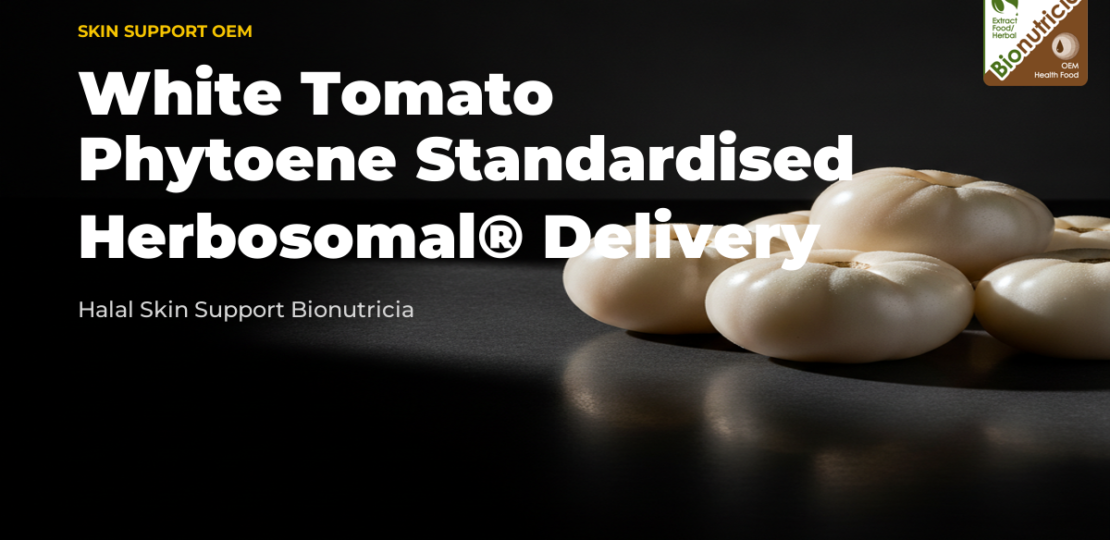
Direct answer: White tomato extract (Solanum lycopersicum) is a skin-support ingredient built around two colourless carotenoids — phytoene and phytofluene — that accumulate in human serum after dietary intake and have been studied for their association with reduced UV-induced erythema in healthy volunteers. For a brand owner commissioning a white tomato skin-supplement OEM product, the decisions that matter are phytoene/phytofluene standardisation on the CoA, the extraction method behind the extract, the delivery technology that protects the carotenoids through manufacturing and storage, and the halal certification chain from raw material to finished sachet or bottle. Bionutricia manufactures white tomato extract skin-support products in powder sachets, liquid bottles, gel sachets, pouch beverages, and chewable tablets — all under JAKIM Halal certification, with patented enzymatic ultrasonic extraction (MY-188945-A) for the botanical fraction and Herbosomal® — Bionutricia’s proprietary liposomal encapsulation and sustained-release technology (registered trademark; patent-pending PI2023005773) — available for enhanced-absorption delivery.
What White Tomato Extract Is
White tomato is an heirloom variety of Solanum lycopersicum with creamy white flesh and skin. Unlike red tomatoes, which are dominated by lycopene, white tomatoes are naturally rich in the colourless carotenoids phytoene and phytofluene. These two compounds are C40 isoprenoid hydrocarbons that absorb UV light in the 280–360 nm range — a property that has drawn research interest in the context of dietary photoprotection.
For OEM formulation, the relevant specification is not “tomato powder” but a standardised extract quantified by HPLC for phytoene and phytofluene content. A typical commercial white tomato extract is standardised to a combined phytoene + phytofluene content in the range of 1–5 mg/g, though exact figures depend on the cultivar, harvest conditions, and extraction process. The extract is typically supplied as a spray-dried powder or a liquid concentrate, and the CoA should report the assay method (HPLC-UV at 286 nm for phytoene and 348 nm for phytofluene), the marker compound, and the measured value per batch.
Phytoene & Phytofluene Standardisation — What to Specify on the CoA
A brand owner commissioning a white tomato skin-support product should specify the following on the Certificate of Analysis:
- Phytoene content — measured by HPLC-UV, reported in mg/g or %. This is the primary marker compound.
- Phytofluene content — measured by HPLC-UV, reported in mg/g or %.
- Combined phytoene + phytofluene — the total colourless carotenoid content, which is the figure most commonly used in marketing and regulatory documentation.
- Lycopene content — white tomato contains trace lycopene; the CoA should report it so the buyer knows the full carotenoid profile.
- Heavy metals — lead, arsenic, cadmium, mercury, each below pharmacopeial or food-grade limits.
- Microbial limits — total plate count, yeast and mould, coliforms, and specified pathogens (Salmonella, E. coli) per USP or equivalent food safety standards.
- Moisture content — typically ≤5% for spray-dried powder, to ensure stability and flowability.
- Particle size — for powder formats, a D90 of ≤150 µm ensures uniform blending and dissolution.
The extraction method matters because it determines marker retention. Bionutricia’s patented enzymatic ultrasonic extraction (MY-188945-A) uses an enzymatic pre-treatment combined with ultrasonic cavitation to release carotenoids from the plant matrix without the thermal degradation that conventional solvent extraction can cause. This is particularly relevant for phytoene and phytofluene, which are sensitive to oxidation and light.
What the Research Shows
A human study published in the International Journal for Vitamin and Nutrition Research in 2015 reported that tomato-based supplementation raised serum phytoene and phytofluene levels in healthy volunteers, and that this elevation was associated with reduced UV-induced erythema (PMID: 24920476; https://pubmed.ncbi.nlm.nih.gov/24920476/). The study measured serum carotenoid response and skin erythema after UV exposure in a healthy volunteer population. This finding supports the rationale for standardising white tomato extract to phytoene and phytofluene content, because the serum response and the associated skin outcome depend on the dose of these specific carotenoids delivered.
A narrative review published in Nutrients in 2017 examined the role of dietary carotenoids, including phytoene and phytofluene, in skin physiology (DOI: 10.3390/nu9080866). The review provides background context on colourless carotenoids and skin health.
For a brand owner, the practical takeaway is that standardisation to phytoene and phytofluene is not a marketing flourish — it is the specification that ties the finished product to the published serum-response data. A white tomato extract that is not standardised to these markers cannot be linked to the existing research, regardless of the raw material’s origin.
Herbosomal® Technology for White Tomato Extract Delivery
Phytoene and phytofluene are lipophilic carotenoids — they dissolve in fat, not water. This presents a formulation challenge for water-based delivery formats such as pouch beverages and liquid bottles, and an absorption consideration for all formats. Bionutricia offers Herbosomal® — Bionutricia’s proprietary liposomal encapsulation and sustained-release technology (registered trademark; patent-pending PI2023005773) — which pairs phyto-actives with phospholipid carriers to support the delivery of lipophilic compounds in water-based and powder formats.
For a white tomato skin-support product, Herbosomal® encapsulation can be applied to the carotenoid fraction to produce a water-dispersible powder or liquid that integrates into sachet, beverage, and bottle formats without the oil separation that unencapsulated carotenoids would cause. The encapsulation process is verified through Dynamic Light Scattering (DLS) particle-size measurement, and the finished product’s CoA should report the particle-size distribution as evidence of the liposomal process.
Approved Halal OEM Formats for White Tomato Skin-Support Products
Bionutricia manufactures white tomato extract skin-support products in the following approved formats:
- Powder sachets — the most cost-effective format for a standardised white tomato extract powder. Suitable for single-dose servings, stable in moisture-barrier laminate film, and easy to transport. The powder can be dissolved in water or a beverage before consumption.
- Liquid bottles — a ready-to-drink format for brands targeting the beauty-from-within beverage category. Requires preservative system validation and stability testing, but offers the strongest consumer convenience story.
- Gel sachets — a single-dose gel format that combines the portability of a sachet with the sensory experience of a liquid. Suitable for premium positioning.
- Pouch beverages — a flexible-format beverage in a stand-up pouch, lighter than glass bottles and suitable for ambient distribution channels.
- Chewable tablets — a format that avoids the need for water and supports on-the-go consumption. Requires careful taste-masking of the tomato flavour profile.
Each format is manufactured under JAKIM Halal certification at Bionutricia’s Sungai Buloh facility, with full batch traceability from raw material to finished product.
Halal Chain & Certifications
For a white tomato skin-support product sold in Muslim-majority markets or exported to GCC and Southeast Asian countries, the halal chain must cover every component — not just the active ingredient. Bionutricia holds JAKIM Halal certification (OEM Kontrak Pengilangan), which covers the manufacturing process, the facility, and the finished product. The halal chain extends to carriers, excipients, and packaging materials, all of which must be supplied by halal-compliant suppliers with documentation.
Beyond halal, Bionutricia holds six quality certifications: FSSC 22000 (SGS audited), GMP, HACCP, US FDA registration, and MeSTI — plus NanoVerify validation for nano-processed ingredients. These certifications are relevant to white tomato extract products because they cover food safety, manufacturing practice, and — through NanoVerify — the particle-size claims associated with liposomal delivery.
What a Brand Owner Should Ask a Supplier
Before commissioning a white tomato skin-support OEM product, a brand owner should ask the manufacturer the following questions:
- What is the phytoene and phytofluene content of the extract, and what HPLC method was used to measure it?
- Can you provide a batch-specific CoA with heavy-metal, microbial, and moisture data?
- What extraction method is used, and how does it preserve carotenoid markers?
- Is Herbosomal® encapsulation available for this ingredient, and can you provide DLS particle-size data?
- What is the halal certification status of the full formulation — active, carriers, and packaging?
- What stability data is available for the proposed format, and under what ICH climate zone?
- What is the minimum production volume and what is the lead time from formula approval to first batch?
Frequently Asked Questions
What is white tomato extract standardised to for skin-support OEM?
White tomato extract for skin-support OEM is standardised to phytoene and phytofluene content, measured by HPLC-UV. The combined phytoene + phytofluene figure is the primary specification, and the CoA should report each marker individually alongside lycopene, heavy metals, microbial limits, and moisture.
Which OEM formats are available for white tomato skin-support products?
Bionutricia manufactures white tomato skin-support products in powder sachets, liquid bottles, gel sachets, pouch beverages, and chewable tablets. Capsules, softgels, and hard tablets are not part of Bionutricia’s manufacturing capability.
How does Herbosomal® technology apply to white tomato extract?
Herbosomal® — Bionutricia’s proprietary liposomal encapsulation and sustained-release technology (registered trademark; patent-pending PI2023005773) — pairs the lipophilic carotenoids in white tomato extract with phospholipid carriers, producing a water-dispersible form suitable for sachet, beverage, and bottle formats. The process is verified by DLS particle-size measurement.
Is white tomato extract halal-certified for OEM manufacturing?
Yes. Bionutricia holds JAKIM Halal certification (OEM Kontrak Pengilangan) covering the manufacturing facility, process, and finished product. The halal chain extends to all carriers, excipients, and packaging materials, each of which must be supplied by halal-compliant suppliers with documentation.
What evidence supports white tomato extract for skin support?
A human study published in the International Journal for Vitamin and Nutrition Research in 2015 reported that tomato-based supplementation raised serum phytoene and phytofluene levels and was associated with reduced UV-induced erythema in healthy volunteers (PMID: 24920476). Standardising the extract to phytoene and phytofluene content is what links the finished product to this published serum-response data.
Related Guides
- White Tomato + Collagen Peptide OEM: Phytoene Standardisation, Herbosomal® Technology & Halal Formats
- White Tomato Extract — Commercial Monograph
- Collagen & Beauty-from-Within OEM: Marine Collagen, Formats & Halal
Request a Quotation
Bionutricia Holding Sdn Bhd is a JAKIM-certified halal supplement OEM and contract manufacturer in Malaysia, founded in 2006. The company operates a fully integrated GMP and HACCP facility in Sungai Buloh with FSSC 22000, US FDA registration, MeSTI, and NanoVerify validation. OEM formats include powder sachets, liquid sachets, gel sachets, pouch beverages, chewable tablets, and liquid bottles. Extraction runs on Bionutricia’s patented enzymatic ultrasonic process (MY-188945-A), with Herbosomal® liposomal encapsulation available for enhanced-absorption actives.
To discuss a white tomato extract skin-support OEM project, contact:
Email: ng@bio-nutricia.com
WhatsApp: +60 16-661 8510
Website: bionutricia.com
Article by Bionutricia R&D Team. Last updated: 25 September 2026.
RELATED POSTS
View all


Twenty Years Behind the Label: What We Learned Building 239+ Supplement Brands
July 13, 2026 | by supersuper
Cempedak (Artocarpus integer) & Mangosteen Extract Powder Sachet OEM: Assay Marker Standardisation & Batch Consistency
September 30, 2026 | by supersuper

Ashwagandha (Withania somnifera) for Stress Resilience: Evidence Review & OEM Options
September 24, 2026 | by supersuper