

Hawthorn Berry & Blackcurrant Antioxidant Supplement OEM: Liquid Bottle Standardisation with Herbosomal®
September 25, 2026 | by supersuper
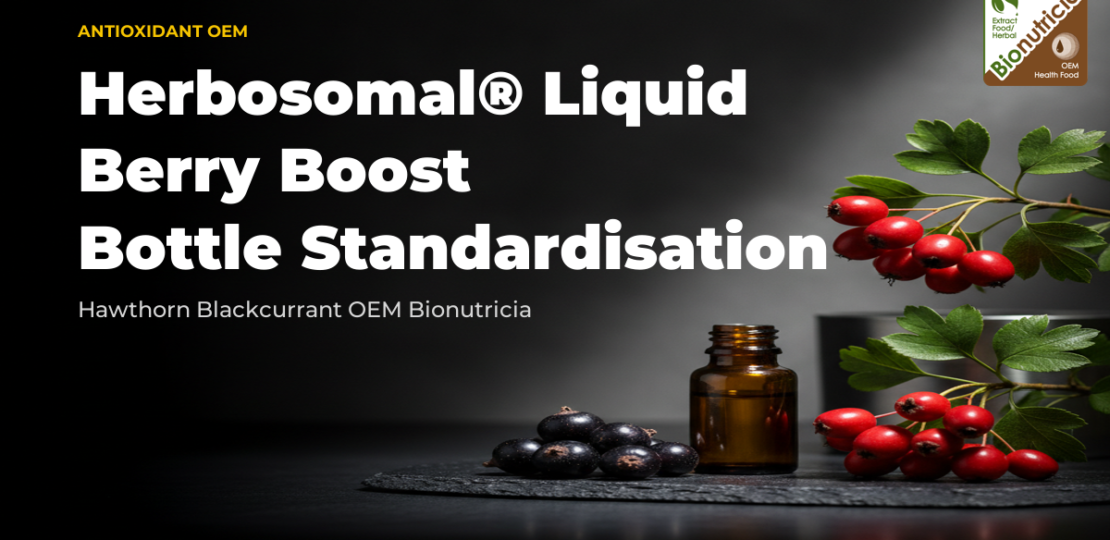
Direct answer: To formulate a hawthorn berry and blackcurrant antioxidant supplement as a liquid bottle product in Malaysia, specify a hawthorn (Crataegus monogyna) extract standardised to flavonoids (hyperoside, vitexin, rutin) and procyanidins, and a blackcurrant (Ribes nigrum) extract standardised to anthocyanins (cyanidin-3-glucoside, cyanidin-3-rutinoside, delphinidin-3-glucoside). Your CoA must carry assay markers, heavy-metal limits (Pb, As, Cd, Hg), microbial counts, and residual solvent data. The liquid bottle format suits water-soluble botanical extracts and pairs naturally with Herbosomal® — Bionutricia’s proprietary liposomal encapsulation and sustained-release technology (registered trademark; patent-pending PI2023005773) — which pairs phyto-actives with phospholipid carriers. Bionutricia’s patented enzymatic ultrasonic extraction (MY-188945-A) produces standardised hawthorn fractions, while the Sungai Buloh facility holds JAKIM Halal, FSSC 22000, GMP, HACCP, US FDA and MeSTI certifications. Brand owners should request full CoA documentation, confirm the halal chain from raw material to finished liquid bottle, and specify particle-size verification if using Herbosomal® encapsulation.
Why Hawthorn Berry and Blackcurrant for an Antioxidant Liquid?
Hawthorn (Crataegus monogyna) berries are a rich source of flavonoids — including hyperoside, vitexin, quercetin and rutin — and oligomeric procyanidins. These compound classes are the primary markers used to standardise hawthorn extracts for supplement formulation. Blackcurrant (Ribes nigrum) berries are among the most concentrated dietary suppliers of anthocyanins, with cyanidin-3-glucoside, cyanidin-3-rutinoside and delphinidin-3-glucoside as the dominant glycosides. Together, these two botanicals bring complementary phenolic profiles to a single liquid formulation: hawthorn contributes flavonoid and procyanidin fractions, while blackcurrant contributes anthocyanin pigments that also serve as natural colourants for the finished beverage.
For a brand owner evaluating an OEM partner, the formulation question is not whether these compounds “work together” — it is whether the extract standardisation, CoA documentation and manufacturing process deliver a consistent, measurable phenolic load in every bottle. That consistency is what differentiates a premium OEM product from a commodity botanical drink.
Standardisation Markers and Assay Methods
Hawthorn Berry Extract
Specify a hawthorn berry extract standardised to total flavonoids (typically expressed as hyperoside or quercetin equivalents) and oligomeric procyanidins. Common assay methods include UV-Vis spectrophotometry for total flavonoid content and HPLC for individual marker identification (hyperoside, vitexin, rutin). A typical specification might call for 1.5–3.0% total flavonoids calculated as hyperoside, though the exact target depends on the extract ratio and your formulation dose. Bionutricia’s patented enzymatic ultrasonic extraction (MY-188945-A) produces standardised hawthorn fractions that meet international quality, safety and efficacy norms.
Blackcurrant Extract
Specify a blackcurrant extract standardised to total anthocyanins, with HPLC identification of the four major glycosides: cyanidin-3-glucoside, cyanidin-3-rutinoside, delphinidin-3-glucoside and delphinidin-3-rutinoside. A common specification targets 25–35% total anthocyanins calculated as cyanidin-3-glucoside equivalents. The pH of the liquid matrix matters: anthocyanins are most stable at pH 2–4, so an acidic liquid bottle formulation helps preserve colour and marker integrity throughout shelf life.
Certificate of Analysis: What to Specify
A compliant CoA for a hawthorn berry and blackcurrant liquid bottle should include:
- Assay: Total flavonoids (hawthorn) and total anthocyanins (blackcurrant), with HPLC chromatograms on request
- Heavy metals: Lead (Pb) ≤ 3.0 ppm, Arsenic (As) ≤ 2.0 ppm, Cadmium (Cd) ≤ 1.0 ppm, Mercury (Hg) ≤ 0.5 ppm
- Microbial limits: Total plate count ≤ 1,000 CFU/g, Yeast and mould ≤ 100 CFU/g, E. coli negative, Salmonella negative
- Residual solvents: Within ICH Q3C limits, particularly relevant for solvent-extracted anthocyanin concentrates
- Pesticide residues: Compliant with EU MRLs or target-market requirements
- Water activity (aw): Relevant for liquid stability and microbial control
- pH: Measured and recorded for anthocyanin stability tracking
Brand owners should request the full CoA for each batch, not just a summary certificate. If the formulation uses Herbosomal® encapsulation, request particle-size distribution data (DLS measurement) to verify the liposomal dispersion.
Liquid Bottle Format with Herbosomal® Technology
The liquid bottle is one of Bionutricia’s approved OEM formats, alongside powder sachets, liquid sachets, gel sachets, pouch beverages and chewable tablets. For a hawthorn and blackcurrant antioxidant formulation, the liquid bottle offers several practical advantages: water-soluble phenolic extracts integrate directly into the matrix, anthocyanins provide natural colour, and the format supports precise dose measurement.
Herbosomal® — Bionutricia’s proprietary liposomal encapsulation and sustained-release technology (registered trademark; patent-pending PI2023005773) — pairs phyto-actives with phospholipid carriers. For a liquid bottle application, this means the hawthorn flavonoid and blackcurrant anthocyanin fractions can be encapsulated within phospholipid vesicles dispersed throughout the liquid matrix. Bionutricia’s NanoVerify validation confirms the nano-scale process, and brand owners can request DLS particle-size data as part of the technical dossier.
The extraction of the hawthorn botanical fraction runs on Bionutricia’s patented enzymatic ultrasonic extraction (MY-188945-A), which produces standardised fractions of premium quality. This integrated extraction-to-encapsulation pipeline — from raw botanical to finished Herbosomal® liquid bottle — is managed under one roof at the Sungai Buloh facility.
Halal Certification and Quality Chain
For brand owners targeting the Malaysian, Middle Eastern or Southeast Asian markets, JAKIM Halal certification is a non-negotiable. Bionutricia holds JAKIM Halal certification (OEM Kontrak Pengilangan) across its full manufacturing operation. The halal chain extends from raw material supply through extraction, formulation, filling and packaging — every stage must be documented and auditable.
Bionutricia’s six quality certifications are:
- FSSC 22000 — Food Safety System Certification (SGS audited)
- GMP — Good Manufacturing Practice (pharmaceutical-grade)
- HACCP — Hazard Analysis Critical Control Point (process-validated)
- JAKIM Halal — certified for OEM contract manufacturing
- US FDA — registered (FCE / FDA filings)
- MeSTI — Makanan Selamat Tanggungjawab Industri (Ministry of Health Malaysia)
Additionally, NanoVerify validates the nano-scale liposomal process. Bionutricia’s OEM formats are food-classified and go through MeSTI notification — they do not require NPRA health-supplement MAL registration. Brand owners exporting to markets with different regulatory frameworks should confirm local requirements with Bionutricia’s in-house authority team, which includes a registered pharmacist, a nutritionist, a dietitian and a PhD biomedical scientist.
What the Research Shows
A laboratory study analysed the phenolic composition and measured the antioxidant activity of hawthorn extract fractions using in vitro assays (Phenolic Profile and Antioxidant Activity of Fractions, Molecules, 2025; https://pmc.ncbi.nlm.nih.gov/articles/PMC12655011/). This study was conducted in vitro, not in human subjects.
A randomised controlled trial reported that black currant nectar reduced muscle damage and inflammation following a bout of high-intensity eccentric contractions (Hutchison et al., Journal of Dietary Supplements, 2016; PMID 25153307; https://pubmed.ncbi.nlm.nih.gov/25153307/). The outcome measured was exercise-induced muscle damage and inflammation in an athletic context, not antioxidant activity directly.
Reviews of hawthorn’s chemical composition and biological activities, including reported antioxidant properties, have been published in Frontiers in Pharmacology (2023; https://pmc.ncbi.nlm.nih.gov/articles/PMC10623334/) and Foods (2022; https://pmc.ncbi.nlm.nih.gov/articles/PMC9498108/). A review of blackcurrant’s biological activities and pharmacological properties has been published in Food Science & Nutrition (2023; https://pmc.ncbi.nlm.nih.gov/articles/PMC10563683/).
For OEM formulation, these findings underscore why standardisation markers — not broad efficacy claims — should drive the specification. The assay method, the marker compound and the percentage on the CoA are what a brand owner can verify, batch after batch. That verifiable consistency is the foundation of a defensible antioxidant supplement brand.
Manufacturing Capability at Bionutricia
Bionutricia Holding Sdn Bhd, founded in 2006 and headquartered in Kota Damansara, operates a fully integrated GMP and HACCP manufacturing facility in Sungai Buloh, Selangor. The facility handles contract extraction (standardised and phytosome form), contract spray-drying, grinding and packing under one roof. With 239+ brand partners served across Southeast Asia, the Middle East, the US and the EU, Bionutricia’s OEM pipeline covers the full journey from botanical raw material to finished, labelled liquid bottle.
The in-house R&D team — a registered pharmacist, a nutritionist, a dietitian and a PhD biomedical scientist — supports formula development, stability testing and regulatory documentation. For a hawthorn and blackcurrant antioxidant liquid bottle, the team can advise on extract ratio selection, pH optimisation for anthocyanin stability, preservative system design, and Herbosomal® encapsulation parameters.
Frequently Asked Questions
1. What standardisation should I specify for hawthorn berry extract in a liquid bottle?
Specify total flavonoids (as hyperoside equivalents) and oligomeric procyanidins, with HPLC identification of individual markers including hyperoside, vitexin and rutin. A typical target is 1.5–3.0% total flavonoids, though the exact percentage depends on your extract ratio and desired dose per serving. Request the full HPLC chromatogram, not just a summary figure.
2. What anthocyanin standardisation should I ask for with blackcurrant extract?
Specify total anthocyanins calculated as cyanidin-3-glucoside equivalents, with HPLC identification of the four major glycosides: cyanidin-3-glucoside, cyanidin-3-rutinoside, delphinidin-3-glucoside and delphinidin-3-rutinoside. A common target is 25–35% total anthocyanins. Ensure the liquid matrix pH is 2–4 to preserve anthocyanin stability and colour throughout shelf life.
3. How does Herbosomal® technology apply to a liquid bottle format?
Herbosomal® — Bionutricia’s proprietary liposomal encapsulation and sustained-release technology (registered trademark; patent-pending PI2023005773) — pairs phyto-actives with phospholipid carriers. In a liquid bottle, the encapsulated actives are dispersed as liposomal vesicles throughout the liquid matrix. Brand owners can request DLS particle-size distribution data to verify the dispersion. NanoVerify validation confirms the nano-scale process.
4. Does a hawthorn and blackcurrant liquid bottle require NPRA MAL registration?
No. Bionutricia’s OEM formats are food-classified and go through MeSTI notification. They do not require NPRA health-supplement MAL registration or undergo the 116–245 working-day NPRA evaluation. NPRA and MAL may be relevant as general market education about the Malaysian regulatory landscape, but Bionutricia’s own products follow the MeSTI food notification route. Brand owners should confirm export-market requirements with Bionutricia’s regulatory team.
5. What should I put on the CoA for a Herbosomal® liquid bottle?
In addition to standard assay, heavy-metal, microbial, residual-solvent and pesticide parameters, request particle-size distribution data (DLS measurement) to verify the liposomal dispersion, pH for anthocyanin stability tracking, and water activity for microbial control. If both hawthorn and blackcurrant extracts are encapsulated, request separate assay data for each active fraction.
Related Guides
- Elderberry (Sambucus nigra) Extract OEM: Anthocyanin & Vitamin C Standardisation for Immune-Support Formats
- White Tomato + Collagen Peptide OEM: Phytoene Standardisation, Herbosomal® Technology & Halal Formats
- Liposomal Supplement OEM: What Brand Owners Should Know Before Choosing a Manufacturer
Request a Quotation
Ready to formulate your hawthorn berry and blackcurrant antioxidant liquid bottle with Herbosomal® technology? Bionutricia’s R&D team will work with you on extract standardisation, CoA specifications, halal certification documentation and format selection.
Email: ng@bio-nutricia.com
Phone / WhatsApp: +60 16-661 8510
Website: https://bionutricia.com
Article by Bionutricia R&D Team. Last updated: 2026-09-25.
RELATED POSTS
View all


How much does it cost to manufacture a private-label supplement in Malaysia?
May 26, 2026 | by supersuper
Halal Segregated Storage & Logistics: What a Supplement OEM Must Prove to a Brand Owner
September 28, 2026 | by supersuper