

White Tomato Extract & Grape Seed Skin-Support OEM: Phytoene, Phytofluene & Proanthocyanidin Specs for Halal Sachet and Beverage Formats
September 25, 2026 | by supersuper
Direct answer: Bionutricia is a JAKIM-certified halal OEM in Sungai Buloh, Malaysia, that formulates white tomato extract (standardised to phytoene and phytofluene) with grape seed extract (standardised to proanthocyanidins) into skin-support supplement formats — powder sachets, liquid bottles, pouch beverages, gel sachets and chewable tablets. White tomato extract is valued in beauty-from-within formulations for its colourless carotenoid content (phytoene and phytofluene), while grape seed extract contributes a standardised proanthocyanidin fraction. Bionutricia’s patented enzymatic ultrasonic extraction (MY-188945-A) processes the botanical fractions, and Herbosomal® — Bionutricia’s proprietary liposomal encapsulation and sustained-release technology (registered trademark; patent-pending PI2023005773) — is available for actives suited to liposomal delivery. The facility holds FSSC 22000, GMP, HACCP, JAKIM Halal, US FDA and MeSTI certification, plus NanoVerify validation. Brand owners commissioning a white tomato skin-support line should request a full Certificate of Analysis specifying the phytoene/phytofluene assay, proanthocyanidin percentage, heavy-metal limits and microbial panel — and confirm the manufacturer does not supply capsule formats, which Bionutricia does not produce.
Why White Tomato Extract and Grape Seed for a Skin-Support OEM Formula
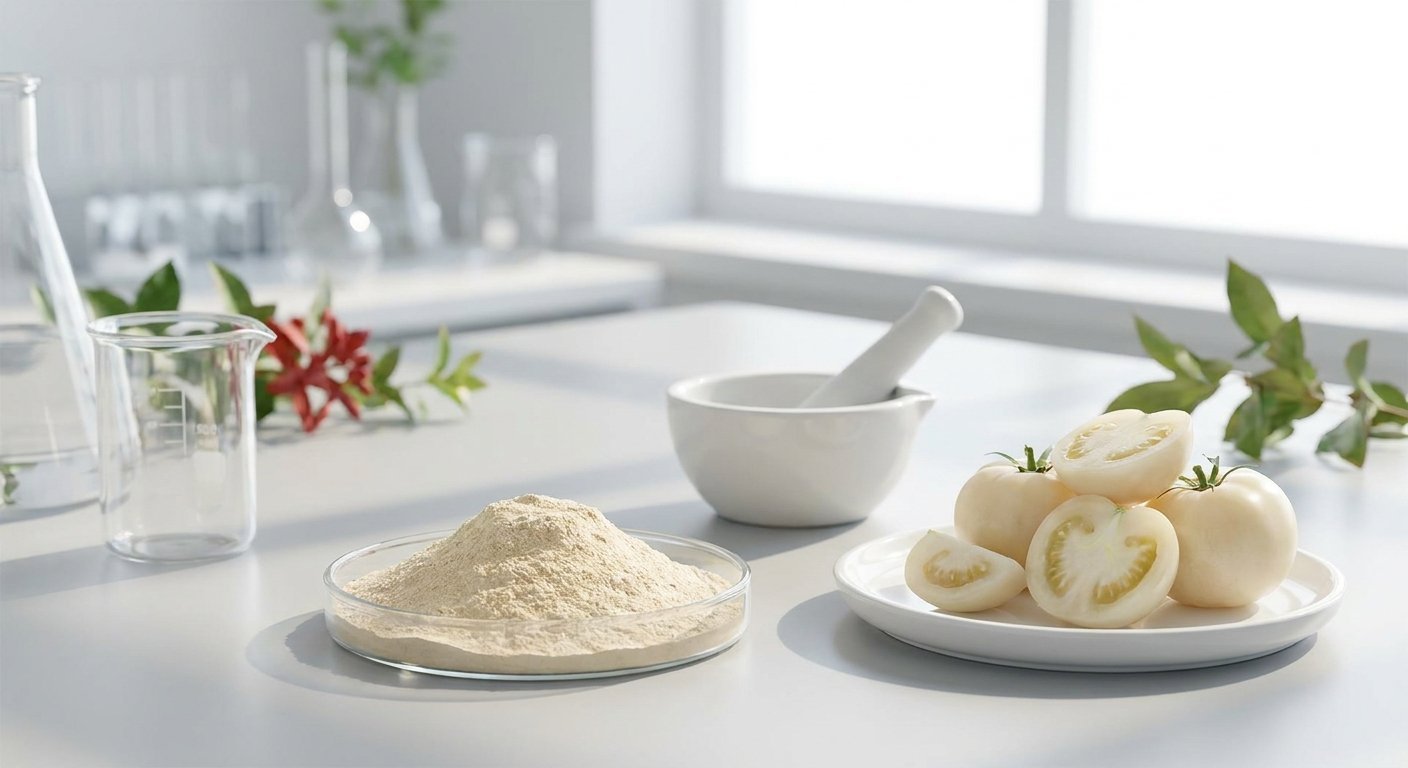
White tomato (Solanum lycopersicum) extract is a specialised botanical fraction distinct from standard red tomato extract. Its key compositional markers are two colourless carotenoids — phytoene and phytofluene — which are quantifiable by HPLC and form the basis of a standardised specification for OEM use. Unlike lycopene (the red pigment in conventional tomatoes), phytoene and phytofluene are optically transparent, making them suitable for formulations where colour stability and a pale or neutral finished-product appearance matter to the brand.
Grape seed (Vitis vinifera) extract is standardised to its proanthocyanidin content — a class of polyphenolic compounds measurable by HPLC and typically expressed as a percentage of oligomeric proanthocyanidins (OPC). For OEM specification purposes, grape seed extract is defined by its OPC assay value, moisture content, heavy-metal limits and microbial panel on the Certificate of Analysis.
Together, these two botanicals give a brand owner a dual-marker formulation: phytoene/phytofluene from the tomato fraction and OPC from the grape seed fraction. Each active is quantified independently, so the finished product’s CoA reports both assay values — giving the brand a defensible specification for buyer-facing labelling and retailer submissions.
What the Research Shows
A human study published in Int J Vitam Nutr Res in 2015 reported that tomato-based supplementation raised serum phytoene and phytofluene levels and was associated with reduced UV-induced erythema in healthy volunteers (PMID: 24920476). The association between supplementation and reduced erythema was observed in the study population; the finding does not establish a causal mechanism and should not be read as a guarantee of a specific outcome for every user.
A narrative review titled “Colourless carotenoids in skin health: a narrative review” was published in Nutrients in 2017 (DOI: 10.3390/nu9080866), addressing the topic of dietary carotenoids and skin physiology.
Grape seed extract’s role in this formulation is defined by its composition — a standardised proanthocyanidin fraction — and its specification on the CoA. The combination of white tomato and grape seed in a single OEM formula is a formulation decision based on dual-marker standardisation, not a clinical trial outcome.
For brand owners, the practical takeaway is this: the specification matters as much as the evidence. A standardised phytoene/phytofluene assay, a verifiable OPC percentage, and a clean heavy-metal and microbial panel are what a retailer, a regulator or a third-party lab will actually check — and what a compliant CoA must show.
Specification and Standardisation
White Tomato Extract — Phytoene and Phytofluene
For OEM formulation, white tomato extract should be standardised to a stated phytoene and phytofluene content, typically measured by HPLC. A brand owner commissioning this formulation should specify:
- Phytoene content (e.g. stated as mg/g or % by HPLC)
- Phytofluene content (e.g. stated as mg/g or % by HPLC)
- Extraction ratio (e.g. 10:1 or 20:1, confirming concentrate vs. raw material)
- Heavy-metal limits: lead (Pb), cadmium (Cd), mercury (Hg), arsenic (As) — each within Malaysian Food Act 1983 and USP limits
- Microbial panel: total plate count, yeast and mould, E. coli, Salmonella, Candida
- Moisture content and water activity (aw)
- Particle size (if spray-dried powder for sachet formulation)
The CoA for each batch must show the actual measured values against these limits — not a “passes” or “complies” statement without the numbers.
Grape Seed Extract — Proanthocyanidins (OPC)
Grape seed extract for OEM use should be standardised to a stated OPC percentage. Specify:
- OPC content (e.g. ≥95% or stated value, by HPLC or gravimetric method)
- Heavy-metal limits: Pb, Cd, Hg, As — each within applicable limits
- Microbial panel: total plate count, yeast and mould, E. coli, Salmonella
- Moisture content
- Solvent residue limits (if applicable to the extraction method used)
Both extracts should carry their own batch CoA, traceable to the supplier lot. The finished-product CoA should then report the blended formulation’s combined values.
Bionutricia’s Extraction and Encapsulation Technology
White tomato extract at Bionutricia is processed using patented enzymatic ultrasonic extraction (MY-188945-A) — a green-biotech assisted process that produces standardised fractions meeting international quality, safety and efficacy norms. The extraction method does not use harsh solvents and is validated for reproducible marker content batch to batch.
For actives suited to liposomal delivery, Herbosomal® — Bionutricia’s proprietary liposomal encapsulation and sustained-release technology (registered trademark; patent-pending PI2023005773) — pairs phyto-active compounds with phospholipid carriers. Particle-size verification by dynamic light scattering (DLS) is available for NanoVerify-validated batches, confirming the liposomal dispersion specification on the CoA.
OEM Formats for a Skin-Support Formula
Bionutricia manufactures the following formats — and does not produce capsules, softgels, hard tablets, gummies, effervescent tablets or stick-packs. A white tomato and grape seed skin-support formula can be commissioned in:
- Powder sachets — dry-blend both extracts with carrier and flavour; stable, compact, cost-efficient; ideal for beauty-from-within stick sachets sold in multipacks
- Liquid bottles — suspend both extracts in a liquid vehicle; higher sensory appeal; requires preservative stability and water-activity control
- Pouch beverages — single-serve ready-to-drink format; suitable for premium beauty beverage lines; shelf-life and packaging barrier specifications apply
- Gel sachets — semi-liquid format with a smooth mouthfeel; suitable for beauty-shot positioning
- Chewable tablets — compact, portable; requires taste-masking and excipient compatibility for the proanthocyanidin fraction, which has an astringent character
Format choice is one of the highest-leverage decisions in supplement OEM and is irreversible once tooling and packaging materials are committed. A powder sachet wins on cost, stability and volume flexibility for dry-ingredient actives; a liquid bottle or pouch beverage wins on sensory experience for a premium beauty positioning. A brand owner should brief the R&D team on the target retail price point, shelf-life requirement and distribution channel before committing.
Halal and Certification Chain
Bionutricia holds six quality certifications — FSSC 22000 (SGS audited), GMP, HACCP, JAKIM Halal (OEM Kontrak Pengilangan), US FDA registration, and MeSTI — plus NanoVerify validation. For a white tomato and grape seed skin-support formula, the halal chain covers:
- Ingredient-level halal status of each botanical extract and carrier
- Manufacturing facility halal certification (JAKIM)
- Cross-contact prevention between halal and non-halal materials on the production line
- Finished-product halal certification per batch, if required by the destination market
Bionutricia’s OEM formats are food-classified and go through MeSTI notification. They do not require NPRA health-supplement MAL registration and do not undergo the 116–245 working-day NPRA evaluation pathway. Brand owners exporting to the GCC, Indonesia or other halal-sensitive markets should confirm that JAKIM certification is recognised in the destination jurisdiction — it is recognised across the GCC including Saudi Arabia, the UAE, Qatar, Kuwait, Oman and Bahrain, as well as Indonesia and Brunei.
Related Guides
- White Tomato + Collagen Peptide OEM: Phytoene Standardisation, Herbosomal® Technology & Halal Formats
- Collagen & Beauty-from-Within OEM: Marine Collagen, Formats & Halal
- Knowledge: Herbasomal Skinboost
FAQ
What phytoene and phytofluene standardisation should I specify for a white tomato extract OEM formulation?
Specify a dual HPLC assay for both phytoene and phytofluene — each as a stated mg/g or percentage value. Request the extraction ratio (e.g. 10:1 or 20:1) to confirm you are buying a concentrate, not a raw powder. The CoA for every batch must show the actual measured values for both markers, plus heavy-metal limits (Pb, Cd, Hg, As) and a full microbial panel.
Can Bionutricia manufacture a white tomato skin supplement in capsule format?
No. Bionutricia does not produce capsules, softgels, hard tablets, gummies, effervescent tablets or stick-packs. Approved OEM formats are powder sachets, liquid sachets, gel sachets, pouch beverages, chewable tablets and liquid bottles. A white tomato and grape seed skin-support formula can be formulated in any of these — the choice depends on your brand’s retail positioning, shelf-life requirement and price point.
What does the Certificate of Analysis need to show for a white tomato and grape seed combination formula?
The finished-product CoA should report both the phytoene/phytofluene assay values (from the white tomato fraction) and the OPC percentage (from the grape seed fraction), each measured by HPLC. It must also list heavy-metal limits (Pb, Cd, Hg, As), a microbial panel (total plate count, yeast and mould, E. coli, Salmonella), moisture content and water activity. If the formula uses Herbosomal® liposomal delivery, the CoA should additionally report particle-size distribution by DLS.
Is a white tomato and grape seed skin-support supplement classified as a medicine in Malaysia?
No. Bionutricia’s OEM formats are food-classified and go through MeSTI notification. They do not require NPRA health-supplement MAL registration and do not undergo the 116–245 working-day NPRA evaluation pathway. The formula should be positioned as a food/beverage supplement, not as a medicinal product. Claims on packaging should comply with food-supplement labelling requirements, not pharmaceutical product registration requirements.
How do I request a quotation for a white tomato and grape seed OEM formulation?
Contact Bionutricia’s R&D team with your target formulation brief: preferred format (powder sachet, liquid bottle, pouch beverage, gel sachet or chewable tablet), target phytoene/phytofluene and OPC specifications, desired shelf life, target markets and estimated volume. The team will respond with a formulation proposal, CoA template and quotation. Email ng@bio-nutricia.com or WhatsApp +60 16-661 8510 to begin.
Commission Your White Tomato Skin-Support Formula
Bionutricia Holding Sdn Bhd is a JAKIM-certified halal supplement OEM headquartered in Kota Damansara, Selangor, with an integrated GMP and HACCP manufacturing facility in Sungai Buloh, Malaysia. Founded in 2006, Bionutricia has served 239+ brand partners across SEA, MENA, the US and EU. Six quality certifications — FSSC 22000, GMP, HACCP, JAKIM Halal, US FDA and MeSTI — plus NanoVerify validation sit behind every batch. The in-house authority team comprises a registered pharmacist, a nutritionist, a dietitian and a PhD biomedical scientist.
To request a formulation proposal, CoA template and quotation for a white tomato extract and grape seed skin-support OEM line, email ng@bio-nutricia.com or WhatsApp +60 16-661 8510.
Article by Bionutricia R&D Team. Last updated: 25 September 2026.
RELATED POSTS
View all

Shan Yao (Chinese Yam) Extract for Functional Beverages – OEM Guide
September 24, 2026 | by supersuper
Certifications & Audit-Readiness Hub — Pensijilan & Audit-Readiness Hub
September 18, 2026 | by supersuper