

Halal Segregated Storage & Logistics: What a Supplement OEM Must Prove to a Brand Owner
September 28, 2026 | by supersuper
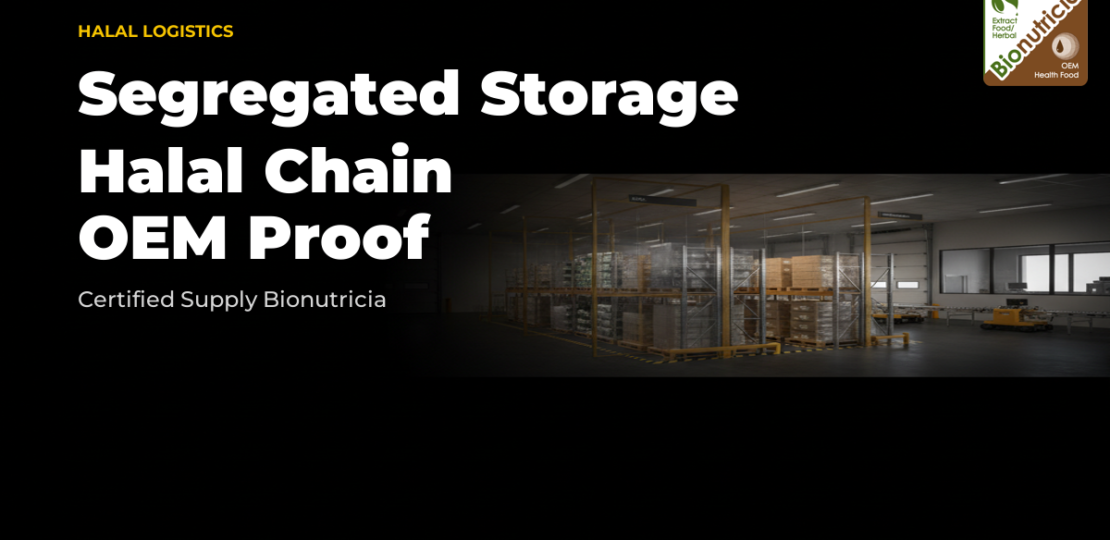
Direct answer: Halal segregated storage and logistics under MS 1500:2019 requires a supplement manufacturer to physically separate halal-certified materials from non-halal at every stage — receiving, warehousing, production, packaging, storage and transport. A brand owner should verify warehouse zoning, dedicated equipment protocols, documented cleaning between batches, and full traceability from raw material supplier to finished-product dispatch.
For a brand owner commissioning a halal-certified supplement, the JAKIM logo on a certificate is only the starting point. What happens inside the warehouse — how raw materials are received, where they are stored, how non-halal substances are kept apart, and how finished goods leave the facility — determines whether the halal integrity you paid for actually reaches your customer. MS 1500:2019, the Malaysian standard for halal food (including halal supplements and functional beverages), sets out the requirements a manufacturer must meet to hold and retain JAKIM certification.
This guide explains what segregated storage and logistics means in practice for a supplement OEM, what a brand owner should ask to see, and how the halal chain extends beyond the factory floor into transport and distribution.
What MS 1500:2019 Requires for Halal Storage
MS 1500:2019 is the Malaysian standard governing halal food production, and it applies to supplement manufacturers holding JAKIM certification. The standard requires that halal products must be protected from contamination by non-halal substances at every point in the manufacturing and storage chain. This is not a recommendation — it is a condition of certification, and a JAKIM auditor will inspect the physical layout and documented procedures during both initial certification and surveillance audits.
The core requirement is segregation. A manufacturer must be able to demonstrate that halal-certified raw materials, work-in-progress, and finished products are physically separated from any non-halal material at all times. This applies whether the non-halal material is in the same building, arrives on the same loading dock, or is handled by the same staff. The standard also requires that equipment, utensils, and transport vehicles used for halal products must not be shared with non-halal production unless a documented cleaning and sanitisation protocol has been validated and followed.
Physical Segregation: Warehouse Zoning and Layout
The most visible evidence of halal segregated storage is the warehouse layout itself. A compliant facility zones its storage areas so that halal and non-halal materials cannot come into contact, even accidentally. Common approaches include:
- Dedicated halal zones: Physically separated storage areas, rooms or racking sections reserved exclusively for halal-certified materials, with clear floor markings, signage, and access controls.
- Vertical separation: Where floor space is constrained, halal materials may be stored on upper tiers with non-halal below, provided there is no risk of cross-contamination through spills, dust, or shared air handling.
- Dedicated equipment: Pallets, trolleys, forklifts and handling tools used in halal zones are identified and not shared with non-halal material handling without validated cleaning between uses.
- Buffer areas: Designated quarantine zones for incoming materials awaiting halal status verification before release into the main halal storage area.
A brand owner visiting a facility should be able to see these zones clearly demarcated and ask to see the warehouse layout plan that documents them. The plan should show the flow of halal materials from receiving through production to finished-goods storage and dispatch, with no intersection points where halal and non-halal paths cross.
Receiving, Dispatch and Transport Controls
Segregation does not stop at the warehouse door. The halal chain extends to how materials arrive at the facility and how finished products leave it.
Incoming Materials
Every incoming raw material must be checked for halal certification status before it enters the halal storage zone. A manufacturer should have a documented receiving procedure that includes:
- Verification of the supplier’s halal certificate and its validity period
- Checking that the material matches the certificate’s product description and manufacturer
- Physical inspection of packaging integrity to ensure no contamination in transit
- Quarantine of any material whose halal status cannot be confirmed until documentation is resolved
Materials arriving without valid halal documentation should not enter the halal storage area under any circumstances. A brand owner should ask to see the receiving log and the procedure for handling materials that arrive without complete halal certification.
Outbound Dispatch
Finished halal products must be dispatched in packaging that maintains halal integrity. Transport vehicles must not have carried non-halal cargo — particularly pork or alcohol — without documented cleaning. The dispatch procedure should record the vehicle’s previous cargo, cleaning status, and the batch numbers of products loaded. For export shipments, the halal certificate and certificate of analysis should travel with the goods, and the transport route should be documented as part of the traceability chain.
Documentation and Traceability for the Halal Chain
Documentation is what turns physical segregation into auditable proof. A JAKIM-certified manufacturer must maintain records that demonstrate halal integrity at every step. The key documents a brand owner should expect to see include:
| Document | What It Proves |
|---|---|
| Supplier halal certificates | Each raw material supplier holds valid JAKIM-recognised halal certification |
| Receiving logs | Every incoming batch was checked for halal status before entering storage |
| Warehouse zoning plan | Physical layout separates halal and non-halal materials with no crossover points |
| Cleaning validation records | Equipment and transport used for both halal and non-halal production has validated cleaning protocols |
| Batch production records | Each finished batch traces its raw materials, production line, and dispatch details |
| Dispatch and transport logs | Finished goods left the facility in vehicles that met halal transport requirements |
Traceability must work in both directions. A brand owner should be able to give a batch number to the manufacturer and receive a complete chain: which raw material lots went into it, when they were received, who supplied them, which production line ran the batch, and which vehicle carried the finished goods. This is the same traceability system required under FSSC 22000 and GMP — but for a halal-certified product, it carries the additional dimension of halal status verification at each link.
What a Brand Owner Should Verify
Before signing a manufacturing agreement, a brand owner commissioning a halal supplement should verify the following about the OEM’s segregated storage and logistics:
- Warehouse layout: Request the physical warehouse plan and confirm halal and non-halal zones are separated with no shared pathways.
- Supplier verification: Ask how the manufacturer verifies the halal status of every incoming raw material and what happens when documentation is missing.
- Cleaning protocols: Request the validated cleaning procedure for any equipment or transport shared between halal and non-halal production.
- Traceability test: Provide a batch number from a previous run and ask the manufacturer to trace it back to raw material lots and forward to dispatch records.
- Transport controls: Confirm that dispatch procedures include verification of vehicle cargo history and cleaning status.
- Audit history: Request the most recent JAKIM surveillance audit report or summary, and check whether any non-conformances related to storage or segregation were raised.
A manufacturer that cannot answer these questions on the spot — or that needs weeks to assemble the documentation — may not have the systems in place to protect halal integrity under real production conditions.
Manufacturing a Halal-Certified Supplement Under Your Own Brand
Bionutricia operates a JAKIM-certified halal manufacturing facility in Sungai Buloh, Malaysia, with segregated storage and logistics procedures aligned to MS 1500:2019. The facility manufactures powder, liquid and gel sachets, pouch beverages, chewable tablets, and liquid bottles for brand owners and distributors under their own label. Botanical extracts are produced using patented enzymatic ultrasonic extraction (MY-188945-A), and Herbosomal® — Bionutricia’s proprietary liposomal encapsulation and sustained-release technology (registered trademark; patent-pending PI2023005773) — is available for formulations requiring phospholipid encapsulation. The facility holds FSSC 22000, GMP, HACCP, JAKIM Halal, US FDA registration, MeSTI and NanoVerify certification. For brand owners evaluating a halal OEM partner, the full certification stack and integrated warehouse layout are available for review. Learn what a JAKIM auditor actually checks inside a supplement factory.
To request a quotation or discuss your halal supplement formulation, email ng@bio-nutricia.com or WhatsApp +60 16-661 8510. The integrated manufacturing facility is in Sungai Buloh, Selangor, Malaysia.
Frequently Asked Questions
Does MS 1500:2019 apply to supplement OEM manufacturing?
Yes. MS 1500:2019 covers halal food production, which includes halal-certified supplements and functional beverages manufactured in Malaysia. Any manufacturer holding JAKIM certification for supplement OEM production must comply with the standard’s segregation, storage, and traceability requirements.
Can a manufacturer store halal and non-halal materials in the same warehouse?
Yes, but only with documented physical segregation. MS 1500:2019 does not require separate buildings, but it does require that halal and non-halal materials are separated by physical barriers, dedicated zones, or clear spatial separation that prevents cross-contamination. The segregation must be documented in a warehouse layout plan and verified during JAKIM audits.
What happens if a raw material arrives without a valid halal certificate?
The material should be quarantined in a buffer area and must not enter the halal storage zone until its halal status is verified. If the supplier cannot provide a valid halal certificate recognised by JAKIM, the material cannot be used in halal-certified production. A brand owner should ask to see the manufacturer’s procedure for handling this scenario.
How does halal segregation interact with FSSC 22000 and GMP requirements?
Halal segregation adds a specific dimension to the broader food safety and quality management systems. FSSC 22000 and GMP require allergen control, cross-contamination prevention, and full traceability — and halal segregation builds on these same systems with the additional requirement of separating halal from non-halal substances. A manufacturer holding both FSSC 22000 and JAKIM certification has integrated both sets of requirements into a single documented system.
What transport documentation should a brand owner request for halal shipments?
A brand owner should request dispatch records that show the transport vehicle’s previous cargo, cleaning status, and the batch numbers loaded. For export shipments, the halal certificate and certificate of analysis should accompany the goods. The transport route and carrier details should be recorded as part of the batch traceability chain, so that halal integrity can be demonstrated from factory to destination.
Related Guides
- Your Halal Logo Is Not Your Audit: What a JAKIM Auditor Actually Checks
- Halal-Certified vs Halal-Friendly Supplement OEM: What’s the Real Difference?
- Halal Certification Renewal & Surveillance Audits: What Changes After Year One
Article by Bionutricia R&D Team. Last updated: 28 September 2026.
RELATED POSTS
View all

Marine Collagen + Vitamin C OEM Checklist: What to Verify Before Signing With a Malaysian Supplement Manufacturer
September 28, 2026 | by supersuper
Purple Sweet Potato (Ipomoea batatas) & Ginger Extract OEM: Anthocyanin Standardisation for Functional Beverage
September 24, 2026 | by supersuper