


Asam Gelugur + Collagen Peptides Pouch Beverage Versus Powder Sachet: Which Format Yields the Higher Margin and Better Shelf Stability
October 2, 2026 | by supersuper
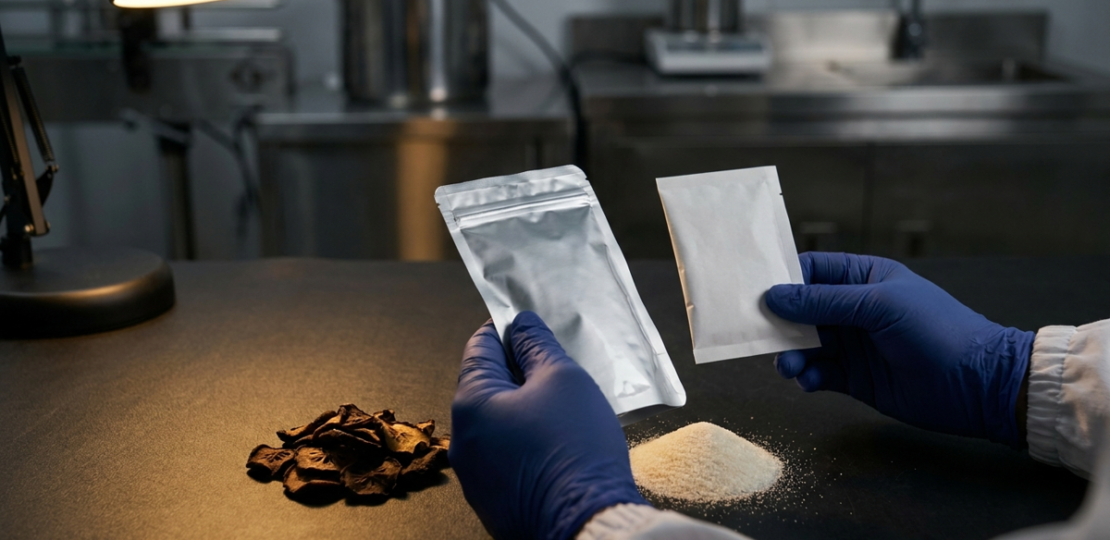
Direct answer: For a Malaysian functional supplement brand formulating with asam gelugur + collagen peptides, a powder sachet generally yields the higher margin and better shelf stability than a pouch beverage. Powder sachets have lower production cost (no water, no preservatives, lighter packaging), a longer shelf life (typically 24 months vs 6–12 months for liquid), and simpler logistics. A pouch beverage wins on consumer convenience and sensory experience but carries higher per-unit cost and stability risk.
The format decision — pouch beverage versus powder sachet — is one of the highest-leverage choices a brand owner makes when commissioning a functional supplement. It affects production cost, shelf life, packaging weight, regulatory pathway, and the consumer’s experience. For a combination of asam gelugur (Garcinia atroviridis) and collagen peptides, the two formats interact differently with each ingredient’s chemical properties, and the right choice depends on the brand’s target channel, price point, and shelf-life requirement.
This guide compares the two formats across margin, shelf stability, composition, and manufacturing considerations so a brand owner can make an informed decision.
Format Comparison at a Glance
| Factor | Powder Sachet | Pouch Beverage |
|---|---|---|
| Production cost per unit | Lower — no water content, simpler filling, lighter packaging | Higher — liquid filling, pasteurisation or preservatives, heavier packaging |
| Shelf life (typical) | 24 months (ambient, sealed) | 6–12 months (ambient) or 12–18 months (retort) |
| Shelf stability risk | Low — moisture-controlled powder, no microbial growth risk if water activity is managed | Higher — liquid matrix supports microbial growth; preservatives or retort processing required |
| Logistics weight | Light — 5–15 g per sachet | Heavy — 50–200 ml liquid per pouch |
| Consumer convenience | Moderate — requires mixing with water before consumption | High — ready to drink, no preparation needed |
| Flavour challenge | Asam gelugur’s tartness is manageable in powder; collagen is tasteless | Tartness is diluted in liquid; flavour masking is easier but preservatives may affect taste |
Asam Gelugur (Garcinia atroviridis): Composition and Format Interaction
Asam gelugur is a traditional Malaysian fruit used in cooking for its tart, acidic flavour. The key compositional marker is hydroxycitric acid (HCA), an organic acid found in the fruit’s dried slices. For a functional supplement, the extract is typically standardised to a specified HCA content, and the extract ratio is agreed with the supplier.
In a powder sachet, the HCA content is stable because the dry matrix protects the compound from degradation. The tart flavour is concentrated, which can be an advantage for a functional positioning (the consumer expects a sharp, acidic taste) or a challenge if the brand wants a more palatable profile. Flavour systems can be added to the powder blend to moderate the tartness.
In a pouch beverage, the HCA is dissolved in the liquid matrix. The tartness is diluted across a larger volume, making the flavour more approachable — but the liquid environment introduces stability considerations. HCA is an organic acid, and in solution it can interact with other ingredients, affect pH, and influence the preservative system. The formulation must account for the pH shift that HCA creates in the liquid.
Collagen Peptides: Composition and Format Interaction
Collagen peptides are hydrolysed proteins with a molecular weight typically below 3,000 Da. They are soluble in water, tasteless or mildly flavoured, and stable in both dry and liquid forms. For halal certification, marine collagen is the preferred origin because it does not require slaughter certification.
In a powder sachet, collagen peptides are the bulk of the fill weight — a typical serving contains 3–10 g of collagen peptides. The powder is hygroscopic (it absorbs moisture from the air), so the sachet film must have a high moisture barrier and the powder blend must meet a water activity specification that prevents caking and microbial growth.
In a pouch beverage, collagen peptides dissolve readily in the liquid. The challenge is not solubility but stability — the liquid matrix must maintain the collagen peptide integrity over the claimed shelf life, and the preservative system must prevent microbial growth without affecting the collagen. Collagen peptides in solution are a protein substrate for microorganisms, so the preservative or processing choice (hot-fill, retort, or cold-fill with preservatives) is critical.
Shelf Stability: Why Powder Wins for This Combination
The combination of asam gelugur (an acidic botanical) and collagen peptides (a protein) creates a specific stability challenge in liquid form. The acidic environment from HCA can accelerate protein degradation over time, and the liquid matrix supports microbial growth that requires either preservatives or thermal processing.
A powder sachet avoids both issues. The dry matrix prevents microbial growth (provided the water activity is controlled), and the acidic HCA does not interact with the collagen peptides because both are in a dry state. The shelf life of a powder sachet is typically 24 months under ambient storage conditions, compared with 6–12 months for an ambient pouch beverage without retort processing.
For a brand owner targeting convenience-store or pharmacy retail, where products may sit on the shelf for months before purchase, the longer shelf life of a powder sachet reduces the risk of expired stock and returns. For a brand targeting direct-to-consumer or subscription models, where the product moves quickly, a pouch beverage’s shorter shelf life may be acceptable.
Margin Economics: The Cost Structure Difference
The per-unit cost difference between the two formats is driven by three factors:
- Raw material concentration: A powder sachet delivers the active dose in 5–15 g of powder. A pouch beverage delivers the same dose in 50–200 ml of liquid — but the liquid is mostly water, which is cheap. The difference is in the packaging cost: a liquid pouch requires more material, a heavier film, and a larger fill volume.
- Processing cost: Powder sachet filling is a dry process — blending, filling, and sealing. Pouch beverage filling involves liquid preparation, pasteurisation or preservative addition, filling, and sealing — more steps, more equipment time, and more energy.
- Logistics cost: A powder sachet weighs 5–15 g; a pouch beverage weighs 50–200 g. Shipping and warehousing costs scale with weight. For a brand exporting from Malaysia, the weight difference is significant.
The result is that a powder sachet typically delivers a higher gross margin per unit than a pouch beverage for the same active dose — unless the brand can command a premium price for the convenience of a ready-to-drink format.
When a Pouch Beverage Is the Right Choice
A pouch beverage is not the wrong choice in every scenario. It wins when:
- The brand’s positioning is premium convenience — the consumer pays for ready-to-drink, not for mixing
- The target channel is impulse purchase (convenience stores, gyms, cafes) where powder mixing is impractical
- The brand can price the pouch beverage at a premium that covers the higher production cost
- The shelf-life requirement is short (subscription model, direct-to-consumer, fast turnover)
For a brand owner who wants both formats, the manufacturer can produce the same formulation in both — but the specifications, preservative systems, and stability data will differ for each.
Herbosomal® as a Format Differentiator
Herbosomal® — Bionutricia’s proprietary liposomal encapsulation and sustained-release technology (registered trademark; patent-pending PI2023005773) — is available for this formulation as an encapsulation option. In a liquid sachet, liposomal encapsulation pairs the actives with phospholipid carriers. The phospholipids must be halal-verified (typically soy-derived or sunflower-derived lecithin). This adds cost but creates a differentiated product that a standard powder sachet or pouch beverage does not match.
Manufacturing an Asam Gelugur + Collagen Peptides Supplement Under Your Own Brand
Bionutricia offers OEM and ODM manufacturing for brand owners and distributors commissioning an asam gelugur + collagen peptides supplement under their own label. The approved formats for this formulation include powder sachets, pouch beverages, and liquid bottles. The integrated facility in Sungai Buloh, Selangor, operates under JAKIM halal certification alongside FSSC 22000, GMP, HACCP, US FDA registration, and MeSTI, with NanoVerify validation for liposomal processes. Formulation development, private-label manufacturing, and packaging are handled in-house. The in-house authority team — a registered pharmacist, a nutritionist, a dietitian, and a PhD biomedical scientist — reviews the format specification and stability data before production begins. To request a quotation, submit an enquiry through our website at our enquiries page or email ng@bio-nutricia.com.
Frequently Asked Questions
Why does a powder sachet have a longer shelf life than a pouch beverage for this combination?
A powder sachet stores the actives in a dry matrix where microbial growth cannot occur (provided water activity is controlled) and the acidic HCA does not interact with the collagen peptides. A pouch beverage places both actives in a liquid environment where the acid can affect the protein over time and the liquid supports microbial growth, requiring preservatives or thermal processing that themselves affect shelf life.
Can I offer the same formulation in both formats?
Yes, but the specifications differ. The powder sachet needs a moisture barrier film and a water activity specification. The pouch beverage needs a preservative system or retort processing, a pH specification, and liquid stability data. The manufacturer will develop separate stability protocols for each format, and the CoA parameters will differ.
What is hydroxycitric acid, and why does it matter for format selection?
Hydroxycitric acid (HCA) is the principal organic acid in asam gelugur (Garcinia atroviridis). It gives the fruit its tart flavour and is the standardisation marker for the extract. In a powder sachet, HCA is stable in the dry matrix. In a pouch beverage, HCA dissolves into the liquid and lowers the pH, which affects the preservative system and the stability of the collagen peptides. The formulation must account for this interaction.
Is a pouch beverage always more expensive to produce than a powder sachet?
Generally yes, because of the additional processing steps (liquid preparation, pasteurisation or preservative addition), heavier packaging, and higher logistics weight. However, if the brand can price the pouch beverage at a premium for the convenience of a ready-to-drink format, the margin per unit may be comparable or higher despite the higher production cost.
Does the halal certification process differ between the two formats?
The halal requirements under MS 1500:2019 are the same for both formats — every ingredient and excipient must be halal-verified. However, a pouch beverage may require additional excipients (preservatives, stabilisers, flavour carriers) that a powder sachet does not, and each additional excipient must be individually halal-verified. The documentation pack for a liquid formulation is typically longer.
Related Guides
- Powder Sachet vs Liquid Sachet vs Pouch Beverage vs Liquid Bottle: Which Format Wins?
- Powder Supplement vs Liquid Supplement: Which Format for Your Active?
- Marine vs Bovine Collagen for a Halal Supplement Brand
Article by Bionutricia R&D Team. Last updated: 2 October 2026.
RELATED POSTS
View all

Top 7 nutraceutical OEM manufacturers in Malaysia compared (2026)
May 26, 2026 | by supersuper
Agaricus Blazei Murrill & Reishi Mushroom Beta-Glucan Immune-Support Powder Sachet OEM
September 28, 2026 | by supersuper

Which Malaysian supplement manufacturers have Halal + FDA + FSSC 22000 certification?
May 26, 2026 | by supersuper