

Marine Collagen + Vitamin C OEM Checklist: What to Verify Before Signing With a Malaysian Supplement Manufacturer
September 28, 2026 | by supersuper
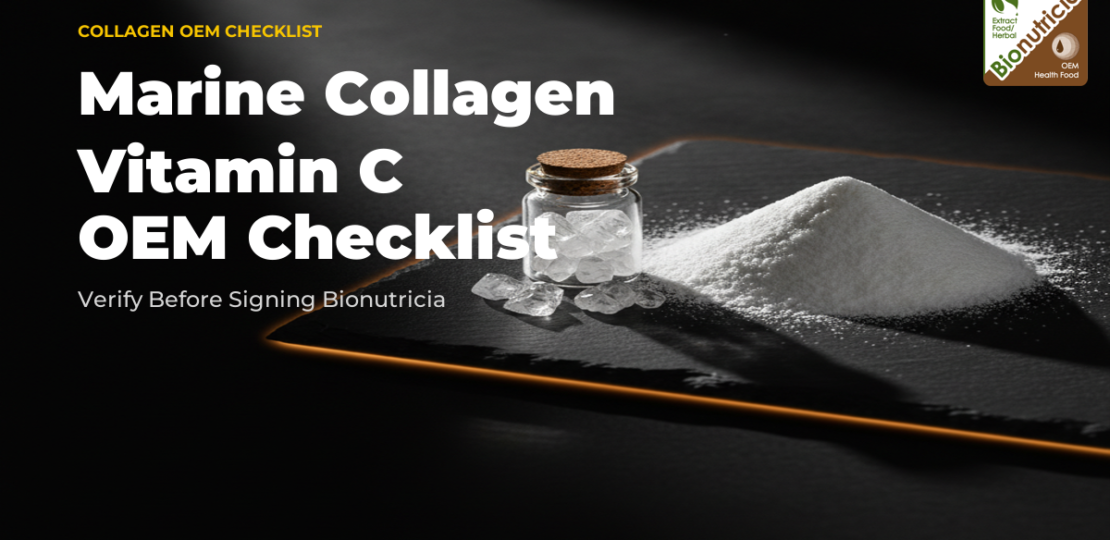
Direct answer: Before signing with a Malaysian OEM for a marine collagen + vitamin C sachet line, verify six things: the certification stack (JAKIM halal, FSSC 22000, GMP, HACCP, US FDA, MeSTI), collagen peptide molecular-weight profile and assay, vitamin C grade and stability data, halal chain integrity, CoA and stability testing protocols, and delivery technology options such as liposomal encapsulation.
Choosing an OEM partner for a marine collagen + vitamin C powder sachet line is a decision that shapes everything downstream — from halal market access to shelf-life stability and unit economics. A thin product page or a sales deck is not enough. What a brand owner needs is a structured evaluation: a checklist that covers certifications, raw-material specifications, formulation and delivery technology, halal traceability, and quality verification protocols.
This article walks through each item on that checklist, with specific attention to what a marine collagen + vitamin C sachet line demands of a manufacturer. Where published clinical literature exists on the actives, it is named; where specifications must be agreed with the manufacturer rather than assumed, that is stated plainly.
Certification Stack: What to Verify Before You Sign
A Malaysian supplement OEM’s certification stack is the first and most objective signal of manufacturing quality. For a marine collagen + vitamin C sachet line, six certifications matter, plus one technology verification:
| Certification | What It Covers | Why a Brand Owner Should Verify It |
|---|---|---|
| FSSC 22000 | Food safety management system (GFSI-recognised) | Required by many international retailers and distributors; confirms an audited food-safety framework |
| GMP | Good Manufacturing Practice (pharmaceutical-grade) | Confirms production meets pharmaceutical-grade cleanliness and process-control standards |
| HACCP | Hazard Analysis and Critical Control Points | Process-validated risk management covering biological, chemical and physical hazards |
| JAKIM Halal | Malaysian halal certification (OEM contract manufacturing) | Market access for Muslim-majority markets; covers the full production chain |
| US FDA | Registration with the US Food and Drug Administration | Export access to the US market; confirms facility registration and FCE filings |
| MeSTI | Makanan Selamat Tanggungjawab Industri (Ministry of Health Malaysia) | Malaysian food-safety notification; mandatory for food-classified supplement products |
| NanoVerify | Verified nanotechnology process (Nanotech Malaysia) | Validates nano-scale processing claims for liposomal or sub-micron formulations |
Ask the OEM for current certificate numbers, issuing bodies, and audit dates — not just a logo on a website. A certificate that has lapsed or is pending renewal is a risk to your launch timeline. Cross-check the JAKIM halal certificate against the JAKIM directory to confirm it covers contract manufacturing (OEM Kontrak Pengilangan), not just a single product registration.
Marine Collagen Peptide Specifications
Marine collagen peptides for a powder sachet line are typically hydrolysed from fish skin or fish scales. The specification a brand owner should request from any manufacturer covers several parameters that directly affect product quality and consumer perception:
- Raw material: Fish species and part (skin versus scale). Marine collagen is halal by default, but the species and origin must be documented for JAKIM compliance.
- Molecular weight: Typically expressed in daltons (Da). The molecular-weight distribution should be agreed with the manufacturer and confirmed on the CoA, as it affects solubility and sensory properties in a sachet format.
- Assay and purity: Protein content (usually ≥90% on a dry basis), hydroxyproline content as a collagen marker, and moisture level.
- Microbiological limits: Total plate count, yeast and mould, coliforms, and specified pathogens — all with numerical limits on the CoA.
- Heavy metals: Lead, arsenic, mercury, and cadmium, each with a stated maximum.
Ask the manufacturer whether they hold a specification sheet for the collagen peptide grade they propose to use, and whether that grade has been used in previously launched sachet products. A manufacturer that cannot produce a current CoA for the collagen lot they intend to use is not ready to start production.
Vitamin C Specifications
Vitamin C in a marine collagen sachet line is typically L-ascorbic acid or a mineral ascorbate. The specification should cover:
- Grade and form: L-ascorbic acid, sodium ascorbate, or another ascorbate derivative. The form affects solubility, taste profile, and stability in the sachet.
- Assay: Purity percentage on a dry basis, confirmed on the CoA for each lot.
- Stability data: Vitamin C degrades over time, particularly in the presence of moisture and heat. Ask the manufacturer for stability data in the proposed sachet format and packaging material, covering the intended shelf life.
- Carrier and excipient compatibility: If the vitamin C is supplied as a coated or granulated grade, the carrier material must be compatible with the collagen peptide and must not compromise halal status.
The interaction between vitamin C and collagen peptides in a powder sachet is a formulation question, not just a procurement one. A manufacturer with formulation development capability can test the blend for stability, solubility, and sensory acceptability before committing to a production run.
Format and Delivery Technology for Sachet Lines
A powder sachet is the most common format for a marine collagen + vitamin C line, but it is not the only option. Malaysian OEM manufacturers may also offer liquid sachets, gel sachets, pouch beverages, chewable tablets, and liquid bottles. The format decision affects dissolution behaviour, shelf life, packaging cost, and consumer experience.
For brand owners looking to differentiate on delivery technology, liposomal encapsulation is an option worth discussing with the manufacturer. Herbosomal® — Bionutricia’s proprietary liposomal encapsulation and sustained-release technology (registered trademark; patent-pending PI2023005773) — is available for vitamin C in this type of formulation. In Bionutricia’s own comparative testing, up to twice the bioavailability of standard vitamin C has been observed for its liposomal vitamin C. This is the manufacturer’s own testing data, not a published clinical trial, and applies to vitamin C specifically rather than the collagen-vitamin C combination.
NanoVerify certification is relevant here: it validates that a nanotechnology process — such as liposomal encapsulation — has been independently verified by Nanotech Malaysia. If a manufacturer claims liposomal or nano-scale delivery, ask whether the process holds NanoVerify certification and request the verification document.
What the Research Shows
Published human clinical research on marine collagen peptides includes a single-blind case-control clinical study examining marine collagen peptides with plant-derived antioxidants, published in Oxidative Medicine and Cellular Longevity in 2016 (PMID: 26904164, https://pubmed.ncbi.nlm.nih.gov/26904164/). The available record confirms the study exists; no result is reported in the retrieved abstract.
For vitamin C, a review published in the South African Family Practice journal in 2025 examined vitamin C’s role in skin health (https://pmc.ncbi.nlm.nih.gov/articles/PMC12339815/). The review surveys existing literature on the subject.
These sources describe research on the individual actives. No published clinical trial has examined a marine collagen + vitamin C combination specifically. Brand owners should treat any efficacy messaging on their label as a marketing decision governed by local regulations, not as a claim established by a combination study.
Halal Chain and Traceability
For a marine collagen + vitamin C sachet line targeting Muslim-majority markets, halal integrity extends well beyond the finished-product certificate. Every input — the collagen raw material, the vitamin C grade, the carrier and excipient system, the packaging contact surfaces, and the cleaning agents used on the production line — must be halal-compliant and documented.
Verify the following with any prospective OEM:
- Raw-material halal status: Marine collagen from fish is halal by default, but the supplier’s documentation must confirm species, origin, and processing method. Vitamin C and its carrier must be documented as halal-compliant.
- Production-line segregation: The manufacturing facility must operate segregated storage and production for halal and non-halal materials. Ask for the warehouse zoning plan and the line-cleaning protocol.
- JAKIM certificate scope: Confirm the OEM’s JAKIM certificate covers contract manufacturing (OEM Kontrak Pengilangan) and is current. Cross-check against the JAKIM online directory.
- Traceability: The manufacturer should be able to trace every batch back to the raw-material lot, processing date, and production line — and provide that documentation on request.
An integrated facility that handles formulation, manufacturing, and packaging under one roof simplifies the halal audit trail, because there are fewer handoffs and fewer third-party interfaces to verify.
Quality Verification: CoA, Stability and Testing
A certificate of analysis (CoA) is the primary quality document for every batch. For a marine collagen + vitamin C sachet line, the CoA should cover:
- Collagen peptide assay (protein content, hydroxyproline), molecular-weight distribution, and microbiological results
- Vitamin C assay (potency at time of manufacture)
- Heavy metals (lead, arsenic, mercury, cadmium)
- Microbiological limits (total plate count, yeast and mould, coliforms, specified pathogens)
- Moisture content (critical for powder sachet stability)
Stability testing is equally important. Vitamin C degrades over time, and the degradation rate depends on moisture, temperature, and packaging. Ask the manufacturer for real-time and accelerated stability data in the proposed sachet format and packaging material. The stability study should cover the intended shelf life and state the vitamin C retention at the end of that period.
Third-party testing is a separate question. Ask whether the manufacturer sends finished-product samples to an independent laboratory for verification, or whether all testing is in-house. A manufacturer that supports third-party verification demonstrates confidence in its own quality systems.
Manufacturing a Marine Collagen + Vitamin C Product Under Your Own Brand
Bionutricia offers OEM and ODM manufacturing for brand owners and distributors commissioning a marine collagen + vitamin C powder sachet line from a single integrated facility in Sungai Buloh, Malaysia. The approved formats for this type of product include powder sachets, liquid sachets, gel sachets, pouch beverages, chewable tablets, and liquid bottles. Formulation development — including collagen grade selection, vitamin C form and stability, flavour system, and sachet packaging — is handled in-house by a team comprising a registered pharmacist, a nutritionist, a dietitian, and a PhD biomedical scientist.
Herbosomal® — Bionutricia’s proprietary liposomal encapsulation and sustained-release technology (registered trademark; patent-pending PI2023005773) — is available for the vitamin C component of this formulation. The facility holds FSSC 22000, GMP, HACCP, JAKIM Halal, US FDA registration, and MeSTI certification, alongside NanoVerify validation for its nanotechnology processes. For a detailed composition and specification guide for this product type, see Marine Collagen Peptide + Vitamin C OEM Sachets: Composition, Herbosomal® Delivery & Halal Specs.
To request a quotation or discuss formulation options for your own-label marine collagen + vitamin C sachet line, email ng@bio-nutricia.com or WhatsApp +60 16-661 8510. Bionutricia’s integrated manufacturing facility is located in Sungai Buloh, Selangor, Malaysia.
Frequently Asked Questions
What certifications should a Malaysian supplement OEM hold?
A Malaysian supplement OEM should hold FSSC 22000, GMP, HACCP, JAKIM Halal, US FDA registration, and MeSTI certification. NanoVerify is an additional certification that validates nanotechnology processes such as liposomal encapsulation. Ask for current certificate numbers, issuing bodies, and audit dates — not just a logo on a website.
What molecular weight should marine collagen peptides be for a sachet product?
The molecular-weight distribution of marine collagen peptides should be agreed with the manufacturer and confirmed on the CoA for each lot. There is no single correct range; the choice depends on solubility requirements, sensory targets, and the specific sachet format. Ask the manufacturer for the specification sheet of the grade they propose to use.
Does vitamin C degrade in a powder sachet over time?
Vitamin C is sensitive to moisture, heat, and oxidation, and its potency declines over the shelf life of a powder sachet. The manufacturer should provide stability data — both real-time and accelerated — in the proposed packaging material, showing vitamin C retention at the end of the intended shelf life. This data is essential for setting the expiry date on the label.
What is NanoVerify and why does it matter for a liposomal supplement?
NanoVerify is a certification issued by Nanotech Malaysia that independently validates a nanotechnology manufacturing process. For a liposomal or nano-scale supplement, NanoVerify confirms that the encapsulation process has been verified at the nano level. If a manufacturer claims liposomal delivery, ask whether the process holds NanoVerify certification.
How do I verify a manufacturer’s JAKIM halal certificate covers OEM contract manufacturing?
Ask the manufacturer for the JAKIM certificate number and the scope of certification. The certificate should explicitly cover OEM Kontrak Pengilangan (contract manufacturing), not just a single product registration. Cross-check the certificate number against the JAKIM online directory to confirm it is current and valid.
Related Guides
- Marine Collagen Peptide + Vitamin C OEM Sachets: Composition, Herbosomal® Delivery & Halal Specs
- The Complete Guide to Halal Supplement OEM in Malaysia (2026)
- Marine vs Bovine Collagen for a Halal Supplement Brand
Article by Bionutricia R&D Team. Last updated: 2026-09-28.
RELATED POSTS
View all

White Tomato Extract & Astaxanthin Skin-Support OEM: Phytoene, Phytofluene Specs & Halal Sachet Formats
September 27, 2026 | by supersuper
White Tomato Extract Skin-Support OEM: Phytoene Standardisation, Herbosomal® Technology & Halal Formats
September 25, 2026 | by supersuper