


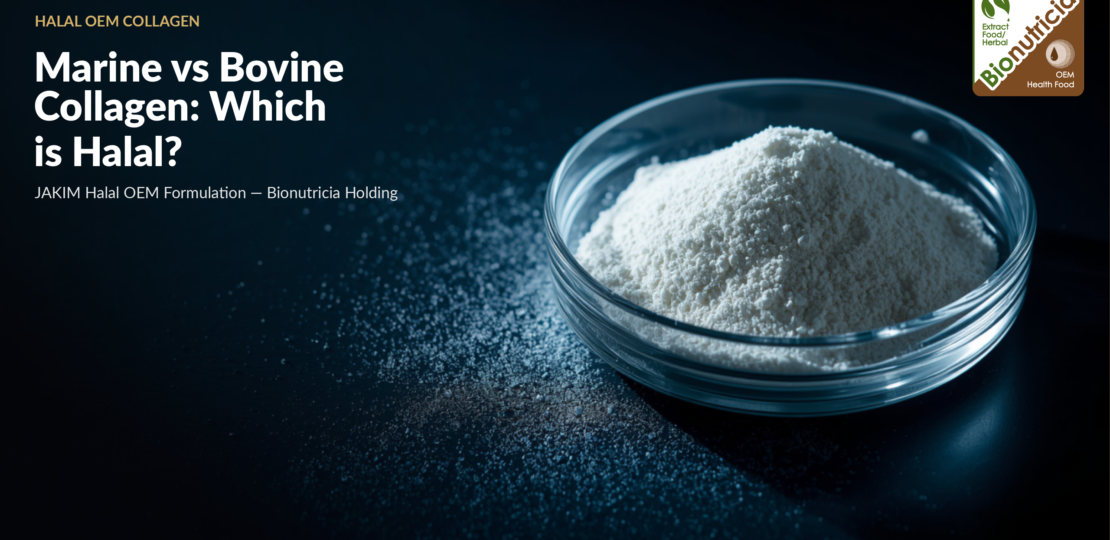
Direct answer: Marine collagen is the halal-by-default choice: fish does not require zabiha slaughter under any of the four Sunni madhhabs, so a marine-origin collagen peptide carries no inherent halal risk beyond standard facility hygiene and cross-contact control. Bovine collagen can also be halal — but only if the cattle are zabiha-slaughtered by a certified abattoir and the hide/bone-to-peptide supply chain is documented end to end; a large share of bovine collagen sold globally comes from conventional (non-zabiha) slaughter and is not automatically halal just because the animal itself is a halal species. On bioavailability, the deciding factor is not the originating animal but the degree of hydrolysis: peptides need to be broken down to roughly 2,000–5,000 daltons (Da) to absorb efficiently, and a well-hydrolyzed bovine collagen at ~2,000 Da will out-perform a poorly hydrolyzed marine collagen at 5,000+ Da. Marine collagen supplies almost exclusively Type I (skin, hair, nail, bone-matrix positioning); bovine collagen can supply Type I and III (skin/vascular) from hide, or Type II (joint and cartilage) from bovine cartilage — a functional profile marine collagen does not cover. Verdict: for a halal-first brand with no existing supplier relationship, marine collagen is the lower-compliance-risk default; bovine collagen remains a sound choice — often the only choice for joint-health (Type II) positioning — provided you can obtain a documented zabiha-slaughter and halal chain-of-custody certificate from your raw-material supplier. Bionutricia’s OEM team formulates and fills either peptide into finished, JAKIM halal-certified SKUs at its Sungai Buloh facility.
Why halal status is automatic for one origin and conditional for the other
This is the question that should be settled before any spec sheet gets written, because it changes the entire supplier-qualification process.
Marine collagen: halal by default. Fish and other aquatic animals are considered halal without a specific slaughter method under Hanafi, Shafi’i, Maliki and Hanbali jurisprudence — there is no zabiha requirement for fish. Collagen extracted from fish skin, scales or bones therefore carries no inherent halal risk from the raw material itself. The remaining diligence is standard food-safety and facility hygiene: confirming the processing line has no cross-contact with non-halal ingredients, and that any processing aids (enzymes, carriers) are themselves halal-certified.
Bovine collagen: halal only with zabiha certification. Cattle are a halal species, but the hide and bone that collagen is extracted from are only halal if the animal was zabiha-slaughtered — a Muslim slaughterer invoking the name of Allah, with a swift cut to the throat, windpipe and blood vessels. Much of the bovine collagen made for the global nutraceutical market comes from conventional Western abattoirs that do not follow zabiha procedure, and is not halal regardless of how the finished powder is marketed. A halal-compliant bovine collagen needs a documented certificate from a recognised halal body (JAKIM, IFANCA, MUI or equivalent) covering the slaughter itself, not just the finishing plant.
The bigger risk: cross-contamination, not the cattle themselves. Bovine and porcine collagen/gelatin are frequently processed on shared rendering and hydrolysis lines, because the chemistry is nearly identical. A bovine collagen batch run on shared equipment carries contamination risk even if the cattle were zabiha-slaughtered. So the real supplier-qualification question is not just “was this zabiha slaughtered” but “is this line ever exposed to porcine material” — ask for a segregated-line declaration, not just a slaughter certificate.
Molecular weight and bioavailability: the spec that actually matters
Marketing copy frequently implies that marine collagen is inherently more bioavailable than bovine. The evidence is more nuanced, and the nuance matters for anyone writing an OEM brief.
Hydrolyzed collagen peptides absorb efficiently once broken down to roughly 2,000–5,000 daltons; unhydrolyzed collagen (hundreds of thousands of daltons) is not meaningfully absorbed intact. Marine collagen is frequently hydrolyzed to a smaller average peptide size — commercial marine peptide powders are commonly marketed in the 2,000–3,000 Da range — which is where the “marine absorbs faster” claim originates. But degree of hydrolysis is a manufacturing choice, not an inherent property of the originating animal: a bovine collagen hydrolyzed to 2,000 Da performs comparably to, or better than, a marine collagen only hydrolyzed to 5,000+ Da. The practical takeaway: specify and verify molecular weight distribution on the CoA rather than treating “marine” or “bovine” as a bioavailability proxy.
both origins also share a broadly similar amino acid backbone — high in glycine, proline and hydroxyproline — though exact ratios vary by species and tissue of origin. Neither has a categorical amino-acid advantage large enough to be the deciding factor on its own.
Collagen type: the functional difference that does matter
Where origin genuinely changes the functional profile is collagen type, and this is often a more decisive factor than bioavailability marketing:
- Type I — skin, hair, nail, bone-matrix support. Available from both marine (fish skin/scale) and bovine (hide) origins. This is the type most “beauty-from-within” SKUs are built around, and either origin formulates well here.
- Type III — skin elasticity and vascular support, usually paired with Type I. Predominantly a bovine-hide profile; marine collagen is overwhelmingly Type I with comparatively little Type III.
- Type II — joint cartilage support, including undenatured Type II (UC-II) positioning. This is a bovine (or chicken sternal cartilage) profile. Marine collagen does not meaningfully supply Type II, so a joint-health SKU brief is, in practice, a bovine-origin decision.
So the origin decision should follow the positioning, not the other way around: a beauty/skin SKU can credibly use either origin; a joint-health SKU needs bovine (or a non-collagen joint active) because marine collagen does not deliver the Type II profile the claim depends on.
Fish broth vs standardized marine collagen peptide
Fish bone broth — long-simmered fish bones, skin and connective tissue — is the traditional, whole-food route to Type I marine collagen, and it is halal on the same basis as any other marine collagen: fish requires no zabiha slaughter. It carries a “clean-label,” minimally processed appeal that resonates with some beauty-from-within and gut-health audiences, and it is where marine collagen entered the diet long before spray-dried peptide powders existed.
For OEM purposes, however, broth is not a substitute for a standardized hydrolyzed collagen peptide. Collagen content in a simmered broth varies with bone-to-water ratio, simmer time and fish species, and cannot be declared on a label as a fixed mg-per-serving dose the way a spray-dried or liquid-concentrate peptide can — there is no CoA-verifiable molecular weight or protein-content figure behind an unstandardized stock. A brand that wants the savoury “broth” positioning while still making a verifiable collagen claim typically starts from a standardized hydrolyzed marine collagen peptide and formulates it into a broth-style liquid or bouillon-style powder sachet, rather than relying on simmered stock as the finished product. Bionutricia’s formulation team can build this: standardized marine collagen peptide as the actives base, with natural broth flavour, salt and aromatics, giving the sensory profile of a bone broth with a CoA-verified collagen dose behind it.
Specification: what to put on the CoA requirement
Whichever origin is chosen, specify all of the following:
Identity & origin
- Species and tissue of origin stated (e.g. tilapia skin, cod skin, bovine hide, bovine cartilage)
- For bovine: documented zabiha-slaughter halal certificate from the abattoir, plus a segregated-processing-line declaration confirming no porcine cross-contact
- Collagen type (I, II or III) and, where relevant, undenatured status
Molecular characterisation
- Average molecular weight / molecular weight distribution (Da) — target 2,000–5,000 Da for absorption-relevant hydrolyzed peptide
- Protein content: typically ≥90% (dry basis) for a hydrolyzed collagen peptide powder
- Amino acid profile including glycine, proline and hydroxyproline content
Physical parameters
- Appearance: free-flowing, near-white to off-white powder (colour/odour vary slightly by origin and tissue)
- Moisture: ≤8.0%
- Solubility: complete solubility in cold water is the practical usability test for beverage formats
Microbiological limits
- Total plate count: ≤10,000 CFU/g
- Yeast and mould: ≤1,000 CFU/g
- E. coli, Salmonella spp., S. aureus: absent/25g
Heavy metals
- Lead (Pb) ≤2.0 ppm · Cadmium (Cd) ≤1.0 ppm · Mercury (Hg) ≤0.1 ppm · Arsenic (As) ≤1.5 ppm
Allergen declaration
- Marine collagen: declare fish as an allergen on the finished-product label
- Bovine collagen: no standard allergen declaration is required, but the bovine origin itself should be stated for religious and dietary-preference labelling
Formats Bionutricia manufactures with collagen actives
Bionutricia’s OEM team formulates and fills marine- or bovine-origin collagen peptide — whether nominated by the brand or supplied through a JAKIM halal-certified raw-material partner — into finished SKUs at the Sungai Buloh facility, in the approved format set:
Powder sachet (single-serve): the most common collagen format — hydrolyzed collagen blended with vitamin C, hyaluronic acid or botanical actives, dissolved in water or a beverage of choice.
Liquid sachet: pre-dissolved single-serve “beauty shot,” popular for marine collagen given its faster-dissolving reputation and premium positioning.
Pouch beverage: larger-volume ready-to-drink collagen beverage for retail or café channels, often layered with fruit flavour or functional botanicals such as roselle or butterfly pea for taste and clean-label colour.
Liquid bottle: glass or PET collagen tonic or wellness shot, typically the premium-tier SKU in a beauty-from-within range.
Chewable tablet: a lower-dose maintenance/travel format, usually paired with a core sachet or liquid range rather than used as the primary high-dose SKU.
Why an integrated, JAKIM-certified OEM matters specifically for collagen
Animal-derived actives carry a halal-integrity risk that plant-derived botanicals do not: the biggest failure point is usually an undocumented or contaminated point upstream in the raw-material supply chain, not the finished-product formulation. Bionutricia’s Sungai Buloh facility operates under FSSC 22000, GMP, HACCP, JAKIM halal, US FDA and MeSTI certification, with JAKIM halal coverage extending through the finished-product line. For a collagen SKU, that means the brand’s halal claim rests on a certified, auditable chain — from raw-material intake (zabiha or fish-origin documentation reviewed at the door) through to the finished, labelled sachet, beverage or bottle — rather than a raw-material certificate trusted in isolation.
📚 Related guides
- Collagen & Beauty-from-Within OEM: Marine Collagen, Formats & Halal
- The Complete Guide to Halal Supplement OEM in Malaysia (2026): Certification, Capacity, and Choosing the Right Manufacturer
- Powder Supplement vs Liquid Supplement: Which Format for Your Active?
Frequently asked questions
Is marine collagen always halal and bovine collagen always haram?
Not quite — marine collagen is halal by default because fish does not require zabiha slaughter, so it carries minimal inherent halal risk. Bovine collagen is not automatically haram, but it is only halal if the cattle were zabiha-slaughtered and the supply chain is certified end to end; a bovine collagen without documented zabiha certification should be treated as non-halal regardless of how it is marketed.
Which is more bioavailable, marine or bovine collagen?
Neither origin has an inherent bioavailability advantage. What determines absorption is the degree of hydrolysis — peptides broken down to roughly 2,000–5,000 daltons absorb efficiently regardless of origin. A well-hydrolyzed bovine collagen can out-perform a poorly hydrolyzed marine collagen. Specify and verify molecular weight on the CoA rather than relying on origin alone.
Can marine collagen support joint health the way bovine collagen (Type II) does?
No. Marine collagen is overwhelmingly Type I, which supports skin, hair, nail and bone-matrix positioning. Type II collagen, used for joint and cartilage support (including undenatured Type II/UC-II claims), is a bovine or chicken-cartilage profile that marine origins do not meaningfully supply. A joint-health SKU brief should be built around bovine Type II, not marine collagen.
What halal documentation should I request from a bovine collagen supplier?
Ask for a recognised halal certificate (JAKIM, IFANCA, MUI or equivalent) that specifically covers the zabiha slaughter of the origin cattle, plus a segregated-processing-line declaration confirming the hydrolysis line has no cross-contact with porcine material. A finishing-plant halal certificate alone, without slaughter-level documentation, is not sufficient.
Does Bionutricia extract collagen in-house?
Bionutricia’s core in-house extraction capability covers botanical actives. For collagen, Bionutricia’s OEM team formulates and fills marine- or bovine-origin hydrolyzed collagen peptide — brand-nominated or supplied through a JAKIM halal-certified raw-material partner — into the finished SKU at the Sungai Buloh facility, keeping the certification chain intact from raw-material intake to finished, labelled product.
Ready to develop a collagen SKU?
JAKIM halal-certified formulation and filling for marine- or bovine-origin collagen, in powder-sachet, liquid-sachet, pouch-beverage, liquid-bottle and chewable-tablet formats. Full CoA and halal chain-of-custody review, and a free formulation consultation.
Request a quotation · See our OEM services · View our certifications
WhatsApp: +60 16-661 8510
Article by Bionutricia R&D Team. Last updated: July 19, 2026.
RELATED POSTS
View all

Halal-Certified vs Halal-Friendly Supplement OEM: What’s the Real Difference?
August 23, 2026 | by supersuper
Standardised Extract vs Whole-Herb Powder: What’s the Difference for OEM?
July 16, 2026 | by supersuper
Co-Packing vs Full-Service OEM: What’s the Difference for a Growing Brand?
September 3, 2026 | by supersuper