

Powder Supplement vs Liquid Supplement: Which Format for Your Active?
July 6, 2026 | by supersuper
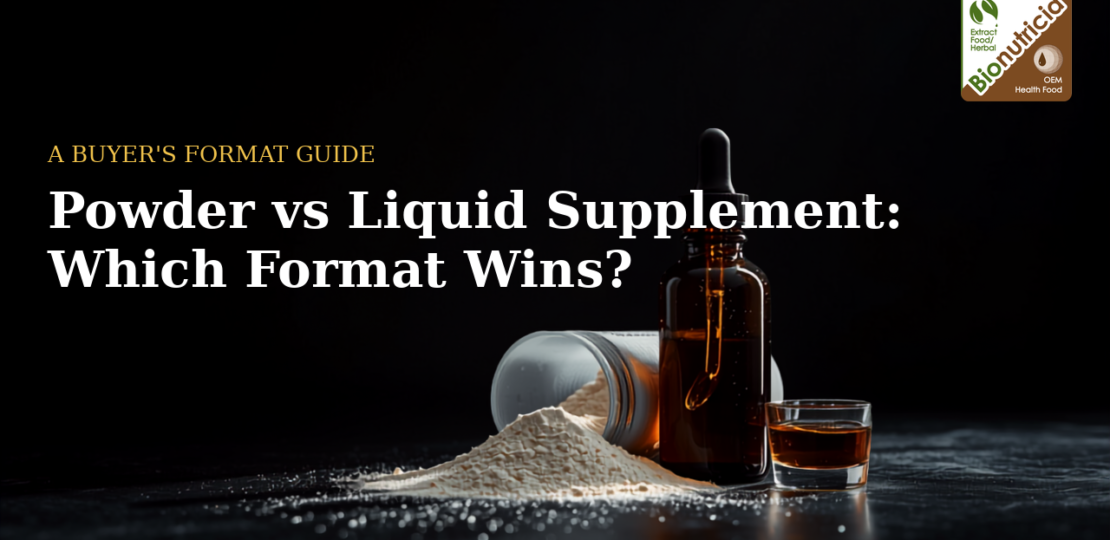
Direct answer: Choose powder when your active is moisture-sensitive, needs a long ambient shelf life, or is dosed at a high gram-weight (protein, collagen, most botanical extracts, mineral blends); choose liquid when your active needs fast absorption, easy swallowing for seniors or children, or a beverage-style consumer experience (electrolytes, liposomal vitamins, tonics, functional drinks). The deciding factors are moisture sensitivity, dose size, and how the consumer will use the product — not which format “sounds premium.” Powder sachets are the most cost-stable, longest-shelf-life format and the easiest to export in bulk brand-partner volumes; liquid sachets, pouch beverages and liquid bottles carry a shorter shelf life and usually need a preservative or acid system, but suit actives that work better pre-dissolved and formats built around a ready-to-drink positioning. Chewable tablets and gel sachets sit in between — solid enough for stability, but formulated for an easier consumer experience than a powder that must be mixed. Bionutricia manufactures all of these formats — powder sachets, liquid sachets, gel sachets, pouch beverages, chewable tablets and liquid bottles — under one JAKIM-halal, FSSC 22000 and GMP-certified roof, so the honest answer to “which format” starts with your active’s chemistry, not a marketing preference.
Why this question comes up on almost every OEM brief
Brand owners often arrive at a manufacturer with the format already decided — usually because a competitor uses it, or because “liquid feels more premium.” That’s the wrong starting point. Format should be a downstream decision made after you know three things about your active: its moisture and oxygen sensitivity, its effective dose weight, and how your target consumer will realistically take it. Get the format wrong and you inherit problems that no amount of flavour-masking or packaging design can fix — a moisture-sensitive botanical that clumps and degrades in a liquid suspension, or a high-dose mineral blend that would require an unreasonably large liquid sachet to deliver a meaningful dose.
When powder is the better format
Powder is the default format for actives that are chemically unstable in water, dosed in gram quantities, or destined for long-distance export where ambient shelf life matters more than sipping convenience.
Moisture and oxidation sensitivity
Many standardised botanical extracts, plant proteins and certain vitamin forms degrade faster in an aqueous environment than in a dry, low-water-activity powder. Keeping water activity below roughly 0.6 in a finished powder sachet meaningfully slows both microbial growth and oxidative degradation of sensitive actives, which is why most botanical-extract-forward supplements ship as powder rather than pre-dissolved liquid.
High-dose actives
Collagen, plant protein blends, and full-dose mineral or electrolyte systems are often dosed at several grams per serving. Delivering that weight in a liquid sachet or bottle would mean either a large-volume format or a very concentrated (and often less palatable) liquid. A powder sachet mixed into water at point of use lets the brand deliver a full-weight dose without shipping the water itself — a meaningful advantage for export freight economics.
Shelf life and export logistics
A well-formulated powder sachet with a moisture-barrier laminate typically holds an 18–24 month ambient shelf life, no cold chain required. For brand partners exporting from Malaysia to the Middle East, Europe or North America, that ambient stability is often the deciding factor over any other formulation consideration.
Formats: powder sachets and chewable tablets
Bionutricia produces powder sachets (single-serve, 5–20g fill typical) for instant-mix drinks, premix blends and daily-dose sachets, and chewable tablets for actives that suit a solid, no-mixing-required format — particularly useful for on-the-go dosing, paediatric-adjacent (adult) formats, and brands positioning around convenience rather than a beverage ritual.
When liquid is the better format
Liquid formats earn their place when the active benefits from being pre-dissolved, when the consumer experience calls for a beverage rather than a mix-it-yourself ritual, or when the brand’s positioning is built around hydration or a functional-drink category.
Faster perceived absorption and easier intake
A pre-dissolved liquid active reaches the gut without needing to first dissolve in the stomach, which is one reason liposomal and other enhanced-delivery actives are frequently formulated as liquid sachets or bottles. Liquid formats are also the practical choice for consumers who have difficulty swallowing solids — seniors, or anyone who prefers not to mix a powder.
Beverage-style consumer experience
Pouch beverages and liquid bottles let a brand compete in the ready-to-drink and functional-beverage category directly — grab-and-go at convenience retail, gym, or café channels — rather than asking the consumer to prepare anything. This is a positioning decision as much as a technical one: if the brand story is “hydration” or “on-the-go wellness,” a pre-made liquid usually outperforms a powder that requires mixing.
Trade-offs to plan for
Liquid formats generally carry a shorter shelf life than powder — commonly 6–12 months, longer with an appropriate acid or preservative system, shorter still if the brand wants a “clean” preservative-free label. Liquid formats also cost more to freight per dose (you’re shipping the water), and flavour-masking is harder in an aqueous system than in a dry powder blend. None of these are disqualifying — they’re planning inputs that should shape which actives you put into a liquid SKU.
Formats: liquid sachets, liquid bottles, pouch beverages and gel sachets
Bionutricia manufactures liquid sachets (single-serve shots, 10–50ml typical), liquid bottles (100–250ml wellness shots and tonics), pouch beverages (200–500ml for retail and HORECA), and gel sachets for actives that suit a texture between a liquid and a powder — useful for viscosity-dependent sensory positioning or actives that are more stable in a gel matrix than a thin liquid.
What to specify regardless of which format you choose
Whichever format you land on, the same baseline quality checks apply to a finished OEM batch: microbial limits (total plate count typically ≤10,000 CFU/g, yeast and mould ≤1,000 CFU/g, pathogens absent per Malaysian Food Act and standard botanical-extract convention), heavy-metal limits (lead, cadmium, mercury and arsenic within recognised botanical-extract thresholds), and a stated shelf-life claim backed by real-time or accelerated stability data rather than an assumed number. Ask your manufacturer for the stability dossier before committing to a format — a powder claim of 24 months and a liquid claim of 12 months should both be backed by data, not marketing copy.
A simple decision framework
As a starting heuristic: standardised botanical extracts, plant proteins, collagen, and mineral or electrolyte blends default to powder sachets or chewable tablets. Liposomal vitamin systems, hydration and electrolyte-forward positioning, and any SKU built around a ready-to-drink consumer experience default to liquid sachets, liquid bottles or pouch beverages. Actives needing a texture-forward sensory profile, or a stability compromise between the two, suit gel sachets. If your active could reasonably go either way, let the consumer use-case decide: a daily at-home ritual favours powder; an on-the-go or beverage-category product favours liquid.
How Bionutricia supports the decision
Because Bionutricia manufactures all six approved OEM formats — powder sachets, liquid sachets, gel sachets, pouch beverages, chewable tablets and liquid bottles — under one FSSC 22000, GMP, HACCP, JAKIM Halal, US FDA and MeSTI-certified facility in Sungai Buloh, brand owners get a format recommendation based on the active’s actual chemistry and the brand’s real freight and shelf-life needs, rather than being steered toward whichever single format a narrower manufacturer happens to offer. The R&D team runs a short compatibility check on the active before recommending a format, and can produce a small-batch trial in either powder or liquid so the brand can compare stability and consumer experience side by side before committing.
📚 Related guides
- Phytosome vs Liposomal Delivery: Which Absorption Tech Wins for Botanicals?
- Functional Beverage OEM for Convenience Retail: Shelf-Life, Pricing & Co-Packing
- Supplement OEM for Sports & Gym Brands: Formats, Actives & Speed-to-Market
Frequently asked questions
Is powder or liquid better for a botanical extract supplement?
Powder is usually the better default. Most standardised botanical extracts are more stable at low water activity, so a powder sachet holds potency for longer than the same extract pre-dissolved in a liquid. Liquid can still work well if the brand’s positioning specifically calls for a ready-to-drink experience — the trade-off is a shorter shelf life and a need for an acid or preservative system.
Does liquid format mean faster absorption?
Pre-dissolved actives skip the dissolution step the body would otherwise need to perform, which is one reason enhanced-delivery systems like liposomal vitamins are frequently formulated as liquids. That said, absorption also depends on the active itself and the delivery technology used, not the liquid format alone.
What shelf life should I expect from each format?
A well-formulated powder sachet with a moisture-barrier laminate typically holds 18–24 months ambient. Liquid sachets, bottles and pouch beverages typically hold 6–12 months, depending on the acid or preservative system and whether the brand wants a preservative-free label. Always ask for the real stability data behind any shelf-life claim.
Can I launch the same active in both powder and liquid?
Yes — many brand partners run a powder sachet SKU for the at-home daily-ritual customer and a liquid or pouch-beverage SKU for the on-the-go or retail-channel customer, using the same core active at a format-appropriate dose. Bionutricia can develop both from a single formulation brief.
Are all these formats halal certified?
Yes. Bionutricia’s Sungai Buloh facility carries JAKIM Halal certification at the facility level, which covers powder sachets, liquid sachets, gel sachets, pouch beverages, chewable tablets and liquid bottles produced there, alongside FSSC 22000, GMP, HACCP, US FDA registration and MeSTI.
Ready to choose the right format for your active?
Bionutricia manufactures powder sachets, liquid sachets, gel sachets, pouch beverages, chewable tablets and liquid bottles under one JAKIM-halal, FSSC 22000 and GMP-certified roof in Sungai Buloh, Malaysia. Share your active and target market and the R&D team will recommend a format backed by real stability data.
Request a quotation · See our OEM services · View our certifications · WhatsApp +60 16-661 8510
Article by Bionutricia R&D Team. Last updated: July 6, 2026.
RELATED POSTS
View all

Co-Packing vs Full-Service OEM: What’s the Difference for a Growing Brand?
September 3, 2026 | by supersuper
Malaysia vs Thailand for Supplement OEM: Halal, Cost & Capability
August 2, 2026 | by supersuper
Single-Herb vs Multi-Herb Blend Formulation: Which Is Right for Your OEM Brand?
August 2, 2026 | by supersuper