

Pouch Beverage vs Bottled Liquid Supplement: Which Format for Your Brand?
August 18, 2026 | by supersuper
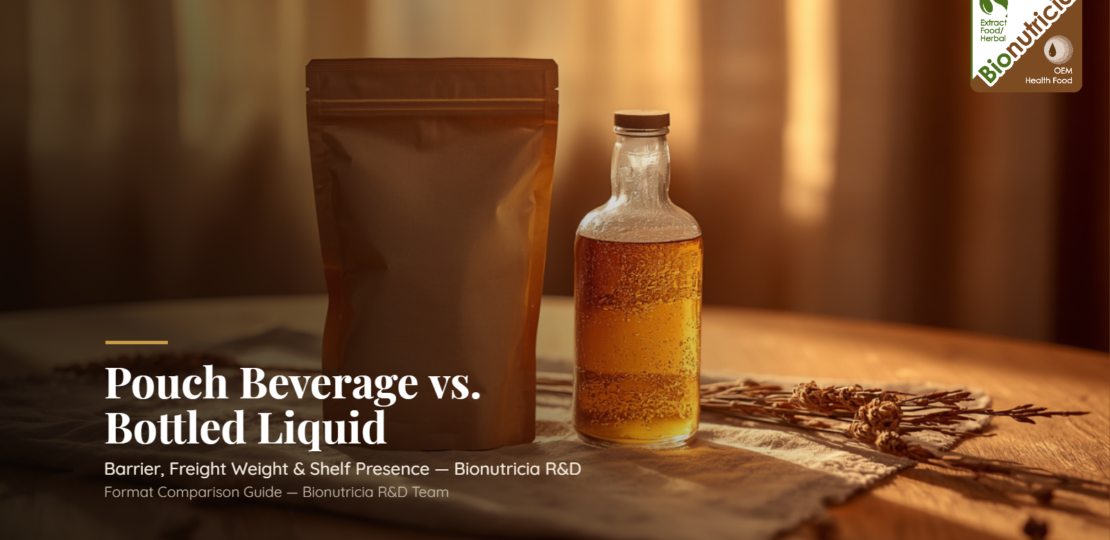
Direct answer: Choose a pouch beverage (sometimes called a pouch sachet) when shipping weight, freight efficiency and an on-the-go convenience cue matter most to your brand; choose a bottled liquid — glass or PET — when premium shelf presence, a see-through “look at the product” cue, or a multi-serve pour ritual matter more. Both are approved Bionutricia OEM formats, both can be JAKIM halal-certified and FSSC 22000-manufactured, and both can carry the same active-ingredient system — this is a packaging-and-positioning decision, not a formulation one. Pouch beverages (typically 200–500ml, foil-laminate barrier) weigh a fraction of an equivalent glass bottle, reduce carton cube for the same fill volume, and travel well for e-commerce and subscription-box brands where freight weight and breakage risk are the real drivers. Bottled liquids (100–250ml, glass or PET) hold their shape on a retail shelf, photograph well for social content, and read as premium to a shopper picking up a wellness shot — a cue a flexible pouch cannot fully replicate. Many brands that scale end up running both: a pouch SKU for DTC/subscription and a bottle SKU for retail, produced from the same base formulation under one roof.
Pouch Beverage vs Bottled Liquid: What Actually Differs
The two formats deliver the same category of product — a ready-to-drink or single-serve functional beverage — through very different packaging physics. A pouch beverage is a flexible, multi-layer laminate structure, usually stand-up or flat-format, filled and sealed under aseptic or retort conditions. A bottled liquid is a rigid container — glass or PET — filled, capped and, depending on the formulation’s pH and preservative system, either hot-filled or aseptically filled. The formulation inside can be identical; what changes is barrier performance, weight, shelf behaviour and the story the format tells a shopper before they’ve read a single word of copy.
Barrier Protection: Which Format Protects Sensitive Actives Better
Pouch laminate structures
Most beverage pouches use a three- or four-layer laminate — commonly PET (outer, print surface), aluminium foil or metallised film (barrier layer), and PE or PP (inner sealant layer). The foil or metallised layer gives near-total oxygen and light exclusion, which matters for actives that degrade under light or oxidation, such as anthocyanin-rich botanicals, vitamin C systems and many polyphenol extracts. A correctly structured pouch can hold ambient shelf stability comparable to a canned beverage without the weight of a can.
Glass vs PET bottles
Glass is functionally impermeable to oxygen and moisture, making it the strongest single-material barrier of the three options — but clear glass transmits light freely, so light-sensitive actives need amber or tinted glass, or a secondary carton sleeve. PET is lightweight and shatter-resistant, but has materially higher oxygen transmission than glass or foil laminate; PET-bottled actives that oxidise easily typically need an oxygen scavenger, a nitrogen flush at fill, or a shorter stated shelf life to compensate. A brand formulating an oxygen-sensitive active should ask its OEM for the transmission-rate spec of whichever bottle resin is proposed, rather than assume “bottle” automatically means “protected.”
Weight, Freight and Landed Efficiency
Packaging weight is one of the largest hidden variables in a beverage SKU, and it is where the two formats diverge most. A filled glass bottle can weigh several times more than an equivalent-volume pouch once the container itself is counted, which raises freight weight, carton count per pallet, and breakage risk in transit — all real considerations for brands shipping direct-to-consumer or exporting by sea or air. PET narrows that gap versus glass but still weighs more than flexible laminate film. Pouches, by contrast, are largely product weight with a thin film shell, so more finished units fit within the same shipping volume and pallet weight limit. For a brand whose primary channel is e-commerce, subscription or export, that difference compounds across every shipment.
Recyclability and Sustainability Positioning
Glass is the most straightforwardly recyclable of the three options — it can be recycled indefinitely without losing material quality, provided local collection infrastructure exists. PET bottles are also widely recyclable through standard kerbside and industrial PET streams in most markets. Multi-layer foil-laminate pouches are harder to recycle because the barrier layer is bonded to plastic film rather than being a separable material; some packaging suppliers now offer mono-material recyclable pouch laminates that trade a small amount of barrier performance for recyclability, which is worth raising with your OEM if sustainability claims are part of the brand story. None of the three formats is automatically the “greener” choice — the honest comparison is materials-and-infrastructure-specific, and a brand making an on-pack recyclability claim should verify it against the exact laminate or resin used, not the format category in general.
Brand Positioning: Convenience vs Shelf Presence
Format is also a positioning signal before a shopper reads any copy. A pouch reads as convenient, portable and casual — it suits gym bags, desks, on-the-go hydration, and subscription-box unboxing where the product needs to survive a mailbox drop. A bottle, particularly glass, reads as considered and premium — it suits a retail shelf, a pharmacy counter, a spa or clinic dispensing environment, or a gifting programme where the unboxing moment is part of the product experience. Neither cue is inherently better; the right one depends on where and how the customer actually encounters the product. A brand unsure which signal fits should look at where its closest retail or e-commerce comparison sits, not at which format looks more premium in isolation.
Which Format Fits Which Sales Channel
The channel a SKU is built for is usually the fastest way to settle the format question:
| Primary channel | Format that usually fits best | Why |
|---|---|---|
| E-commerce / DTC / subscription box | Pouch beverage | Lower shipping weight, no glass breakage risk in transit, fits standard mailer dimensions |
| Retail shelf / pharmacy / health store | Bottled liquid (glass or PET) | Stands upright unaided, higher shelf-facing visibility, reads as premium next to competitor SKUs |
| Gym, HORECA counter, on-the-go retail | Pouch beverage or small PET bottle | Grab-and-go format, lower unit weight for display refrigeration or ambient racks |
| Corporate gifting / clinic dispensing | Bottled liquid (glass) | Unboxing and presentation carry weight in a gifted or practitioner-dispensed product |
A Five-Question Decision Framework
- Is the active oxygen- or light-sensitive? If yes, a foil-laminate pouch or amber glass outperforms clear PET.
- Where does the customer receive the product? Mailbox and courier delivery favour a pouch; a retail shelf favours a bottle.
- What does the unboxing moment need to communicate? Premium or gifting positioning favours glass; convenience favours a pouch.
- What is the realistic fill volume per serving? Single-serve 100–250ml sits comfortably in either format; larger 300–500ml RTD volumes lean toward a pouch for weight reasons.
- Does the brand plan to run more than one channel? If retail and DTC are both on the roadmap, plan for two SKUs on the same base formulation rather than forcing one format to do both jobs.
Formats Bionutricia Manufactures
Bionutricia produces both formats under one roof at its Sungai Buloh facility, alongside the rest of its approved OEM range: powder sachets, liquid sachets, gel sachets, pouch beverages (200–500ml), chewable tablets, and liquid bottles (100–250ml, glass or PET). Running both formats through the same facility means a brand testing a pouch SKU for DTC and a bottle SKU for retail can do so from one formulation, one CoA chain, and one JAKIM halal certification, rather than qualifying two separate manufacturing partners.
📚 Related guides
- Powder Supplement vs Liquid Supplement: Which Format for Your Active?
- How Packaging Affects Supplement Shelf Life
Frequently Asked Questions
Should my functional beverage be a pouch sachet or a bottled liquid?
Base it on your primary channel and how oxygen- or light-sensitive your active is. E-commerce and subscription brands typically do better with a pouch beverage because of shipping weight and breakage risk; retail and gifting-led brands typically do better with a bottled liquid for shelf presence. Both formats can carry the same formulation, so the decision is about packaging and channel fit, not about what the active requires.
Which format has better barrier protection — pouch or bottle?
It depends on the specific structure, not the format category. A foil-laminate pouch and amber glass both give strong oxygen and light protection; clear PET gives the weakest barrier of the common options unless paired with an oxygen scavenger or nitrogen flush. Ask your OEM for the transmission-rate spec of the exact laminate or resin proposed rather than assuming.
Is a pouch beverage lighter to ship than a bottled liquid?
Yes, generally. A filled pouch is mostly product weight with a thin film shell, while a glass or PET bottle adds the container’s own weight to every unit shipped. For freight-sensitive channels like export or DTC courier delivery, that difference affects freight weight and carton count per pallet.
Can the same formulation go into both a pouch and a bottle?
In most cases, yes — the active system and base formulation don’t need to change between formats. What does need re-checking is the barrier requirement (whether the active is oxygen- or light-sensitive enough to need the pouch’s foil layer or amber glass) and the fill process (retort or aseptic pouch fill vs hot-fill or aseptic bottle fill), which your OEM’s R&D team should confirm before scaling a second format.
Are pouch beverages recyclable?
It depends on the laminate structure. Standard multi-layer foil-laminate pouches are harder to recycle than glass or PET because the barrier layer is bonded to plastic film. Mono-material recyclable pouch laminates exist and trade some barrier performance for recyclability — worth specifying explicitly if an on-pack recyclability claim is part of the brand story, rather than assuming the format is automatically recyclable.
Ready to Develop Your Beverage Format?
Bionutricia manufactures both pouch beverages and liquid bottles — plus powder, liquid and gel sachets and chewable tablets — under FSSC 22000, GMP, HACCP and JAKIM halal certification at one integrated facility. Free formulation consultation and a fast RFQ turnaround.
Request a quotation · See our OEM services · View our certifications
WhatsApp: +60 16-661 8510
Article by Bionutricia R&D Team — reviewed for accuracy by Bionutricia’s in-house registered pharmacist, nutritionist, dietitian and PhD biomedical scientist. Last updated: August 11, 2026.
RELATED POSTS
View all

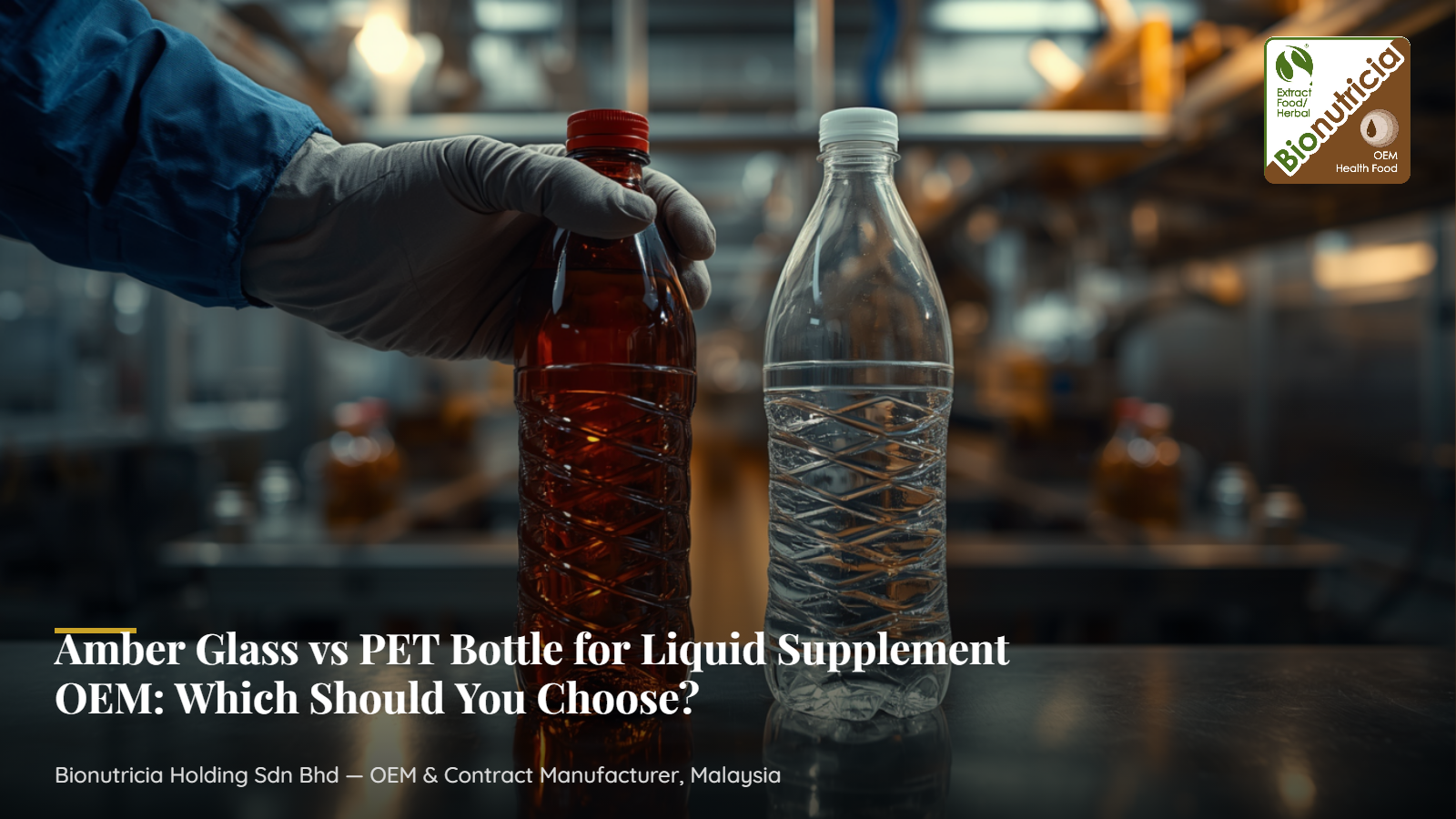
Amber Glass vs PET Bottle for Liquid Supplement OEM: Which Should You Choose?
September 15, 2026 | by supersuper
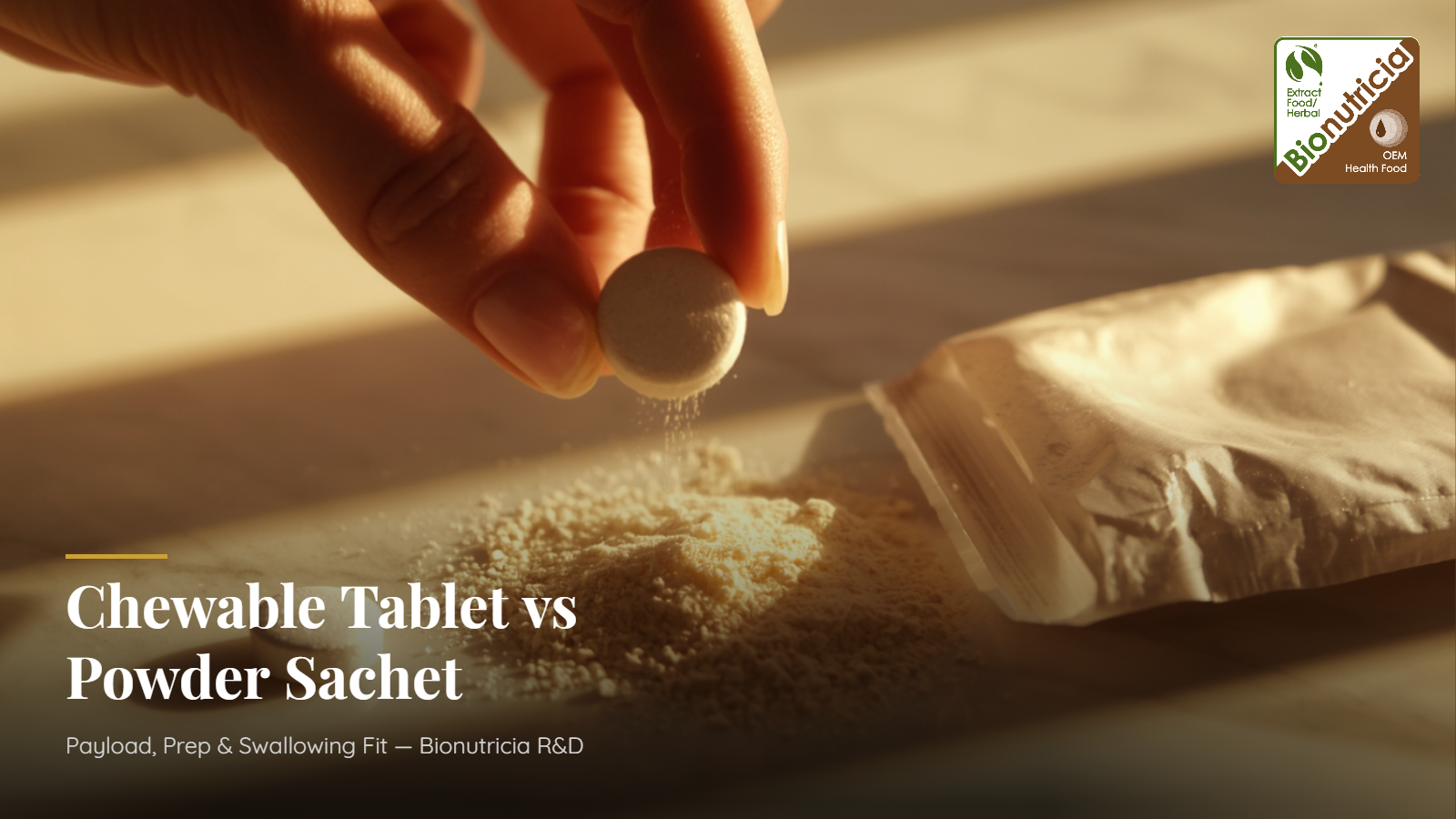
Chewable Tablet vs Powder Sachet: Which Format Fits Kids, Seniors & On-the-Go Brands?
August 13, 2026 | by supersuper
Malaysia vs Vietnam vs Indonesia for Supplement OEM: Cost, Speed & Quality Trade-Offs
June 30, 2026 | by supersuper