

Amber Glass vs PET Bottle for Liquid Supplement OEM: Which Should You Choose?
September 15, 2026 | by supersuper
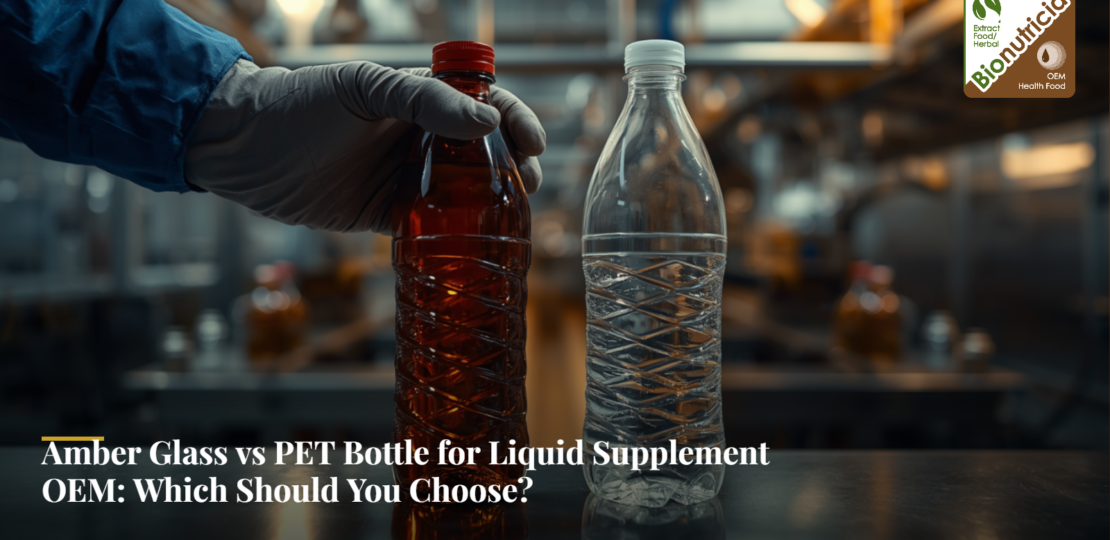
Direct answer: Choose amber glass when your formulation contains light- or oxygen-sensitive actives — vitamin C systems, many botanical extracts, polyphenols, probiotics, and most vitamins and minerals — and your brand’s positioning depends on a premium, considered shelf presence; amber glass filters out more than 90% of UV wavelengths and is functionally impermeable to oxygen and moisture, making it the strongest single-material barrier available for a liquid supplement bottle. Choose PET when your formulation is chemically stable under normal light and oxygen exposure and your priority is shipping weight, breakage risk, and landed cost across export or e-commerce channels — PET weighs a fraction of glass, will not shatter in transit, and is widely recyclable through standard kerbside and industrial PET streams. Both are approved Bionutricia OEM liquid-bottle formats (100–250ml), both can be JAKIM halal-certified and FSSC 22000-manufactured, and both can carry the same active-ingredient system — this is a packaging-and-stability decision, not a formulation one. The practical answer for most brands: ask your OEM for the oxygen-transmission-rate (OTR) sensitivity of the specific actives before choosing on price or aesthetics alone.
Why This Decision Comes Up in Every Liquid-Bottle Brief
Almost every brand briefing a liquid supplement — a tonic, a wellness shot, a liquid vitamin or mineral system — eventually asks the same question: glass or plastic? The question gets asked late more often than it should, usually after a formulation is already finalised and a launch timeline is already set, which is the wrong order. Bottle material is not a cosmetic finishing choice; it is a stability variable that determines whether the formulation inside actually holds its potency for the shelf-life claim printed on the label. Settling amber glass versus PET at the same time as the formulation brief — not after — avoids discovering a stability problem once packaging is already tooled and ordered.
Amber Glass vs PET: What Actually Differs
The two materials are not interchangeable variations on the same container — they differ across nearly every property that matters for a liquid supplement: barrier performance, weight, breakage behaviour, cost profile, and the shelf-presence signal each sends before a buyer reads a single word of copy.
| Property | Amber Glass | PET |
|---|---|---|
| UV / light barrier | Blocks 90%+ of UV wavelengths | Clear PET transmits light freely; UV protection needs an opaque or tinted resin |
| Oxygen barrier | Functionally impermeable | Materially higher oxygen transmission rate (OTR) than glass |
| Moisture barrier | Impermeable | Very good, though marginally more permeable than glass |
| Weight (filled bottle) | Several times heavier than an equivalent PET bottle | A fraction of glass’s weight |
| Breakage risk in transit | Real risk; needs protective secondary packaging | Shatter-resistant |
| Recyclability | Infinitely recyclable without quality loss, where collection infrastructure exists | Widely recyclable through standard kerbside and industrial PET streams |
| Shelf perception | Reads as premium, considered, pharmacy-grade | Reads as practical, accessible, everyday |
Light & Oxygen Protection: Why Amber Glass Is the Gold Standard for Sensitive Actives
Two variables drive most liquid-formulation degradation: how much light reaches the product, and how much oxygen reaches it. Amber glass addresses both by default — the tint itself blocks the UV and visible-light wavelengths that break down photosensitive compounds, while the glass wall is functionally impermeable to oxygen regardless of tint. Clear PET transmits light freely, so a light-sensitive active packed in clear PET needs a secondary carton sleeve or an opaque/tinted resin to get equivalent protection. PET also has a materially higher oxygen transmission rate than glass; formulations with oxygen-sensitive actives — vitamin C, many polyphenol and botanical extract systems, some B-vitamins — packed in standard PET typically need an oxygen scavenger, a nitrogen flush at fill, or a shorter stated shelf life to compensate. Neither workaround is a defect, but both are added cost and complexity that amber glass avoids structurally. A brand should ask its OEM for the specific transmission-rate spec of whichever resin is proposed, rather than assume “bottle” automatically means “protected.”
PET’s Real Advantages: Weight, Breakage Risk and Freight Economics
Packaging weight is one of the largest hidden cost variables in a liquid SKU, and it is where PET wins decisively. A filled glass bottle can weigh several times more than an equivalent-volume PET bottle once the container itself is counted, which raises freight weight, carton count per pallet, and breakage risk in transit — all real considerations for brands exporting by sea or air, or shipping direct-to-consumer through courier networks. PET will not shatter or crack during filling, transit, or on a retail shelf if knocked, which reduces product loss and the customer-service cost of damaged-in-transit claims. For a brand whose primary channel is e-commerce, subscription, or export to markets with long transit times, PET’s durability and lighter freight profile compound into a meaningfully lower landed cost per unit than an equivalent glass SKU.
Recyclability and Sustainability Positioning
Glass is the most straightforwardly recyclable of the two materials — it can be recycled indefinitely without losing material quality, provided local collection infrastructure exists. PET is also widely recyclable through standard kerbside and industrial PET recycling streams in most markets, and its lighter weight reduces shipping-related carbon footprint per unit shipped. Neither material is automatically the “greener” choice in every market: the honest comparison depends on local collection and recycling infrastructure, not the material category in the abstract. A brand making an on-pack recyclability or sustainability claim should verify it against the exact resin or glass composition used and the collection reality of its actual sales markets, rather than asserting a blanket claim based on material type alone.
Brand Positioning: Premium Shelf Presence vs Practical Scale
Bottle material is also a positioning signal before a shopper reads any copy. Amber glass reads as considered, pharmaceutical-grade, and premium — it suits a retail shelf next to established wellness brands, a pharmacy counter, a spa or clinic dispensing environment, or a gifting programme where the unboxing moment carries part of the product’s perceived value. PET reads as practical and accessible — it suits high-volume, everyday-use SKUs, gym and on-the-go retail, and e-commerce channels where a shopper never handles the physical bottle before purchase. Neither signal is inherently better; the right one depends on where and how the customer actually encounters the product, and on whether the formulation’s sensitivity even allows a PET option in the first place.
Which Bottle Fits Which Scenario
| Scenario | Bottle that usually fits | Why |
|---|---|---|
| Light- or oxygen-sensitive active (vitamin C, polyphenols, probiotics) | Amber glass | Structural UV and oxygen barrier without added scavengers or nitrogen flush |
| High-volume, everyday-use SKU on a cost target | PET | Lower per-unit material cost and freight weight at scale |
| Export or long-transit e-commerce/DTC channel | PET | Shatter-resistant, lighter freight weight, lower breakage-related product loss |
| Premium retail, pharmacy, spa, or gifting positioning | Amber glass | Considered, pharmacy-grade unboxing and shelf presence |
| Stable formulation, no light/oxygen sensitivity, cost-priority | PET | No barrier advantage is being paid for; PET delivers equivalent protection at lower cost and weight |
A Four-Question Decision Framework
- Is the active light- or oxygen-sensitive? If yes, amber glass gives structural protection without added scavengers or shortened shelf-life claims.
- What is the primary sales channel and positioning? Retail, pharmacy, and gifting favour glass; e-commerce, export, and high-volume everyday use favour PET.
- What does breakage risk actually cost in your supply chain? Long transit times, courier handling, or fragile-freight surcharges make PET’s durability a real cost saving, not just a convenience.
- Does your sustainability claim depend on the material itself? Verify recyclability claims against the specific resin or glass composition and your actual sales-market collection infrastructure before printing a claim on the label.
Formats Bionutricia Manufactures
Bionutricia produces liquid bottles (100–250ml, amber glass or PET) under one roof at its Sungai Buloh facility, alongside the rest of its approved OEM range: powder sachets, liquid sachets, gel sachets, pouch beverages (200–500ml), and chewable tablets. Running both bottle materials through the same facility means a brand can trial an amber-glass SKU for a premium retail line and a PET SKU for an e-commerce line from one formulation, one CoA chain, and one JAKIM halal certification, rather than qualifying two separate manufacturing partners. Bionutricia does not manufacture capsules, softgels, gummies, hard tablets, or effervescent tablets in either material.
📚 Related guides
- Pouch Beverage vs Bottled Liquid Supplement: Which Format for Your Brand?
- How Packaging Affects Supplement Shelf Life: Barrier Properties, Format Choices & What Extends (or Shortens) Your Expiry Date
- Powder Sachet vs Liquid Sachet vs Pouch Beverage vs Liquid Bottle: Which Format Wins for Your Supplement Category?
Frequently Asked Questions
Should my liquid supplement bottle be amber glass or PET, and why?
Base it on the formulation’s sensitivity and your channel. If the active is light- or oxygen-sensitive, amber glass gives structural protection without added scavengers or a shortened shelf-life claim. If the formulation is stable and your priority is freight weight, breakage risk, or cost at scale, PET delivers equivalent food-safety performance at a lower landed cost.
Does PET protect light-sensitive actives as well as amber glass?
Not in its standard clear form. Clear PET transmits light freely, so a light-sensitive active needs an opaque or tinted resin, or a secondary carton sleeve, to approach amber glass’s structural UV protection. Ask your OEM for the transmission-rate spec of the exact resin proposed rather than assuming.
Is amber glass or PET better for export shipping?
PET, in most cases. A filled glass bottle weighs several times more than an equivalent PET bottle, which raises freight weight and breakage risk across long transit times and multiple handling points. Brands exporting by sea or air, or shipping DTC through courier networks, typically see a materially lower landed cost per unit with PET.
Can the same formulation go into either amber glass or PET?
In most cases, yes — the active system and base formulation don’t need to change between materials. What does need re-checking is the barrier requirement: an oxygen- or light-sensitive active moving from amber glass into PET may need an oxygen scavenger, a nitrogen flush at fill, or a revised shelf-life claim, which your OEM’s R&D team should confirm before switching materials.
Is amber glass or PET more sustainable?
It depends on your market’s recycling infrastructure, not the material category alone. Glass is infinitely recyclable without quality loss where collection systems exist; PET is widely recyclable through standard kerbside and industrial streams and is lighter to ship, reducing transport-related emissions per unit. Verify any on-pack recyclability claim against the exact material used and your actual sales-market infrastructure.
Ready to specify your liquid-bottle packaging?
Bionutricia manufactures liquid bottles in both amber glass and PET (100–250ml), alongside powder, liquid and gel sachets, pouch beverages, and chewable tablets — all under FSSC 22000, GMP, HACCP, JAKIM halal, US FDA and MeSTI certification at one integrated Sungai Buloh facility. Free formulation consultation and a fast RFQ turnaround.
Request a quotation · See our OEM services · View our certifications
WhatsApp: +60 16-661 8510
Article by Bionutricia R&D Team — reviewed for accuracy by Bionutricia’s in-house registered pharmacist, nutritionist, dietitian and PhD biomedical scientist. Last updated: September 15, 2026.
RELATED POSTS
View all

OEM vs White-Label vs Private Label: Supplement Terms Explained
August 2, 2026 | by supersuper
Standardised Extract vs Whole-Herb Powder: What’s the Difference for OEM?
July 16, 2026 | by supersuper
Halal-Certified vs Halal-Friendly Supplement OEM: What’s the Real Difference?
August 23, 2026 | by supersuper