

Standardised Extract vs Whole-Herb Powder: What’s the Difference for OEM?
July 16, 2026 | by supersuper
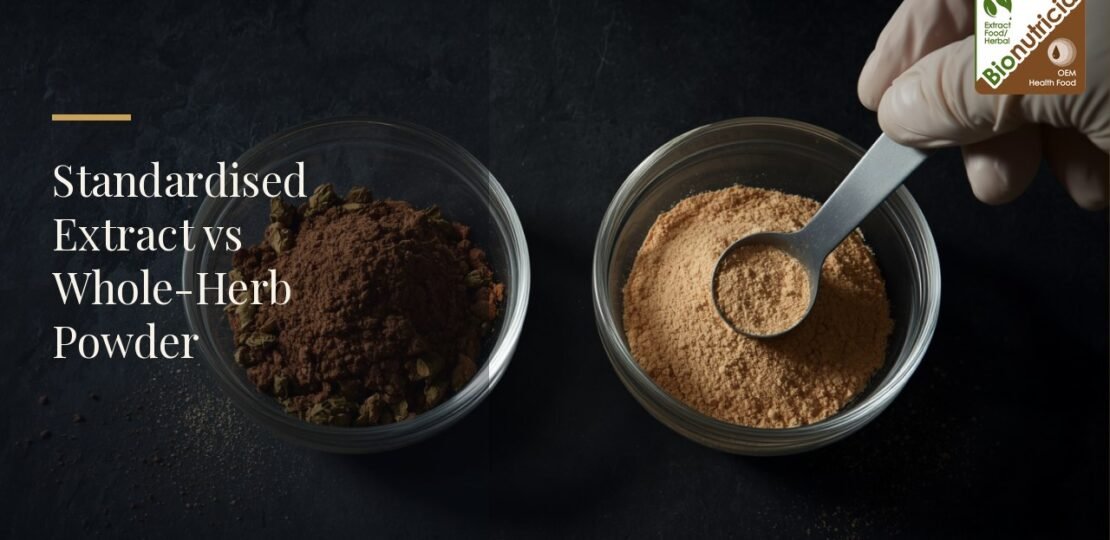
Direct answer: A standardised extract is botanical material processed and concentrated so a named marker compound (or group of compounds) is guaranteed to a specific percentage on every batch, verified by an assay on the Certificate of Analysis — for example, a Centella asiatica extract standardised to a defined triterpene content. A whole-herb powder is simply the raw plant material dried and ground, with no concentration step and no guaranteed actives percentage; its composition reflects natural agricultural variation from harvest to harvest. For OEM purposes, the difference matters most at the label and formulation stage: a standardised extract lets a brand make a specific, defensible potency claim and dose consistently batch to batch, while a whole-herb powder supports a “whole food” or traditional-use positioning but cannot carry a precise actives claim without its own assay. Bionutricia produces both — contract extraction to a standardised marker (in standard and phytosome form) for potency-driven SKUs, and whole-herb powder processing for brands building a clean-label, minimally processed story — filled into powder sachets, liquid sachets, gel sachets, pouch beverages, chewable tablets or liquid bottles depending on the format.
What Is a Standardised Extract?
A standardised extract starts as raw botanical material and goes through an extraction process — at Bionutricia, this includes a patented enzymatic ultrasonic extraction process (MY-188945-A) — that concentrates the compounds of interest and removes bulk plant fibre and inert material. The result is calibrated, usually by dilution with a carrier or by blending extraction batches, so that a named marker compound sits at or above a specified percentage. That percentage is verified on every production lot by an analytical assay (commonly HPLC, UV-spectrophotometry, or a compound-specific method depending on the marker) and reported on the Certificate of Analysis.
The marker compound is a proxy for the extract’s active or characteristic chemistry, not necessarily the only compound that matters biologically, but it’s the number a formulator, buyer, or regulator can independently verify. This is what allows a brand to write a specific claim on packaging — “standardised to X% [compound]” — and defend it if challenged, because the assay result is documented and traceable to the batch in the finished product.
What Is a Whole-Herb Powder?
A whole-herb powder is the plant material — root, leaf, fruit, or calyx depending on the botanical — dried and milled to a target particle size, with no concentration or extraction step. Nothing is removed and nothing is concentrated; the powder is chemically representative of the raw agricultural material, which means its actives content varies with growing conditions, harvest timing, soil, and post-harvest handling, the same way the vitamin content of an orange varies from tree to tree and season to season.
This isn’t a quality defect — it’s simply a different kind of product. Whole-herb powder retains the full spectrum of compounds naturally present in the plant, including fibre and co-occurring phytochemicals that an extraction process would remove, and it supports a “minimally processed” or traditional-preparation positioning that some brands specifically want. What it cannot do is carry a precise, batch-verified potency claim, because there is no standardisation step locking the actives content to a number.
Key Differences Buyers Should Understand
- Potency consistency. A standardised extract delivers the same marker-compound percentage batch after batch, within assay tolerance. A whole-herb powder’s actives content shifts with each raw-material harvest, even when the botanical identity and grade are identical.
- Label claims. A standardised extract supports a specific, quantified claim (“standardised to X%”) because the number is assay-verified. A whole-herb powder supports qualitative or traditional-use claims but not a specific potency number, unless the brand commissions its own batch-by-batch assay — which adds cost and doesn’t change the underlying natural variability.
- Dose-to-effect reliability. Formulations built around a specific physiological target usually need standardisation, so the finished SKU delivers a consistent dose of the marker compound regardless of which raw-material lot went into that batch.
- Cost. Standardisation adds processing steps — extraction, concentration, assay verification — so a standardised extract typically costs more per kilogram than whole-herb powder of the same botanical. Route exact pricing to a formal quotation.
- Positioning and clean-label appeal. Whole-herb powder often suits brands emphasising “whole food,” minimal processing, or traditional preparation methods, where the absence of an extraction step is itself part of the story.
- Traceability documentation. Both forms should carry a CoA, but a standardised extract’s CoA includes a marker-compound assay result; a whole-herb powder’s CoA typically covers identity, microbial limits, and heavy metals without an actives percentage, unless specifically commissioned.
When to Choose a Standardised Extract
Standardised extract is the right choice when a brand needs to make a specific, defensible potency claim on packaging or marketing material; when the formulation targets a specific physiological outcome that depends on a minimum dose of the marker compound; when batch-to-batch consistency matters for a subscription or repeat-purchase product where customers expect the same experience every reorder; or when the destination market’s regulatory framework expects a quantified actives statement to support the product’s claims.
When to Choose a Whole-Herb Powder
Whole-herb powder fits a brand building around “whole food,” traditional-preparation, or minimally processed positioning; a formulation where the co-occurring compounds naturally present in the plant (not just the extractable marker) are part of the intended profile; or a lower price-point SKU where the cost of standardisation isn’t justified by the brand’s claims strategy. It’s also a reasonable starting point for brands still validating product-market fit before committing to the higher per-kilogram cost of a standardised extract.
Format Considerations at Bionutricia
Both standardised extract and whole-herb powder can be filled into Bionutricia’s approved OEM formats — powder sachets, liquid sachets, gel sachets, pouch beverages, chewable tablets, and liquid bottles. Bionutricia does not manufacture capsules, softgels, gummies, or hard tablets, so a brand building a brief around either raw-material type should confirm the target format is on this list before finalising formulation. Powder sachets are the most common vehicle for both forms; liquid sachets and pouch beverages usually call for a standardised, more soluble extract rather than a whole-herb powder, which can leave sediment in a liquid format unless specifically processed for solubility.
What to Put in Your OEM Brief
When briefing an OEM on either material, specify: the botanical name and plant part; whether the brief calls for standardisation (and to what marker, at what percentage) or whole-herb processing; the assay method expected on the CoA; microbial and heavy-metal limits; and the target format, since format affects whether a standardised extract, a whole-herb powder, or a blend of both makes the most technical sense. A capable OEM should be able to explain the trade-off for your specific botanical and formulation goal rather than defaulting to whichever material is easier to origin.
Related guides
- How to Read a Supplement Certificate of Analysis (CoA): A Buyer’s Guide
- Phytosome vs Liposomal Delivery: Which Absorption Tech Wins for Botanicals?
Frequently asked questions
What’s the difference between a standardised extract and a whole-herb powder?
A standardised extract is concentrated and assay-verified so a named marker compound is guaranteed to a specific percentage on every batch. A whole-herb powder is dried, ground raw plant material with no concentration step, so its actives content varies naturally with each harvest.
Which one should I choose for my supplement SKU?
Choose a standardised extract if you need a specific, defensible potency claim or a formulation that targets a minimum dose of an active compound. Choose whole-herb powder if your brand is built around minimal processing, whole-food positioning, or traditional preparation, and you don’t need a quantified potency claim.
Is whole-herb powder lower quality than a standardised extract?
No — they’re different products for different purposes. Whole-herb powder retains the full natural compound profile of the plant, while a standardised extract concentrates a specific marker for consistency and claims support. Neither is inherently better; the right choice depends on the formulation goal.
Can Bionutricia supply both forms for the same botanical?
Yes, for many botanicals Bionutricia can supply both standardised extract (standard or phytosome form) and whole-herb powder, and can advise on which fits a specific formulation and claims strategy during formulation consultation.
Does a whole-herb powder still need a Certificate of Analysis?
Yes. Every batch should carry a CoA covering botanical identity, microbial limits, and heavy metals at minimum. A specific actives-percentage assay is not standard for whole-herb powder unless a brand commissions it, since the material isn’t standardised to a marker compound.
Ready to choose the right raw-material format for your SKU?
Vertically integrated OEM manufacturing under FSSC 22000, GMP, HACCP, JAKIM Halal, US FDA and MeSTI certification, with both standardised extract and whole-herb powder processing available. Free formulation consultation and a fast RFQ turnaround.
Request a quotation · See our OEM services · View our certifications
WhatsApp: +60 16-661 8510
Article by Bionutricia R&D Team. Last updated: July 16, 2026.
RELATED POSTS
View all

OEM vs In-House Supplement Manufacturing: The Real 3-Year Decision Framework (Beyond Gross Margin)
June 10, 2026 | by supersuper
In-House Formula Development vs Ready-to-Manufacture OEM Formulas: Which Is Right for Your Brand?
August 23, 2026 | by supersuper
Pouch Beverage vs Bottled Liquid Supplement: Which Format for Your Brand?
August 18, 2026 | by supersuper