

Roselle + Collagen Peptides in a Herbosomal® Liquid Sachet: How a Malaysian Beauty Brand Uses Liposomal OEM to Outprice a Standard Antioxidant Drink
October 2, 2026 | by supersuper
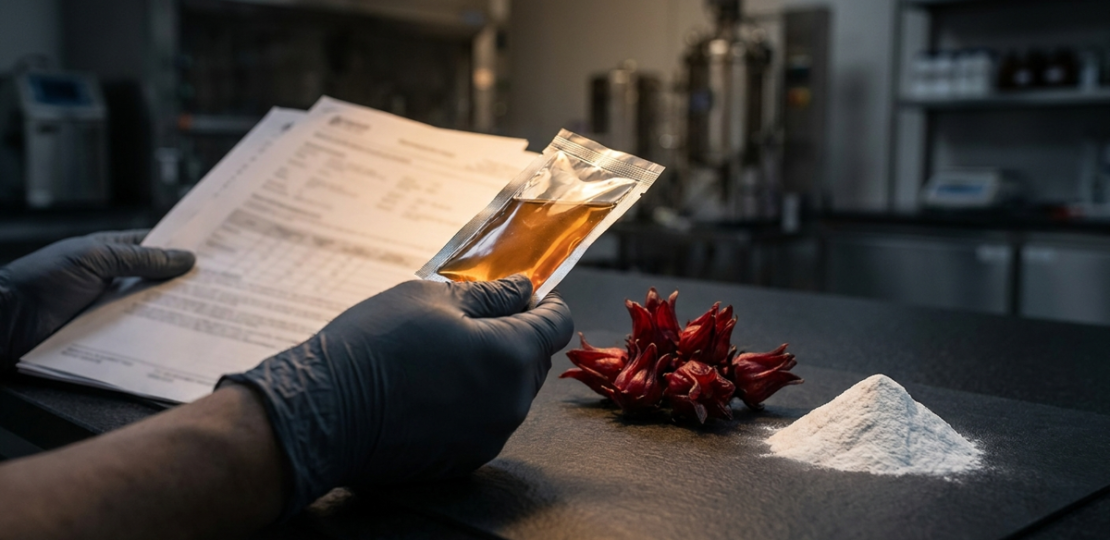
Direct answer: A Malaysian beauty brand uses a Herbosomal® liposomal liquid sachet combining roselle + collagen peptides to outprice a standard antioxidant drink by positioning the liposomal format as a premium delivery technology. The commercial premium comes from the encapsulation process itself — phospholipid carriers, NanoVerify-validated particle size, and a differentiated format that a standard drink cannot match. The brand prices the technology, not just the ingredients.
The beauty supplement market in Malaysia is crowded with standard antioxidant drinks — roselle-based beverages, collagen waters, and fruit-infused functional drinks sold on ingredient content alone. A brand owner who commissions a Herbosomal® liposomal liquid sachet is not competing on the same axis. The liposomal encapsulation process creates a product that is structurally different from a standard drink, and that structural difference is the basis for a premium price point.
This guide explains how a Malaysian beauty brand uses the Herbosomal® liposomal format to differentiate a roselle + collagen peptides product from a standard antioxidant drink, and what the brand owner needs to decide before commissioning the formulation.
What Makes a Herbosomal® Liquid Sachet Different from a Standard Drink
A standard antioxidant drink is a simple liquid formulation — the actives are dissolved or suspended in water, with flavourings, preservatives, and packaging that are functionally identical to any bottled beverage. The active compounds are unprotected in the liquid matrix.
A Herbosomal® liquid sachet is structurally different. Herbosomal® — Bionutricia’s proprietary liposomal encapsulation and sustained-release technology (registered trademark; patent-pending PI2023005773) — pairs the actives with phospholipid carriers, creating a liposomal suspension in a liquid sachet format. The phospholipids form microscopic vesicles around the active compounds, and the particle size is verified by dynamic light scattering (DLS), a measurement technique that confirms the liposomal structure is present in the finished product.
The difference is verifiable: a standard drink has no particle-size data because there is nothing to measure. A Herbosomal® product carries DLS data showing the liposomal particle distribution. This is the technical basis for the commercial premium.
Roselle (Hibiscus sabdariffa): Composition and Standardisation
Roselle calyx is the raw material for the botanical fraction of this formulation. The key compositional markers are the anthocyanins delphinidin-3-sambubioside and cyanidin-3-sambubioside, which give roselle its deep red colour. The extract is typically standardised using the AOAC 2005.02 pH-differential method, which quantifies total anthocyanin content expressed as cyanidin-3-glucoside equivalents.
For a Herbosomal® formulation, the roselle extract is processed into the liposomal suspension alongside the collagen peptides. The anthocyanin content is the standardisation marker that the brand owner specifies on the CoA, and the extraction process uses patented enzymatic ultrasonic extraction (MY-188945-A) to release the anthocyanins from the roselle calyx matrix.
Anthocyanins are sensitive to heat, light, and pH. In a standard drink, they degrade over the shelf life, and the deep red colour fades. In a Herbosomal® liquid sachet, the liposomal encapsulation creates a protective environment that helps preserve the anthocyanin content over the product’s shelf life. The brand owner should request stability data showing anthocyanin retention at the end of the claimed shelf life.
Collagen Peptides: Composition and Halal Chain
Collagen peptides are the protein fraction of this formulation. For a halal beauty product, marine collagen is the preferred origin because it does not require slaughter certification. The specification should include the molecular weight range (typically below 3,000 Da), the protein content (usually above 90% on a dry basis), and the hydroxyproline content as an identity marker.
In a Herbosomal® liquid sachet, the collagen peptides are paired with the phospholipid carriers alongside the roselle extract. The halal documentation chain must cover the collagen raw material, the phospholipids (typically soy-derived or sunflower-derived lecithin), and every excipient in the formulation.
The Commercial Premium: How a Beauty Brand Prices the Technology
The commercial argument for a Herbosomal® liquid sachet over a standard antioxidant drink rests on three pillars:
| Factor | Standard Antioxidant Drink | Herbosomal® Liquid Sachet |
|---|---|---|
| Delivery technology | None — dissolved actives in water | Liposomal encapsulation with phospholipid carriers |
| Verification | No particle-size data | DLS particle-size verification, NanoVerify validation |
| Format | Bottle or pouch — commodity format | Liquid sachet — single-serve, premium format |
| Shelf positioning | Mass-market antioxidant drink | Premium beauty supplement with encapsulation technology |
A brand owner selling a standard roselle drink competes on price, volume, and ingredient content. A brand owner selling a Herbosomal® roselle + collagen peptides liquid sachet competes on technology, format, and differentiation. The price ceiling is higher because the product is not a commodity — it carries a verified technological feature that a standard drink does not have.
The brand owner’s pricing strategy should reflect this. A Herbosomal® liquid sachet is not priced as a beverage — it is priced as a premium beauty supplement. The per-unit cost is higher than a standard drink (the phospholipid carriers, the DLS verification, and the sachet format all add cost), but the retail price can be set at a premium that more than covers the additional cost.
What a Beauty Brand Needs to Decide Before Commissioning
Before requesting a quotation, a beauty brand owner should decide:
- Target price point: What retail price will the product carry, and does the margin support the Herbosomal® production cost?
- Shelf-life requirement: What shelf life does the retail channel demand, and does the liposomal formulation meet it?
- Anthocyanin specification: What total anthocyanin content (by AOAC 2005.02) should the roselle extract carry, and what is the acceptable range on the CoA?
- Collagen specification: What molecular weight range and protein content should the collagen peptides meet, and is the origin marine (halal by default) or bovine (requires zabiha certification)?
- Phospholipid origin: Soy-derived or sunflower-derived lecithin — both are halal, but the choice affects the allergen label
- Flavour system: Roselle is tart; the flavour system must complement the tartness without masking the product’s identity
- Packaging: Liquid sachet size, material, and artwork — the sachet is the consumer’s first interaction with the premium positioning
Manufacturing a Roselle + Collagen Peptides Herbosomal® Liquid Sachet Under Your Own Brand
Bionutricia offers OEM and ODM manufacturing for brand owners and distributors commissioning a roselle + collagen peptides Herbosomal® liquid sachet under their own label. The approved formats for this formulation include liquid sachets and liquid bottles. The integrated facility in Sungai Buloh, Selangor, operates under JAKIM halal certification alongside FSSC 22000, GMP, HACCP, US FDA registration, and MeSTI, with NanoVerify validation for liposomal processes. Herbosomal® — Bionutricia’s proprietary liposomal encapsulation and sustained-release technology (registered trademark; patent-pending PI2023005773) — is available for this formulation. Patented enzymatic ultrasonic extraction (MY-188945-A) is used for the roselle extract. Formulation development, private-label manufacturing, and packaging are handled in-house. The in-house authority team — a registered pharmacist, a nutritionist, a dietitian, and a PhD biomedical scientist — reviews the formulation and stability data before production begins. To request a quotation, submit an enquiry through our website at our enquiries page or email ng@bio-nutricia.com.
Frequently Asked Questions
What makes a Herbosomal® liquid sachet worth more than a standard roselle drink?
The value difference is the delivery technology. A standard roselle drink dissolves the actives in water with no protective structure. A Herbosomal® liquid sachet encapsulates the actives in phospholipid vesicles, and the liposomal structure is verified by DLS particle-size measurement. The brand is selling a verified technological feature — not just an ingredient list — and that feature supports a premium price point.
How does a beauty brand verify that the liposomal structure is real?
The manufacturer should provide DLS (dynamic light scattering) data showing the particle-size distribution of the liposomal vesicles in the finished product. NanoVerify validation confirms that the manufacturing process produces particles in the nano range. A brand owner should request this data as part of the CoA or technical dossier, not as a separate marketing claim.
Can I use the same roselle extract in both a standard drink and a Herbosomal® sachet?
The roselle extract specification (anthocyanin content, extract ratio, CoA parameters) can be the same, but the formulation process differs. In a standard drink, the extract is simply dissolved. In a Herbosomal® sachet, the extract is processed into the liposomal suspension with phospholipid carriers. The manufacturer will develop separate stability protocols for each format, and the Herbosomal® version requires additional processing steps and verification.
What phospholipid options are available, and do they affect the halal status?
Soy-derived lecithin and sunflower-derived lecithin are the two common phospholipid options. Both are plant-derived and halal-compliant. Soy lecithin is more common and less expensive, but it carries an allergen label. Sunflower lecithin avoids the soy allergen and is preferred for brands targeting the clean-label beauty market. The brand owner should specify the phospholipid origin in the formulation brief.
Does the Herbosomal® process affect the anthocyanin content of the roselle extract?
The Herbosomal® process encapsulates the roselle extract within phospholipid vesicles, which creates a protective environment for the anthocyanins. The brand owner should request stability data showing anthocyanin retention (measured by AOAC 2005.02) at the end of the claimed shelf life for both the Herbosomal® formulation and a comparable standard formulation, so the comparison is data-driven rather than assumed.
Related Guides
- Roselle (Hibiscus) Extract: Standardised Anthocyanin Content
- Liposomal Supplement OEM: What Brand Owners Should Know
- Powder Sachet vs Liquid Sachet vs Pouch Beverage vs Liquid Bottle
Article by Bionutricia R&D Team. Last updated: 2 October 2026.
RELATED POSTS
View all

What is liposomal encapsulation and why is it used in premium supplements?
May 26, 2026 | by supersuper

Ashwagandha (Withania somnifera) for Stress Resilience: Evidence Review & OEM Options
September 24, 2026 | by supersuper
Shan Yao (Chinese Yam) Extract for Functional Beverages – OEM Guide
September 24, 2026 | by supersuper