

Chinese Yam (Dioscorea polystachya) + Papaya Chewable Tablet OEM: Standardising Diosgenin and Papain Assay Markers for Batch Consistency
October 5, 2026 | by supersuper
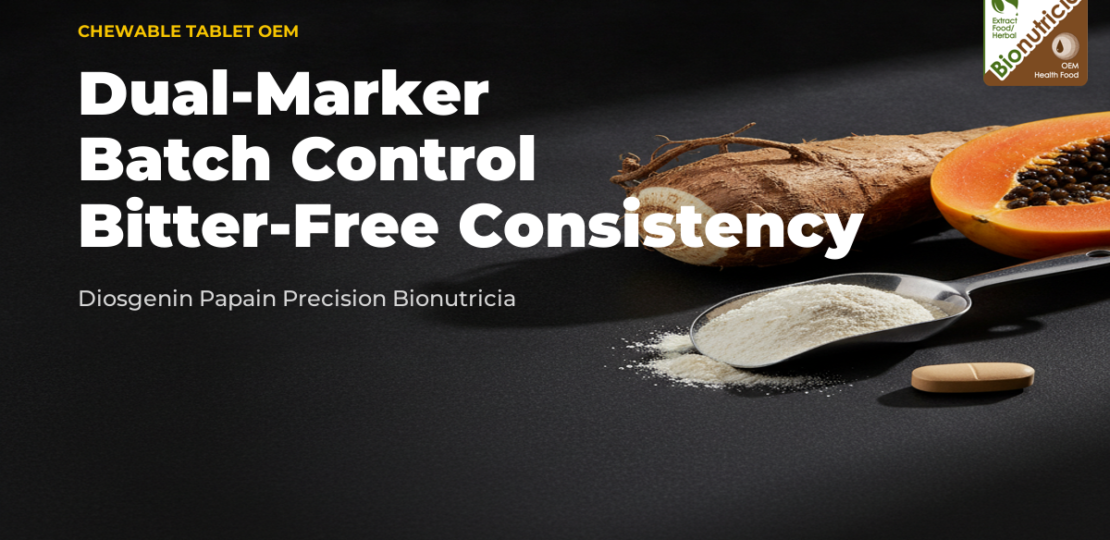
Direct answer: A brand owner standardising diosgenin and papain assay markers in a Chinese yam + papaya chewable tablet must specify the diosgenin content in the Dioscorea polystachya extract, the papain activity (FCC PU/g or U/g) in the Carica papaya extract, and require a dual-marker CoA for every batch. The patented enzymatic ultrasonic extraction (MY-188945-A) produces the consistent extract fractions that make batch-to-batch assay comparison meaningful.
Without dual-marker standardisation, a chewable tablet combining two botanical extracts will vary in composition from batch to batch, making it impossible to maintain a consistent label claim. The assay marker is the anchor that ties the raw extract to the finished tablet.
Diosgenin as a Marker Compound in Chinese Yam Extract
Chinese yam (Dioscorea polystachya), known in traditional Chinese food culture as Shan Yao (山药), is a climbing tuber crop long valued in East-Asian cuisine. Bionutricia’s Chinese yam extract is a 100:1 concentrate of the tuber, supplied as a water-soluble, off-white powder. The specification lists the constituent as a phytonutrient concentrate, with the following CoA parameters:
| Parameter | Specification |
|---|---|
| Botanical origin / part | Dioscorea polystachya, tuber |
| Extraction ratio | 100:1 |
| Appearance / colour | Fine powder, off-white |
| pH | 4–6 |
| Moisture | < 10% |
| Solubility | Soluble in water |
| Dosage | 200–500 mg |
| Heavy metals | As ≤ 0.1 ppm, Pb ≤ 0.2 ppm, Hg ≤ 0.1 ppm |
| Microbial | APC ≤ 10⁴ cfu/g, Y&M ≤ 10³ cfu/g, coliforms ≤ 10² cfu/g, E. coli absent |
| Shelf life | 24 months sealed, cool and dry |
Diosgenin is a steroidal saponin found across Dioscorea species and is the compound most commonly used as a quantitative marker for Chinese yam extract. A brand owner commissioning a chewable tablet should specify the diosgenin assay percentage on the technical specification and require it to appear on every CoA. Where the extract is supplied as a phytonutrient concentrate without a stated diosgenin percentage, the brand owner should request that the laboratory quantify it using a validated HPLC method and agree the acceptance range before production begins.
The patented enzymatic ultrasonic extraction (MY-188945-A) is the process that produces the extract fraction. Because the extraction conditions are controlled and repeatable, the diosgenin content in the resulting powder is consistent from lot to lot — which is what makes a dual-marker CoA meaningful. Without a controlled extraction process, assay variation between batches would be too wide for a label claim to hold.
Papain Assay Standardisation in Papaya Extract
Papain is a proteolytic enzyme derived from the latex of Carica papaya. In the papaya extract specification on file at Bionutricia, papain is listed as the active compound in a 100:1 extract of papaya leaf, with a pH of 6–8, moisture of 2–8%, and a particle size of >85% through 60 mesh. Heavy-metal limits are As ≤ 1 ppm, Pb ≤ 2 ppm, Cd ≤ 1 ppm, Hg ≤ 0.05 ppm. Microbial limits are APC ≤ 10⁴ cfu/g, Y&M ≤ 10³ cfu/g, coliforms ≤ 10² cfu/g, E. coli absent.
For a chewable tablet, papain activity must be expressed in a unit that the release laboratory can verify. FCC PU/g (Food Chemicals Codex papain units per gram) is the unit most commonly used on finished-product labels, while many suppliers quote U/g (units per gram). A brand owner must require the supplier to state the U/g-to-FCC PU/g crosswalk on the CoA. Enzyme activity varies from lot to lot even within the same extract ratio, so the tablet formulation must be activity-adjusted — the charge weight of papain extract is recalculated for each lot based on the CoA assay to hit the label claim plus an agreed overage.
Dual-Marker CoA Parameters for Batch Consistency
For a combination chewable tablet containing both Chinese yam and papaya extracts, a single CoA must report both markers: the diosgenin content (by HPLC, stated as a percentage or mg/g) and the papain activity (by FCC PU/g or U/g, with the crosswalk stated). A brand owner should require the following on every batch CoA:
| CoA field | Chinese yam fraction | Papaya fraction |
|---|---|---|
| Marker compound | Diosgenin | Papain |
| Assay method | HPLC | FCC PU/g or U/g |
| Acceptance range | Agreed with buyer | Agreed with buyer |
| Heavy metals | As ≤ 0.1, Pb ≤ 0.2, Hg ≤ 0.1 ppm | As ≤ 1, Pb ≤ 2, Cd ≤ 1, Hg ≤ 0.05 ppm |
| Microbial | APC ≤ 10⁴, Y&M ≤ 10³, coliforms ≤ 10², E. coli absent | Same |
The acceptance range for each marker should be set during formulation development and written into the manufacturing specification. A range that is too tight will cause unnecessary batch failures; one that is too wide will allow the label claim to drift. The in-house authority team — a registered pharmacist, a nutritionist, a dietitian and a PhD biomedical scientist — supports the brand owner in setting these ranges.
Chewable Tablet Format and Manufacturing Controls
The chewable tablet is one of Bionutricia’s five approved OEM formats. For a Chinese yam + papaya combination, the chewable tablet offers several advantages: it delivers a precise dose of both extracts in a single unit, does not require water to consume, and suits an on-the-go or senior demographic. The manufacturing controls a brand owner should verify include:
- Blend uniformity: The two extract powders must be dispersed evenly throughout the tablet matrix. A geometric premix of the micro-actives with a carrier excipient, sieved through 40 mesh, ensures uniform distribution before compression.
- Enzyme stability: Papain is heat-sensitive. Compression generates frictional heat, so the tablet press speed and compression force must be controlled to avoid denaturing the enzyme. The formulation should include an overage sufficient to maintain the label claim through shelf life.
- Moisture control: Both extracts are hygroscopic. The manufacturing environment should maintain relative humidity below 45%, and the finished tablets should be packaged in moisture-barrier blister or strip packaging with desiccant.
- Release QC: Each batch should be tested for diosgenin content (HPLC), papain activity (FCC PU/g), moisture, microbial panel and tablet hardness/friability.
Halal Chain and Certification
Both Chinese yam and papaya extracts are listed on JAKIM halal certificates held by Bionutricia. The full certification stack at the manufacturing facility includes FSSC 22000, GMP, HACCP, JAKIM Halal, US FDA registration and MeSTI. A brand owner should request the current halal certificate for each ingredient and verify it on the JAKIM Halal Malaysia portal, not rely on a photocopy. The carrier excipients, binders and flavouring agents used in the chewable tablet must also be halal-compliant — a detail the manufacturer should confirm in writing.
Manufacturing a Chinese Yam + Papaya Chewable Tablet Under Your Own Brand
Bionutricia offers formulation development and private-label OEM/ODM manufacturing of finished supplements for brand owners and distributors. The chewable tablet is one of five approved formats — alongside powder sachets, liquid sachets, gel sachets, pouch beverages and liquid bottles — manufactured at the integrated facility in Sungai Buloh, Selangor, Malaysia. For a Chinese yam + papaya combination, the patented enzymatic ultrasonic extraction (MY-188945-A) is applied to both botanical fractions, producing the consistent extract powders that make dual-marker CoA verification possible. To request a quotation, email ng@bio-nutricia.com or submit an enquiry through our enquiries page.
Frequently Asked Questions
Why specify diosgenin as the marker for Chinese yam extract?
Diosgenin is a steroidal saponin found across Dioscorea species and is the compound most commonly quantified by HPLC in Chinese yam extract. Specifying it as the marker gives the laboratory a measurable target for batch-to-batch comparison.
What papain activity unit should appear on the CoA?
FCC PU/g is the unit most recognised on finished-product labels, but many suppliers quote U/g. Require the supplier to state the U/g-to-FCC PU/g crosswalk on the CoA so the label claim can be independently verified.
How is enzyme activity maintained through tablet compression?
Papain is heat-sensitive, so compression force and press speed must be controlled to limit frictional heat. An overage percentage is built into the formulation to account for activity loss during compression and over shelf life. The exact overage is validated through accelerated stability testing.
Can the two extracts be standardised independently on the same CoA?
Yes. A dual-marker CoA reports the diosgenin content (by HPLC) for the Chinese yam fraction and the papain activity (by FCC PU/g) for the papaya fraction on the same document. Each marker is assayed against its own acceptance range.
What stability data should a brand owner request for a chewable tablet?
Request an accelerated stability report at 40°C/75% RH for a minimum of three months, covering diosgenin content, papain activity, moisture, microbial panel and tablet physical properties (hardness, friability, disintegration time).
Related Guides
- Shan Yao (Chinese Yam) Extract for Functional Beverages – OEM Guide
- Chewable Tablet vs Powder Sachet: Which Format Fits Kids, Seniors & On-the-Go Brands?
- Third-Party Lab Testing for Supplement OEM: What to Request and Why
Article by Bionutricia R&D Team. Last updated: 5 October 2026.
RELATED POSTS
View all

What is liposomal encapsulation and why is it used in premium supplements?
May 26, 2026 | by supersuper

Twenty Years Behind the Label: What We Learned Building 239+ Supplement Brands
July 13, 2026 | by supersuper