


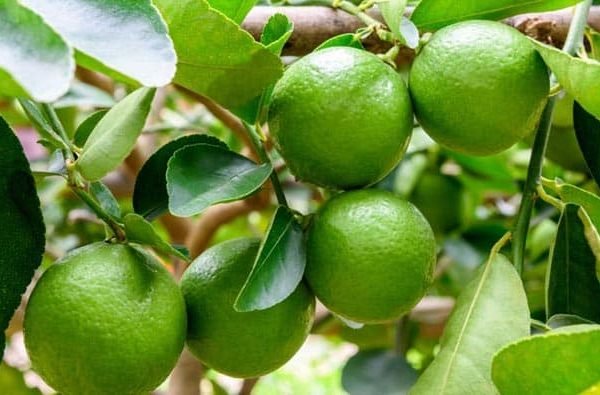
Latin Name: Citrus x aurantifolia
Family: Rutaceae
CTFA name:
CTFA Name: Citrus Aurantifolia (Lime) Oil
CTFA Name: Citrus Aurantifolia (Lime) Oil
Introduction
The lime is a small citrus tree native to the Southeastern region of India that grows to about 8 feet in tropical or subtropical climates.1 The fragrant white flowers appear in spring and summer2 and are followed by fruit that is half the size of a lemon.3 The parts used are the juice and an oil that is distilled from the fresh peel of the unripe fruit.4 There are two varieties of C. x aurantifolia commonly found in the U.S. supermarket, the seedless Persian lime and the seeded Key lime or Mexican lime, sometimes called West Indian lime.5 Mexico and the West Indies are the major producers of distilled lime oil. Limes are also grown in other parts of Central America, south Florida, south Texas, and southern California.4
History and Cultural Significance
Columbus brought the lime to the New World in 1493. Ponce de Leon may have introduced the lime to Florida in 1513.1 In the 1600s, it was discovered that lemon or lime juice could be used to aid individuals with diets low in Vitamin C. British ships are required to carry enough lime or lemon juice for each seaman to have an ounce each day after being at sea ten days.3 Lime is used in aromatherapy for skin care, circulation, and other body care.6 Lime oil is utilized by the food industry to give flavor to carbonated and alcoholic beverages, hard candy, gelatins, puddings, frozen dairy desserts, baked goods, meat, and meat products.3,4 In the United States, lemon-lime flavor is second in popularity only to cola.7 Lime oil is used externally in cosmetics as a fragrance and as a fixative in detergents, creams, lotions, perfumes, and soaps.4
Modern Research
Lime extracts have been studied for their ability to repel mosquitoes8 and their insecticidal effect against mosquitoes, cockroaches, and houseflies.9
Future Outlook
Currently there are no human clinical studies on the internal or external uses of lime or lime oil.
References
1 Oregon State University Food Resource. Web site. Febuary 20 2005. Available at:http://food.oregonstate.edu/faq/uffva/lime1.html. Accessed May 5, 2005.
2 Bown D. The Herb Society of America New Encyclopedia of Herbs and Their Uses. London: Dorling Kindersley Ltd.; 2001.
3 Grieve M. A Modern Herbal. New York: Dover Publications; 1971.
4 Leung AY, Foster S, eds. Encyclopedia of Common Natural Ingredients Used in Food, Drugs, and Cosmetics. 2nd ed. New York: John Wiley and Sons, Inc; 1996.
5 Wood R. The New Whole Foods Encyclopedia. New York: Penguin Group; 1999.
6 Lawless J. The Illustrated Encyclopedia of Essential Oils. Dorset, UK: Element Books; 1995.
7 Arctander S. Perfume and Flavor Materials of Natural Origin. Carol Stream, IL: Allured Publishing Corporation; 1994.
8 Das N, Baruah I, Talukdar P, Das S. Evaluation of botanicals as repellents against mosquitoes. J. Vector Borne Dis. 2003;40:49-53.
9 Ezeonu F, Chidume G, Udedi S. Insecticidal properties of volatile extracts of orange peels. Bioresour Technol. 2001;76:273-274.
10 Landes P. 1992 U.S. trade in essential oils. HerbalGram. 1994;No. 30:55. Available at: http://www.herbalgram.org/herbalgram/articleview.asp?a=705. Accessed May 5, 2005.
11 Practical Answers to Poverty. Lime Oil and Juice. April 13, 2005. Available at. http://www.itdg.org/docs/technical_information_service/lime_oil_and_juice.pdf. Accessed May 5, 2005.

RELATED POSTS
View all

Mostly Creatinine, Not Creatine: Why Creatine Gummies Keep Failing Lab Tests
August 29, 2026 | by supersuper
Knowledge: Misai Kucing / Cats Whiskers (Orthosiphon Aristatus / Orthosiphon Stamineus)
October 5, 2024 | by bionutriciaadmin
How to Source Trusted Pandan Leaf Extract in Bulk to the US and Canada?
October 5, 2024 | by bionutriciaadmin