

OEM for Pharmacy & Drugstore Chain Private-Label Supplements
August 9, 2026 | by supersuper
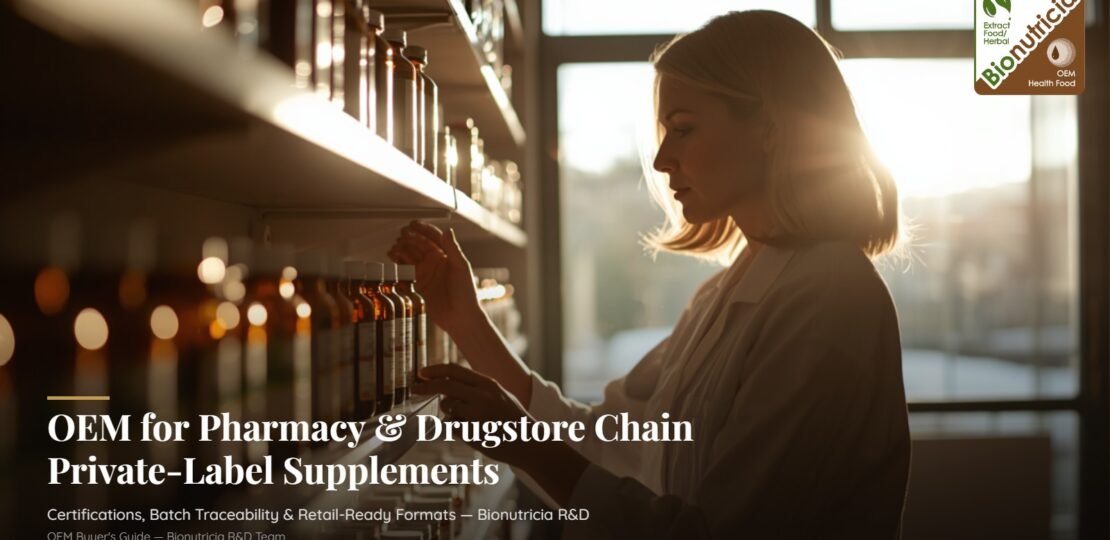
Direct answer: A pharmacy or drugstore chain buying private-label supplements needs three things an e-commerce or DTC brand can treat as optional: facility-level regulatory certification the pharmacist-in-charge can defend to an inspector, batch-level traceability that survives a recall drill, and a reorder cadence tight enough to keep planogram space filled without dead stock. Concretely, that means an OEM holding FSSC 22000, GMP, HACCP, JAKIM Halal, US FDA registration and MeSTI notification at the facility (not just claimed on a spec sheet), a Certificate of Analysis and batch record issued against every production lot with a traceable lot code printed on-pack, and finished formats suited to pharmacy retail — powder, liquid and gel sachets, pouch beverages, chewable tablets and liquid bottles — rather than bulk or foodservice packaging. Bionutricia manufactures under all six of those certifications at one Sungai Buloh facility, issues a CoA and batch record with every lot, and has supplied 239+ brand partners since 2006, giving a pharmacy chain’s procurement and QA teams a single, auditable point of accountability instead of a fragmented multi-vendor supply chain.
Why pharmacy and drugstore procurement is a different buyer than DTC
An e-commerce or direct-to-consumer brand can launch on a single SKU, iterate the formula every few months, and absorb the risk of a slow-moving batch. A pharmacy or drugstore chain cannot. Once a private-label supplement is listed, it sits on a planogram next to registered pharmaceuticals and other health products, is sold by staff who may be asked to explain it, and is subject to the same recall and complaint-handling expectations the store already applies to its regulated stock. That shifts the OEM selection criteria from “can you make this fast and cheap” to “can you make this the same way, batch after batch, with paperwork that holds up.”
In practice, three procurement questions dominate the pharmacy-chain buying conversation: Is the facility certified, not just the ingredient? Can every batch be traced back to raw-material lots if something is queried? And can the manufacturer sustain a reorder rhythm without the chain having to hold weeks of buffer stock in a distribution centre?
Certification a pharmacist-in-charge can stand behind
Retail pharmacy buyers typically ask for facility certificates, not marketing claims. The certifications that matter for this channel are:
- FSSC 22000 — food safety management system certification, SGS-audited, confirming the facility runs a documented, auditable food-safety programme rather than an informal one.
- GMP — Good Manufacturing Practice at a pharmaceutical-grade standard, the baseline a pharmacy buyer expects even for a food-classified supplement.
- HACCP — Hazard Analysis Critical Control Point, showing the process risk points are identified and controlled, not just inspected after the fact.
- JAKIM Halal — facility-level halal certification (OEM Kontrak Pengilangan) so every SKU carries defensible halal status through to the shelf, essential for the Malaysian and wider Muslim-majority retail market.
- US FDA registration — facility registration (FCE/FDA filings) relevant for chains that also list or export to US-linked retail.
- MeSTI — Makanan Selamat Tanggungjawab Industri, the Ministry of Health Malaysia’s food-safety notification for the facility. Bionutricia’s OEM formats (sachets, pouch beverages, chewable tablets, liquid bottles) are food-classified and go through MeSTI notification at the manufacturing level; this sits alongside, not in place of, NPRA’s separate food-vs-supplement classification framework and the labelling requirements under the Food Regulations 1985.
A pharmacy chain’s QA team should ask to see current certificates, not a list of acronyms on a proposal deck — and should confirm the certificate covers the specific facility that will physically manufacture the order, since some OEMs subcontract production to a different, uncertified site.
Batch traceability: the paperwork that survives a recall drill
Every production lot should generate a Certificate of Analysis and a batch manufacturing record before it ships. For a pharmacy-chain listing, the CoA should confirm identity of actives, microbial limits (total plate count typically ≤10,000 CFU/g, yeast and mould ≤1,000 CFU/g, E. coli, Salmonella and S. aureus absent/25g) and heavy-metal limits (lead ≤2.0 ppm, cadmium ≤1.0 ppm, mercury ≤0.1 ppm, arsenic ≤1.5 ppm). The batch record should tie the finished-goods lot code back to the raw-material lots used, the equipment run, and the date of manufacture — the exact chain a store’s compliance team needs if a single batch is ever queried, without having to pull the whole SKU from every shelf.
Ask any prospective OEM two direct questions: can you produce the CoA and batch record for a specific lot code within 24–48 hours of request, and will the lot code on the outer carton match the lot code on the individual retail unit? An OEM that hesitates on either question is not set up for pharmacy-channel accountability.
Formats that fit pharmacy and drugstore retail
Pharmacy and drugstore shelf space favours formats that are compact, shelf-stable, and easy for staff to explain and for customers to dose consistently. Bionutricia manufactures private-label supplements in:
- Powder sachets — single-serve, ambient-stable, easy to merchandise in small planogram facings.
- Liquid sachets — single-dose liquid formats for actives that suit a liquid delivery matrix.
- Gel sachets — for actives or textures better suited to a gel base than a dry powder.
- Pouch beverages — larger-volume ready-to-drink formats for wellness-shot or functional-beverage listings.
- Chewable tablets — no-water dosing, well suited to senior, paediatric or on-the-go positioning within a pharmacy assortment.
- Liquid bottles — multi-dose bottled formats for tonics and daily-use liquid supplements.
These formats share ambient or refrigerated-optional stability profiles that fit standard pharmacy distribution — no specialist cold-chain requirement beyond what most chains already run for other refrigerated retail lines.
Reorder cadence and minimising dead stock on a fixed planogram
A pharmacy chain’s category manager is optimising shelf space against sell-through, not just landed cost. Two supply-chain factors matter more here than in DTC: a dependable, predictable replenishment cycle from purchase order to delivery (so restocking can be scheduled against a fixed planogram reset calendar), and formulation consistency batch to batch (so a repeat customer’s experience doesn’t drift). Because Bionutricia extracts, spray-dries, blends, and fills under one roof at its Sungai Buloh facility, the same team that standardises the active ingredient also fills the finished SKU — removing the handoff risk that occurs when an ingredient supplier and a separate co-packer have to reconcile two different CoAs before a batch can ship.
For chains carrying private-label supplements alongside branded stock, this consistency also protects the store’s own reputation: a private-label SKU that varies noticeably from batch to batch reflects on the retailer’s name on the label, not on a third-party brand the customer can simply stop buying.
Private label vs a distributed branded line: what changes for the OEM relationship
A private-label pharmacy programme differs from stocking a distributed branded supplement in one structural way: the retailer, not a brand owner, carries the regulatory and quality accountability for the product on its own label. That means the OEM relationship needs to support the retailer’s own QA sign-off process — providing specification sheets, stability data, and label-claim substantiation the retailer’s own compliance team can review and approve before the product goes to print, rather than simply supplying finished goods to a brand that has already done that work upstream.
What Bionutricia provides for pharmacy and drugstore private label
Bionutricia is a JAKIM-certified halal OEM and contract manufacturer, founded in 2006, with 20+ years of R&D experience, 15+ years of manufacturing experience, and 239+ brand partners served. Extraction runs on Bionutricia’s own granted patent, MY-188945-A, covering an enzymatic ultrasonic extraction process for standardised botanical fractions. Separately, for formulation briefs that call for an enhanced-absorption active, Bionutricia offers Herbosomal® — a proprietary, registered-trademark liposomal encapsulation and sustained-release technology, currently patent-pending under application PI2023005773. All six quality certifications (FSSC 22000, GMP, HACCP, JAKIM Halal, US FDA, MeSTI) sit at the single Sungai Buloh manufacturing facility, with company headquarters in Kota Damansara, Selangor, and export shipped via Port Klang.
📚 Related guides
- Private Label Supplements for E-commerce & DTC Brands: MOQ Flexibility & Compliance
- Supplement OEM for Clinics & Practitioner-Dispensed Brands
- How to Read a Supplement Certificate of Analysis (CoA): A Buyer’s Guide
Frequently asked questions
What certifications should a pharmacy chain require from a private-label supplement OEM?
At minimum, facility-level FSSC 22000, GMP, HACCP, JAKIM Halal, US FDA registration and MeSTI notification — verified as current certificates for the specific manufacturing site, not a general claim on a proposal. Bionutricia holds all six at its Sungai Buloh facility.
Can a private-label supplement OEM support batch-level recall traceability?
It should. Every production lot should carry a Certificate of Analysis and batch manufacturing record that ties the finished-goods lot code back to raw-material lots, equipment run and manufacture date, retrievable within 24–48 hours of a query.
What supplement formats work best for pharmacy and drugstore shelf space?
Compact, ambient-stable, single- or standard-dose formats: powder, liquid and gel sachets, pouch beverages, chewable tablets and liquid bottles. These fit standard planogram facings and distribution without specialist cold-chain handling.
How is a pharmacy private-label programme different from supplying a DTC brand?
The retailer carries the regulatory and quality accountability for the product on its own label, so the OEM needs to support the retailer’s internal QA sign-off with specification sheets, stability data and label-claim substantiation, alongside a tighter reorder cadence to protect fixed shelf space.
Does Bionutricia manufacture and fill private-label supplements at the same facility?
Yes. Bionutricia extracts, spray-dries, blends and fills under one roof at its Sungai Buloh facility, so the team that standardises the active ingredient is the same team that fills the finished SKU, avoiding the CoA handoff risk between a separate ingredient supplier and co-packer.
Ready to develop a pharmacy or drugstore private-label programme?
Facility-certified, vertically integrated OEM manufacturing under FSSC 22000, GMP, HACCP, JAKIM Halal, US FDA and MeSTI. Batch-traceable CoAs, retail-ready sachet, tablet and bottle formats, and a single point of QA accountability.
Request a quotation · See our OEM services · View our certifications
WhatsApp: +60 16-661 8510
Article by Bionutricia R&D Team. Last updated: August 9, 2026.
RELATED POSTS
View all

How to Choose a Halal Botanical Extract & Nutraceutical OEM Supplier in Malaysia
June 24, 2026 | by supersuper
How Contract Grinding & Micronisation Works for Botanical Powders
August 13, 2026 | by supersuper
Men’s Health & Vitality Supplement OEM: Formats, Actives & Compliant Claims
August 23, 2026 | by supersuper