

How Contract Grinding & Micronisation Works for Botanical Powders
August 13, 2026 | by supersuper
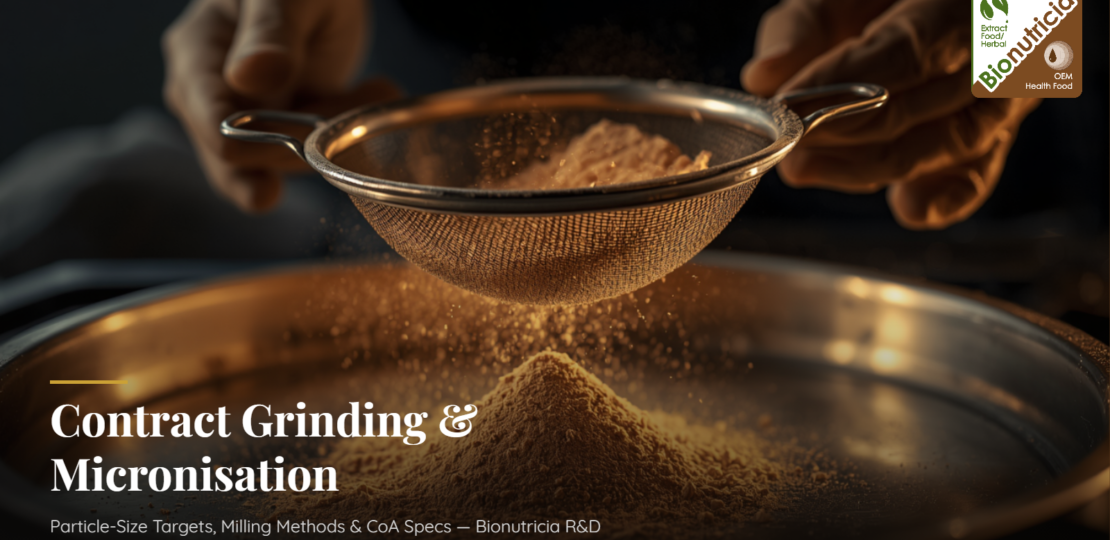
Direct answer: Contract grinding reduces a dried botanical — whole-herb material, spray-dried extract cake, block — to a target particle-size distribution, and micronisation is the fine end of that same process: milling a powder down to a D90 (90th-percentile particle size) below roughly 25 microns, against the 150–180 micron (80–100 mesh) range typical of a standard sachet-fill powder. Particle size is a functional specification, not a cosmetic one. Finer particles carry more surface area per gram, which speeds dissolution and dispersibility in a liquid sachet or pouch beverage, reduces grittiness in a chewable tablet or reconstituted drink, and helps a multi-ingredient premix blend evenly instead of separating during transport. But finer is not automatically better: micronised powder is also more hygroscopic, harder to keep flowing evenly through a sachet filler, and costs more to produce, so the right target is set by the finished format and the ingredient’s own behaviour rather than by chasing the smallest number available. Bionutricia mills to a specified mesh or micron range as part of its contract grinding service — standard milling for sachet and tablet premixes, finer milling or jet-milled micronisation where a formulation genuinely needs it — verified on the Certificate of Analysis by laser diffraction or sieve analysis on every batch.
Grinding and micronisation are a spectrum, not two separate things
“Grinding” spans several distinct particle-size bands, and where a batch lands on that spectrum is chosen deliberately, not left to whatever the mill happens to produce.
- Coarse grind (20–40 mesh, ~420–841 micron): cut or granular material, usually an intermediate stage rather than a finished particle size.
- Standard powder (80–100 mesh, ~150–180 micron): the default for powder-sachet fill and most premix blending — fine enough to flow and blend evenly, coarse enough to avoid dust and caking.
- Fine powder (120–200 mesh, ~74–125 micron): favoured for chewable tablet premixes, where smoother mouthfeel and compression behaviour matter.
- Micronised (D90 below ~25 micron, sometimes pushed to single-digit microns): reserved for formulations where dissolution speed, suspension stability or dispersibility genuinely depends on very fine particle size.
The equipment: why standard grinding and true micronisation use different machines
Getting to a 150-micron powder and getting from there down to 20 microns are different engineering problems — the industry uses different mills for each.
Hammer milling
Impact-based size reduction: a rotor swings hammers against the feed material, which passes through a screen once small enough. Hammer mills are the workhorse for bulk botanical milling — high throughput, robust, well suited to the coarse-to-standard range (roughly 20–100 mesh) — and the usual first step even when a batch is destined for further fine milling.
Pin milling
Intermeshing pins rotate at high speed to shear and impact the material, producing a finer result than a hammer mill — typically down to around 325 mesh (~44 micron). Dwell time inside a pin mill is short, making it a reasonable choice for moderately heat- or oxidation-sensitive botanical powders that a slower process would degrade.
Jet milling (fluid-energy milling)
This is the technology that actually delivers micronisation. Compressed air or nitrogen accelerates particles inside a milling chamber so they collide with each other rather than a mechanical part — no hammers, pins or grinding media to wear down or contaminate the batch. The process is largely self-cooling, since gas expansion absorbs heat as it enters the chamber, which makes jet milling workable for actives that would degrade under frictional heat. This is how a powder moves from the 100-micron range down to single-digit-to-20-micron D90.
Why particle size changes how the finished product performs
Particle size is not an abstract manufacturing detail — it shows up directly in how a finished SKU behaves on the shelf and in the hand.
- Dissolution and reconstitution speed. More surface area per gram means a liquid sachet, gel sachet or pouch beverage reconstitutes faster and more completely, with less undissolved residue left behind.
- Mouthfeel. Grittiness in an RTD beverage or a chewable tablet is very often a particle-size issue rather than a formulation issue — the same active at a coarser cut can feel noticeably different in the mouth.
- Blend uniformity. In a multi-ingredient premix, particles that differ in size or density can separate during transport or vibration — millers call it demixing — leaving some sachets or tablets under-dosed on one active and over-dosed on another. Milling every component to a similar particle-size band is one of the most effective ways to prevent this.
- Flow and fill accuracy. Bulk density, tapped density and the resulting Carr’s Index (a standard flowability measure) determine whether a powder runs cleanly through an automated sachet filler or bridges in the hopper. Overly fine, ungraded powder is often the harder material to fill accurately, not the easier one.
- Hygroscopicity and shelf life. More surface area also means more exposed area for moisture uptake, so micronised material typically needs tighter desiccant packaging and sometimes a different carrier ratio than a standard-milled powder of the same botanical.
What to put on a grinding or micronisation specification
A complete contract-grinding brief specifies particle size the same way a CoA specifies an active marker — a measured number with a method, not a word like “fine” or “superfine.”
| Parameter | What to specify |
|---|---|
| Particle-size distribution | D10 / D50 (median) / D90, by laser diffraction, or percentage retained on stated mesh sizes by sieve analysis |
| Bulk & tapped density | Reported alongside Carr’s Index or Hausner ratio to characterise flowability |
| Moisture content | Typically ≤5% for standard-milled powder; tighter, moisture-controlled packaging spec for micronised material |
| Identity & appearance | Botanical name, plant part, visual/colour description |
| Microbiological limits | Total plate count ≤10,000 CFU/g · yeast & mould ≤1,000 CFU/g · E. coli, Salmonella spp., S. aureus absent/25g |
| Heavy metals | Lead ≤2.0 ppm · cadmium ≤1.0 ppm · mercury ≤0.1 ppm · arsenic ≤1.5 ppm |
Deciding between standard grinding and true micronisation
Run a formulation through this sequence before specifying either:
1. What does the finished format need?
A powder sachet or chewable tablet premix rarely needs anything finer than the standard 80–100 mesh range. A liquid sachet, gel sachet or pouch beverage, where reconstitution speed and mouthfeel are visible to the end user, is where finer milling starts to earn its cost.
2. Is there a real dispersibility problem to solve?
Ask for a reconstitution comparison at standard particle size before paying for micronisation. If the standard-milled powder already reconstitutes cleanly, the finer, more expensive process is not buying the formulation anything measurable.
3. Is this a multi-active blend with segregation risk?
If the SKU combines a botanical powder with vitamins, minerals or other actives of very different native particle size, matching particle-size bands across ingredients is often more important for dose consistency than how fine any single ingredient is alone.
4. Does the cost trade-off make sense at your volume?
Jet milling has lower throughput and higher energy cost per kilogram than hammer or pin milling. It suits a formulation with a genuine dispersibility need, not a default upgrade applied everywhere.
Formats Bionutricia mills for
Particle size is set with the finished format in mind, and Bionutricia’s Sungai Buloh facility runs grinding and micronisation under the same roof as extraction and filling, so the particle-size spec agreed at the start of a project carries straight through to the finished batch.
- Powder sachets: standard 80–100 mesh milling is the default — fine enough to blend and flow, coarse enough to avoid dust and caking.
- Liquid sachets and pouch beverages: finer milling or micronisation improves reconstitution speed and reduces sediment in the finished liquid.
- Gel sachets: particle size is matched to the target viscosity and mouthfeel of the gel base.
- Chewable tablets: a narrower, fine particle-size band supports even compression and a smoother bite compared with a coarser premix.
- Liquid bottles: wellness shots and tonics benefit from the same reconstitution and sediment advantages as pouch beverages.
Why milling under the same roof as extraction matters
When grinding is handled by a separate vendor from extraction and filling, the particle-size spec has to survive a handoff — and the retained sample, the CoA and the batch traceability chain have to survive it too. Bionutricia keeps contract extraction (via patented enzymatic ultrasonic extraction, MY-188945-A), spray-drying, grinding, micronisation and finished filling in one FSSC 22000, GMP, HACCP, JAKIM Halal, US FDA and MeSTI-certified facility, so the particle-size number specified at the brief stage is the same number verified on the finished batch’s CoA — no second facility, no second CoA, no gap where the spec could drift.
Related guides
- Standardised Extract vs Whole-Herb Powder: What’s the Difference for OEM?
- How to Read a Supplement Certificate of Analysis (CoA): A Buyer’s Guide
Ready to specify the right particle size for your SKU?
Vertically integrated contract extraction, grinding and micronisation, and finished manufacturing under FSSC 22000, GMP, HACCP, JAKIM Halal, US FDA and MeSTI certification. Particle-size targets set to your format and verified on every batch’s CoA.
Request a quotation · See our OEM services · View our certifications
WhatsApp: +60 16-661 8510
Frequently asked questions
What’s the difference between grinding and micronisation?
They are the same underlying process — particle-size reduction — at different points on the same spectrum. “Grinding” typically covers coarse-to-standard powder (roughly 20–100 mesh, 150 micron and above), usually done on a hammer or pin mill. “Micronisation” refers specifically to the fine end, generally a D90 below about 25 microns, which requires jet milling rather than mechanical impact milling.
What particle size should I specify for a botanical powder?
For a standard powder sachet or tablet premix, 80–100 mesh (roughly 150–180 micron) is a sound commercial default. Move finer only when a specific format need — faster reconstitution in a liquid sachet, smoother mouthfeel in a chewable tablet, or a genuine dispersibility issue at standard particle size — justifies the added cost.
Does micronisation improve bioavailability?
Finer particle size increases surface area, which supports faster dispersibility and reconstitution — well-established dissolution science. Whether that translates into a meaningfully different absorption outcome depends on the specific active, so it should be verified per-ingredient rather than assumed, and any absorption-related packaging claim substantiated for that active.
Can any botanical powder be micronised?
Most can be mechanically micronised, but not every botanical benefits from it. Very fibrous or oily material can behave poorly under jet milling, and heat- or oxidation-sensitive actives need a milling method and atmosphere chosen to avoid degradation. A capable OEM should test a small batch before committing a full production run to micronisation.
Does Bionutricia grind and micronise in-house?
Yes. Contract grinding, including fine milling and micronisation, is performed at the same Sungai Buloh facility that runs extraction and finished-format filling, so the particle-size spec agreed at the brief stage is the same spec verified on the finished batch’s Certificate of Analysis.
Article by Bionutricia R&D Team. Last updated: August 13, 2026.
RELATED POSTS
View all



Liposomal Multivitamin Blend OEM: Combining Vitamin C, D3 & B-Complex for Functional Beverages and Sachets
September 24, 2026 | by supersuper