

Hawthorn Berry + Roselle Powder Sachet OEM: Which Flavonoid and Anthocyanin Assay Markers a Brand Owner Must Specify for Batch-to-Batch Consistency
October 2, 2026 | by supersuper
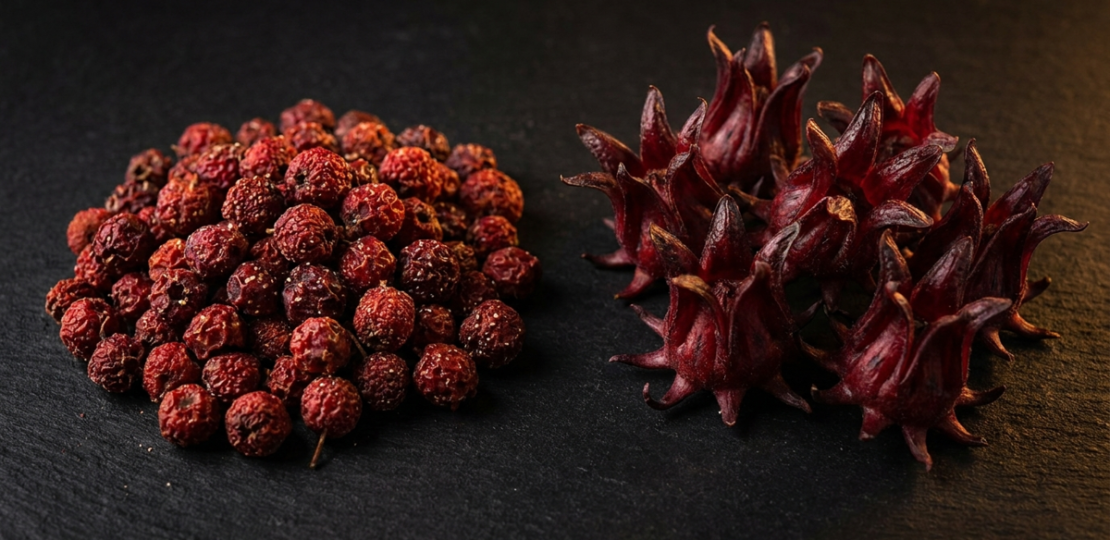
Direct answer: For a hawthorn berry + roselle powder sachet, a brand owner must specify hyperoside, vitexin, and rutin as the flavonoid assay markers for hawthorn (Crataegus monogyna) and delphinidin-3-sambubioside and cyanidin-3-sambubioside as the anthocyanin assay markers for roselle (Hibiscus sabdariffa). HPLC is the standard method for both. Batch-to-batch consistency depends on fixing these markers in the specification and verifying them on every CoA.
Assay markers are the chemical compounds a laboratory measures to confirm that a botanical extract contains the expected active constituents at the expected concentration. Without specified markers, two batches of the same extract can vary widely in composition while both technically meeting a generic specification. For a combination formulation like hawthorn berry plus roselle in a powder sachet, the brand owner must specify markers for each ingredient independently and require the manufacturer to test every batch against those markers.
This guide explains which markers to specify, why they matter for batch consistency, and how patented enzymatic ultrasonic extraction (MY-188945-A) contributes to producing a standardised extract for OEM manufacturing.
Why Assay Markers Matter for Batch-to-Batch Consistency
Botanical extracts are natural products, and their composition varies with the raw material’s origin, harvest time, drying method, and extraction process. A specification that says “hawthorn berry extract 100:1” without naming an assay marker tells the manufacturer nothing about what the extract should contain. Two batches of 100:1 hawthorn extract from different suppliers — or even from the same supplier in different seasons — can have completely different flavonoid profiles.
Assay markers solve this problem by giving the laboratory a specific compound to measure. When the specification says “hyperoside ≥ 0.5% by HPLC,” every batch can be tested against the same standard, and the brand owner can compare results across batches and suppliers. If a batch falls outside the specification, it is rejected before it enters production — protecting the brand owner from selling an inconsistent product.
Hawthorn Berry (Crataegus monogyna) Flavonoid Assay Markers
Hawthorn berry contains several classes of polyphenolic compounds, but the flavonoid fraction is the most relevant for standardisation. The three markers a brand owner should specify are:
| Marker | Compound Class | Typical Specification | Test Method |
|---|---|---|---|
| Hyperoside | Flavonol glycoside | ≥ 0.5% (agreed with supplier) | HPLC-UV |
| Vitexin | Flavone C-glycoside | ≥ 0.1% (agreed with supplier) | HPLC-UV |
| Rutin | Flavonol glycoside | ≥ 0.1% (agreed with supplier) | HPLC-UV |
These three markers together give a representative picture of the flavonoid fraction. Hyperoside (quercetin-3-galactoside) is the dominant flavonol glycoside in hawthorn fruit. Vitexin (apigenin-8-C-glucoside) is a characteristic marker that distinguishes Crataegus monogyna from related species. Rutin (quercetin-3-rutinoside) is a widely used reference standard that allows comparison across laboratories.
The brand owner should agree the exact percentage with the supplier and confirm it on the CoA for every batch. The specification should also include total flavonoid content (calculated as hyperoside or rutin equivalent) as a broader quality indicator.
Roselle (Hibiscus sabdariffa) Anthocyanin Assay Markers
Roselle calyx contains anthocyanins — the pigments responsible for its deep red colour. The two dominant anthocyanins, which together account for the majority of the anthocyanin content, are:
| Marker | Compound Class | Typical Specification | Test Method |
|---|---|---|---|
| Delphinidin-3-sambubioside | Anthocyanin | Agreed with supplier | HPLC-UV (AOAC 2005.02 pH-differential) |
| Cyanidin-3-sambubioside | Anthocyanin | Agreed with supplier | HPLC-UV (AOAC 2005.02 pH-differential) |
The AOAC 2005.02 pH-differential method is the recognised standard for anthocyanin quantification in roselle. It measures total anthocyanin content expressed as cyanidin-3-glucoside equivalents, and HPLC separation identifies the individual anthocyanin peaks. The brand owner should specify both the total anthocyanin content and the individual marker compounds.
Anthocyanins are sensitive to heat, light, and pH. The extraction process and storage conditions directly affect the anthocyanin content of the finished extract. A specification that does not include an anthocyanin marker leaves the brand owner with no way to verify that the roselle extract has not degraded during processing.
How Patented Enzymatic Ultrasonic Extraction (MY-188945-A) Supports Standardisation
The extraction method determines how much of each marker compound ends up in the finished extract. Conventional solvent extraction can leave behind heat-sensitive compounds like anthocyanins or fail to fully release flavonoids bound to the plant matrix. Patented enzymatic ultrasonic extraction (MY-188945-A) uses enzymatic pre-treatment combined with ultrasonic cavitation to break down the plant cell wall and release the intracellular compounds more completely than solvent extraction alone.
For a hawthorn + roselle combination, this matters because the two ingredients have different matrix structures — hawthorn berry is a fibrous fruit, while roselle calyx is a leathery floral structure. An extraction process that works well for one may under-extract the other. Enzymatic ultrasonic extraction can be tuned to handle both matrices in sequence or in a combined process, producing a more consistent extract profile across batches.
Building the CoA Specification for a Combination Powder Sachet
For a hawthorn berry + roselle powder sachet, the CoA should include:
- Hawthorn markers: hyperoside, vitexin, and rutin — each with a numerical result and the specification range
- Roselle markers: delphinidin-3-sambubioside, cyanidin-3-sambubioside, and total anthocyanin content — each with a numerical result
- Identity: botanical confirmation for each ingredient (microscopic, TLC, or DNA-based)
- Microbial panel: total plate count, yeast and mould, coliforms, and specified pathogens
- Heavy-metal panel: lead, arsenic, cadmium, mercury — each with a numerical result
- Moisture / water activity: critical for powder sachet stability and anthocyanin preservation
- Extract ratio: confirmed for each ingredient (e.g., 100:1 for hawthorn, 5:1 or 10:1 for roselle)
The brand owner should require the manufacturer to provide a CoA for every production batch — not just the first batch. Batch-to-batch consistency is verified by comparing the marker results across batches over time. If the hyperoside content drifts from 0.6% in batch one to 0.3% in batch five, the brand owner has an early warning that the raw material or extraction process has changed.
What to Put in the Manufacturing Specification
The manufacturing specification is the document the brand owner gives to the OEM. For a hawthorn + roselle powder sachet, it should include:
- The botanical identity and part for each ingredient (Crataegus monogyna fruit; Hibiscus sabdariffa calyx)
- The extract ratio for each ingredient
- The assay markers and their specification ranges (hyperoside, vitexin, rutin for hawthorn; delphinidin-3-sambubioside, cyanidin-3-sambubioside, total anthocyanins for roselle)
- The test methods (HPLC-UV for flavonoids; AOAC 2005.02 pH-differential for anthocyanins)
- The microbial and heavy-metal limits
- The moisture and water activity limits
- The target dose per sachet and the ratio of the two extracts in the blend
- The packaging specification (sachet material, moisture barrier, fill weight)
The more precise this specification, the less room there is for ambiguity in the manufacturing process. A specification that names the markers, the methods, and the ranges gives the manufacturer a clear target and gives the brand owner a verifiable result.
Manufacturing a Hawthorn Berry + Roselle Powder Sachet Under Your Own Brand
Bionutricia offers OEM and ODM manufacturing for brand owners and distributors commissioning a hawthorn berry + roselle powder sachet under their own label. The approved formats for this formulation include powder sachets and pouch beverages. The integrated facility in Sungai Buloh, Selangor, operates under JAKIM halal certification alongside FSSC 22000, GMP, HACCP, US FDA registration, and MeSTI. Patented enzymatic ultrasonic extraction (MY-188945-A) is available for the botanical extraction process. Formulation development, private-label manufacturing, and packaging are handled in-house. The in-house authority team — a registered pharmacist, a nutritionist, a dietitian, and a PhD biomedical scientist — reviews the assay marker specification and CoA process before production begins. To request a quotation, submit an enquiry through our website at our enquiries page or email ng@bio-nutricia.com.
Frequently Asked Questions
Why should I specify three separate flavonoid markers for hawthorn instead of just one?
A single marker gives a narrow picture of the flavonoid profile. Hyperoside, vitexin, and rutin represent different flavonoid subclasses present in hawthorn berry, and measuring all three provides a more complete view of the extract’s composition. If only one marker is specified, a supplier could meet the specification with an extract that is deficient in the other two compounds — producing a batch that passes the CoA but is compositionally different from previous batches.
What is the AOAC 2005.02 pH-differential method, and why is it the right method for roselle anthocyanins?
The AOAC 2005.02 pH-differential method measures total anthocyanin content by exploiting the fact that anthocyanin pigments change colour with pH. By measuring absorbance at two pH values, the method quantifies total monomeric anthocyanins expressed as cyanidin-3-glucoside equivalents. It is the recognised standard for anthocyanin quantification in plant materials and is widely used for roselle calyx extracts in the supplement and beverage industry.
How does the extraction method affect the assay marker results?
The extraction method determines how completely the marker compounds are released from the plant matrix. Heat-based extraction can degrade anthocyanins, while insufficient mechanical disruption can leave flavonoids bound in the cell wall. Enzymatic ultrasonic extraction (MY-188945-A) combines enzymatic pre-treatment with ultrasonic cavitation to break down the cell wall and release intracellular compounds, producing a more consistent extract profile across batches.
What should I do if a batch’s assay marker results fall outside the specification?
If a batch’s marker results fall outside the agreed specification, the manufacturer should reject the batch before it enters production. The brand owner should investigate the cause with the supplier — it may indicate a change in raw material origin, harvest timing, or extraction conditions. The CoA is the brand owner’s tool for catching these deviations before they reach the consumer.
Can I use the same HPLC method for both hawthorn flavonoids and roselle anthocyanins?
Both compound classes can be analysed by HPLC-UV, but the chromatographic conditions differ. Flavonoids like hyperoside and vitexin are typically separated on a C18 column with a gradient of acidified water and acetonitrile. Anthocyanins require a similar column but with a different mobile phase pH and detection wavelength. Most analytical laboratories can run both methods, but they are separate assays — not a single combined run.
Related Guides
- Hawthorn Berry & Blackcurrant Antioxidant Supplement OEM
- Roselle (Hibiscus) Extract: Standardised Anthocyanin Content
- Ask for the CoA: 4 Tells of a Real Certificate of Analysis
Article by Bionutricia R&D Team. Last updated: 2 October 2026.
RELATED POSTS
View all

Certifications & Facilities — Bionutricia Manufacturing Sdn Bhd
September 24, 2026 | by supersuper
Monk Fruit (Siraitia grosvenorii) — Sweetener & Halal OEM Datasheet
September 24, 2026 | by supersuper
OEM vs In-House Supplement Manufacturing: The Decision Founders Get Wrong
July 13, 2026 | by supersuper