

Private Label Supplements for Pharmacy Chains: Pack Sizes, Pricing & Pharmacy Submission Docs
June 16, 2026 | by supersuper
Direct answer: A pharmacy chain buying private-label supplements from an OEM requires, at minimum: a full Certificate of Analysis (CoA) per batch with third-party verification, accelerated stability data (12-month minimum, ICH Q1A-aligned), child-resistant packaging compliant with the relevant market’s pharmacy regulations, and a regulatory dossier that passes the pharmacy’s own supplier qualification process. In Malaysia, this means MAL notification or registration for health supplement claims, plus NPRA-aligned labelling. For export pharmacies (UK, GCC, Singapore), additional documentation (Trading Standards, SFDA dossier, HSA notification respectively) is required. OEMs that can supply the documentation pack — not just the product — win pharmacy listings. Bionutricia produces private-label supplements in powder sachet, liquid sachet, chewable tablet, and liquid bottle formats with the full documentation stack for both local and export pharmacy channels.
Why pharmacy is a high-value, high-barrier B2B supplement channel
Pharmacy chains represent the highest-value private-label supplement channel in Southeast Asia, but they are also the most demanding buyer. A typical supermarket private-label buyer reviews price and shelf appeal. A pharmacy private-label buyer reviews:
- Regulatory compliance — is the product legally saleable in their stores under pharmacy regulations?
- Clinical credibility — can the product make structure/function claims that pharmacy staff can substantiate?
- Documentation completeness — can the supplier produce every document for their supplier qualification audit?
- Consistent quality — batch-to-batch CoA consistency with verified third-party testing.
- Packaging compliance — child-resistant caps, tamper-evident seals, and pharmacy-grade label inserts.
OEMs that compete only on price fail pharmacy procurement. The dossier is the product.
The documentation pack every pharmacy chain requires
1. Certificate of Analysis (CoA) — per batch
Every batch must have a CoA issued against a product specification the pharmacy approved at listing stage. The CoA must state at minimum: product name, batch number, manufacturing date, expiry date; active ingredient identity and assay (% of label claim); microbial limits (TPC, yeast/mould, absence of pathogens); heavy metals (lead, cadmium, mercury, arsenic) for botanical products; dissolution or uniformity of fill; moisture content (powder formats); packaging integrity confirmation. Most pharmacy chains require at minimum annual third-party analytical verification on key actives.
2. Stability data (ICH Q1A-aligned)
Accelerated stability (minimum acceptable): 6 months at 40°C / 75% RH. This predicts 2-year shelf life under ICH Q1A conditions. Most chains require a study showing no degradation of the primary active at the proposed shelf-life endpoint.
Real-time stability (preferred): 12 months at 30°C / 65% RH (ICH Zone IVb, for tropical markets including Malaysia, Singapore, GCC). Bionutricia’s stability programme runs both accelerated and real-time studies at a contracted analytical laboratory with WHO-GMP compliant stability chambers. Raw data is available to pharmacy clients on request.
3. Regulatory dossier (market-specific)
Malaysia: MAL notification (NPRA). Permitted claims under Malaysian Food Act 1983. Mandatory label elements: product name, net content, ingredient list, direction for use, warning statement, MAL notification number, manufacturer details, country of origin.
Singapore: HSA Health Products notification. GMP certification of manufacturer required.
GCC: SFDA registration (Saudi Arabia); ESMA/DM registration (UAE). JAKIM halal certification recognised under GCC Halal Accreditation scheme.
UK/EU: Food supplement notification to FSA or member state authority. Claims restricted to EU-approved health claims (Regulation 1924/2006). Novel food check if ingredient is post-1997 introduction.
4. Child-resistant and pharmacy-grade packaging
Pharmacy chains typically require CR packaging for any product containing iron, vitamin D ≥1,000 IU, melatonin, or pharmacological-level doses. Push-and-turn CR caps must meet ISO 8317 test compliance. A printed patient/consumer information leaflet (PIL), bilingual where required (English + Bahasa Malaysia for MY; English + Arabic for GCC), and tamper-evident induction seal are standard expectations. Bionutricia’s packaging line accommodates CR closures, induction sealing, and shrink-banding.
Pack sizes that work for pharmacy
| Format | Recommended unit count | Rationale |
|---|---|---|
| Powder sachet | 15 or 30 sachets/box | 15-day or 30-day supply for once-daily dosing |
| Chewable tablet | 30 or 60 tablets | 30-day or 60-day supply at 1–2 tablets/day |
| Liquid sachet | 10 or 15 sachets/box | Shorter-course products (collagen shots, pre/probiotics) |
| Liquid bottle (30ml) | Single-serve shots, 10-pack boxes | Wellness shots and energy formats |
What pharmacy chains actually audit in a supplier qualification visit
Pharmacy buyers check: GMP certificate and validity dates; FSSC 22000 (or equivalent GFSI-recognised cert); analytical laboratory qualification traceable to UKAS/SAMM standards; stability chamber qualification records; batch manufacturing record (BMR) template; warehouse temperature/humidity monitoring logs; documented product recall SOP; product liability insurance.
Bionutricia is FSSC 22000 (SGS-audited), GMP, HACCP, JAKIM halal, US FDA registered, and MeSTI (MOH Malaysia) certified. Full documentation pack including stability protocol, BMR template, and analytical qualification records is available to qualified pharmacy buyers under NDA.
Related guides
- OEM Manufacturing for Direct-Selling and Network Marketing Brands: Speed-to-Market and Compliance That Won’t Burn Your Field
- FSSC 22000 vs ISO 22000 for Supplement OEMs in 2026: What B2B Buyers Actually Audit
Frequently asked questions
How long does stability testing take before I can list in a pharmacy?
Accelerated stability (6 months at 40°C / 75% RH) takes 6 months. We initiate stability studies at formulation sign-off, so the study runs during your artwork, regulatory, and procurement timeline in parallel.
Do I need to register the product with NPRA before approaching a pharmacy chain?
For health supplement claims in Malaysia, yes — an NPRA MAL notification is typically required before a pharmacy chain’s purchasing team will approve listing. Bionutricia can prepare and submit the NPRA notification on behalf of clients or provide the technical dossier for client-managed submission.
Can Bionutricia supply a bilingual packaging insert?
Yes — we provide bilingual label text for English + Bahasa Malaysia. For Arabic inserts (GCC export), we work with a qualified Arabic medical translation partner.
Ready to develop a pharmacy-ready private-label supplement?
FSSC 22000 (SGS-audited). JAKIM facility-level halal. US FDA registered. Full documentation stack: CoA, stability data, NPRA support, pharmacy-grade packaging. 24-hour RFQ reply.
Request a quotation · View our certifications · See our facilities
WhatsApp: +60 16-661 8510
Related Bionutricia services: private label supplement manufacturer in Malaysia · halal supplement OEM in Malaysia
RELATED POSTS
View all

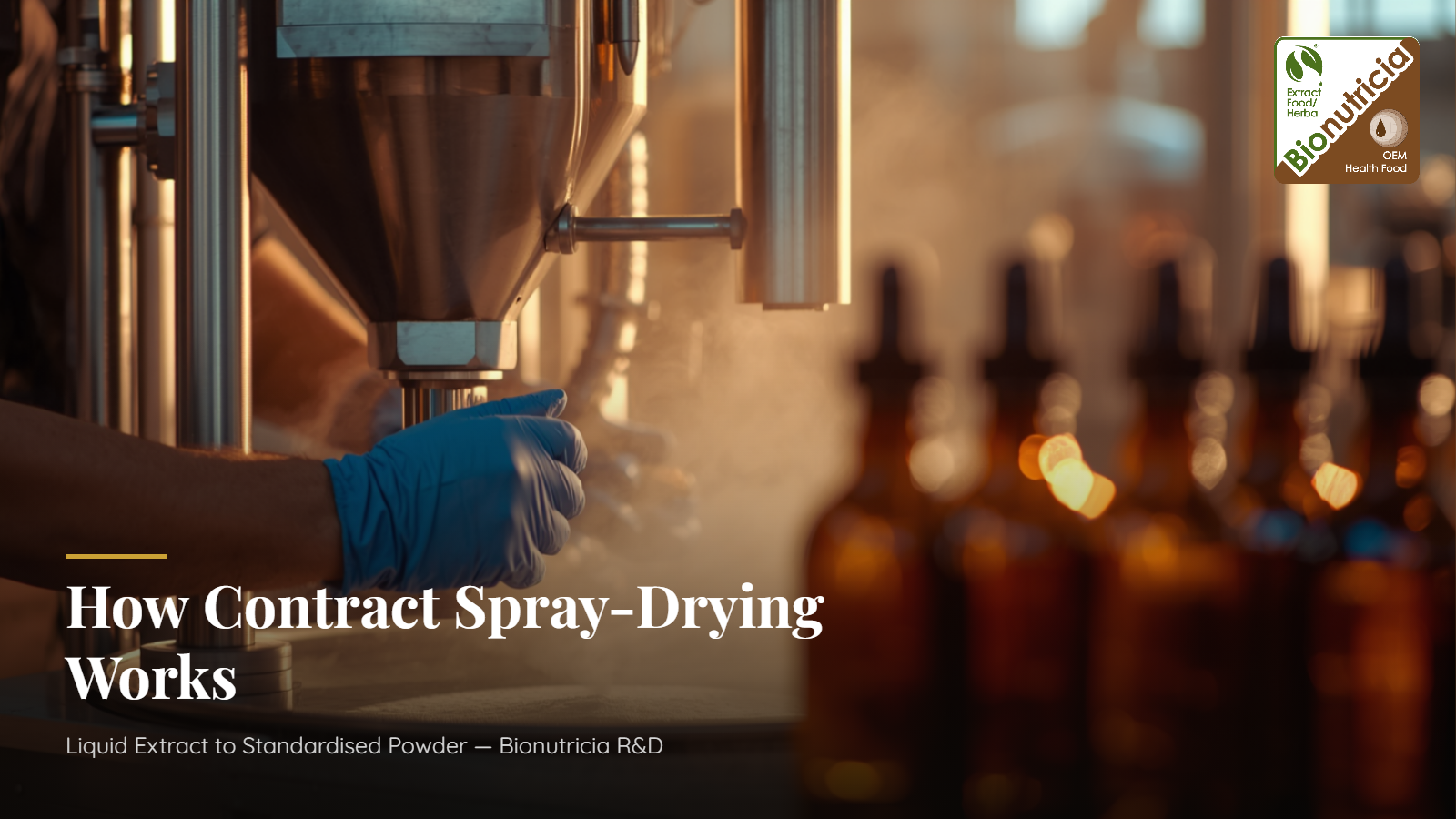
How Contract Spray-Drying Works: From Liquid Extract to Standardised Powder
August 13, 2026 | by supersuper
Chewable Tablet Supplement OEM Malaysia: Formats, Actives & Halal Compliance
September 24, 2026 | by supersuper