

Mangosteen (Garcinia mangostana) Pericarp Extract for Antioxidant SKUs: Xanthone Standardisation & OEM Specs
July 29, 2026 | by supersuper
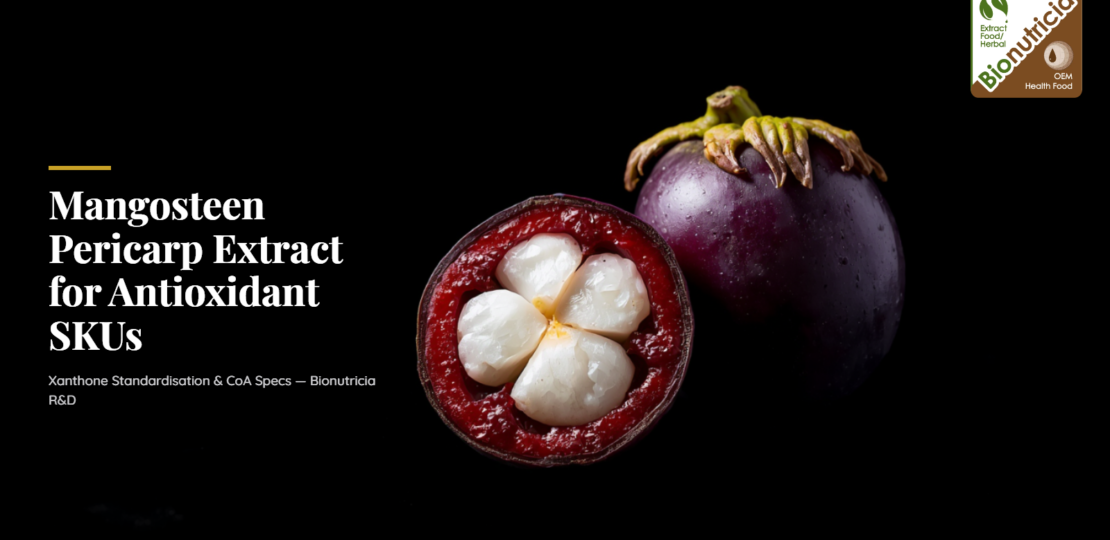
Direct answer: Mangosteen pericarp — the thick, deep purple-red rind of Garcinia mangostana, not the sweet white flesh inside — is standardised to its xanthone content, the polyphenolic compounds that give the rind its antioxidant activity. For a commercial-grade standardised extract, the specification to request is total xanthones ≥10–20% by HPLC (UV detection, typically 320–340 nm), with alpha-mangostin identified as the primary marker compound and gamma-mangostin as a secondary marker. Higher-purity grades — 40% total xanthones and above, with alpha-mangostin isolated to 90%+ purity in specialised extracts — exist for brands that want a concentrated antioxidant claim, though cost and yield trade off against purity. Always confirm the extract is made from pericarp (rind), not pulp, seed or whole-fruit powder: xanthones concentrate almost entirely in the rind, and a supplier quoting “mangosteen extract” without specifying plant part may be supplying a diluted, low-xanthone whole-fruit powder. Add total polyphenol content, an HPLC fingerprint, and standard microbial and heavy-metal limits to the contract. Bionutricia offers contract extraction of mangosteen pericarp in standardised and phytosome form, plus finished antioxidant SKUs — powder sachets, liquid sachets, pouch beverages and liquid bottles — under FSSC 22000 and JAKIM halal certification.
Pericarp vs. pulp: why plant part is the first thing to check
Mangosteen is unusual among tropical fruits in that its commercial value as a supplement ingredient sits almost entirely in a part most people throw away. The edible white segments are mild in flavour and contain negligible xanthone content. The dark purple-red rind — the pericarp — is where the plant concentrates xanthones as a natural defence compound, alongside tannins and other phenolics.
This matters commercially because “mangosteen extract” is not a precise enough spec on its own. A whole-fruit or pulp-inclusive powder can legitimately carry the mangosteen name while containing only a fraction of the xanthone content of a true pericarp extract. A correct Certificate of Analysis (CoA) should state plant part: pericarp (rind), dried — not “whole fruit” and not “pulp.” If a supplier cannot confirm plant part on the CoA, treat the quoted xanthone percentage with caution regardless of how high it looks on paper.
Why xanthones are the specification that matters
Two suppliers can both offer “standardised mangosteen extract” and deliver materially different ingredients. The variable that separates a genuinely standardised, bioactive extract from a nominal one is xanthone content and identity.
Xanthone family. Garcinia mangostana pericarp contains a family of prenylated xanthones, of which alpha-mangostin is the most abundant and most studied, with gamma-mangostin present as a secondary marker. These compounds are responsible for the antioxidant capacity associated with mangosteen rind extract in laboratory assays (DPPH, ORAC, FRAP). For OEM labelling, keep claims to permitted antioxidant / structure-function language rather than disease-treatment statements, and confirm exact wording against your destination market’s claims rules.
The assay to request. Total xanthone content is typically quantified by HPLC with UV detection around 320–340 nm, referenced against an alpha-mangostin standard. A supplier who can only offer a total-phenolic (Folin-Ciocalteu) reading, without an HPLC xanthone fingerprint, is not giving you a truly standardised extract — total phenolics is a useful secondary parameter, not a substitute for the xanthone assay.
Purity tiers. Commercial mangosteen pericarp extracts are commonly offered at 10%, 20% and 40% total xanthones, with specialised high-purity grades isolating alpha-mangostin to 90%+ for concentrated antioxidant or research-grade applications. Set your floor according to the positioning: a mass-market functional beverage may use a 10–20% grade blended with other antioxidants, while a premium single-ingredient SKU may specify 40%+.
Extract forms and what each suits
Spray-dried powder (most common for OEM)
Carrier: maltodextrin or tapioca starch (halal, non-GMO options available). Typical total xanthones: 10–40% depending on grade ordered. Moisture: ≤5%. Shelf life: 18–24 months ambient in moisture-controlled, light-protective packaging — xanthones are relatively heat-stable compared to anthocyanin-type pigments, but UV exposure over long storage can still degrade potency. Applications: powder-sachet antioxidant blends, premix systems, chewable tablet bases.
Liquid concentrate
Typical xanthone retention: comparable to or higher than spray-dried, since there is no drying step. Brix: 30–50 depending on concentration ratio. Shelf life: 6–12 months refrigerated, shorter ambient without a preservative or acid system. Applications: liquid-sachet antioxidant shots, RTD pouch beverages, liquid bottles.
High-purity xanthone concentrate
Where the brief calls for a concentrated, alpha-mangostin-forward ingredient rather than a general pericarp extract, higher-purity fractions (40%–90%+ alpha-mangostin) can be produced, typically at lower yield and higher unit complexity. This grade suits single-ingredient antioxidant formats such as chewable tablets or premium liquid shots rather than high-dilution beverage bases.
Standardisation specification: what to put in your contract
For any mangosteen pericarp extract procurement, include all of the following in the CoA requirement:
Identity & authenticity
- Botanical name: Garcinia mangostana L.
- Plant part: pericarp (rind), dried — not pulp, seed or whole fruit
- Country of origin stated; cultivated, traceable supply
Active marker assay
- Total xanthones: ≥10–20% (HPLC, UV ~320–340 nm) — set the exact floor to your positioning and cost target
- Alpha-mangostin identified as primary marker; gamma-mangostin as secondary marker
- Total polyphenols (Folin-Ciocalteu) as a secondary confirmatory parameter
Physical parameters
- Appearance: free-flowing dark reddish-brown to purple-brown powder (spray-dried) or dark liquid (concentrate)
- Moisture: ≤5.0% (powder)
- Particle size: ≥90% passing 80 mesh (powder)
Microbiological limits (Malaysian Food Act 1983 + BP/USP convention)
- Total plate count: ≤10,000 CFU/g
- Yeast and mould: ≤1,000 CFU/g
- E. coli: absent/25g · Salmonella spp.: absent/25g · S. aureus: absent/25g
Heavy metals (botanical extract standard)
- Lead (Pb) ≤2.0 ppm · Cadmium (Cd) ≤1.0 ppm · Mercury (Hg) ≤0.1 ppm · Arsenic (As) ≤1.5 ppm
Solvent residuals
- Water extraction: not applicable · Ethanol extraction: ≤5,000 ppm residual ethanol
Functional formats Bionutricia manufactures with mangosteen pericarp
Bionutricia’s vertically integrated model — from pericarp extraction to finished filling at the Sungai Buloh facility — means the team that standardises your mangosteen extract also fills your finished SKU, removing the CoA handoff risk between a separate extract supplier and co-packer.
Powder sachet (10–20g): mangosteen pericarp blended with other antioxidants, vitamin C or collagen for an instant antioxidant drink. Ambient-stable, 18–24 month shelf life.
Liquid sachet (30–50ml): single-serve antioxidant shot format. JAKIM halal certified at product level.
Pouch beverage (200–500ml): larger-volume RTD for café, gym and convenience-retail antioxidant or wellness positioning.
Liquid bottle (100–250ml): glass or PET wellness tonics where a concentrated xanthone extract is the hero ingredient.
Mangosteen pericarp pairs well with other polyphenol-forward botanicals — roselle, moringa — in a multi-antioxidant SKU, and all can be extracted and finished under one roof.
Why traceable Southeast Asian origin is a defensible spec
Mangosteen is grown across Southeast Asia — Thailand, Indonesia, the Philippines and Malaysia are all established growing regions. Specifying cultivated, traceable pericarp supply gives an export-bound SKU two advantages. First, traceability: Malaysian agricultural suppliers maintain plantation, harvest and treatment records that satisfy the full traceability requirement of FSSC 22000 and JAKIM halal certification — documentation that loosely-aggregated regional supply chains often cannot provide consistently. Second, integrated processing: extracting and finishing in the same JAKIM-certified facility keeps the halal chain unbroken from rind to finished export carton, which is exactly what a customs inspector or an importer’s compliance team audits.
📚 Related guides
- Roselle (Hibiscus) Extract: Standardised Anthocyanin Content for Supplement & Beverage OEM
- Moringa Extract OEM: Standardisation for Supplement & Beverage Brands
- How to Read a Supplement Certificate of Analysis (CoA): A Buyer’s Guide
Frequently asked questions
What xanthone spec should I ask for in a mangosteen pericarp extract?
For a standardised, commercial-grade powder, ask for total xanthones ≥10–20% by HPLC (UV detection ~320–340 nm), with alpha-mangostin confirmed as the primary marker compound. Raise the floor to 40% or higher for a premium, more concentrated antioxidant positioning. Always pair the percentage with an HPLC fingerprint and a stated plant part of pericarp (rind), not whole fruit.
Is mangosteen pericarp extract the same as mangosteen juice or whole-fruit powder?
No. Xanthones concentrate almost entirely in the rind (pericarp), not the edible pulp. Whole-fruit powders and juices are diluted by pulp content and typically carry a much lower, often unstated, xanthone level. Always confirm plant part is pericarp on the CoA.
What is the difference between alpha-mangostin and total xanthones?
Alpha-mangostin is the single most abundant xanthone in mangosteen pericarp and the primary marker compound used for identity and potency testing. “Total xanthones” is the broader family sum, including gamma-mangostin and other minor xanthones. A complete CoA reports both the total xanthone percentage and the alpha-mangostin marker level.
Is mangosteen pericarp extract halal-certified?
Mangosteen pericarp is a plant-derived botanical with no haram inputs. Bionutricia’s mangosteen extraction and finished-beverage manufacturing are both covered under JAKIM facility-level halal certification, so finished SKUs carry halal status through to export.
Does Bionutricia extract mangosteen pericarp in-house or buy it in?
In-house. Bionutricia provides contract extraction of mangosteen pericarp in standardised and phytosome form, then spray-dries, blends and fills the finished SKU at the same Sungai Buloh facility — so a single CoA chain covers the ingredient and the finished product.
Ready to develop a mangosteen antioxidant SKU?
Vertically integrated mangosteen pericarp extraction and finished manufacturing under FSSC 22000 and JAKIM halal. Standardised xanthone spec, full CoA stack, and powder-sachet, liquid-sachet, pouch-beverage and liquid-bottle formats. Free formulation consultation and 24-hour RFQ reply.
Request a quotation · See our OEM services · View our certifications
WhatsApp: +60 16-661 8510
Article by Bionutricia R&D Team. Last updated: July 29, 2026.
RELATED POSTS
View all

Knowledge: Dandelion (Taraxacum Officinale)
October 5, 2024 | by bionutriciaadmin
Knowledge: Kaffir Lime Extract Liquid (Citrus hysteria, Citrus hystrix)
October 5, 2024 | by bionutriciaadmin
Knowledge: Fermented Black Garlic (Allium sativum L.)
October 5, 2024 | by bionutriciaadmin