

Moringa Extract OEM: Standardisation for Supplement & Beverage Brands
July 22, 2026 | by supersuper
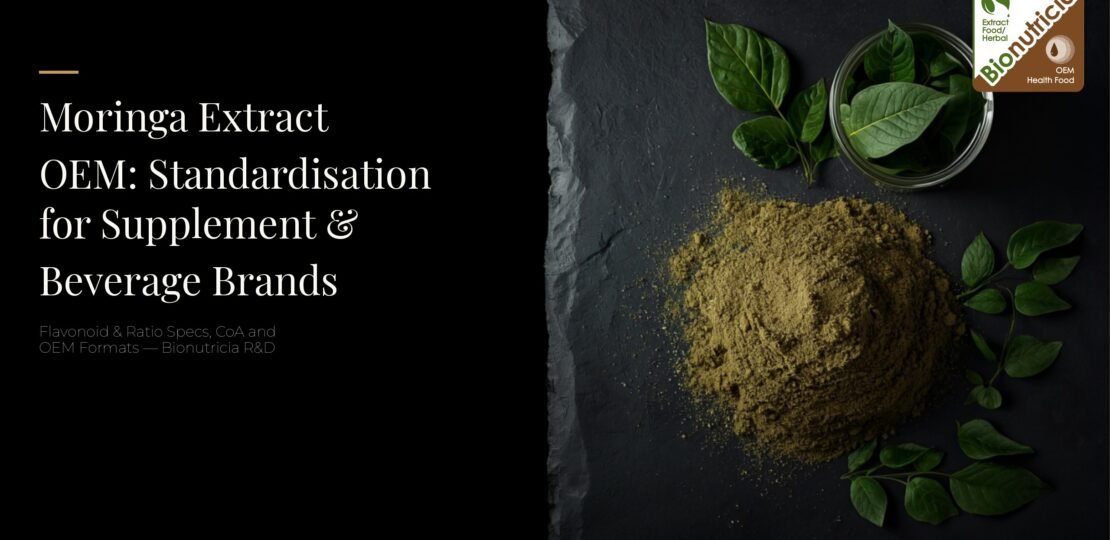
Direct answer: A moringa (Moringa oleifera) leaf extract for supplement or beverage OEM should be standardised on two dimensions, not one: an extraction ratio (commonly 10:1 or 20:1 against dried leaf) and a named, HPLC-verifiable active marker — total flavonoids, expressed as quercetin equivalent, is the most widely used and commercially available marker, typically specified at ≥1.0% for a standard-grade extract and ≥2.0% for a potency-forward SKU. Chlorogenic acid is a secondary marker some suppliers quote alongside flavonoids, but published values vary enormously by extraction solvent and leaf origin, so it should never be accepted as a standalone spec without a matching HPLC chromatogram. A raw, unstandardised “moringa leaf powder” (whole-leaf, sun- or drum-dried, no solvent extraction) is a different, cheaper product — it belongs in a different brief and should never be substituted for a standardised extract on a spec sheet without the brand’s sign-off. Verdict: ask for extraction ratio + total flavonoids (as quercetin, HPLC) as the two non-negotiable numbers on the CoA; treat chlorogenic acid as a bonus marker, not the primary spec. Bionutricia’s OEM team formulates and fills standardised moringa leaf extract into finished, JAKIM halal-certified SKUs at its Sungai Buloh facility, in powder, liquid and beverage formats.
Why “moringa extract” needs a spec sheet before it needs a marketing angle
Moringa is marketed heavily on general nutrition claims — vitamins, minerals, amino acids, antioxidants — and that breadth is exactly why an unspecified “moringa extract” line item on a supplier quote is a red flag. Without a stated extraction ratio and a named active marker, a brand cannot verify batch-to-batch consistency, cannot defend a label claim if challenged, and cannot compare two suppliers’ quotes on equal terms. The fix is straightforward: require both an extraction ratio (how concentrated the extract is relative to dried leaf) and a quantified marker compound (what specifically was measured to confirm potency).
Extraction ratio: the concentration number
Moringa leaf extract is typically supplied as a ratio extract — most commonly 10:1 (10 kg of dried leaf reduced to 1 kg of extract) or 20:1 for a more concentrated, lower-dose SKU. A ratio extract is a legitimate, widely used format, but the ratio alone does not guarantee a consistent level of any specific active compound — two 10:1 extracts from different leaf lots can carry meaningfully different flavonoid content. This is why a ratio number should always be paired with a marker-compound assay, never quoted alone as if it were a potency guarantee.
Active marker: total flavonoids (as quercetin) is the workable standard
Moringa leaf is rich in flavonoid glycosides, with quercetin derivatives and kaempferol derivatives the most studied. In practice, the commercially workable standardisation marker is total flavonoid content, expressed as quercetin equivalent, quantified by HPLC or a validated spectrophotometric method (e.g. aluminium chloride colorimetric assay, cross-checked against an HPLC reference standard). A reasonable specification range for OEM purposes is:
- Standard-grade extract: total flavonoids ≥1.0% (as quercetin, HPLC), 10:1 ratio
- Potency-forward extract: total flavonoids ≥2.0% (as quercetin, HPLC), 20:1 ratio or further concentrated
Chlorogenic acid is sometimes quoted as a secondary or co-marker. Published literature on chlorogenic acid content in moringa leaf extracts is inconsistent — figures vary by more than an order of magnitude depending on solvent polarity, extraction temperature and leaf provenance — so a brand should treat a chlorogenic acid figure as supplementary evidence, not the primary CoA spec, unless the supplier can produce a matching validated HPLC method for that specific batch.
Standardised extract vs raw leaf powder: not the same product
A whole-leaf moringa powder (dried and milled leaf, no solvent extraction step) is a real, common ingredient — used for its general nutrient density and “whole food” positioning — but it is not a substitute for a standardised extract on a spec sheet. Raw leaf powder carries no quantified active marker and its nutrient content varies with growing conditions, harvest timing and drying method. If a supplier quotes “moringa powder” against a brief that asked for standardised extract, that is a scope mismatch, not a cheaper equivalent — flag it before formulation begins.
Certificate of Analysis: what to require
Whichever grade is chosen, the CoA should confirm:
| Parameter | Specification |
|---|---|
| Botanical name & plant part | Moringa oleifera Lam., leaf |
| Extraction ratio | 10:1 or 20:1 (extraction solvent class disclosed) |
| Total flavonoids (as quercetin, HPLC) | ≥1.0% standard-grade / ≥2.0% potency-forward |
| Appearance | Fine powder, olive-green to dark green |
| Moisture | ≤6.0% |
| Particle size | 80–100 mesh (beverage-ready) |
| Total plate count | ≤10,000 CFU/g |
| Yeast and mould | ≤1,000 CFU/g |
| E. coli, Salmonella spp., S. aureus | Absent/25g |
| Lead (Pb) | ≤2.0 ppm |
| Cadmium (Cd) | ≤1.0 ppm |
| Mercury (Hg) | ≤0.1 ppm |
| Arsenic (As) | ≤1.5 ppm |
Colour intensity is a rough but useful visual QC check — an unusually pale or brown-green powder can indicate over-processing or poor leaf quality.
Heavy-metal screening matters more for a leafy-green ingredient than for many botanicals, since leaves can accumulate soil-borne heavy metals more readily than roots, bark or fruit — ask the supplier for the origin farm’s soil-testing history if the crop is grown at scale.
What the flavonoid spec does — and doesn’t — support on a label
A verified total-flavonoid figure is a manufacturing and quality-control spec, not automatically a substantiated health claim. “Standardised to ≥1.0% flavonoids (as quercetin, HPLC)” is a factual, defensible statement about the raw material — it confirms batch consistency and lets a formulator calculate an accurate per-serving dose. It is a separate exercise, usually involving regulatory and legal review specific to the target market, to determine what structure/function or antioxidant-support claim (if any) that dose level can support on a finished-product label. Brands should keep these two conversations distinct: the CoA spec answers “is this raw material consistent and traceable,” while the claims review answers “what can I legally say about it.” Bionutricia’s OEM formulation brief process flags this separation early so a brand isn’t left reconciling the two after formulation is already locked.
supply and traceability for a leafy-green ingredient
Moringa is grown widely across South and Southeast Asia, and leaf quality varies meaningfully with growing region, harvest season and post-harvest drying method — a rushed or high-heat drying step can degrade flavonoid content before extraction ever begins. For an OEM brief, ask the supplier for harvest-to-extraction traceability (farm or region of origin, harvest date range, drying method) alongside the CoA. This matters more for moringa than for many botanicals precisely because the finished-extract flavonoid level is sensitive to upstream handling, not just the extraction step itself — a well-run extraction cannot fully compensate for leaf that was poorly dried or stored before processing.
Formats Bionutricia manufactures with moringa extract
Bionutricia’s OEM team formulates and fills standardised moringa leaf extract into finished SKUs at the Sungai Buloh facility, in the approved format set:
Powder sachet (single-serve): the most common moringa format — standardised extract blended with citrus, ginger or other functional botanicals to offset the leafy-green flavour profile, dissolved in water.
Chewable tablet: a lower-dose, travel-friendly format, typically paired with a core powder sachet range rather than replacing it.
Pouch beverage: ready-to-drink green-nutrition beverage for retail or café channels, often layered with fruit or herbal flavour to manage moringa’s naturally grassy, slightly bitter profile.
Liquid bottle: concentrated moringa tonic or wellness shot format, typically positioned in a premium daily-greens range.
📚 Related guides
- Pandan Leaf Extract in Functional Beverages: From Raw Material to Finished SKU
- Pegaga (Centella asiatica) Extract for Beauty & Cognitive Supplements
- How to Choose a Halal Botanical Extract Supplier in Malaysia
Frequently asked questions
What should I standardise a moringa extract to for supplements and beverages?
Specify both an extraction ratio (commonly 10:1 or 20:1) and a quantified active marker — total flavonoid content as quercetin equivalent, verified by HPLC, at ≥1.0% for a standard-grade extract or ≥2.0% for a potency-forward SKU. Treat chlorogenic acid as a secondary marker only, since published values vary widely by extraction method.
Is moringa leaf powder the same as moringa leaf extract?
No. Whole-leaf powder is dried and milled leaf with no standardisation and no quantified active marker; extract has undergone a concentration/extraction step and carries a verifiable ratio and marker-compound assay. They are different products and should not be substituted for each other without the brand’s approval.
Why does chlorogenic acid content vary so much between suppliers?
Chlorogenic acid yield is highly sensitive to extraction solvent, temperature and leaf provenance, so published figures differ by more than an order of magnitude across studies and suppliers. It’s a useful secondary data point but should not be relied on as the sole standardisation marker without a matching validated HPLC method for that specific batch.
What formats can Bionutricia make with moringa extract?
Powder sachet, chewable tablet, pouch beverage and liquid bottle — all JAKIM halal-certified and formulated to offset moringa’s naturally grassy flavour profile where the brand wants a more palatable finished product.
Does Bionutricia grow or extract moringa in-house?
Bionutricia’s in-house extraction capability, built on 20+ years of R&D, covers standardised botanical actives including leafy-green ingredients like moringa. The team can formulate to a brand-specified extraction ratio and flavonoid marker and fill the finished, JAKIM halal-certified SKU at the Sungai Buloh facility.
Ready to develop a moringa SKU?
JAKIM halal-certified formulation and filling for standardised moringa leaf extract, in powder-sachet, chewable-tablet, pouch-beverage and liquid-bottle formats. Full CoA review and a free formulation consultation.
Request a quotation · See our OEM services · View our certifications
WhatsApp: +60 16-661 8510
Article by Bionutricia R&D Team — in-house registered pharmacist, nutritionist, dietitian, and PhD biomedical scientist. Last updated: July 21, 2026.
RELATED POSTS
View all

How to Choose a Halal Botanical Extract & Nutraceutical OEM Supplier in Malaysia
June 24, 2026 | by supersuper
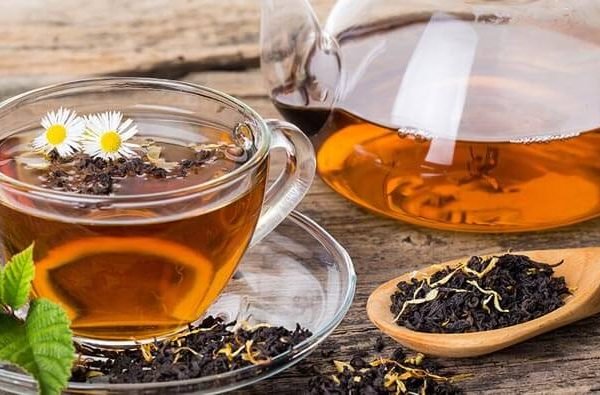
Knowledge: Black Tea (Camellia Sinensis)
October 5, 2024 | by bionutriciaadmin
Knowledge: Kacip Fatimah (Labisia pumila)
October 5, 2024 | by bionutriciaadmin