

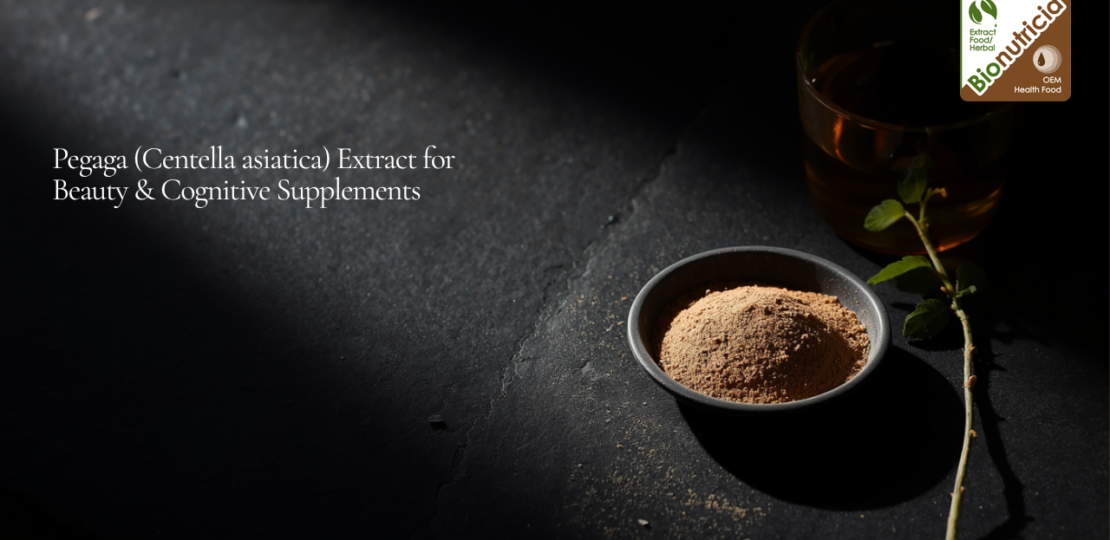
Pegaga (Centella asiatica) Extract for Beauty & Cognitive Supplements
July 4, 2026 | by supersuper
Direct answer: For a Centella asiatica (pegaga, also called gotu kola) extract, the specification that matters most is asiaticoside content — the marker triterpene that defines a genuine gotu kola extract. As the trade saying goes, without asiaticoside it is not really Centella. Ask your supplier to standardise to a stated asiaticoside percentage, verified by HPLC, and to report the companion markers — madecassoside, asiatic acid and madecassic acid — alongside it. Bionutricia’s Gotu Kola / Centella extract is a 100:1 extract standardised to 0.3–0.8% asiaticoside, produced by ultrasonic hot-water/solvent extraction and lab-tested for identity and active content. Higher-concentration “TECA” pharmaceutical fractions (standardised to a much larger total-triterpene figure) exist for specialised skin applications, but for supplement and beverage OEM a defined asiaticoside spec on a food-grade botanical extract is the practical standard. Always confirm the botanical name is Centella asiatica (L.) Urban, that the plant part is the aerial part / whole herb, and that the material is not confused with Bacopa monnieri, which shares the common name “Brahmi” but is a different plant. Bionutricia offers contract extraction of Centella in standardised and phytosome form, plus finished halal SKUs — powder sachets, chewable tablets, liquid bottles and pouch beverages — under FSSC 22000 and JAKIM certification.
Pegaga, gotu kola, Brahmi: naming the plant correctly
Before you brief a supplier, settle the name. Centella asiatica (L.) Urban is a low-growing herb of the Apiaceae family. In Malaysia it is pegaga; in the wider supplement trade it is gotu kola or Indian pennywort; in Ayurveda it is often called Brahmi. That last name is where buyers get caught out.
“Brahmi” is ambiguous. The name is applied to two different plants — Centella asiatica and Bacopa monnieri. They are botanically unrelated and have entirely different active chemistry: Centella is standardised to triterpenes such as asiaticoside and madecassoside, while Bacopa is standardised to bacosides. If a spec sheet simply says “Brahmi extract,” that is not a specification — insist on the Latin binomial. For a pegaga SKU you want Centella asiatica (L.) Urban, full stop.
The used part is the aerial herb. Centella is harvested for its leaves and stems — the aerial parts — where the triterpenoids concentrate. A correct Certificate of Analysis will state plant part: aerial parts (whole herb, dried). Root-only or unspecified material should prompt a question.
Why asiaticoside is the specification that matters
Two buyers can order “Centella extract” and receive materials that perform very differently. The variable that separates a genuine, bioactive ingredient from a weak commodity powder is its marker-triterpene content — and the marker that matters first is asiaticoside.
The markers. Centella’s activity is driven by a group of pentacyclic triterpenoids. The two dominant glycosides are asiaticoside and madecassoside; their corresponding aglycones (sugar-free forms) are asiatic acid and madecassic acid. Asiaticoside is the primary identity-and-activity marker: a supplier who cannot state and prove an asiaticoside figure is not really selling you standardised gotu kola. Bionutricia’s standard grade is a 100:1 extract standardised to 0.3–0.8% asiaticoside, with the companion triterpenes reported on the CoA.
How extraction sets the level. Bionutricia produces its Centella extract by ultrasonic hot-water/solvent extraction — the green-biotech method behind the company’s patented extraction platform — which concentrates the marker triterpenes while keeping the process food-grade and traceable. The 100:1 ratio describes how much raw herb is concentrated into the finished powder; the asiaticoside percentage describes how much active is verified to be present. Both belong on your spec, because a ratio alone does not guarantee an active level.
Skin (the “cica” story). Centella is the botanical behind the “cica” category in beauty-from-within and topical care. Its triterpenes are studied for supporting collagen synthesis, skin-barrier resilience and the appearance of firmness, which is why it pairs naturally with collagen and vitamin-C beauty SKUs. For ingestible supplements, keep marketing to permitted structure/function and beauty-support language and confirm wording against your destination market’s claims rules.
Cognitive and micro-circulatory. Gotu kola has a long traditional use for mental clarity and calm focus, and modern interest centres on the same triterpenes plus its microcirculation-supporting profile. As with any botanical, the honest position for an OEM is to standardise the actives and let the brand build a compliant claim on top — not to promise disease outcomes.
The assay to request. Asiaticoside and the companion markers are quantified by HPLC. A supplier who offers only a “100:1 ratio extract” with no asiaticoside figure is selling you a concentration ratio, not a verified active level — those are not the same thing. Always ask for the HPLC assay number and the lab report behind it.
Extract forms and what each suits
Standardised spray-dried powder (most common for OEM)
Carrier: maltodextrin or tapioca-derived options (halal, non-GMO available). Bionutricia standard: 100:1, 0.3–0.8% asiaticoside by HPLC. Moisture: ≤5%. Shelf life: 18–24 months ambient in moisture-controlled packaging. Applications: powder sachets, chewable-tablet bases, beauty and nootropic premixes. Spray-dried Centella is the most supply-stable form and blends cleanly into dry operations. Note the finished extract powder is a light tan-brown — the green colour belongs to the fresh leaf, not the standardised powder.
Phytosome / herbosomal form
Centella triterpenes are relatively large, polar molecules, so a phytosome (phospholipid-complexed) form is a popular way to support absorption of the actives. Bionutricia’s patent-pending herbosomal platform pairs the triterpenic fraction with food-grade phospholipids, which suits premium beauty-from-within and cognitive SKUs where bioavailability is a selling point.
Liquid concentrate
For liquid bottles, pouch beverages and wellness shots, Centella can be supplied as a concentrate. Applications: beauty tonics, botanical hydration drinks and calm-focus shots. Liquid formats carry cold-chain and preservation considerations that the R&D team confirms against your matrix.
Standardisation specification: what to put in your contract
For any Centella asiatica (pegaga) procurement, include all of the following in the CoA requirement:
Identity & authenticity
- Botanical name: Centella asiatica (L.) Urban — not Bacopa monnieri
- Plant part: aerial parts / whole herb (dried) — not root-only or unspecified
- Country of origin stated; cultivated, traceable supply
Active marker assay
- Asiaticoside: stated percentage by HPLC (Bionutricia standard grade: 0.3–0.8% asiaticoside at 100:1) — the primary identity-and-activity marker
- Companion markers reported: madecassoside, asiatic acid, madecassic acid
- Extract ratio and extraction method disclosed (Bionutricia: 100:1, ultrasonic hot-water/solvent extraction)
Physical parameters
- Appearance: free-flowing fine powder, light tan-brown (spray-dried)
- Moisture: ≤5.0%
- Particle size: ≥90% passing 80 mesh
Microbiological limits (Malaysian Food Act 1983 + BP/USP convention)
- Total plate count: ≤10,000 CFU/g
- Yeast and mould: ≤1,000 CFU/g
- E. coli: absent/25g · Salmonella spp.: absent/25g · S. aureus: absent/25g
Heavy metals (botanical extract standard)
- Lead (Pb) ≤2.0 ppm · Cadmium (Cd) ≤1.0 ppm · Mercury (Hg) ≤0.1 ppm · Arsenic (As) ≤1.5 ppm
Solvent residuals
- Water extraction: not applicable · Ethanol/solvent extraction: ≤5,000 ppm residual solvent
Functional formats Bionutricia manufactures with Centella
Bionutricia’s vertically integrated model — from aerial-herb extraction to finished filling at the Sungai Buloh facility — means the team that standardises your Centella also fills your finished SKU, removing the CoA handoff risk between a separate extract supplier and a co-packer.
Powder sachet (5–15g): Centella blended with collagen, vitamin C or botanical systems for a beauty-from-within or calm-focus drink. Ambient-stable, 18–24 month shelf life.
Chewable tablet: a convenient daily beauty or cognitive-support format, with Centella standardised to a declared asiaticoside level per tablet.
Liquid bottle (100–250ml): beauty tonics and calm-focus wellness shots where a clean botanical story is the selling point.
Pouch beverage (200–500ml): larger-volume ready-to-drink for café, gym and convenience-retail channels, Centella layered with complementary botanicals.
Centella pairs especially well with collagen and liposomal vitamin C systems in the beauty-from-within space — and all can be produced under one roof.
Why Malaysian-origin pegaga is a defensible spec
Centella asiatica grows across South and Southeast Asia, but specifying Malaysian-origin, cultivated, traceable pegaga gives an export-bound SKU two advantages. First, traceability: Malaysian agricultural suppliers maintain plantation, harvest and treatment records that satisfy the traceability requirements of FSSC 22000 and JAKIM halal certification — documentation that loosely-aggregated or wild-harvested supply often cannot provide. Second, integrated processing: extracting and finishing in the same JAKIM-certified facility keeps the halal chain unbroken from harvested herb to finished export carton, which is exactly what a customs inspector or a Gulf importer audits.
Related guides
- Kacip Fatimah (Labisia pumila) Extract OEM: Standardisation, Benefits & supply
- Phytosome vs Liposomal Delivery: Which Absorption Tech Wins for Botanicals?
- How to Read a Supplement Certificate of Analysis (CoA): A Buyer’s Guide
Frequently asked questions
What asiaticoside spec should I ask for in a Centella asiatica extract?
Ask for a stated asiaticoside percentage verified by HPLC, with the companion markers — madecassoside, asiatic acid and madecassic acid — reported alongside. Bionutricia’s standard grade is a 100:1 extract standardised to 0.3–0.8% asiaticoside. Avoid ratio-only extracts (“100:1”) that quote no asiaticoside figure — a ratio is not a verified active level.
Is pegaga the same as gotu kola and Brahmi?
Pegaga and gotu kola are both common names for Centella asiatica. “Brahmi,” however, is ambiguous — it is used for both Centella asiatica and the unrelated Bacopa monnieri. Always confirm the Latin binomial on the CoA so you receive the plant with the triterpene chemistry you intend.
Is a phytosome form of Centella worth it?
For premium beauty-from-within and cognitive SKUs, often yes. Centella’s triterpenes are large, polar molecules, and a phytosome (phospholipid complex) is a recognised way to support their absorption. Bionutricia’s patent-pending herbosomal platform can deliver Centella in this form for brands where bioavailability is a selling point.
Is Bionutricia’s Centella extract halal-certified?
Centella is a plant-derived botanical with no haram inputs. Bionutricia’s Centella extraction and finished manufacturing are covered under JAKIM facility-level halal certification, so finished SKUs carry halal status through to export.
Does Bionutricia extract Centella in-house or buy it in?
In-house. Bionutricia provides contract extraction of Centella asiatica in standardised and phytosome form using ultrasonic hot-water/solvent extraction, then blends and fills the finished SKU at the same facility — so a single CoA chain covers the ingredient and the finished product.
Ready to develop a pegaga / Centella SKU?
Vertically integrated Centella asiatica extraction and finished manufacturing under FSSC 22000 and JAKIM halal. Standardised asiaticoside spec, full CoA stack, and powder-sachet, chewable-tablet, liquid-bottle and pouch-beverage formats. Free formulation consultation and 24-hour RFQ reply.
Request a quotation · See our OEM services · View our certifications
WhatsApp: +60 16-661 8510
Article by Bionutricia R&D Team. Last updated: July 5, 2026.
RELATED POSTS
View all

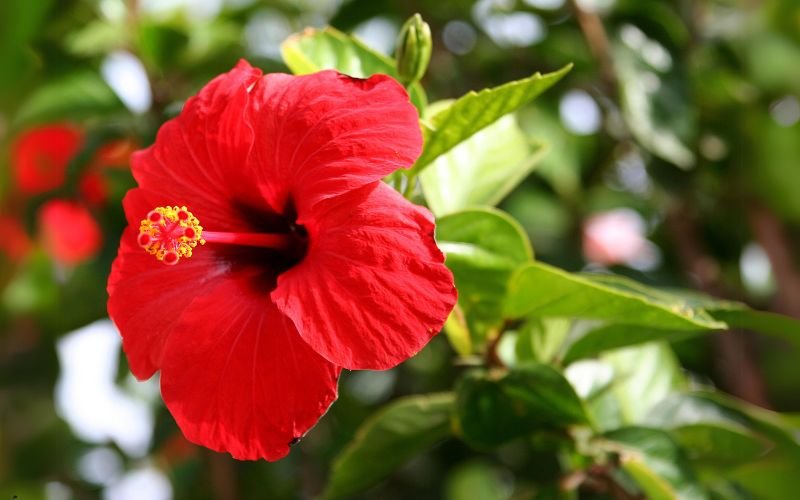
Knowledge: Rose Hibiscus Extract Liquid (Rosa rubiginosa), (Hibiscus sabdariffa L.)
October 5, 2024 | by bionutriciaadmin
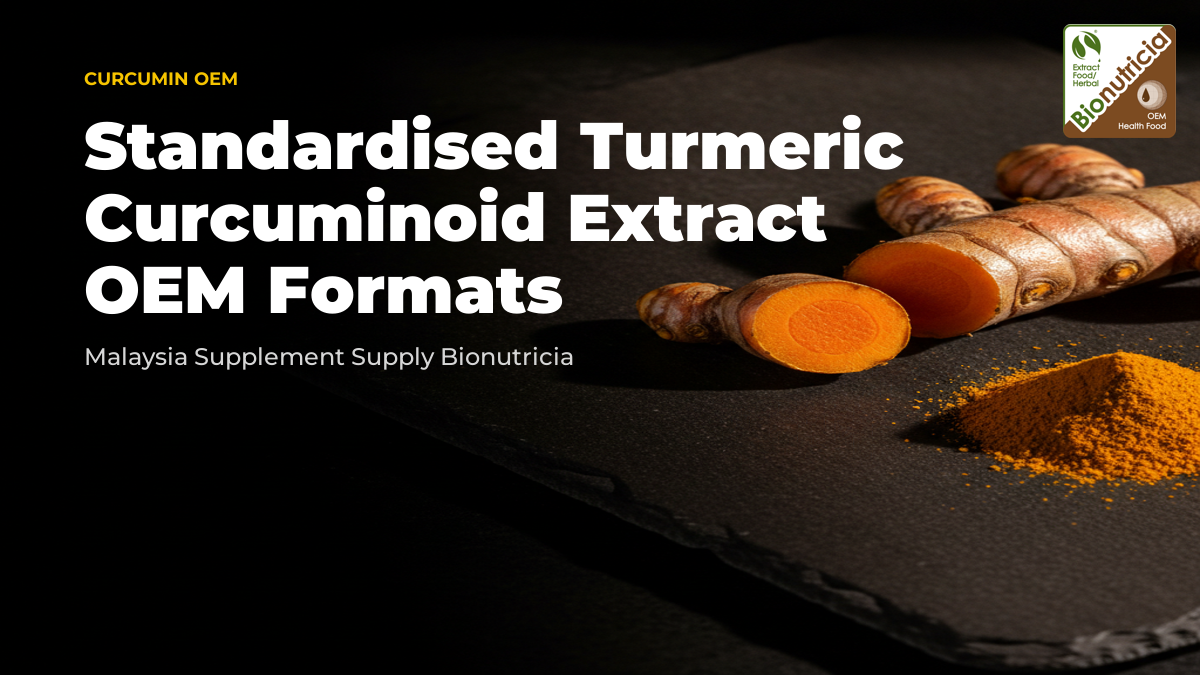
Standardised Turmeric (Curcuma longa) Extract OEM: Curcuminoid Specification & Formats
August 18, 2026 | by supersuper
Tongkat Ali (Eurycoma longifolia) Extract OEM: Eurycomanone Standardisation & Halal Formats
August 2, 2026 | by supersuper