

Cinnamon (Cinnamomum burmannii) Bark Extract for Functional Food & Beverage OEM
August 18, 2026 | by supersuper
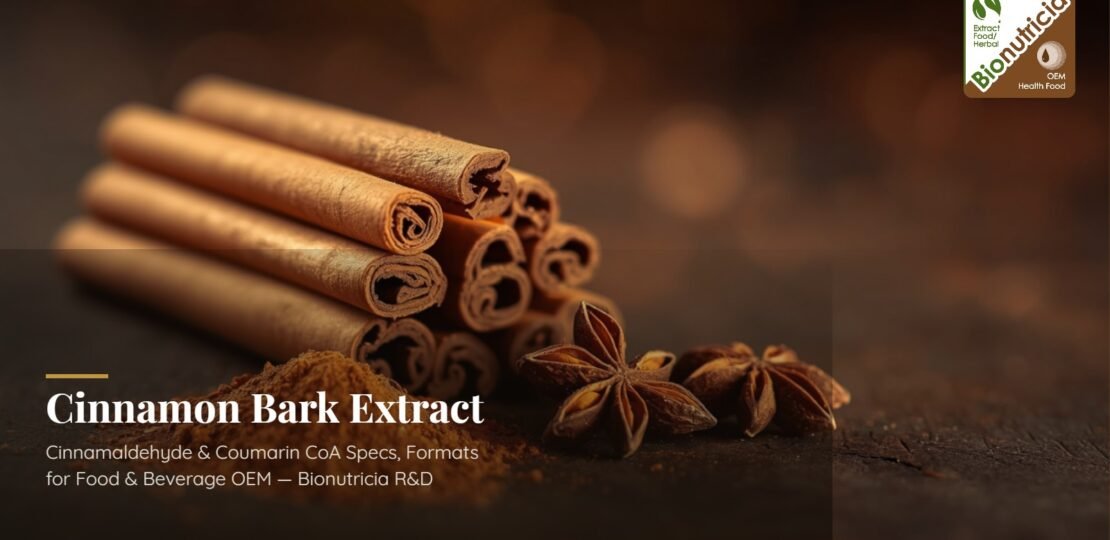
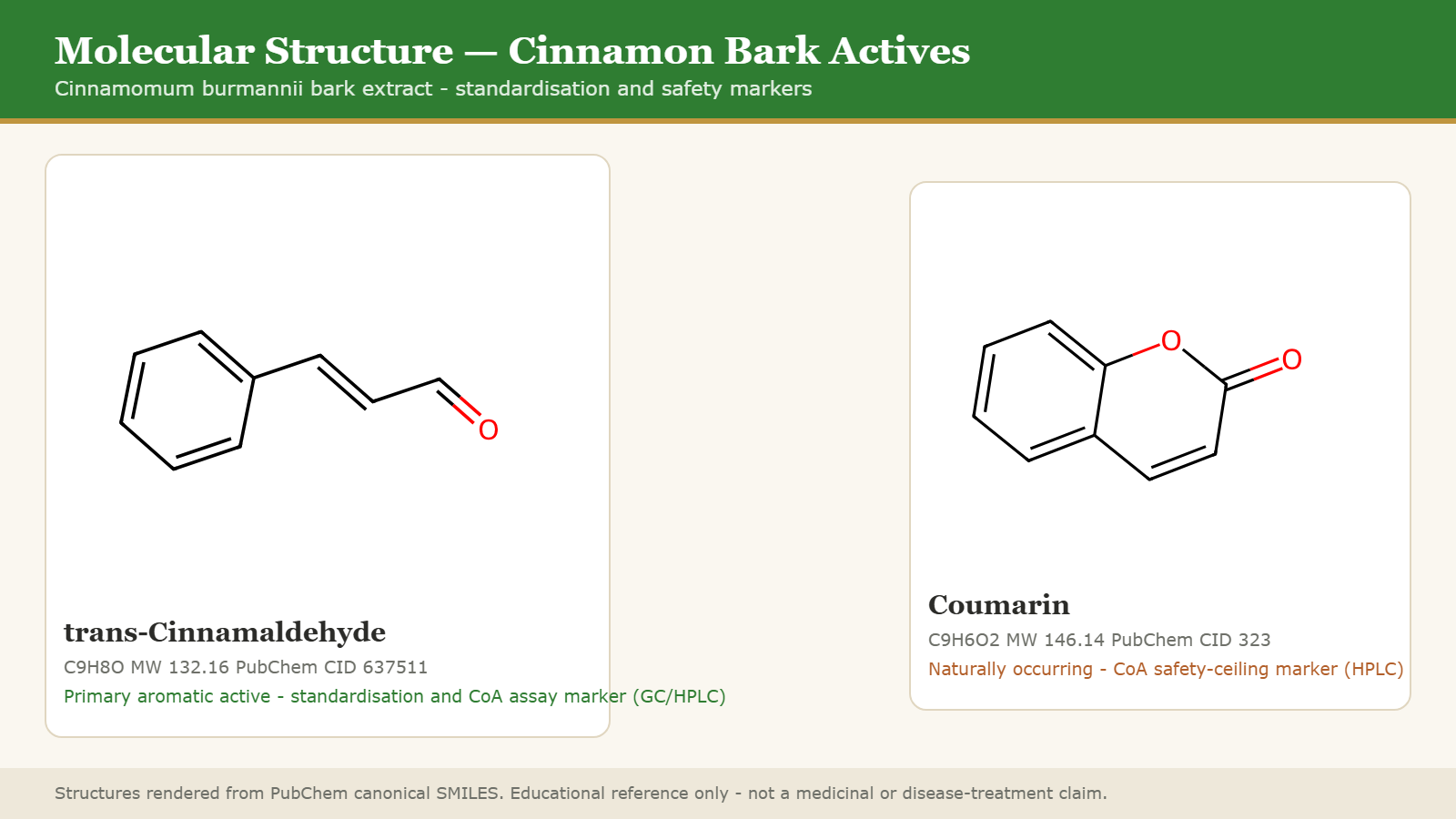
Direct answer: Specify a Cinnamomum burmannii bark extract standardised to a minimum cinnamaldehyde content — typically 1.0-5.0% for a 10:1 to 20:1 water or hydro-alcoholic extract, assayed by GC or HPLC — alongside a quantified coumarin ceiling tested by HPLC, since cassia-type cinnamons (including C. burmannii) naturally carry far more coumarin than Ceylon cinnamon (Cinnamomum verum). Bionutricia standardises cinnamon bark extract on Cinnamomum burmannii, the cassia-type cinnamon that dominates Southeast Asian and global commercial supply, running it through the same patented enzymatic ultrasonic extraction process (MY-188945-A) used across its botanical range before spray-drying to a stable, halal-certified powder for functional food and beverage formulation. A compliant Certificate of Analysis should report identity (macroscopic and TLC/HPTLC fingerprint), a cinnamaldehyde assay, coumarin content referenced against the EFSA tolerable daily intake of 0.1 mg/kg body weight/day, plus standard microbial and heavy-metal limits. Cinnamon bark extract is supplied as powder, liquid or gel sachets, pouch beverages, chewable tablets, or liquid bottles — Bionutricia does not offer capsule, softgel or gummy formats. This guide covers the ingredient strictly as a flavour, colour and polyphenol-antioxidant functional food/beverage input; any specific health claim on a finished label needs its own regulatory substantiation and sits outside a food-classified OEM SKU.
What Is Cinnamon (Cinnamomum burmannii) Bark Extract?
Cinnamomum burmannii, commonly called Indonesian cassia or Padang cassia, is the inner bark of an evergreen tree in the Lauraceae family, harvested, dried into quills or chips, and either ground directly or processed into a concentrated extract. It is the cassia-type species that supplies the large majority of the world’s commercial “cinnamon” — including most ground cinnamon sold at retail across Southeast Asia, the US and Europe — distinct from the smaller, more expensive Ceylon cinnamon (Cinnamomum verum) associated with Sri Lanka.
As an extract rather than raw ground bark, it concentrates the bark’s aromatic and phenolic fraction — principally cinnamaldehyde (the compound responsible for cinnamon’s characteristic aroma and pungency), along with cinnamic acid, procyanidin-type tannins, and other polyphenols — into a standardised, assayable powder that gives an OEM formulator a consistent flavour and functional profile batch to batch, which raw ground spice cannot reliably guarantee.
Cassia vs Ceylon: Why the Species Matters for OEM Specification
The single most important technical distinction when specifying any cassia-type cinnamon extract — burmannii, cassia, or loureiroi — is coumarin. Coumarin is a naturally occurring aromatic lactone that contributes to cinnamon’s sweet scent, but at sustained high intake it is associated with liver effects, which is why the European Food Safety Authority (EFSA) has set a tolerable daily intake (TDI) of 0.1 mg coumarin per kg of body weight per day. Published surveys from Germany’s Federal Institute for Risk Assessment (BfR) and related food-safety studies report cassia-type cinnamon bark running in the range of roughly 1-11 mg coumarin per gram, while Ceylon cinnamon contains only trace, largely non-quantifiable amounts.
This does not disqualify C. burmannii as a functional food ingredient — cassia cinnamon is used in food and beverage products worldwide within normal culinary serving sizes — but it does mean a buyer’s Certificate of Analysis should always carry a quantified coumarin figure (by HPLC) rather than assuming a spice ingredient needs no heavy-metal-style ceiling. A formulator working on a higher-inclusion RTD beverage or a daily-use sachet should size the coumarin contribution against the EFSA TDI for the finished serving, the same way a formulator would size any other dose-dependent constituent.
Pharmacology: How Cinnamon Bark Actives Work in the Body
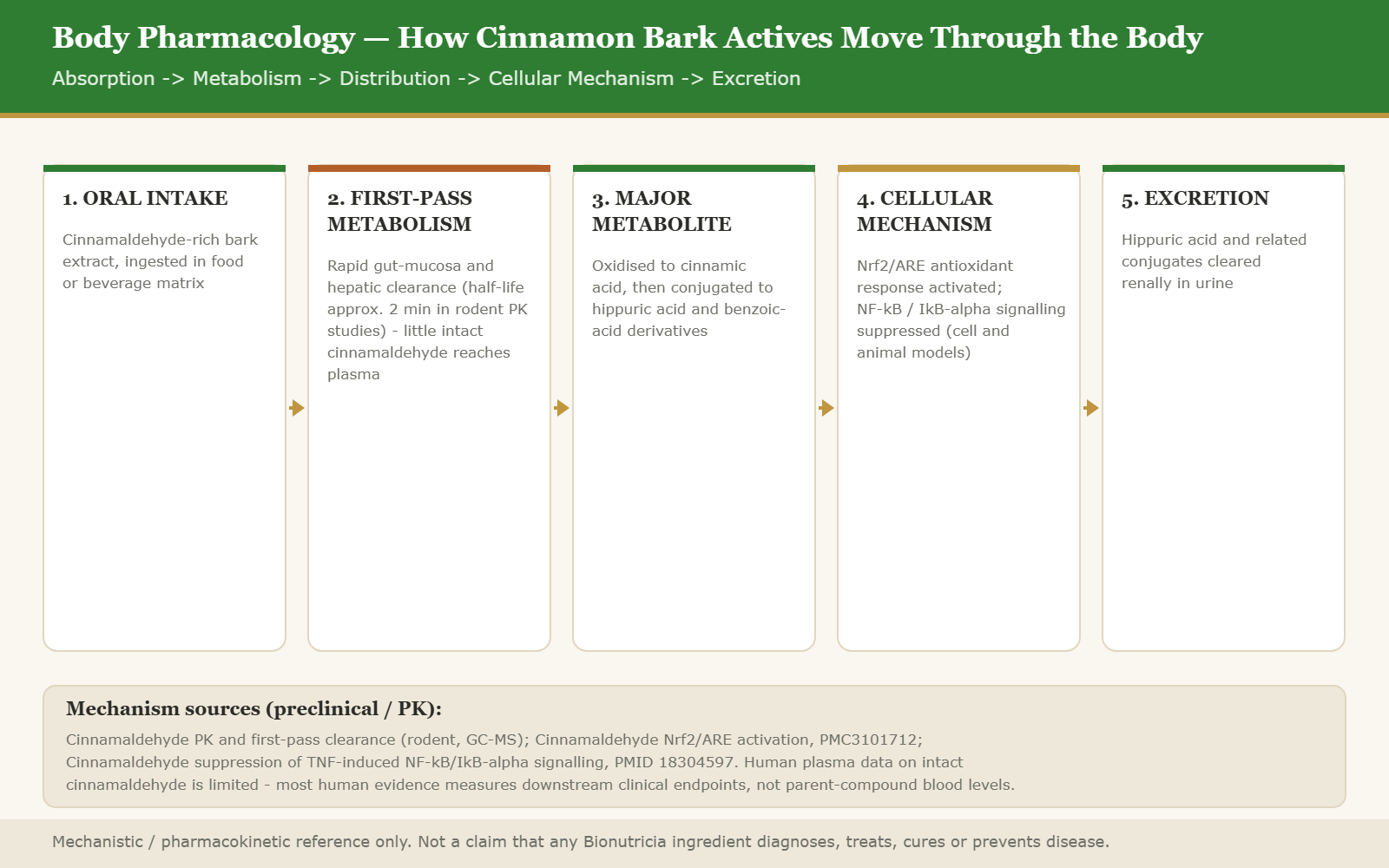
Cinnamaldehyde is rapidly metabolised. Pharmacokinetic studies report that intact cinnamaldehyde is largely undetectable in plasma after oral intake — it undergoes extensive first-pass metabolism in the gut mucosa and liver, with an estimated clearance in the order of minutes, and is oxidised to cinnamic acid before further conjugation to hippuric acid and related benzoic-acid derivatives, which are then cleared renally. In other words, very little parent cinnamaldehyde itself circulates; most of what has been studied mechanistically comes from cell and animal models rather than human plasma measurements.
At the cellular level, in vitro and animal studies describe two linked mechanisms: cinnamaldehyde has been shown to activate the Nrf2/antioxidant-response-element (ARE) pathway — promoting Nrf2 nuclear translocation and upregulation of antioxidant genes such as thioredoxin reductase-1 — and to suppress NF-κB inflammatory signalling by blocking degradation of the inhibitory protein IκBα, reducing downstream expression of cell-adhesion and pro-inflammatory markers in endothelial cell models. These are the same antioxidant/anti-inflammatory pathway families reported for many polyphenol-rich botanical extracts; they describe laboratory mechanism, not a clinical outcome or treatment claim.
What Does the Published Clinical Research Show?
The most frequently cited human trial is Khan et al. (2003), a randomised, placebo-controlled study in 60 people with type 2 diabetes in Pakistan. Participants took 1, 3, or 6 grams of cassia cinnamon daily for 40 days; all three active doses reduced mean fasting serum glucose by 18-29%, triglycerides by 23-30%, LDL cholesterol by 7-27%, and total cholesterol by 12-26%, with no significant change in the placebo groups. Notably, the reductions were similar across all three doses — the study did not report a clear dose-response gradient.
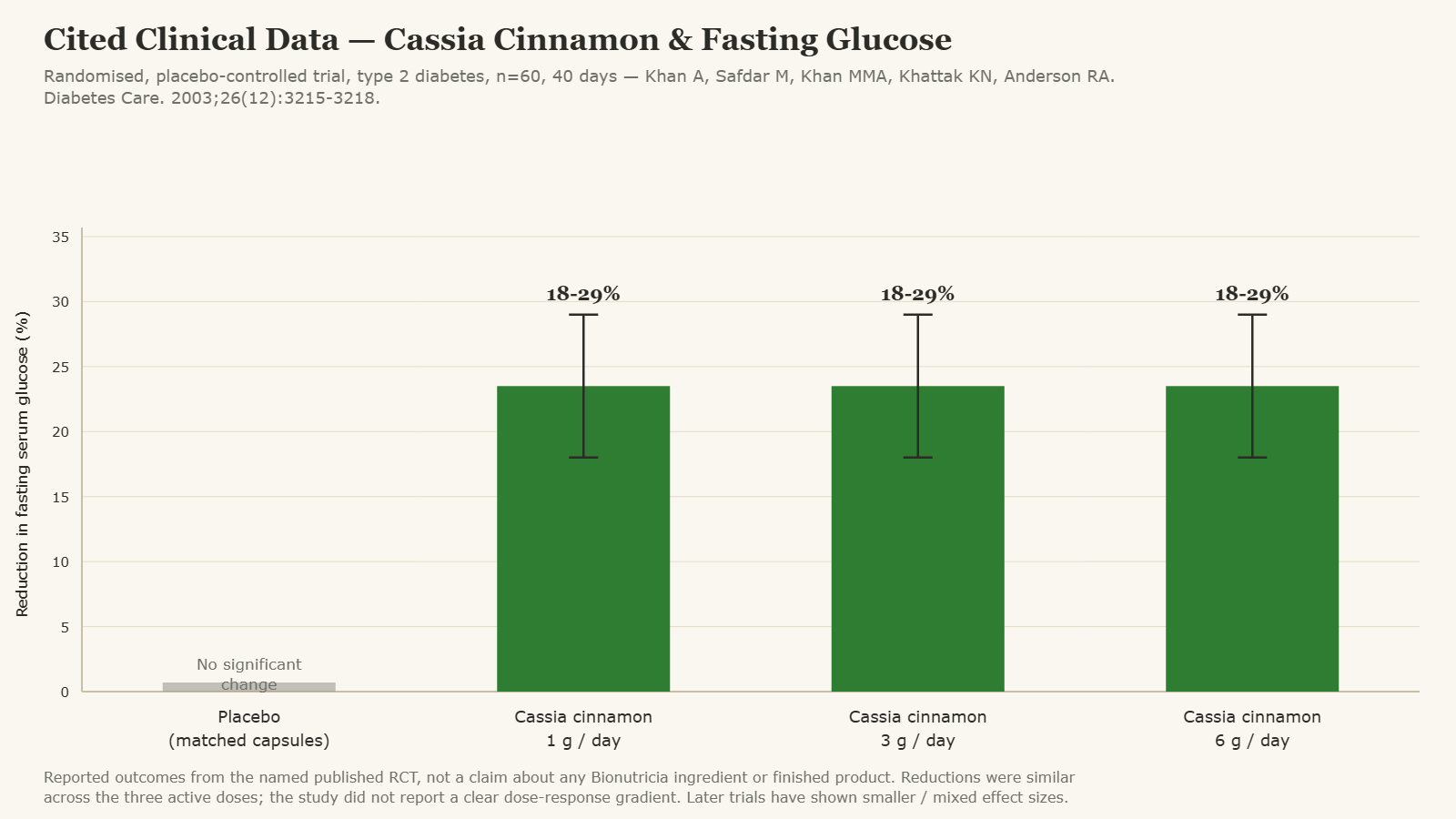
This single trial generated most of cinnamon’s popular reputation as a “blood sugar spice,” but it should be read alongside the wider literature: a later systematic review and meta-analysis of randomised trials (Allen et al., Annals of Family Medicine, 2013) pooled multiple cinnamon studies and found a statistically significant but modest average reduction in fasting glucose, with substantial variability between trials attributable to differences in cinnamon species, dose, and study population — some trials since have found smaller or non-significant effects. The evidence is real and worth citing accurately, but it is mixed in magnitude, not uniformly strong. This section is included for scientific/educational completeness under Bionutricia’s standing content policy; it is not a claim that Bionutricia’s cinnamon bark extract or any finished product manufactured with it treats, manages, or controls blood glucose or diabetes. A brand wishing to make any such structure-function or health claim on a finished label is responsible for its own separate regulatory and clinical substantiation.
Typical Certificate of Analysis (CoA) Specification
Ask any cinnamon bark extract supplier for a CoA covering identity, potency, the coumarin safety marker, and standard contaminant limits before qualifying a batch:
| Parameter | Typical specification | Method |
|---|---|---|
| Identity | Cinnamomum burmannii bark; macroscopic/organoleptic conforming; TLC/HPTLC fingerprint match to reference | Pharmacopoeial TLC/HPTLC |
| Cinnamaldehyde content | 1.0-5.0% (extract-ratio dependent; e.g. 10:1-20:1 water or hydro-alcoholic extract) | GC or HPLC |
| Coumarin content | Quantified and reported; ceiling set with reference to EFSA TDI 0.1 mg/kg bw/day for the finished serving | HPLC |
| Total polyphenols (optional secondary marker) | Reported as mg GAE/g | Folin-Ciocalteu |
| Loss on drying | ≤5.0% | LOD / moisture balance |
| Total Plate Count | ≤10,000 CFU/g | Pharmacopoeial microbial |
| Yeast & Mould | ≤1,000 CFU/g | Pharmacopoeial microbial |
| E. coli / Salmonella / S. aureus | Absent/25g | Pharmacopoeial microbial |
| Lead (Pb) | ≤2.0 ppm | ICP-MS |
| Cadmium (Cd) | ≤1.0 ppm | ICP-MS |
| Mercury (Hg) | ≤0.1 ppm | ICP-MS |
| Arsenic (As) | ≤1.5 ppm | ICP-MS |
A supplier that cannot return a coumarin figure on request is a flag — for a cassia-type ingredient it is as material to formulation safety as a heavy-metal panel.
OEM Formats for Cinnamon Bark Extract
Bionutricia processes standardised cinnamon bark extract into the formats it manufactures under contract:
- Powder sachets — spice-blend sachets, instant chai/masala mixes, bakery premixes
- Liquid sachets and gel sachets — concentrated flavour shots, warming-beverage bases
- Pouch beverages — ready-to-mix or ready-to-drink spiced/functional beverage lines
- Chewable tablets — spice-forward wellness chewables where cinnamon is a flavour-masking or flavour-lead component
- Liquid bottles — bottled spiced tonics, syrups, and beverage concentrates
Bionutricia does not offer capsule, softgel, gummy, hard tablet, effervescent, or stick-pack formats for any ingredient, cinnamon included.
Applications in Functional Food & Beverage
Standardised cinnamon bark extract formulates well wherever a brand wants consistent warmth, sweetness-without-sugar perception, and an antioxidant polyphenol story without the sediment and colour variability of ground spice: spiced chai and golden-latte-style RTD or pouch beverages; bakery and confectionery flavour systems; seasonal seasoning and spice-blend sachets; wellness shots and tonics paired with ginger, turmeric, or citrus; and functional beverage lines built around a cinnamon-plus-polyphenol positioning. Because the extract is assayed and standardised, a formulator can dose to a target cinnamaldehyde level precisely, rather than adjusting a recipe around variable raw-spice potency batch to batch.
Related Guides
- Bentong Ginger Extract for Functional Food & Beverage OEM
- Moringa Extract OEM: Standardisation for Supplement & Beverage Brands
- How to Read a Supplement Certificate of Analysis (CoA): A Buyer’s Guide
Frequently Asked Questions
What’s the difference between Cinnamomum burmannii and Ceylon cinnamon for OEM formulation? Both are true cinnamon-family bark spices, but C. burmannii (like C. cassia) carries substantially more coumarin than Ceylon cinnamon (Cinnamomum verum) and has a stronger, more pungent cinnamaldehyde-forward flavour. Burmannii is the dominant, more widely available cassia type in commercial supply; Ceylon is a lower-coumarin, milder-flavoured, typically higher-cost alternative some brands prefer for a “true cinnamon” claim.
Why does coumarin content matter when specifying a cinnamon bark extract? Coumarin is naturally present in all cassia-type cinnamons at levels far higher than in Ceylon cinnamon, and EFSA has set a tolerable daily intake of 0.1 mg/kg body weight/day due to liver-related effects at sustained high intake. A CoA with a quantified, HPLC-tested coumarin figure lets a formulator size the ingredient’s inclusion rate against that reference for the finished serving.
What extract ratio should I ask for — 10:1, 20:1, or whole-herb powder? A 10:1 to 20:1 water or hydro-alcoholic extract standardised to a stated cinnamaldehyde percentage gives batch-to-batch consistency that whole-herb ground bark cannot guarantee, since raw spice potency varies with harvest and origin. Whole-herb powder remains appropriate where a brand specifically wants a “whole spice” label claim rather than an “extract” claim.
What formats can a cinnamon bark extract be delivered in for a Bionutricia OEM SKU? Powder sachets, liquid sachets, gel sachets, pouch beverages, chewable tablets, and liquid bottles. Bionutricia does not manufacture capsules, softgels, gummies, hard tablets, or effervescent tablets in any format.
Does cinnamon bark extract have published clinical research behind it? Yes — cassia cinnamon has been studied in human randomised controlled trials on fasting glucose and lipid parameters, most notably Khan et al. (2003), with a 2013 systematic review and meta-analysis (Allen et al.) finding a modest, variable average effect across pooled trials. This is published third-party research on the ingredient category, not a claim about any specific Bionutricia product or finished label — brands must independently substantiate any health claim they wish to make.
Article by Bionutricia R&D Team — reviewed in-house by our registered pharmacist, nutritionist, dietitian and PhD biomedical scientist. Last updated: 17 August 2026.
Request a quotation → · See our OEM services → · Our certifications → · WhatsApp +60 16-661 8510
RELATED POSTS
View all

Knowledge: Gotu Kola Pegaga (Centella asiatica)
October 5, 2024 | by bionutriciaadmin
Knowledge: Kaffir Lime Extract Liquid (Citrus hysteria, Citrus hystrix)
October 5, 2024 | by bionutriciaadmin
Knowledge: Black Tongkat Ali (Polyalthia bullata)
October 5, 2024 | by bionutriciaadmin