

Bentong Ginger Extract for Functional Food & Beverage OEM
July 17, 2026 | by supersuper
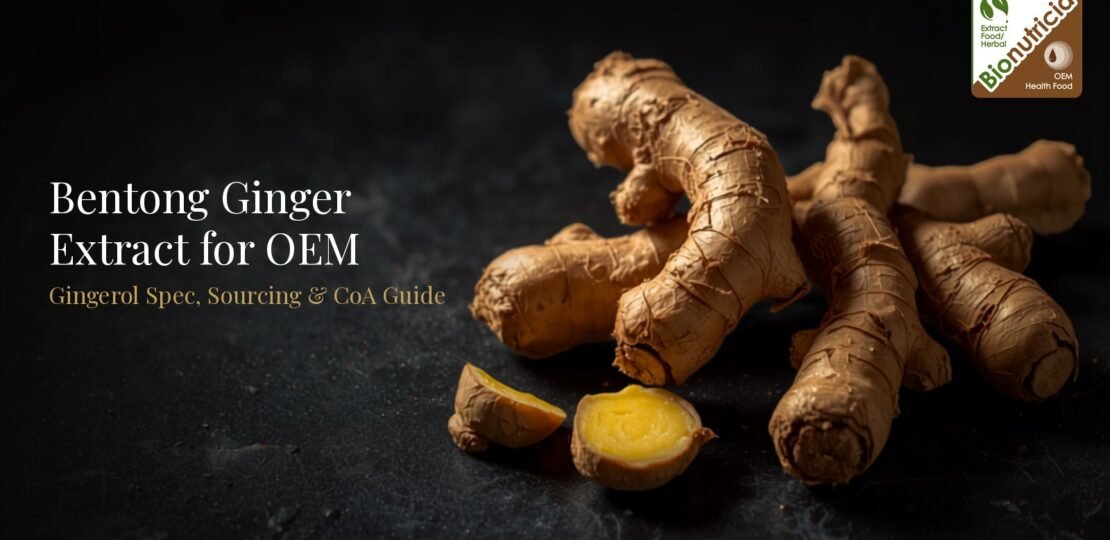
Direct answer: Bentong ginger — Zingiber officinale grown in the highlands around Bentong, Pahang, and recognised as a Pahang Geographical Indication (GI) since 2015 — is prized for a higher gingerol load than lowland-grown ginger, thanks to the cooler highland climate and fertile volcanic soil around Janda Baik and Bukit Tinggi. The specification that actually matters when you brief an OEM is total gingerol content, measured by HPLC and expressed as combined 6-, 8- and 10-gingerol (with 6-shogaol tracked separately as the heat-degradation marker). A defensible commercial floor for a standardised spray-dried extract is ≥2.5% total gingerols, rising to 5% for a potency-forward SKU under tighter thermal control; raw ginger root itself carries only 1–3% by comparison, and spray-drying’s heat exposure degrades a further portion of gingerol into 6-shogaol, so these floors are set to what a finished, post-drying batch can realistically hit — not a pre-processing estimate. Always confirm the plant part is rhizome (not leaf or stem), request an HPLC fingerprint alongside the percentage, and add moisture, particle size, microbial and heavy-metal limits to the contract. Bionutricia offers contract extraction of Bentong ginger in standardised and phytosome form, then fills the finished SKU — powder sachets, liquid sachets, pouch beverages and liquid bottles — under FSSC 22000 and JAKIM halal certification at the same Sungai Buloh facility.
What makes Bentong ginger different from generic ginger extract
“Ginger extract” on a spec sheet can come from almost anywhere — China, India, Nigeria and Peru are all major Zingiber officinale export origins, and quality varies widely by cultivar, soil and post-harvest handling. Bentong ginger is a named-origin exception: it is grown exclusively in the Bentong district of Pahang, Malaysia, in highland smallholdings near Janda Baik and Bukit Tinggi, and has been cultivated there for generations. In 2015, the Pahang Agriculture Bureau formally certified Bentong ginger as one of the state’s Geographical Indications — a legal recognition that ties the name to the place, similar in principle to Champagne or Darjeeling tea.
The agronomic reason buyers pay attention to this is straightforward: the cooler highland temperature and fertile soil slow the rhizome’s growth cycle, which research has associated with a stronger gingerol and shogaol accumulation and a more pronounced, fragrant, earthy-spicy aroma than lowland-grown ginger of the same species. For an OEM brief, that translates into a feedstock that can hit a higher standardisation target without diluting yield as heavily — a practical advantage when a brand wants a potency claim on the label.
The gingerol spec: what to actually put in the brief
Why gingerol (not “ginger extract %”) is the marker
Gingerols — principally 6-gingerol, with 8-gingerol and 10-gingerol as related homologues — are the pungent phenolic compounds responsible for both ginger’s characteristic heat and most of its studied bioactivity. When ginger is dried or heat-processed, a portion of gingerol dehydrates into 6-shogaol, a related compound that is more heat-stable and slightly more pungent. A rigorous CoA reports both: total gingerols as the primary marker, and 6-shogaol as a secondary marker that also signals how the material was processed (higher shogaol relative to gingerol usually means more thermal exposure during drying).
Asking a supplier for “ginger extract” without a gingerol percentage is the single most common mistake buyers make — it leaves room for a supplier to ship a low-potency, maltodextrin-heavy powder that technically qualifies as “extract” but delivers a fraction of the active load a formulator expects.
Typical standardisation ranges
Commercial ginger extracts are standardised across a wide band depending on positioning:
- 2.5% total gingerols — a sound, heat-loss-adjusted commercial floor for a standard spray-dried powder, roughly 1–2.5x more concentrated than raw ginger root (1–3% gingerols) once spray-drying losses are factored in.
- 5% total gingerols — a potency-forward specification suited to sports-recovery, anti-nausea or joint-support positioning, achievable only with tighter thermal control during extraction and drying to limit gingerol-to-shogaol conversion.
- 10%+ total gingerols — realistically only achievable as a concentrated oleoresin or CO2-extract rather than a spray-dried powder; a specialised, higher-cost order with its own handling, dosing and shelf-life considerations.
Set the floor to your formulation’s target dose and cost target, then hold the supplier to it with an HPLC assay on every batch — not just a certificate on file from a prior lot.
Extract forms Bionutricia produces
Spray-dried powder
Carrier: maltodextrin or tapioca starch (halal, non-GMO options available). Typical total gingerols: 2.5–5% (HPLC, combined 6-/8-/10-gingerol) — spray-drying’s heat exposure degrades part of the gingerol content to 6-shogaol, so this reflects the realistic finished-batch range, not the pre-drying figure. Moisture: ≤5%. Shelf life: 18–24 months ambient in moisture-controlled packaging. Applications: powder-sachet beverages, instant tea/tonic premixes, chewable tablet bases, capsule-free wellness blends. Spray-dried ginger is the most supply-chain-stable form and blends cleanly into dry-fill operations.
Liquid concentrate
Typical gingerol retention is higher than spray-dried because there is no drying step, at the cost of a shorter shelf life and cold-chain sensitivity. Brix and gingerol concentration are set by the extraction ratio. Applications: liquid-sachet shots, RTD pouch beverages, liquid bottles — where the pungent, warming ginger character is part of the sensory profile, not just the actives.
Standardisation specification: what to put in your contract
For any Bentong ginger extract procurement, include all of the following in the CoA requirement:
Identity & authenticity
- Botanical name: Zingiber officinale Roscoe, Bentong cultivar
- Plant part: rhizome (dried) — not leaf, not stem
- Origin stated: Bentong district, Pahang, Malaysia; cultivated, traceable supply
Active marker assay
- Total gingerols (6-, 8-, 10-gingerol): ≥2.5% by HPLC for spray-dried powder — set the exact floor to your potency and cost target, and confirm the figure is assayed on the finished, post-drying batch rather than a pre-processing estimate
- 6-shogaol reported separately as a processing/heat-exposure marker
- HPLC fingerprint confirming the gingerol/shogaol profile, not a colour or Brix reading alone
Physical parameters
- Appearance: free-flowing tan-to-brown powder (spray-dried) or amber liquid (concentrate)
- Moisture: ≤5.0% (powder)
- Particle size: ≥90% passing 80 mesh (powder)
Microbiological limits (Malaysian Food Act 1983 + BP/USP convention)
- Total plate count: ≤10,000 CFU/g
- Yeast and mould: ≤1,000 CFU/g
- E. coli: absent/25g · Salmonella spp.: absent/25g · S. aureus: absent/25g
Heavy metals (botanical extract standard)
- Lead (Pb) ≤2.0 ppm · Cadmium (Cd) ≤1.0 ppm · Mercury (Hg) ≤0.1 ppm · Arsenic (As) ≤1.5 ppm
Solvent residuals
- Water/ethanol extraction: ≤5,000 ppm residual ethanol where applicable
Functional formats Bionutricia manufactures with Bentong ginger
Bionutricia’s vertically integrated model — from rhizome extraction to finished filling at the Sungai Buloh facility — means the team that standardises your ginger also fills your finished SKU, removing the CoA handoff risk between an extract supplier and a separate co-packer.
Powder sachet (10–20g): ginger blended with honey powder, turmeric or electrolytes for an instant warming tonic or digestive-support drink. Ambient-stable, 18–24 month shelf life.
Liquid sachet (30–50ml): single-serve wellness-shot format for digestive, immune or recovery positioning. JAKIM halal certified at product level.
Pouch beverage (200–500ml): larger-volume RTD for café, gym and convenience-retail channels; ginger layered with lemon, honey or turmeric.
Liquid bottle (100–250ml): glass or PET tonics and shots where the pungent ginger profile is the front-of-pack selling point.
Chewable tablet: a capsule-free format for a ginger digestive-aid or travel/motion-sickness SKU, compressed with permitted excipients.
Ginger pairs well with liposomal vitamin C and turmeric/curcumin systems for an immune- or joint-positioned combination SKU, all producible under one roof.
Why GI-certified Bentong origin is a defensible spec
Ginger grows across the tropics, and China, India and Peru all supply large volumes of commodity-grade extract. Specifying Bentong-origin, GI-certified, cultivated and traceable ginger gives an export-bound SKU two advantages. First, traceability: Malaysian smallholder and agricultural supply chains linked to the Bentong GI maintain plantation and harvest records that satisfy the full traceability requirement of FSSC 22000 and JAKIM halal certification — documentation that commodity-aggregated ginger supply often cannot provide. Second, integrated processing: extracting and finishing in the same JAKIM-certified facility keeps the halal chain unbroken from rhizome to finished export carton, which is exactly what a Gulf importer or customs inspector audits on arrival.
📚 Related guides
- Knowledge: Black Ginger Extract Liquid (Kaempferia parviflora)
- Roselle (Hibiscus) Extract: Standardised Anthocyanin Content for Supplement & Beverage OEM
- How to Choose a Halal Botanical Extract Supplier in Malaysia
Frequently asked questions
What gingerol percentage should I specify for a Bentong ginger extract?
For a standardised spray-dried powder, ≥2.5% total gingerols (HPLC, combined 6-/8-/10-gingerol) is a sound commercial floor once heat-processing losses during spray-drying are accounted for — some gingerol degrades to 6-shogaol under drying heat, so this reflects a realistic finished-batch figure rather than a pre-processing estimate. Raise it to 5% for a potency-forward positioning such as sports recovery or digestive support, which requires tighter thermal control during extraction and drying. Pushing materially higher than that typically means moving to a concentrated oleoresin rather than a spray-dried powder. Always pair the percentage with an HPLC fingerprint so you are verifying authentic gingerol content, not just a colour or Brix reading.
Is Bentong ginger different from ordinary ginger, botanically?
No — Bentong ginger is the same species, Zingiber officinale, grown specifically in the highlands of Bentong, Pahang, and certified as a Pahang Geographical Indication since 2015. The highland climate and soil are associated with a higher gingerol and shogaol load and a more pronounced aroma than lowland-grown ginger, which is why buyers specify the origin rather than treating “ginger extract” as a commodity.
What’s the difference between gingerol and shogaol on a CoA?
Gingerols (6-, 8-, 10-gingerol) are the primary active compounds in fresh and lightly processed ginger. 6-shogaol forms when gingerol dehydrates under heat during drying or processing, and is more heat-stable. A complete CoA reports both — total gingerols as the main potency marker, and 6-shogaol as a secondary marker that also indicates processing intensity.
Is Bentong ginger extract halal-certified?
Ginger is a plant-derived botanical with no haram inputs. Bionutricia’s ginger extraction and finished-beverage manufacturing are both covered under JAKIM facility-level halal certification, so finished SKUs carry halal status through to export.
Does Bionutricia extract Bentong ginger in-house or buy it in?
In-house. Bionutricia provides contract extraction of Bentong ginger rhizome in standardised and phytosome form, then spray-dries, blends and fills the finished SKU at the same Sungai Buloh facility — so a single CoA chain covers the ingredient and the finished product.
Ready to develop a Bentong ginger SKU?
Vertically integrated ginger extraction and finished manufacturing under FSSC 22000 and JAKIM halal. Standardised gingerol spec, full CoA stack, and powder-sachet, liquid-sachet, pouch-beverage, liquid-bottle and chewable-tablet formats. Free formulation consultation and 24-hour RFQ reply.
Request a quotation · See our OEM services · View our certifications
WhatsApp: +60 16-661 8510
Article by Bionutricia R&D Team. Last updated: July 17, 2026.
RELATED POSTS
View all

Knowledge: Kale (Brassica oleracea var. sabellica)
October 5, 2024 | by bionutriciaadmin
Moringa Extract OEM: Standardisation for Supplement & Beverage Brands
July 22, 2026 | by supersuper
Knowledge: Red Tongkat Ali (Stema Tuberosa)
October 5, 2024 | by bionutriciaadmin