

Black Pepper (Piper nigrum) Extract: Piperine Standardisation for Food & Supplement OEM
August 29, 2026 | by supersuper
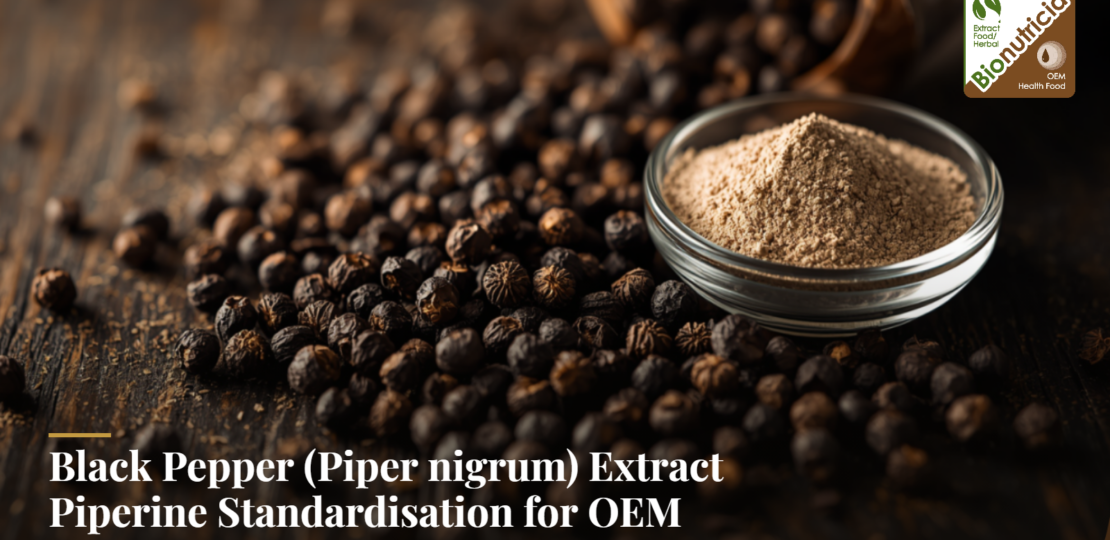
Direct answer: Specify a black pepper (Piper nigrum) fruit extract standardised to piperine content by HPLC — the industry benchmark is ≥95% piperine for a potency-forward, bioavailability-enhancer grade, or a lower ≥5% (roughly a 20:1 whole-fruit equivalent) grade for culinary-style spice applications where the full pepper flavour profile matters more than a single marker compound. Native dried black peppercorns naturally contain roughly 5–9% piperine by weight, so a supplier quoting a plain “black pepper extract” without a stated percentage and analytical method is not giving you a real specification. Ask for an identity fingerprint (TLC or HPLC match to a piperine reference standard), the piperine assay itself, and the standard microbial and heavy-metal panel. Piperine’s main functional role in OEM formulation is as a bioavailability-enhancing co-ingredient: published human trials have measured higher serum levels of co-administered nutrients — beta-carotene, coenzyme Q10, curcumin — when piperine was included alongside them, via inhibition of the CYP3A4 enzyme and the P-glycoprotein efflux pump. Bionutricia supplies standardised Piper nigrum extract from its Sungai Buloh facility (JAKIM halal, GMP, HACCP, FSSC 22000, US FDA, MeSTI) in powder, liquid and gel sachets, pouch beverages, chewable tablets and liquid bottles — most often co-formulated alongside a primary active rather than sold as a standalone SKU.
Why Piperine Standardisation Matters for OEM Buyers
Black pepper is one of the most widely traded spices in the world, and Malaysia’s own Sarawak pepper is internationally recognised — but “black pepper extract” on a supplier quote sheet is a category, not a specification. Piperine content in the raw peppercorn varies with cultivar, growing region, harvest timing and post-harvest processing, so two extracts both labelled “black pepper extract” can differ several-fold in actual potency. A buyer who accepts a percentage figure without knowing the analytical method behind it — and without a chromatogram to back it up — has no reliable way to compare quotes or verify batch-to-batch consistency.
This matters more for piperine than for many botanical markers because piperine is frequently added to a formula in small quantities specifically to modulate the absorption of a separate primary active. An under-potency piperine input silently weakens the entire absorption-enhancement rationale of the finished product, while an over-potency or adulterated input changes the dose calculation brands rely on for label claims. An HPLC-verified chromatogram showing a clean, resolved piperine peak against a certified reference standard is the only reliable way to confirm what is actually in the drum.
What “Piperine Content” Actually Means — Grades & Specification
Two grades cover most OEM applications, and the right one depends on why piperine is in the formula in the first place:
- Potency-forward grade, ≥95% piperine by HPLC. This is the concentrated, near-pure alkaloid fraction used when piperine’s job is specifically to act as a bioavailability-enhancing co-ingredient alongside a primary active such as curcumin, a fat-soluble vitamin, or a mineral chelate. At this potency, dosing is precise and the flavour/pungency contribution to the finished product is minimal at the small inclusion levels typically used.
- Whole-fruit-equivalent grade, ≥5% piperine (roughly a 20:1 concentration). This grade retains more of black pepper’s natural volatile oil and flavour compounds alongside the piperine, and suits culinary-style powders, spice blends, and beverage formats where pepper’s characteristic pungency and aroma are part of the product experience, not just the marker compound.
Whichever grade is specified, the CoA should report piperine content by HPLC specifically — not a generic “alkaloid content” or a colourimetric proxy — because piperine co-elutes with structurally similar isomers (such as chavicine and isopiperine) that a poorly validated assay method can misreport as piperine.
Pharmacology — How Piperine Works in the Body
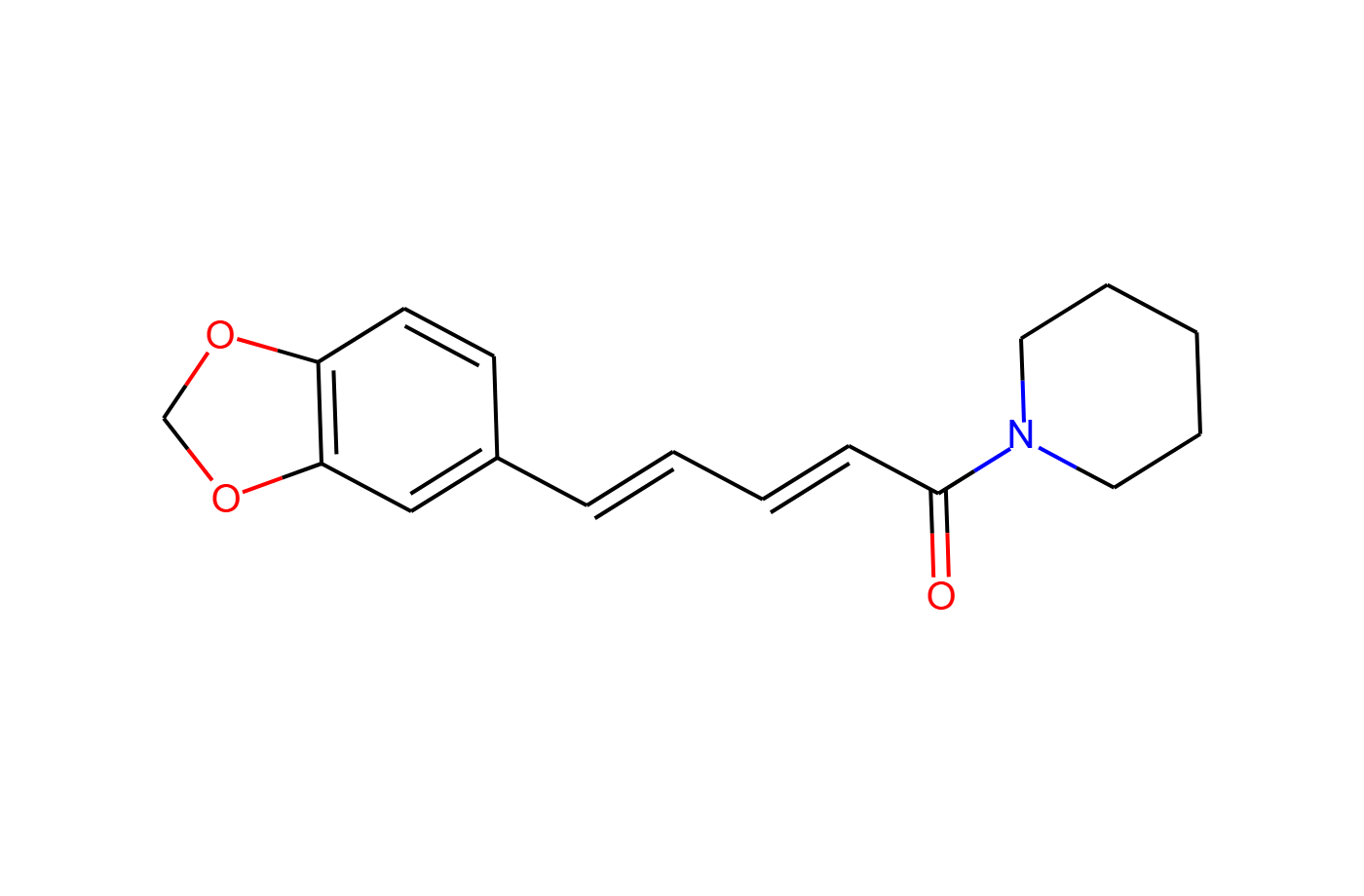
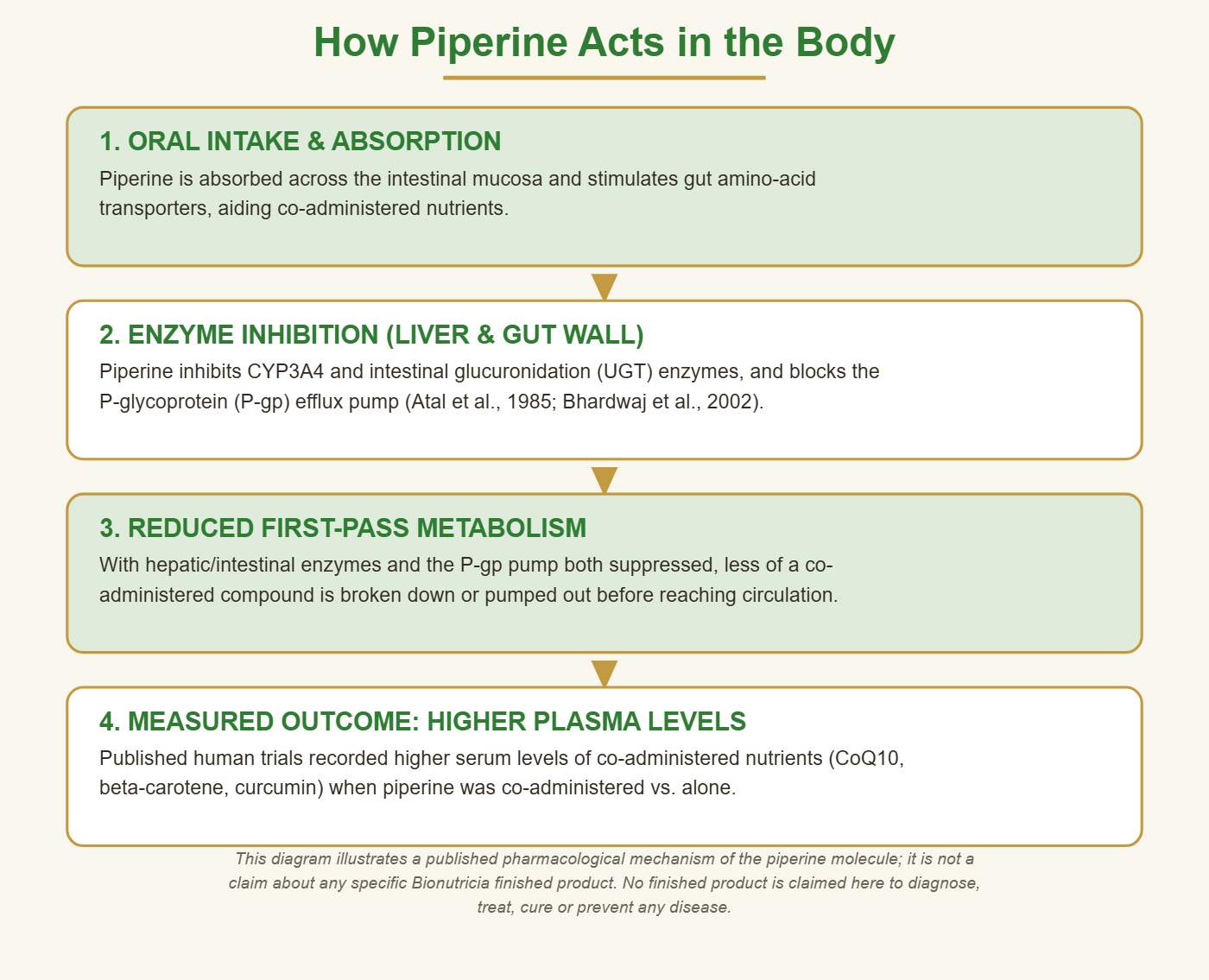
Piperine’s best-documented biological action is as a bioavailability enhancer for co-administered compounds, and the mechanism has been characterised in pharmacology literature since the mid-1980s. Piperine inhibits CYP3A4, a cytochrome P450 enzyme responsible for a large share of first-pass drug and phytochemical metabolism in the liver and intestinal wall, and also inhibits the P-glycoprotein (P-gp) efflux transporter, which normally pumps absorbed compounds back out of intestinal cells before they can reach systemic circulation (Atal et al., 1985; Bhardwaj et al., Journal of Pharmacology and Experimental Therapeutics, 2002). Piperine has also been shown to inhibit intestinal glucuronidation (UGT enzyme activity) and to stimulate gut amino-acid transporters, both of which independently support higher absorption of certain co-administered nutrients.
The practical effect of suppressing both a metabolising enzyme and an efflux pump at the same time is that a larger fraction of a co-administered compound survives first-pass metabolism and reaches the bloodstream intact — which is the basis for pairing piperine with actives that are otherwise poorly absorbed on their own, such as standardised curcumin.
What the Clinical Literature Shows
Several published human trials have measured piperine’s co-administration effect on specific nutrients:
Beta-carotene. In a human trial, co-administering piperine alongside oral beta-carotene supplementation over 14 days produced a significantly greater increase in serum beta-carotene response compared with beta-carotene alone (Badmaev, Majeed & Norkus, Nutrition Research, 1999).
Coenzyme Q10. In a separate human trial, piperine co-administration increased plasma coenzyme Q10 levels following oral supplementation compared with CoQ10 alone (Badmaev, Majeed & Prakash, Journal of Nutritional Biochemistry, 2000).
Curcumin. A widely cited human pharmacokinetic study found that co-administering 20 mg piperine alongside a 2 g oral curcumin dose produced measurably higher and faster-appearing serum curcumin concentrations than curcumin alone (Shoba et al., Planta Medica, 1998) — though later independent replication attempts have shown more mixed results, so this combination is best treated as a formulation option worth testing in a specific finished format rather than a guaranteed multiplier.
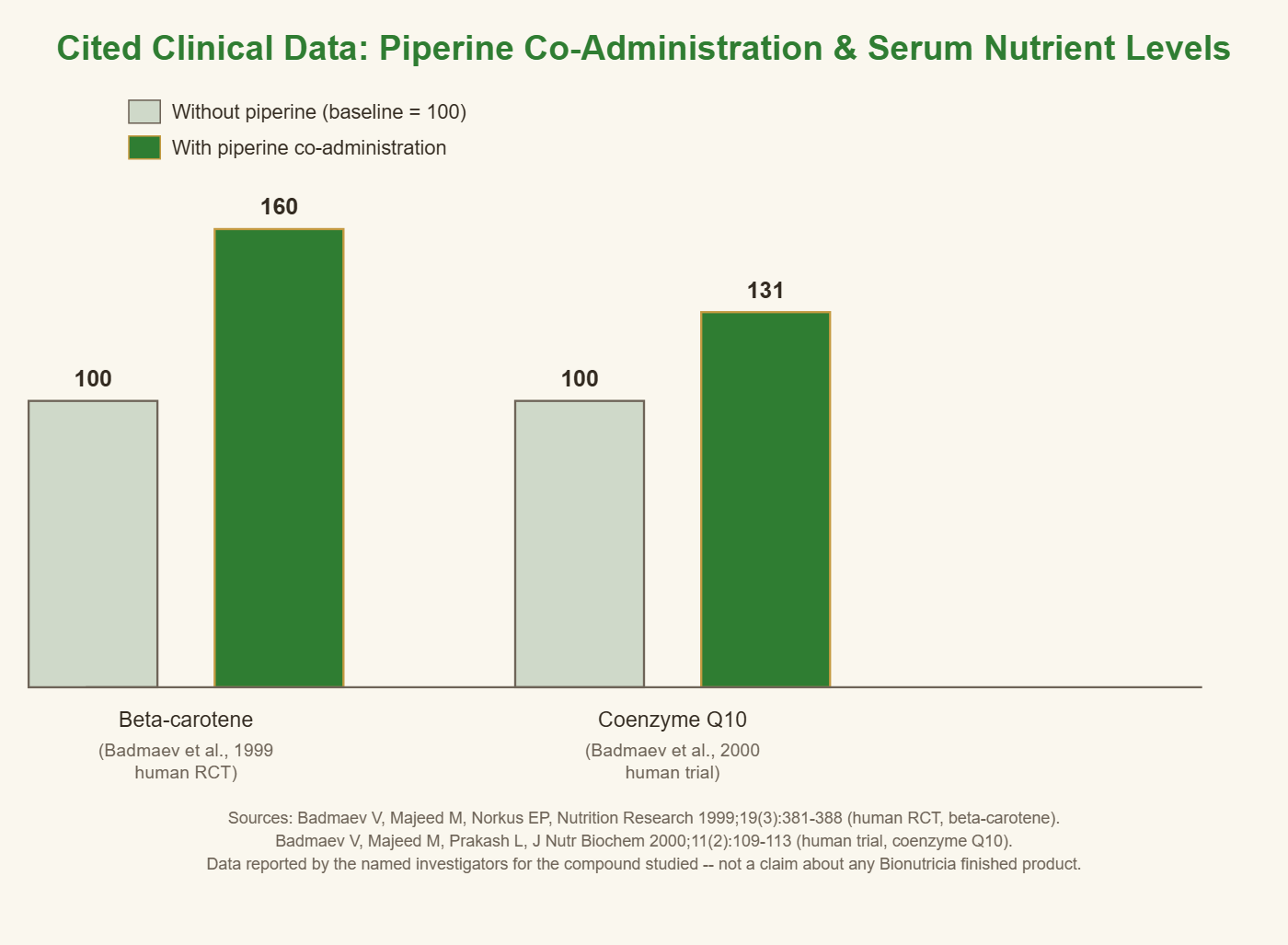
This section describes published research on the biological activity of the piperine compound class co-administered with other nutrients; it is not a claim about any specific Bionutricia finished product. Bionutricia supplies standardised Piper nigrum extract as a food-grade ingredient for functional food and beverage OEM. No finished product is claimed here to diagnose, treat, cure or prevent any disease, and brand owners remain responsible for ensuring their own finished-product claims are substantiated and compliant in each target market.
A Formulation Consideration: Enzyme Inhibition Cuts Both Ways
Because piperine inhibits the same CYP3A4 enzyme and P-glycoprotein pump used to metabolise and transport many oral medications, brand owners formulating a piperine-containing product should account for this as a genuine drug-interaction consideration in their own labelling and consumer guidance — not just a beneficial “absorption boost” story. This is a formulation and compliance matter for the brand owner to manage in their own finished-product claims and cautionary labelling; Bionutricia supplies the standardised ingredient and CoA data needed to support that assessment.
Certificate of Analysis — What to Specify
| Parameter | Specification |
|---|---|
| Identity | Macroscopic/organoleptic conformance + TLC or HPLC fingerprint match to piperine reference standard |
| Active marker assay | Piperine by HPLC — ≥95% (potency-forward, bioavailability-enhancer grade) or ≥5%, equivalent to a 20:1 concentration (whole-fruit spice grade) |
| Total plate count | ≤10,000 CFU/g |
| Yeast & mould | ≤1,000 CFU/g |
| E. coli / Salmonella spp. / S. aureus | Absent in 25 g |
| Lead (Pb) | ≤2.0 ppm |
| Cadmium (Cd) | ≤1.0 ppm |
| Mercury (Hg) | ≤0.1 ppm |
| Arsenic (As) | ≤1.5 ppm |
OEM Formats for Piperine / Black Pepper Extract
Bionutricia manufactures piperine and black pepper extract formulations only in its approved OEM formats:
- Powder sachets — spice blends and bioavailability-enhancer stacks paired with curcumin or other primary actives
- Liquid or gel sachets — single-serve functional shots combining piperine with a primary active
- Pouch beverages — ready-to-drink functional tonics with a piperine-enhanced active
- Chewable tablets — a flavour-masked format for daily combination actives
- Liquid bottles — premium tonic and shot formats at retail-bottle scale
All formats are produced at Bionutricia’s Sungai Buloh facility under JAKIM halal, GMP, HACCP, FSSC 22000, US FDA and MeSTI certification, with NanoVerify validation available for nano-enabled formats. Bionutricia’s enzymatic ultrasonic extraction process — patented, MY-188945-A — is available for the base extraction step. For buyers formulating piperine alongside a primary active that itself needs an absorption boost, Herbosomal® — Bionutricia’s proprietary liposomal encapsulation and sustained-release technology (registered trademark; patent-pending PI2023005773) — is available as an additional, separate enhanced-absorption route for that primary active.
Related Guides
- Standardised Turmeric (Curcuma longa) Extract OEM: Curcuminoid Specification & Formats
- Bentong Ginger Extract for Functional Food & Beverage OEM
- How to Read a Supplement Certificate of Analysis (CoA): A Buyer’s Guide
FAQ
What piperine standardisation should I ask for in a black pepper extract for OEM?
Ask for piperine content by HPLC, either ≥95% for a potency-forward, bioavailability-enhancer grade or ≥5% (roughly 20:1) for a whole-fruit, culinary-style spice grade — plus an identity fingerprint test against a certified piperine reference standard, not a generic alkaloid or colourimetric figure alone.
What is the difference between a 95% piperine extract and a whole black pepper extract?
A 95% piperine extract is a concentrated, near-pure alkaloid fraction used mainly as a small-inclusion bioavailability-enhancing co-ingredient. A whole-fruit-equivalent extract (around 5% piperine, roughly 20:1) retains more of black pepper’s natural flavour and volatile oil profile and suits culinary-style powders and beverages where pepper’s characteristic taste is part of the product.
Does piperine actually increase absorption of other nutrients — what does the research show?
Published human trials have measured higher serum levels of beta-carotene and coenzyme Q10 when piperine was co-administered alongside them, and higher serum curcumin in one widely cited study, via piperine’s inhibition of CYP3A4 and the P-glycoprotein efflux pump. Later replication of the curcumin finding has been mixed, so results vary by compound and formulation.
Is black pepper/piperine extract halal, and what OEM formats can it be made into?
Yes — black pepper is a plant-derived spice with no halal complication, and Bionutricia manufactures it under JAKIM halal certification in powder, liquid and gel sachets, pouch beverages, chewable tablets and liquid bottles.
Are there any interaction considerations when formulating with piperine?
Yes. Because piperine inhibits the same CYP3A4 enzyme and P-glycoprotein pump involved in metabolising many oral medications, brand owners should treat this as a genuine formulation and labelling consideration for their own finished product, not only as an absorption benefit.
Get a Quotation
Request a quotation → https://bionutricia.com/pricing-quotation/
See our OEM services → https://bionutricia.com/our-services/
View our certifications → https://bionutricia.com/awards-certifications/
WhatsApp +60 16-661 8510 → https://wa.me/60166618510
Article by Bionutricia R&D Team — in-house registered pharmacist, nutritionist, dietitian, and PhD biomedical scientist. Last updated: 29 August 2026.
RELATED POSTS
View all

Knowledge: Spearmint Extract Liquid: spearmint leaf
October 5, 2024 | by bionutriciaadmin
Knowledge: Fermented Black Garlic (Allium sativum L.)
October 5, 2024 | by bionutriciaadmin
How to Choose a Halal Botanical Extract & Nutraceutical OEM Supplier in Malaysia
June 24, 2026 | by supersuper