

Bee Propolis Extract OEM: Specification, CoA and Halal Formats
September 24, 2026 | by supersuper
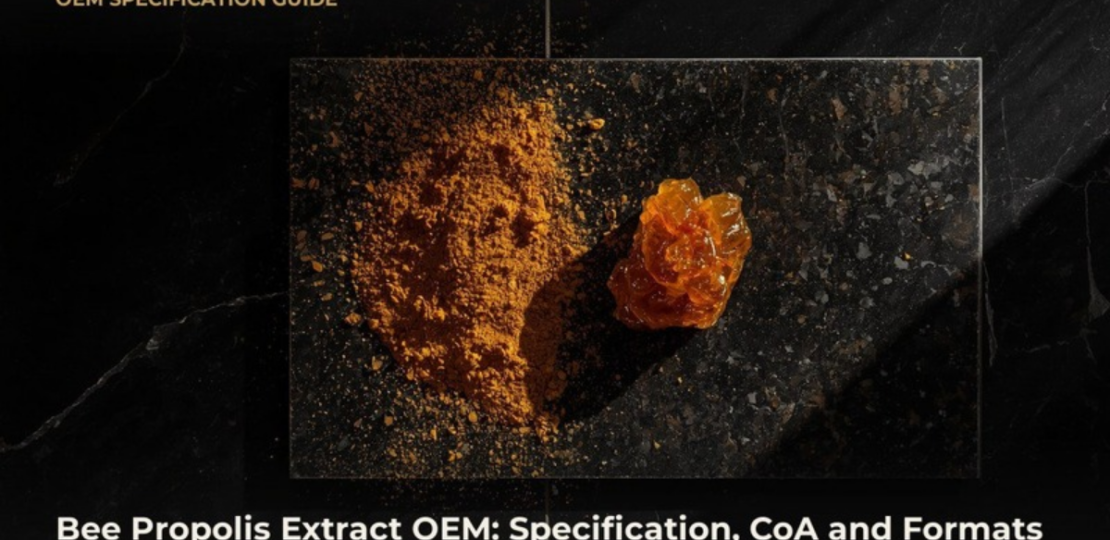
Direct answer: Ask your manufacturer for a bee propolis extract powder specified at flavone above 17 percent, propolis assay above 96 percent, 100 percent passing an 80-mesh sieve, loss on drying at or below 8 percent and total ash at or below 7 percent, with a batch Certificate of Analysis for every lot.
What a bee propolis extract powder is as a raw material
Bionutricia supplies bee propolis as a brown powder extract with a characteristic odour and taste. For a brand owner, the material is defined by its specification sheet: the assay figures, the physical form, the contaminant and microbial limits and the packing together decide what can be filled, stored and tested to the buyer’s requirements.
The specification figures
The table below sets out the Bionutricia specification for the powder. Each row shows the figure on file and the point to agree with your manufacturer before a brief is quoted.
| Specification item | Bionutricia specification | Agree with your manufacturer |
|---|---|---|
| Appearance | Brown powder | How colour is checked on each lot |
| Odour and taste | Characteristic | The sensory reference used at release |
| Flavone assay | Above 17% | The test method and how results are reported |
| Propolis assay | Above 96% | The test method and how results are reported |
| Mesh size | 100% passing 80 mesh | The sieving method |
| Loss on drying | At or below 8% | The drying method and conditions |
| Total ash | At or below 7% | The ashing method |
Contaminant and microbial limits
A brand owner’s market may require tighter limits than the ones below. Agree any tighter limit with your manufacturer before the production run, and record the agreed figure in the specification.
| Test | Bionutricia limit |
|---|---|
| Total heavy metals | At or below 10 mg/kg |
| Arsenic (As) | At or below 2 mg/kg |
| Cadmium (Cd) | At or below 1 mg/kg |
| Lead (Pb) | At or below 1 mg/kg |
| Mercury (Hg) | At or below 0.5 mg/kg |
| Total plate count | At or below 1,000 cfu/g |
| Total yeast and mould | At or below 100 cfu/g |
| E. coli | Negative |
| Salmonella | Negative |
| Staphylococcus | Negative |
What the batch Certificate of Analysis should show
Request a batch Certificate of Analysis (CoA) for every lot. It should report the same tests, in the same units and against the same limits as the specification, so that a brand owner can line the two documents up row by row. Our guide How to read a supplement Certificate of Analysis sets out the layout to check.
A CoA that omits a specification test, or reports a result without its method, cannot be checked against the specification. Ask for the method reference alongside each result.
Questions to put to your manufacturer
- Which test method sits behind the flavone and propolis assay figures?
- How is loss on drying measured, and under which conditions?
- Which tests appear on each batch CoA, and against which limit?
- Which halal documents cover the finished product for each production run?
Packing, storage and shelf life
The powder is packed in double plastic bags for inner packing and a fibre drum for outer packing. The stated shelf life is 2 years when stored properly. Agree the storage conditions and the shelf-life position for your chosen format with your manufacturer before the first production run.
Format options for the powder
Two formats suit a powder of this kind for a brand owner’s line. The table compares what each one is and what must be settled before the brief is quoted.
| Format | What it is | What to settle first |
|---|---|---|
| Powder sachet | Single-serve powder in a pillow, 3-side-seal or stick-pack sachet | Loss on drying, seal integrity and fill range |
| Chewable tablet | Chewable tablet unit | Flavour, texture and count per pack |
Sachet and pouch formats are covered on our sachet and pouch beverage OEM page, and chewable tablet formats on our chewable tablet and liquid bottle OEM page.
Halal status and documentation
Bionutricia’s bee propolis extract is JAKIM halal certified. For each production run, ask your manufacturer for the JAKIM halal certificate covering the finished product, together with a raw material declaration for the propolis powder.
Manufacturing a propolis extract product under your own brand
Bionutricia offers OEM and ODM manufacturing for brand owners and distributors, covering formulation development, private-label production and finished supplement manufacturing at our integrated facility in Sungai Buloh, Selangor. For a propolis extract powder, the formats we would discuss are the powder sachet and the chewable tablet, and our sachet and pouch beverage OEM service covers the sachet route. Our certifications are FSSC 22000, GMP, HACCP, JAKIM Halal, US FDA registration, MeSTI and NanoVerify. The specification in this guide is the starting point for that discussion, and the brief you send should name the format, the target market and the quantity you expect per run. Set up a meeting with our nutrition specialist to decide minimum order, lead time, fill range, pack size and packaging for your product.
Send us your product brief
Tell us your product concept, format, target market, quantity per run and launch date, and name the propolis extract powder as your hero ingredient. Request a quotation on our enquiries page, email ng@bio-nutricia.com, or message us on WhatsApp at +60 16-661 8510.
Bionutricia Sdn Bhd, 14 & 16, Jalan TSB 7, Taman Perindustrian Sg Buloh, 47000 Kota Damansara, Selangor.
Related guides: Misai Kucing (Orthosiphon) extract OEM and Mangosteen pericarp extract OEM.
Frequently asked questions
What should a bee propolis extract specification include?
The flavone and propolis assay figures, the loss on drying and total ash limits, the sieve size, the heavy metal and microbial limits, and a batch CoA for each lot. Agree the test method behind each figure before the brief is quoted.
What figures does the Bionutricia propolis extract powder specification state?
Flavone above 17%, propolis assay above 96%, 100% passing 80 mesh, loss on drying at or below 8%, total ash at or below 7%, total heavy metals at or below 10 mg/kg, and negative results for E. coli, Salmonella and Staphylococcus. The stated shelf life is 2 years when stored properly.
Which formats suit a propolis extract powder?
A powder sachet in a pillow, 3-side-seal or stick-pack format, and a chewable tablet. Choose between them by loss on drying, seal integrity, flavour and texture.
Is the propolis extract halal certified?
Bionutricia’s bee propolis extract is JAKIM halal certified. Ask for the JAKIM halal certificate covering the finished product for each production run, together with a raw material declaration for the propolis powder.
Which documents should a brand owner request for propolis?
The JAKIM halal certificate covering the finished product, a raw material declaration for the propolis powder, and a batch CoA for each lot that reports the specification tests.
Article by Ts. Ng Kuak Ping. Last updated: 2026-10-26.
RELATED POSTS
View all


Exclusive vs Non-Exclusive OEM Manufacturing Agreements: What Should a Growing Brand Choose?
September 28, 2026 | by supersuper
What is the difference between OEM and ODM supplement manufacturing?
May 26, 2026 | by supersuper
HACCP Certification Explained: What It Covers for a Supplement Contract Manufacturer
September 27, 2026 | by supersuper