

Purple Sweet Potato (Ipomoea batatas) & Ginger Extract OEM: Anthocyanin Standardisation for Functional Beverage
September 24, 2026 | by supersuper
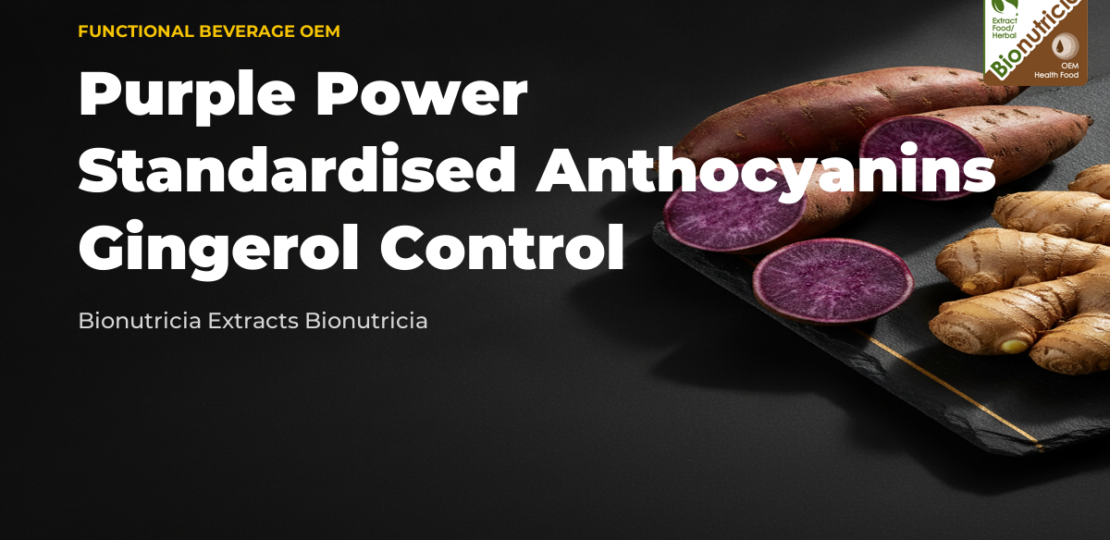
Direct answer: For a purple sweet potato and ginger functional beverage OEM, specify a purple sweet potato extract standardised to total acylated anthocyanin content measured by HPLC (typically expressed as peonidin-3-caffeoylsophoroside-5-glucoside equivalents), and a ginger extract standardised to 5–6% total gingerols by HPLC with 6-gingerol as the primary marker. The two ingredients complement each other in a beverage: purple sweet potato contributes deep natural colour and acylated anthocyanins, while ginger contributes pungent gingerols and aromatic warmth. Bionutricia manufactures this combination in pouch beverage, liquid sachet, liquid bottle, and powder sachet formats under JAKIM Halal certification, using patented enzymatic ultrasonic extraction (MY-188945-A) for the botanical fraction. Herbosomal® — Bionutricia’s proprietary liposomal encapsulation and sustained-release technology (registered trademark; patent-pending PI2023005773) — is available for actives where enhanced delivery is desired. Request a full Certificate of Analysis from your OEM partner covering assay, heavy metals, microbial limits, and solvent residue before committing to production.
Why Pair Purple Sweet Potato with Ginger?
Purple sweet potato (Ipomoea batatas), a member of the Convolvulaceae family, is one of the richest natural suppliers of acylated anthocyanins — pigments that give the tuber its deep purple flesh. Unlike anthocyanins from many other botanicals, the acylated forms in purple sweet potato are noted for their relative stability under heat and light, which makes them well suited to beverage manufacturing where pasteurisation and ambient storage are common.
Ginger (Zingiber officinale), from the Zingiberaceae family, contributes a pungent, aromatic profile driven by gingerols and shogaols. In a functional beverage, ginger adds flavour complexity that balances the earthy sweetness of purple sweet potato, creating a more rounded sensory experience — a critical factor for reorder rates in powder sachets, pouch beverages, and liquid bottles where taste is fully exposed to the consumer.
For a brand owner, the combination offers a dual-angle product: natural colour from the anthocyanin fraction and functional pungency from the gingerol fraction, in a single halal-certified SKU. Each ingredient is standardised to its own marker compound, and the blend is treated as a new formulation rather than a pre-proven synergy.
Purple Sweet Potato Anthocyanin Standardisation
Marker Compounds and Assay Method
The primary anthocyanins in purple sweet potato are acylated peonidin glycosides — specifically peonidin 3-caffeoylsophoroside-5-glucoside and peonidin 3-caffeoyl-p-hydroxybenzoylsophoroside-5-glucoside. These are the markers a Certificate of Analysis should identify.
Specify total anthocyanin content measured by HPLC (high-performance liquid chromatography), not by a crude spectrophotometric colour value alone. A typical specification for a spray-dried purple sweet potato extract powder is 1–5% total anthocyanins on a dry basis, depending on the extraction ratio and cultivar. Higher concentrations are achievable but may compromise solubility and colour stability in solution.
What to Require on the CoA
A compliant CoA for a purple sweet potato extract should include:
- Total anthocyanin content (HPLC, expressed as peonidin glycoside equivalents, % w/w)
- Extraction ratio (e.g., 10:1 or 20:1)
- Moisture content (typically ≤5% for spray-dried powder)
- Heavy metals: lead ≤2 ppm, arsenic ≤1 ppm, cadmium ≤0.3 ppm, mercury ≤0.1 ppm
- Microbial limits: total plate count ≤10,000 CFU/g, yeast and mould ≤100 CFU/g, E. coli negative, Salmonella negative
- Particle size (typically 80–100 mesh for beverage-grade powder)
- Colour value (for beverage applications, a defined E1% value at a specified wavelength)
pH and Stability Considerations
Anthocyanins are pH-sensitive: they shift from red in acidic conditions to purple-blue in neutral and alkaline environments. For a functional beverage, the formulation pH should be controlled — typically pH 3.0–4.5 for optimal colour retention. This is a physicochemical property of the pigment, not a health claim, and it directly affects shelf life and visual appeal in retail packaging.
Ginger Extract Standardisation
Marker Compounds and Assay Method
The bioactive pungent compounds in ginger are gingerols (primarily 6-gingerol, with smaller amounts of 8-gingerol and 10-gingerol) and shogaols (formed from gingerols during drying). 6-Gingerol is the standard marker for HPLC quantification.
A typical specification for a ginger extract for beverage OEM is 5–6% total gingerols by HPLC. Higher concentrations (up to 10% or more) are available but may increase pungency beyond what a beverage formulation can carry palatably.
What to Require on the CoA
A compliant CoA for a ginger extract should include:
- Total gingerol content (HPLC, % w/w, with 6-gingerol identified)
- 6-Shogaol content (HPLC, % w/w)
- Extraction ratio (e.g., 10:1)
- Moisture content (≤5%)
- Heavy metals: lead ≤2 ppm, arsenic ≤1 ppm, cadmium ≤0.3 ppm, mercury ≤0.1 ppm
- Microbial limits: total plate count ≤10,000 CFU/g, yeast and mould ≤100 CFU/g, E. coli negative, Salmonella negative
- Residual solvent (if applicable, within pharmacopoeial limits)
What the Research Shows
Published reviews have examined the antioxidant properties and bioavailability of anthocyanins from purple plant foods, including purple sweet potato. A 2019 review in Molecules surveyed research advances on purple sweet potato anthocyanins, including their antioxidant and other biological activities (Liu et al., Molecules, 2019; PMC6864833). A 2022 review in Antioxidants examined the nutritional and antioxidant properties of sweet potato, including anthocyanin-containing varieties, as a functional food supplier (Bovell-Benjamin et al., Antioxidants, 2022; PMC9495970). Both are narrative reviews — they provide context on the ingredient’s studied properties but do not constitute clinical proof of efficacy for any specific product.
For a combination formula pairing purple sweet potato with ginger, the individual ingredient evidence does not extend to the blend itself. Each active should be standardised to its own marker, and the combination should be treated as a new formulation rather than a proven synergy. This is standard practice in functional food OEM: the specification guarantees what is in the product, and the brand owner is responsible for any claim made about what the product does.
Herbosomal® Delivery for Anthocyanin-Rich Formulas
For brand owners seeking enhanced delivery of anthocyanin-rich actives, Bionutricia offers Herbosomal® — Bionutricia’s proprietary liposomal encapsulation and sustained-release technology (registered trademark; patent-pending PI2023005773). This platform pairs phyto-actives with phospholipid carriers, and is available across Bionutricia’s approved OEM formats including powder sachets, liquid sachets, and pouch beverages.
The extraction of the botanical fraction — both purple sweet potato and ginger — runs on Bionutricia’s patented enzymatic ultrasonic extraction (MY-188945-A), a green-biotech assisted process that produces standardised fractions meeting international quality, safety, and efficacy norms. This is a manufacturing capability statement, not a clinical claim: the technology describes how the extract is produced, not what the finished product does in the body.
OEM Formats for a Purple Sweet Potato + Ginger Beverage
Bionutricia manufactures the purple sweet potato and ginger combination in the following approved formats:
- Pouch beverages — ready-to-drink format with ambient shelf life, ideal for retail and HORECA channels
- Liquid sachets — single-serve concentrated shots, convenient for on-the-go consumption
- Liquid bottles — multi-serve bottles in amber glass or PET, depending on UV protection requirements
- Powder sachets — dry blend for reconstitution, offering the longest shelf life and lowest freight cost
Format choice affects anthocyanin stability: powder sachets protect the anthocyanins from degradation until reconstitution, while liquid formats require careful pH control and packaging selection to maintain colour over shelf life. Bionutricia’s in-house R&D team — a registered pharmacist, a nutritionist, a dietitian, and a PhD biomedical scientist — supports format selection and stability testing during formulation development.
Halal Chain and Certifications
Bionutricia is a JAKIM-certified halal supplement OEM, founded in 2006, with six quality certifications: FSSC 22000, GMP, HACCP, JAKIM Halal, US FDA registration, and MeSTI. The facility in Sungai Buloh, Selangor, also holds NanoVerify validation for nano-processed ingredients.
For a purple sweet potato and ginger beverage, the halal chain covers every input: the botanical extracts, the carriers, the processing aids, and the packaging. Bionutricia’s OEM formats are food-classified and go through MeSTI notification — they do not require NPRA health-supplement MAL registration, which involves a separate 116–245 working-day evaluation pathway for products classified as medicines under Malaysian regulations.
Brand owners exporting to Indonesia should note that from 17 October 2026, supplements sold in Indonesia must carry BPJPH halal certification or a non-halal label. Bionutricia’s JAKIM certification is a recognised foundation for BPJPH registration, and the manufacturing documentation supports that process.
Frequently Asked Questions
What anthocyanin standardisation should I ask for in a purple sweet potato extract?
Specify total acylated anthocyanin content by HPLC, expressed as peonidin glycoside equivalents. A typical range for a spray-dried extract is 1–5% total anthocyanins on a dry basis. Require the CoA to identify the specific marker compounds (peonidin 3-caffeoylsophoroside-5-glucoside and related acylated forms) rather than a generic “anthocyanin” figure.
Why combine purple sweet potato with ginger in a beverage?
Purple sweet potato contributes natural colour and acylated anthocyanins, while ginger contributes pungent gingerols and aromatic warmth. The combination creates a dual-angle functional beverage with a balanced sensory profile. Each ingredient is standardised independently to its own marker compound.
Which OEM formats suit a purple sweet potato and ginger beverage?
Bionutricia offers pouch beverages, liquid sachets, liquid bottles, and powder sachets for this combination. Powder sachets offer the longest shelf life and best anthocyanin stability; liquid formats require pH control and appropriate packaging to maintain colour over shelf life.
Does Bionutricia’s Herbosomal® technology apply to this combination?
Yes. Herbosomal® — Bionutricia’s proprietary liposomal encapsulation and sustained-release technology (registered trademark; patent-pending PI2023005773) — is available for anthocyanin-rich actives across powder sachet, liquid sachet, and pouch beverage formats. The botanical extraction runs on Bionutricia’s patented enzymatic ultrasonic extraction (MY-188945-A).
Is NPRA MAL registration required for a purple sweet potato and ginger beverage?
No. Bionutricia’s OEM formats are food-classified and go through MeSTI notification under the Malaysian Food Act 1983. They do not require NPRA health-supplement MAL registration, which applies to products classified as medicines. NPRA and MAL may appear in general market education but are not part of Bionutricia’s own route to market for food-classified products.
Related Guides
- Bentong Ginger Extract for Functional Food & Beverage OEM
- Roselle (Hibiscus) Extract: Standardised Anthocyanin Content for Supplement & Beverage OEM
- Butterfly Pea Flower Extract for Functional Beverages: Colour & Spec
Request a Quotation
Bionutricia Holding Sdn Bhd is a JAKIM-certified halal supplement OEM and contract extraction service provider in Malaysia, founded in 2006. With six quality certifications (FSSC 22000, GMP, HACCP, JAKIM Halal, US FDA, MeSTI) and NanoVerify validation, Bionutricia serves 239+ brand partners across SEA, MENA, US, and EU markets. OEM formats include powder, liquid and gel sachets, pouch beverages, chewable tablets, and liquid bottles, plus contract extraction, spray-drying, grinding, and packing.
To discuss a purple sweet potato and ginger functional beverage formulation, contact:
- Website: bionutricia.com
- Email: ng@bio-nutricia.com
- Phone / WhatsApp: +60 16-661 8510
Article by Bionutricia R&D Team. Last updated: 2026-09-24.
RELATED POSTS
View all

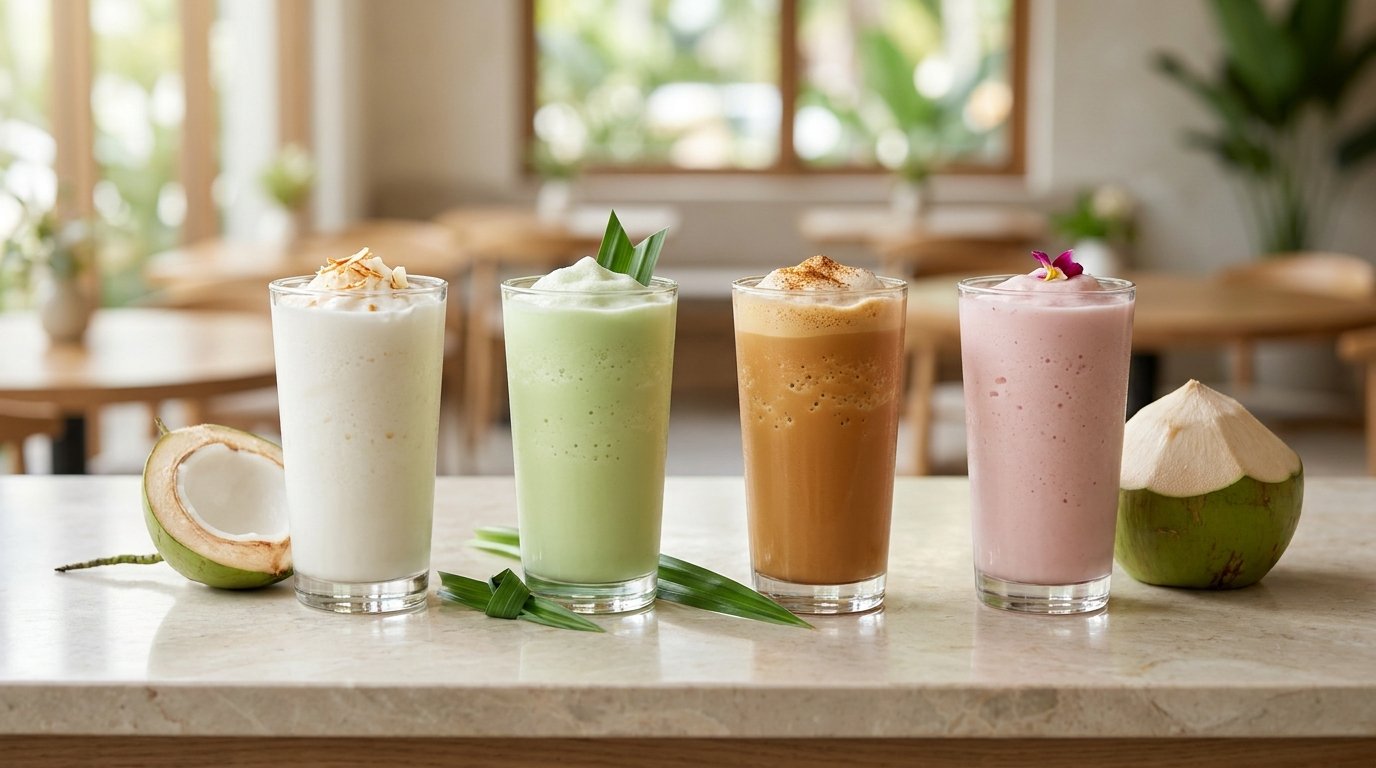
Ice-Blended Coconut Shakes for Cafes, Chains and QSR Menus
July 30, 2026 | by supersuper
US Powder Sachet Supplements: Format Share and What a Quotation Needs
October 29, 2026 | by supersuper