

Liposomal vs Nano-Encapsulation vs Standard Delivery: Which Wins for OEM Customers in 2026?
June 3, 2026 | by supersuper
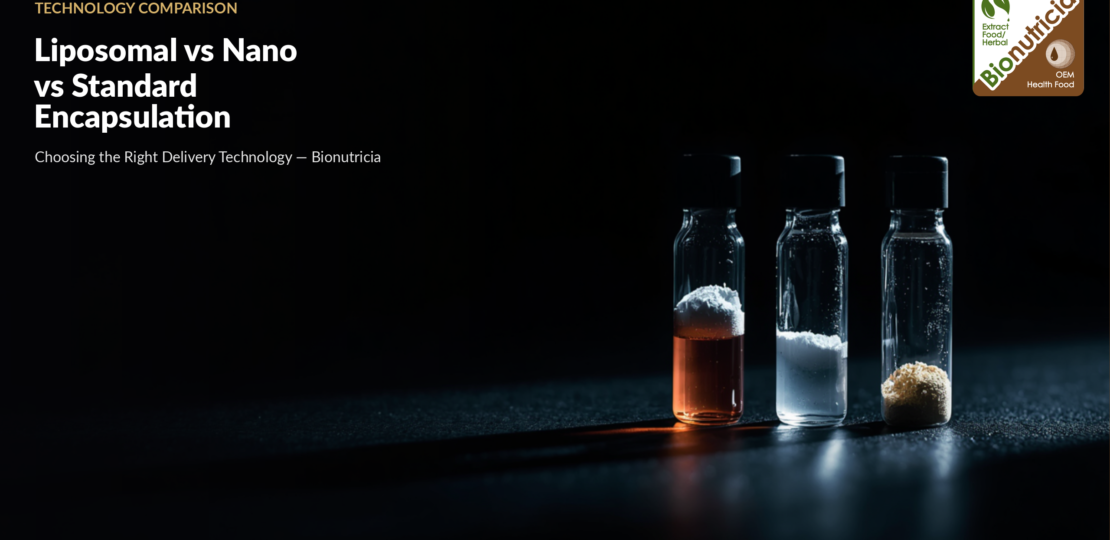
The short verdict for brand owners deciding between delivery technologies in 2026: liposomal encapsulation wins on the combination of proven bioavailability, OEM manufacturability, and cost discipline for the vast majority of water-soluble actives (Vitamin C, glutathione, curcumin, B-complex, polyphenols). Nano-encapsulation has theoretical bioavailability advantages but is overkill, unstable, and unnecessarily expensive for most supplement applications outside research-grade pharma. Standard delivery (powder sachets, chewable tablets, liquid bottles without lipid carriers) remains the right choice for fat-soluble actives, for high-volume cost-sensitive SKUs, and for actives that don’t suffer from poor absorption to begin with. That’s the working framework. Below is the data and decision logic behind it.
What each technology actually does
Standard delivery means a supplement active is presented to the gut without any modification — blended into a powder sachet, pressed into a chewable tablet, or suspended in a liquid bottle or pouch beverage. The active dissolves in the gut, encounters digestive enzymes and stomach acid, and absorbs through the intestinal wall via the body’s normal pathways. For most fat-soluble vitamins (A, D, E, K) and minerals (when chelated properly), this works fine. For water-soluble actives that get destroyed in the stomach or that struggle to cross the intestinal lipid bilayer (Vitamin C above 200 mg, glutathione, curcumin), standard delivery wastes 60–90% of the dose.
Liposomal encapsulation wraps the active inside a tiny bubble of phospholipid (the same molecule your cell membranes are made of). The phospholipid bubble protects the active from stomach acid, then fuses with the intestinal wall and delivers the active directly into the bloodstream — bypassing much of the loss seen in standard delivery. Liposome particle sizes are typically 50–250 nanometres. Liposomal Vitamin C, for example, achieves 2–4× higher peak plasma levels than standard ascorbic acid at the same dose.
Nano-encapsulation wraps the active inside an even smaller particle (typically <100 nm) using one of several carriers: nanoemulsions, solid lipid nanoparticles, polymeric nanoparticles, or nanocrystals. The theoretical advantage is even higher absorption efficiency than liposomes for hydrophobic actives. The practical downside is that genuine nano-encapsulation requires sophisticated pharma-grade equipment, has shelf-life challenges (nano-particles tend to aggregate), and the regulatory landscape is less settled (some markets require additional safety data for nano-formulations).
Bioavailability — the actual numbers
Peer-reviewed comparisons of liposomal vs standard delivery, drawn from clinical pharmacokinetic studies:
| Active | Standard dose AUC | Liposomal dose AUC | Liposomal multiplier |
|---|---|---|---|
| Vitamin C | Baseline | 1.8–2.5× | ~2× |
| Glutathione | Baseline (oral is very poorly absorbed) | 4–8× | ~5× |
| Curcumin | Baseline | 6–10× | ~7× |
| Resveratrol | Baseline | 3–5× | ~4× |
| Quercetin | Baseline | 2–4× | ~3× |
The pattern is clear: for actives that are poorly absorbed in standard form, liposomal delivers a meaningful and measurable multiplier. For actives that are already well-absorbed (most B vitamins, magnesium glycinate, minerals in chelated form), liposomal offers little upside and isn’t worth the added cost.
Nano-encapsulation studies are harder to compare like-for-like because product methodologies vary so much, but in the controlled studies that exist, true nano-formulations beat liposomal by another 10–30% for hydrophobic actives. Whether that incremental 10–30% justifies the cost and complexity is a brand-specific decision.
OEM cost differential — what each adds to your COGS
For a typical 1,500-sachet SKU of Vitamin C 1,000 mg powder sachets (3 g per sachet × 1,000 mg active):
A worked cost-and-margin comparison for your specific actives, formats, and volumes is prepared at the RFQ stage.
Liposomal adds roughly 25–30% to manufacturing cost vs standard. Nano-encapsulation adds 70–80%. From a brand owner perspective:
- If your retail price supports a premium markup, liposomal typically commands a modest retail premium over standard — small relative to the bioavailability gain.
- If your retail price supports a premium markup, nano typically commands a larger retail premium than liposomal — often more than the perceived benefit justifies for water-soluble actives.
Shelf-life and stability differences
Standard delivery has the best shelf life — 24–36 months at room temperature is normal for powder sachet and chewable tablet formats.
Liposomal delivery in well-formulated commercial products has 18–24 months at room temperature, depending on the phospholipid origin and the encapsulation method. Bionutricia’s Herbosomal-platform liposomal SKUs have 24 months at 25°C / 60% RH. Cold-chain is not required for retail.
Nano-encapsulation typically has the shortest shelf life — 12–18 months is normal, and some nano-formulations require refrigeration. Particle aggregation over time degrades the bioavailability benefit, so the product becomes more like a standard delivery as it ages.
OEM manufacturability — who can actually produce what
Standard delivery can be produced by any GMP-certified supplement OEM with basic blending, sachet-filling, chewable-tablet pressing, and liquid-bottling equipment. The capability is commodity-level.
Liposomal encapsulation requires either proprietary technology (e.g., Bionutricia’s Herbosomal IP) or licensed methodology, plus specialised equipment (ultrasonic homogenisers, high-pressure microfluidisers, particle-size verification via DLS). Maybe 10–20 supplement OEMs across Southeast Asia have genuine liposomal capability; most “liposomal” products in the market are pseudo-liposomal mixtures that don’t deliver the claimed bioavailability.
Genuine nano-encapsulation is rare in the supplement OEM world. Most supplement OEMs that claim nano-encapsulation are actually doing micron-scale encapsulation (1–10 microns) and labelling it as “nano” — a regulatory grey area that increasingly attracts FDA and ESMA scrutiny. True nano-encapsulation requires pharma-adjacent equipment that few supplement OEMs invest in.
Decision framework — pick the right tech for your product
Use this matrix:
| Active | Recommended delivery |
|---|---|
| Vitamin A, D, E, K (fat-soluble) | Standard (oil-based liquid sachet or pouch beverage) |
| Vitamin C ≤ 200 mg | Standard |
| Vitamin C ≥ 500 mg | Liposomal |
| Glutathione (oral) | Liposomal (mandatory — standard is wasted) |
| Curcumin | Liposomal |
| Resveratrol, Quercetin, polyphenols | Liposomal |
| B-complex vitamins | Standard (already well-absorbed) |
| Magnesium, Zinc (chelated) | Standard |
| Tongkat Ali, Kacip Fatimah, botanical extracts | Standard (or liposomal for premium tier) |
| CoQ10 | Liposomal (preferred for ubiquinol form) |
| Omega-3 fish oil | Standard liquid bottle or pouch beverage (microencapsulated powder sachet for taste-masking) |
| Probiotics | Standard with enteric coating |
Two principles emerge from the table: (1) match the technology to the active’s natural absorption profile, and (2) reserve liposomal for the active where it makes a real bioavailability difference, not as a generic premium upgrade across the whole product line.
The “fake liposomal” problem brand owners need to know about
A significant share of “liposomal” supplements in the global market are not genuinely liposomal — they’re emulsions of the active in oil or lecithin without forming a true bilayer phospholipid vesicle. The brand owner gets a marketing benefit (the L-word on the label) but the consumer gets no bioavailability advantage.
Three tests separate real liposomal from fake:
Particle size verification — a true liposomal product produces a vesicle distribution centred between 50 and 250 nm, measurable by dynamic light scattering (DLS). Fake liposomal products show particle distributions in the micron range. Bionutricia’s Biolypo and Herbosomal products are DLS-tested at NanoVerify and the reports are public.
Bilayer evidence — cryo-electron microscopy can directly image the phospholipid bilayer. Patent-pending liposomal products typically have this evidence.
In-vivo pharmacokinetic data — a true liposomal product produces a measurably higher and faster peak plasma concentration in human studies vs standard delivery. Fake products show no difference.
For brand owners, the practical test is: ask your OEM for the DLS report and the cryo-EM image on the specific liposomal product in your quote. Real liposomal OEMs have these documents on hand. Fake liposomal OEMs change the subject.
Bionutricia’s liposomal stack
Patent-pending Herbosomal liposomal encapsulation technology. NanoVerify DLS-tested products in the Biolypo line including Vitamin C, Citrus Flavonoid, B-Complex, and the Herbosomal botanical line (EstroBoost, TestoBoost). In-house ultrasonic homogenisers and homogeniser tanks for bilayer formation. 24-month shelf-life across the Biolypo product line at room temperature.
📚 Related guides
- What is liposomal encapsulation and why is it used in premium supplements?
- How much does it cost to manufacture a private-label supplement in Malaysia?
- Top 7 nutraceutical OEM manufacturers in Malaysia compared (2026)
Frequently asked questions
Is liposomal Vitamin C really more bioavailable than regular Vitamin C? Yes, at doses of 500 mg or higher. Standard Vitamin C absorption saturates around 200 mg per dose due to limits on the intestinal transport mechanism. Liposomal delivery bypasses that saturation and produces 1.8–2.5× higher peak plasma levels.
What’s the difference between liposomal and nano-encapsulation? Liposomes are phospholipid bilayer vesicles, typically 50–250 nm. Nano-encapsulation is a broader category including nanoemulsions, solid lipid nanoparticles, and polymeric nanoparticles, often below 100 nm. Liposomes are more proven and easier to manufacture stably at supplement scale; nano covers a wider range of technologies, some of which are pharma-only.
Is liposomal worth the extra cost for my brand? For premium-positioned SKUs, yes. For value SKUs at lower retail price points, the cost differential eats too much margin and the bioavailability claim is hard to defend in low-cost positioning.
How do I verify a “liposomal” supplement is actually liposomal? Ask the manufacturer for the dynamic light scattering (DLS) report from a recognised lab like NanoVerify. The DLS report shows the particle size distribution. True liposomes cluster between 50 and 250 nm. Anything in the micron range is not truly liposomal.
Does liposomal need refrigeration? Well-formulated commercial liposomal products do not require refrigeration. Shelf life is typically 18–24 months at room temperature. Refrigeration is only needed for poorly-formulated products or for specific actives that are heat-sensitive regardless of delivery technology.
Ready to formulate with patent-pending liposomal technology?
Patent-pending Herbosomal liposomal encapsulation. NanoVerify-tested. 20+ years OEM. 239+ brand partners. JAKIM halal. Wholesale-only OEM. 24-hour RFQ reply.
Request a quotation · See our R&D and patent · Our OEM services
WhatsApp: +60 16-661 8510
Article by Bionutricia R&D Team. Last updated: June 3, 2026.
Related Bionutricia services: liposomal & herbosomal contract manufacturing · halal supplement OEM in Malaysia
RELATED POSTS
View all

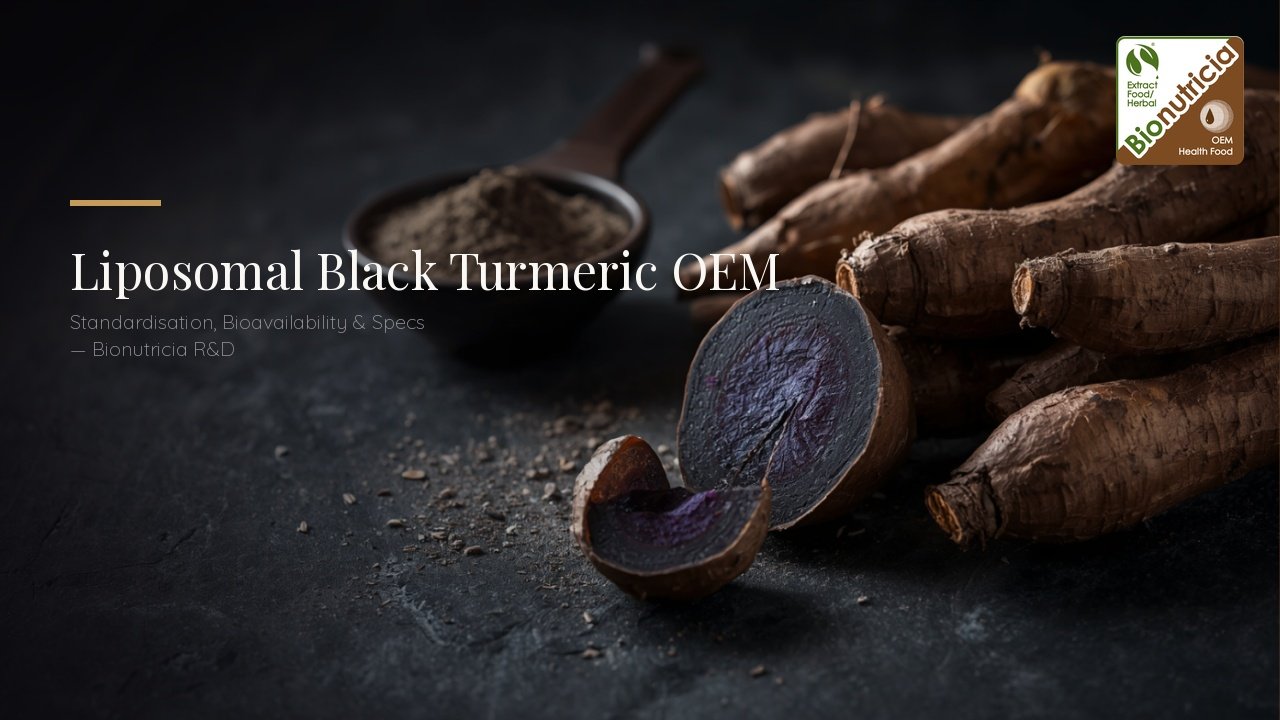
Liposomal Black Turmeric OEM: Standardisation, Bioavailability & Specs
August 2, 2026 | by supersuper
Phytosome vs Liposomal Delivery: Which Absorption Tech Wins for Botanicals?
July 3, 2026 | by supersuper
Liposomal Glutathione OEM: Encapsulation, Formulation & Specs
September 24, 2026 | by supersuper