


In-House vs Contract Lab Testing: What Should a Supplement Brand Outsource?
August 18, 2026 | by supersuper
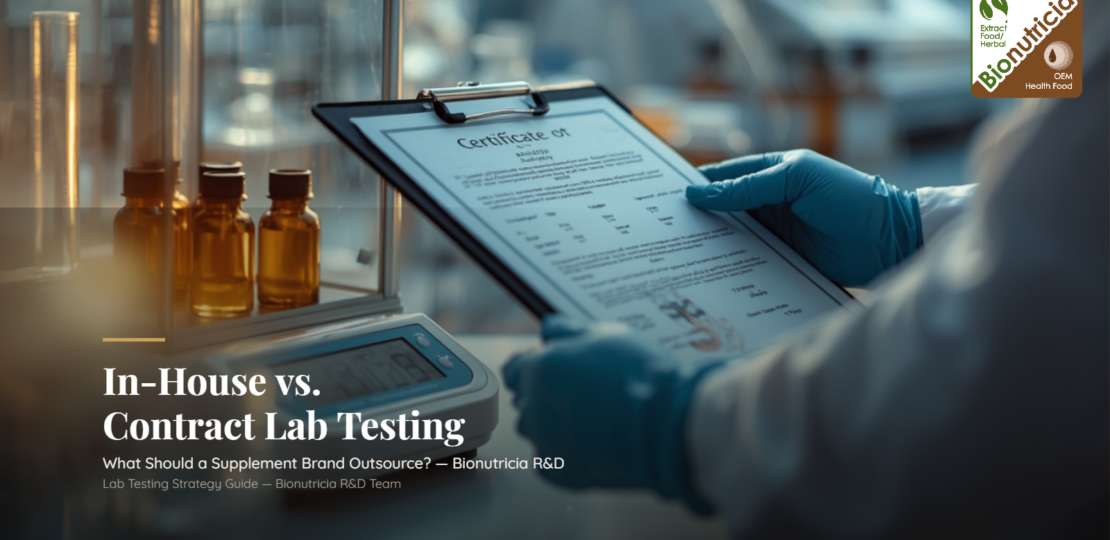
Direct answer: Neither, exclusively — the testing model every credible supplement OEM actually runs is a hybrid. Routine, immediate, every-batch checks (organoleptic assessment, pH, moisture/water activity, fill weight, basic microbial screening) are run in-house because speed matters and the equipment is inexpensive to own. Regulatory-grade, instrumentation-heavy tests — heavy metals by ICP-MS, pathogen confirmation (Salmonella, E. coli, S. aureus), active/marker-compound assay by HPLC or GC-MS, allergen panels, and full ICH-zone stability studies — are sent to an ISO/IEC 17025-accredited third-party lab, because the instrumentation, method validation, and accreditation overhead only make sense at specialist scale. So the real question a brand should ask an OEM isn’t “do you test in-house or outsource?” — it’s “which specific test on my Certificate of Analysis was run by you, and which was run by an accredited external lab, and can you show me that lab’s accreditation scope?” An OEM that claims to run every test in-house, with no named external lab anywhere on the CoA, is usually cutting a corner on the tests that matter most for safety and regulatory defensibility. Bionutricia’s Sungai Buloh facility runs its own on-site analytical laboratory for in-process and release testing, backed by accredited third-party labs for heavy metals, microbial confirmation, and stability — under FSSC 22000, GMP, and HACCP process controls.
Why “in-house vs. contract lab” is the wrong binary
Framing this as a single either/or choice misses how quality control actually works at a serious contract manufacturer. No OEM of any real scale owns an ICP-MS unit, a full microbiology suite capable of confirmatory pathogen identification, and climate-controlled ICH stability chambers for every zone — the capital cost and the accreditation maintenance burden don’t make sense unless testing is your entire business. At the same time, no OEM sends every single check to an external lab, because a same-day pH reading or a fill-weight check needs to happen on the production floor, not after a multi-day courier and lab queue.
What separates a strong OEM from a weak one isn’t whether they own a lab — it’s whether they can tell you, test by test, who ran it and whether that party was qualified. Stop asking “do you have your own lab?” and start asking to see a real batch CoA with the testing party named against every line.
What a competent OEM tests in-house
In-house testing exists to catch problems immediately, on every batch, without waiting on an external turnaround. At a properly equipped facility this typically includes:
- Organoleptic assessment — appearance, colour, odour, and taste against a reference standard, checked at multiple points in the run.
- pH — critical for liquid sachets, liquid bottles, and pouch beverages, where pH also governs preservative efficacy and microbial stability.
- Moisture / water activity — the single biggest driver of shelf life and microbial risk in powder sachets and chewable tablets.
- Fill weight and volume checks — a basic GMP requirement, run continuously during filling, not sampled after the fact.
- Blend and content uniformity — confirming an active is distributed evenly across a batch, not concentrated in the first or last sachets off the line.
- Routine total plate count screening — a fast in-house check used to flag a batch for closer attention before it ever reaches a formal microbial panel.
These are the tests where in-house ownership is a genuine advantage: same-day results mean a batch can be corrected or rejected before it moves further down the line, instead of sitting in quarantine for a week waiting on courier and lab turnaround.
What should always go to an accredited third-party lab
Some tests require instrumentation, validated methods, and formal accreditation that only make sense to maintain at specialist scale — and regulators and export markets generally expect these results to carry independent, accredited sign-off rather than a manufacturer’s own internal reading:
- Heavy metals — lead, cadmium, mercury, arsenic, measured by ICP-MS against botanical-extract and finished-product limits.
- Pathogen confirmation — confirmatory identification of Salmonella spp., E. coli, and S. aureus (not just a presumptive in-house screen).
- Active or marker-compound assay — HPLC or GC-MS quantification of the specific compound a formula is standardised to, run against a validated method and certified reference standard.
- Allergen panels — ELISA or PCR-based testing for undeclared allergen cross-contact.
- Particle-size verification — Dynamic Light Scattering (DLS) for encapsulated or nano-processed actives, where particle size and polydispersity directly affect bioavailability claims.
- Full ICH-zone stability studies — real-time and accelerated stability held in calibrated climate chambers across the relevant humidity/temperature zone for the destination market.
Each of these needs either specialised instrumentation that doesn’t justify in-house ownership, or independent accreditation that a buyer — and a regulator — expects from a named external lab, not the manufacturer marking its own homework.
The Certificate of Analysis is where the split becomes visible
A batch CoA is the one document that should make the in-house/outsourced split obvious, if you know what to look for. Every line item should be traceable to who generated it: an in-house release-testing line typically just states the result and method; a line generated by an external accredited lab should carry that lab’s name, accreditation body, and certificate or scope reference, either directly on the CoA or in a referenced lab report. If a CoA presents heavy-metal or pathogen results with no external lab named anywhere, that’s worth asking about directly — it either means the OEM maintains its own accredited micro/metals lab (rare, and worth confirming with a certificate number) or the result wasn’t independently verified. We cover how to read every section of a CoA, line by line, in our dedicated guide.
How product format changes the testing plan
The testing plan isn’t identical across formats — each of Bionutricia’s manufactured formats carries a different primary risk, and a competent OEM adjusts the panel accordingly rather than running one generic checklist:
| Format | Primary testing focus |
|---|---|
| Powder sachets | Moisture / water activity, particle size, blend uniformity |
| Liquid sachets & liquid bottles | pH, preservative efficacy, microbial stability over shelf life |
| Gel sachets | Viscosity, pH, preservative efficacy, phase stability |
| Pouch beverages | pH, microbial stability, colour/flavour stability under light and heat |
| Chewable tablets | Hardness, disintegration time, content uniformity, moisture |
A brand briefing an OEM on a new SKU should ask which of these format-specific checks are already validated in-house versus which will need a fresh stability study — that answer affects how much lead-in work happens before a first production run, independent of which lab performs which individual assay.
A five-point checklist before you sign with an OEM
- Ask for the split, test by test. Request a real (redacted, if needed) batch CoA and ask which lines were generated in-house and which by an external lab.
- Verify the external lab’s accreditation. ISO/IEC 17025 is the standard to look for; ask for the accreditation body and scope, not just a lab name.
- Ask about out-of-spec protocol. What happens when a result fails — is there a documented retest/investigation procedure, or does a failed batch simply get reworked without record?
- Ask whether stability data already exists for your format. An OEM with existing ICH-zone data for your exact format (sachet, bottle, pouch, chewable) saves real development time versus starting a stability study from zero.
- Confirm certifications cover the testing function, not just the factory floor. FSSC 22000, GMP, and HACCP all touch quality systems — ask how the in-house lab is integrated into that system, not treated separately.
None of this requires a brand to become a laboratory expert — it requires asking the OEM to show its work. A manufacturer confident in its own quality system will welcome the question, not deflect it.
Bionutricia’s testing model
Bionutricia operates a fully integrated facility in Sungai Buloh with its own on-site analytical laboratory for in-process and release testing — organoleptic checks, pH, moisture, fill weight, and routine microbial screening — run under FSSC 22000, GMP, and HACCP process controls. Specialised and regulatory-grade testing, including heavy metals, confirmatory pathogen identification, active-marker assay, allergen panels, and full stability studies, is carried out through accredited third-party laboratories. Every finished SKU — powder sachets, liquid sachets, gel sachets, pouch beverages, chewable tablets, and liquid bottles — carries a CoA built from this combined in-house and external testing chain, reviewed by Bionutricia’s in-house pharmacist, nutritionist, dietitian, and PhD biomedical scientist team.
Frequently asked questions
Should a supplement brand run lab testing in-house or outsource it to a contract lab?
Neither exclusively — reputable OEMs run a hybrid model. Routine, same-day checks (pH, moisture, fill weight, organoleptic, basic microbial screening) are handled in-house for speed. Specialised, regulatory-grade tests (heavy metals, pathogen confirmation, active-marker assay, allergens, full stability studies) go to an ISO/IEC 17025-accredited external lab. Ask any OEM which lab ran each line on your CoA rather than asking whether they test “in-house or outsourced” as a single yes/no question.
What tests can a reputable OEM run in-house?
Organoleptic assessment, pH, moisture/water activity, fill weight and volume checks, blend and content uniformity, and routine total plate count screening are all commonly run in-house because they’re needed on every batch and the equipment cost is justified by daily use.
What tests should always be sent to an accredited third-party lab?
Heavy metals (ICP-MS), confirmatory pathogen identification, active/marker-compound assay (HPLC/GC-MS), allergen panels, particle-size verification for encapsulated actives, and full ICH-zone stability studies should carry independent, accredited sign-off rather than an in-house-only reading.
How do I verify a lab’s accreditation is real?
Ask for the lab’s name, the accrediting body (in Malaysia, typically under the Department of Standards Malaysia’s SAMM scheme, aligned to ISO/IEC 17025), and the specific scope of accreditation — accreditation is granted per test method, not as a blanket certificate, so confirm the exact test you need is within scope.
Does the testing plan change depending on the product format?
Yes. Powder sachets are tested primarily for moisture and particle size; liquid sachets, liquid bottles, and pouch beverages for pH, preservative efficacy, and microbial stability; gel sachets for viscosity and phase stability; and chewable tablets for hardness, disintegration time, and content uniformity.
📚 Related guides
- How to Read a Supplement Certificate of Analysis (CoA): A Buyer’s Guide
- Heavy-Metal & Microbial Testing Standards for Botanical Supplements
- Supplement Stability Testing Explained: ICH Zones, Shelf Life & What Buyers Ask
Ready to review a real testing plan for your SKU?
Bionutricia combines an on-site analytical laboratory with accredited third-party testing partners, under FSSC 22000, GMP, HACCP, JAKIM Halal, US FDA, and MeSTI process controls — across powder sachets, liquid sachets, gel sachets, pouch beverages, chewable tablets, and liquid bottles.
Request a quotation · See our OEM services · View our certifications
WhatsApp: +60 16-661 8510
Article by Bionutricia R&D Team. Reviewed by Bionutricia’s in-house QA & Halal Compliance team. Last updated: August 12, 2026.
RELATED POSTS
View all

OEM vs In-House Supplement Manufacturing: The Real 3-Year Decision Framework (Beyond Gross Margin)
June 10, 2026 | by supersuper
Malaysia vs Vietnam vs Indonesia for Supplement OEM: Cost, Speed & Quality Trade-Offs
June 30, 2026 | by supersuper
Single-Herb vs Multi-Herb Blend Formulation: Which Is Right for Your OEM Brand?
August 2, 2026 | by supersuper