

How Contract Spray-Drying Works: From Liquid Extract to Standardised Powder
August 13, 2026 | by supersuper
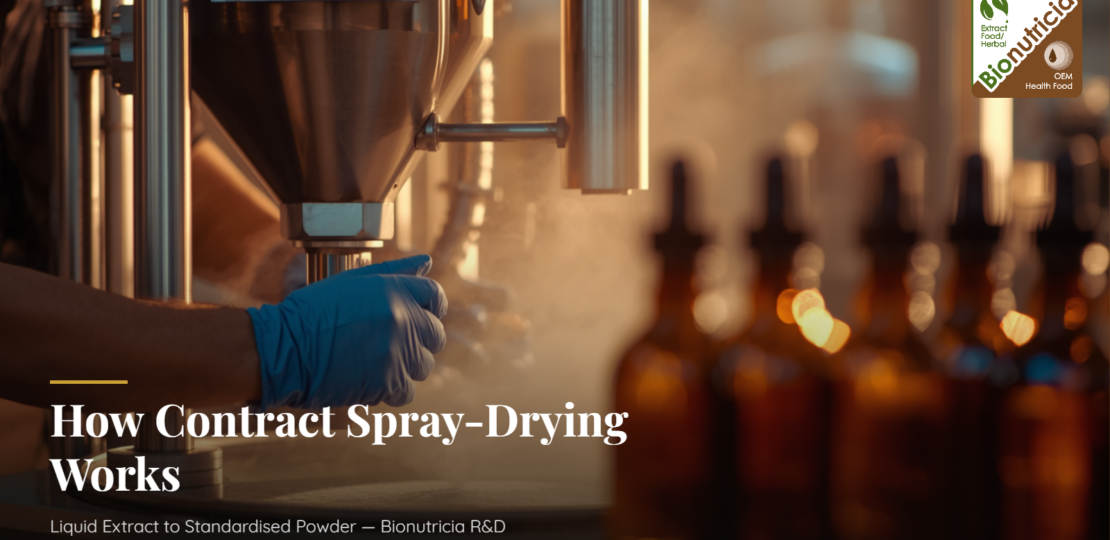
Direct answer: Contract spray-drying converts a liquid botanical extract or concentrate into a free-flowing, shelf-stable powder by atomising the liquid into fine droplets inside a hot-air drying chamber, evaporating the water (or ethanol/water) in seconds, and collecting the resulting dry particles through a cyclone separator. The process typically runs inlet air at 160–200°C and outlet air at 80–100°C, with droplet-to-powder residence time of only a few seconds — short enough that heat-sensitive actives like anthocyanins, vitamin C and polyphenols survive with manageable loss when the process is tuned correctly. The single biggest lever a brand has over quality is carrier selection (maltodextrin, tapioca starch or gum arabic, each with different halal, allergen and mouthfeel implications) and feed concentration going into the dryer, since both determine final moisture, particle size and bulk density. A properly spray-dried botanical powder should land at ≤5% moisture, ≥90% of particles passing 80 mesh, and free-flowing (non-caking) at ambient humidity. Bionutricia runs contract spray-drying in-house at its Sungai Buloh facility, immediately after contract extraction, so a single CoA chain covers the liquid extract and the finished powder — then the same powder can be filled into powder sachets, blended into liquid sachets, pouch beverages, chewable tablets or liquid bottles under FSSC 22000, GMP, HACCP and JAKIM halal certification.
What spray-drying actually does to a liquid extract
Most botanical and nutraceutical actives start life as a liquid — either a water/ethanol extraction directly off the plant material, or a concentrate produced by evaporation. That liquid is heavy, has a short shelf life, and is expensive to ship. Spray-drying solves all three problems in one pass: it removes the water content, locks the active compounds inside a dry carrier matrix, and produces a powder that is lighter, more stable, and easier to blend, dose and package than the liquid it came from.
The transformation is physical, not chemical — a well-run dryer should not alter the identity of the active compounds, only their concentration and physical form. That’s why the marker-compound assay on a spray-dried powder’s Certificate of Analysis should read consistently with the pre-dry liquid extract, adjusted for the concentration factor and any process loss.
The process, step by step
1. Feed preparation and concentration
Before a liquid extract reaches the dryer, it is typically pre-concentrated (often by vacuum evaporation) to reduce the water load the dryer has to remove — this shortens drying time and protects heat-sensitive actives. The feed is then blended with the chosen carrier at a defined ratio, filtered to remove particulates that could clog the atomiser, and held at a controlled viscosity and solids content (commonly 20–40% total solids) so the atomiser produces a consistent droplet size.
2. Atomisation
The feed is pumped through an atomiser — a rotary disk or a pressure nozzle — that breaks the liquid into a fine mist of droplets, typically 10–200 microns in diameter. Droplet size is the single biggest determinant of final particle size, and it is tuned to the target application: finer droplets suit instant-dissolving sachet powders, while slightly coarser droplets suit powders destined for tableting or high-shear blending.
3. Drying chamber
The atomised mist meets a stream of hot air inside the drying chamber. Because the droplets are so small, the surface area-to-volume ratio is enormous, and moisture flashes off within one to a few seconds — before the droplet’s core temperature ever approaches the inlet air temperature. This is the physical reason spray-drying can process heat-sensitive botanicals (anthocyanins, vitamin C, certain flavonoids) without the prolonged heat exposure that would degrade them in a conventional oven or drum dryer. Inlet and outlet temperatures are set and monitored for every batch, and are a standard line item a buyer should ask to see on the batch record.
4. Powder collection
Dried particles fall to the base of the chamber or are carried by the air stream to a cyclone separator, which spins the air to fling the powder out of the airstream and into a collection vessel. Fine powder (“fines”) that escapes the primary cyclone is typically recovered in a secondary bag filter or scrubber, both for yield and for environmental compliance. The collected powder then moves to sieving, blending and packing under controlled humidity, since a freshly dried hygroscopic powder can re-absorb moisture quickly if left in open air.
Carrier selection: the decision that shapes the finished powder
A liquid botanical extract almost never contains enough dissolvable solids to spray-dry on its own — a carrier is added to build body, protect the actives during atomisation and drying, and give the finished powder acceptable flow and reconstitution properties. Carrier choice affects halal status, allergen labelling, mouthfeel and cost, so it belongs in the OEM brief, not left to the manufacturer’s default.
- Maltodextrin (from tapioca or corn): the most common carrier — neutral flavour, good film-forming ability around droplets, widely accepted across halal and non-GMO positioning when tapioca-derived.
- Tapioca starch / modified tapioca starch: a Malaysian-friendly, halal-straightforward carrier with good stability for humid tropical export markets.
- Gum arabic (Arabic gum): a strong emulsifying carrier, well suited to fat-soluble or emulsion-based actives that need extra protection during atomisation.
- Carrier-free / high-solids extracts: possible for some concentrated extracts with naturally high dissolvable-solids content, but yields a stickier, more hygroscopic powder that is harder to handle downstream — usually a specialist request rather than a default.
Carrier ratio (the proportion of carrier to active extract solids) is a formulation decision, not a fixed number: a higher carrier ratio improves flowability and shelf stability but dilutes the active marker per gram of powder, so the ratio has to be set against the target dose per sachet or tablet.
What to check on a spray-dried powder’s spec sheet
Whether the powder is a botanical extract, a functional-beverage premix or a vitamin-carrier blend, these are the parameters a buyer should see on the Certificate of Analysis before accepting a batch:
| Parameter | Typical target |
|---|---|
| Moisture | ≤5.0% |
| Particle size | ≥90% passing 80 mesh (finer for instant-dissolve sachets) |
| Bulk density | Batch-to-batch consistency, stated range |
| Appearance / flow | Free-flowing, non-caking at ambient humidity |
| Active marker assay | Consistent with pre-dry liquid extract, adjusted for concentration factor |
| Total plate count | ≤10,000 CFU/g |
| Yeast & mould | ≤1,000 CFU/g |
| E. coli / Salmonella / S. aureus | Absent/25g |
| Heavy metals | Pb ≤2.0 ppm · Cd ≤1.0 ppm · Hg ≤0.1 ppm · As ≤1.5 ppm |
A supplier who cannot produce inlet/outlet temperature records, carrier ratio, or a pre- vs post-dry active marker comparison is not giving full visibility into what happened to the extract inside the dryer — ask for all three before committing to a production run.
Spray-drying vs the alternatives
Spray-drying is not the only route from liquid extract to powder. Freeze-drying (lyophilisation) generally preserves more of a heat-sensitive active but costs more and runs slower, making it better suited to premium, low-volume SKUs than to standard production runs — see our comparison of spray-dried vs freeze-dried botanical extract for the trade-offs on a specific active. For most functional-food and supplement OEM briefs, spray-drying’s speed, ambient-stable output and lower cost per kilogram make it the default choice, reserving freeze-drying for actives that demonstrably cannot tolerate any heat exposure.
Formats Bionutricia manufactures from a spray-dried powder
Spray-dried powder is the starting point for several finished formats at Bionutricia’s Sungai Buloh facility, all under FSSC 22000, GMP, HACCP and JAKIM halal certification:
- Powder sachets: the powder filled and sealed directly, often blended with flavour, sweetener or complementary actives.
- Chewable tablets: spray-dried powder compressed with tableting excipients into a chewable format.
- Liquid sachets and liquid bottles: the powder reconstituted and reformulated into a liquid base for single-serve or bottled finished products.
- Pouch beverages: the powder dissolved into a ready-to-drink beverage base for pouch filling.
Because extraction, spray-drying and finished-format filling happen under one roof, a brand avoids the CoA handoff risk that comes from moving a powder between an extraction house, a separate spray-drying tolling operation and a third-party filler — each handoff is a point where documentation can go missing or a batch can sit outside controlled humidity.
Related guides
- Spray-Dried vs Freeze-Dried Botanical Extract: Which for Your SKU?
- Standardised Extract vs Whole-Herb Powder: What’s the Difference for OEM?
- How to Read a Supplement Certificate of Analysis (CoA): A Buyer’s Guide
Frequently asked questions
What temperature does spray-drying run at, and does it damage heat-sensitive actives?
Inlet air typically runs 160–200°C and outlet air 80–100°C, but the droplet itself is only exposed to that heat for a few seconds before moisture flashes off — far shorter than an oven or drum-dry cycle. Heat-sensitive actives like anthocyanins and vitamin C do see some process loss, which is why a pre- vs post-dry active marker comparison should be part of the batch record, but a well-tuned process keeps that loss within a predictable, specified range.
What carrier should I use for a spray-dried botanical extract?
Maltodextrin and tapioca starch are the most common halal-friendly carriers for general botanical powders; gum arabic suits emulsion-based or fat-soluble actives that need extra protection during atomisation. The right choice depends on your target moisture, mouthfeel, allergen labelling and the active being carried — specify it in your OEM brief rather than defaulting to whatever the manufacturer runs most often.
How much does spray-drying reduce the volume and weight of a liquid extract?
It depends heavily on the starting solids content and carrier ratio, but liquid extracts commonly reduce to a fraction of their original liquid weight once dried to powder, which is the main reason spray-drying is the default route for export-bound SKUs — lighter freight, ambient stability, and no cold-chain requirement.
Should I choose spray-drying or freeze-drying for my extract?
Spray-drying is faster, cheaper per kilogram, and produces an ambient-stable powder suited to most functional-food and supplement formats. Freeze-drying preserves slightly more of certain very heat-sensitive actives but costs more and runs slower, so it tends to suit premium, low-volume SKUs rather than standard production. See our full spray-dried vs freeze-dried comparison for a side-by-side.
Does Bionutricia spray-dry in-house, or is it outsourced to a separate facility?
In-house. Contract spray-drying runs at Bionutricia’s Sungai Buloh facility immediately after contract extraction, under the same FSSC 22000, GMP, HACCP and JAKIM halal certifications, so a single CoA chain covers the liquid extract and the finished powder before it moves to sachet, tablet, or bottle filling.
Ready to move your liquid extract to a standardised powder?
Contract spray-drying, in-house at Sungai Buloh, under FSSC 22000, GMP, HACCP and JAKIM halal certification — from liquid extract to powder sachet, chewable tablet, liquid sachet, pouch beverage or liquid bottle, with one CoA chain end to end.
Request a quotation · See our OEM services · View our certifications
WhatsApp: +60 16-661 8510
Article by Bionutricia R&D Team. In-house authority: registered pharmacist, nutritionist, dietitian and PhD biomedical scientist. Last updated: August 7, 2026.
Explore our OEM formats: supplement sachet OEM manufacturer in Malaysia · chewable tablet supplement OEM manufacturer in Malaysia
RELATED POSTS
View all

Functional Beverage OEM for Convenience Retail: Shelf-Life, Pricing & Co-Packing
June 30, 2026 | by supersuper
Kilang OEM Minuman Kesihatan & Sachet: Pilihan Format, Kestabilan dan Pensijilan
September 13, 2026 | by supersuper