


The 10-Gram Problem: Why 2026’s Biggest Supplement Trend Doesn’t Fit in a Capsule
August 19, 2026 | by supersuper
The biggest supplement trend of 2026 runs on doses measured in grams, and that single fact decides the format, the plant and the engineering behind every fiber product a customer actually finishes.
The trend that outgrew the pill
Every few years a supplement trend arrives that the industry’s default format cannot carry. Fibermaxxing is that trend for 2026. The consumer content is everywhere, but from a manufacturing seat the story is simpler and harder: fiber is dosed in grams, and the two-piece capsule the industry reaches for by reflex is a milligram container. The trend does not fit in a capsule, and the thing that should never give is the dose.

Two billion views, one real gap
The #fibermaxxing hashtag has passed two billion views, and unlike many social waves it sits on a genuine gap: fewer than 1 in 20 adults consistently reaches the recommended daily fiber intake of roughly 25 to 38 grams, and about two-thirds of consumers say they are actively trying to add more. For brands this is durable, repeat-purchase demand, but only if the product delivers a dose worth repeating.
Do the math: the dose is in grams
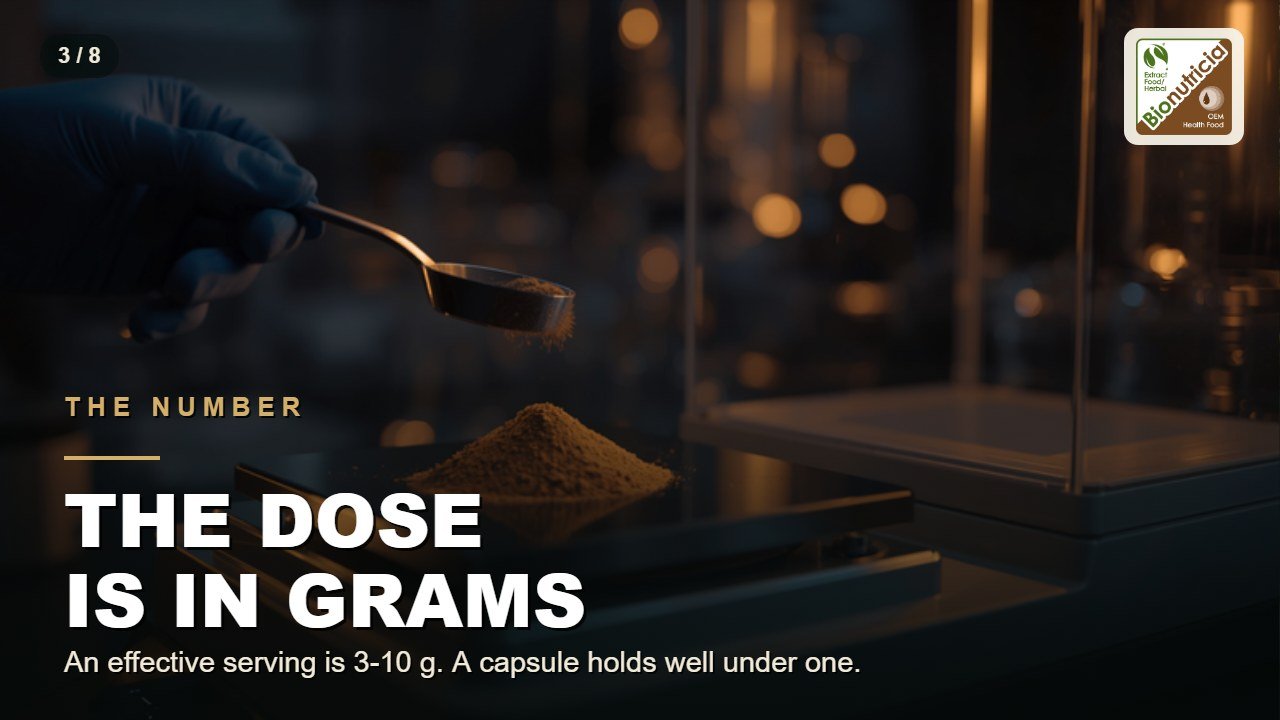
Formulated fiber servings run 3 to 10 grams. A typical capsule holds 500 to 750 milligrams of powder at a realistic fill density. Divide one by the other and the format argument is over: seven to ten capsules for a single serving, every day. That is not a marketing observation, it is arithmetic, and it is the first question we put to any brand arriving with a fiber brief.
Grams need room: the format decision
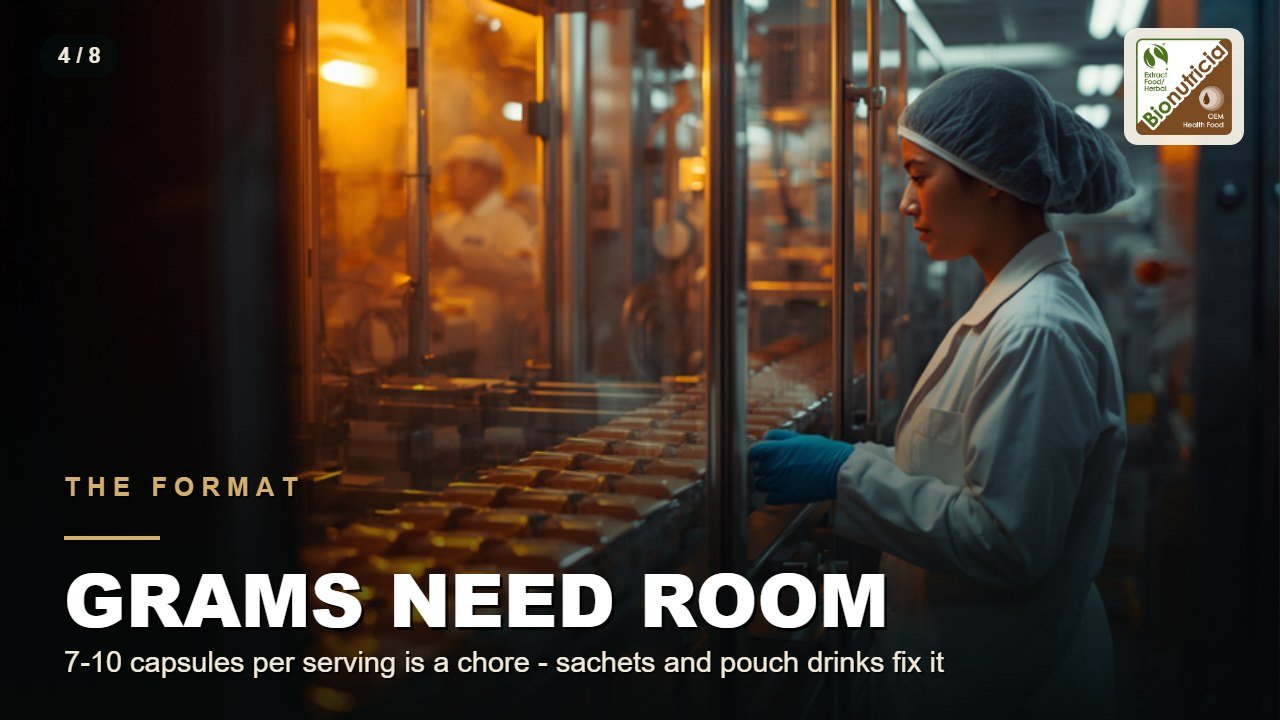
Gram-scale actives belong in formats engineered for grams: powder, liquid and gel sachets, stick-packs and pouch beverages, which carry three to fifteen grams comfortably, dose by weight with high accuracy, and travel well. It is worth being direct here. Bionutricia runs no capsule lines at all; the plant was built around sachet, beverage, chewable and liquid formats, so for fiber the trend and the factory happen to agree.

The hardest powder in the plant
Getting the dose into a sachet is the easy half. Fiber is arguably the hardest powder in the plant to make pleasant. Psyllium starts building viscosity the moment it touches water and can set toward a gel in the glass if the grind is wrong. Inulin drifts sweet as chain length varies. Coarse insoluble grades read as grit; overly fine grades dust and float, refusing to wet. Each source behaves differently, and a blend of three behaves like none of them.

Engineering the vanish
The difference between a fiber drink someone finishes and one they abandon is engineering. Particle-size control sets the wetting and the mouthfeel window. Granulation and instantising build porous granules that pull water in and disperse instead of clumping, so a five-gram dose can vanish into a glass in seconds with a spoon stir. The flavour system is designed around the fiber base rather than sprayed over the top. This is the work that decides the reorder.

Proving every gram, and every source
A gram-scale label claim still has to be true in every unit, so validated blending and in-process checks confirm the grams in each sachet, and finished-batch testing documents it. Sourcing carries the same discipline: every fiber ingredient enters with its own halal documentation, certificates on file per source, inside a facility certified to FSSC 22000, GMP, HACCP, JAKIM Halal, US FDA and MeSTI standards. Proof, not promises, is what survives an audit and a reorder cycle alike.

The rule: milligrams fit, grams need engineering
Milligrams fit in capsules. Grams need a format engineered for them, and a plant that treats dispersion, particle size and flavour as core process work rather than finishing touches. Fibermaxxing will crest like every trend, but the fiber intake gap is structural, and the brands still selling fiber in five years will be the ones whose first production decision respected the dose. Before you approve a fiber product, ask one question: where does the dose go?
FAQ: Fiber dosing and format in supplement manufacturing
What is fibermaxxing?
Fibermaxxing is the 2026 social-media trend of deliberately maximising daily fiber intake, with the hashtag passing two billion views. It took off because the underlying gap is real: fewer than one in twenty adults consistently reaches the recommended daily fiber intake, and trend participants target 40 to 50 grams a day from foods and formulated products combined.
How much fiber is an effective serving in a supplement?
Formulated servings typically run 3 to 10 grams, against recommended daily intakes of roughly 25 to 38 grams from all sources. That is a thousand times the milligram scale most botanical actives are dosed at, and it is the single number that drives every format decision that follows.
Why are capsules a poor fit for fiber products?
A typical capsule holds well under one gram of powder, so a meaningful fiber serving needs seven to ten capsules in one sitting, a routine very few customers keep. It is a capacity problem, not a quality problem. Bionutricia runs no capsule lines; the plant is built around gram-scale formats instead.
Which formats suit gram-scale doses?
Powder, liquid and gel sachets, stick-packs, pouch beverages and liquid bottles carry three to fifteen grams comfortably, dose accurately by weight and travel well. These are exactly the formats a fiber product needs, and they are the formats Bionutricia’s lines are certified to run.
What makes fiber so hard to formulate?
Every fiber behaves differently in water: psyllium builds viscosity fast and can gel, inulin drifts sweet, and coarse grades turn gritty. The fixes are engineering rather than flavouring alone: controlled particle size, granulation and instantising for rapid dispersion, and a flavour system designed around the fiber base rather than sprayed over it.
Planning a fiber product for a modern market? Bionutricia engineers gram-scale dosing, dispersion and format in from the specification stage — in sachets, stick-packs, pouch beverages and liquids, never capsules.
RELATED POSTS
View all

Article: Acerola (Malpighia emarginata, M. glabra)
October 5, 2024 | by bionutriciaadmin
The Other 90% of Your Powder: Why Carrier Origin Decides Your Halal, Allergen and Vegan Claim
July 29, 2026 | by supersuper
Article: Food as Medicine: Black Elderberry (Sambucus nigra, Adoxaceae)
October 5, 2024 | by bionutriciaadmin