

Single-Origin vs Blended-Origin Botanical Extract: Which Should You Specify?
September 4, 2026 | by supersuper
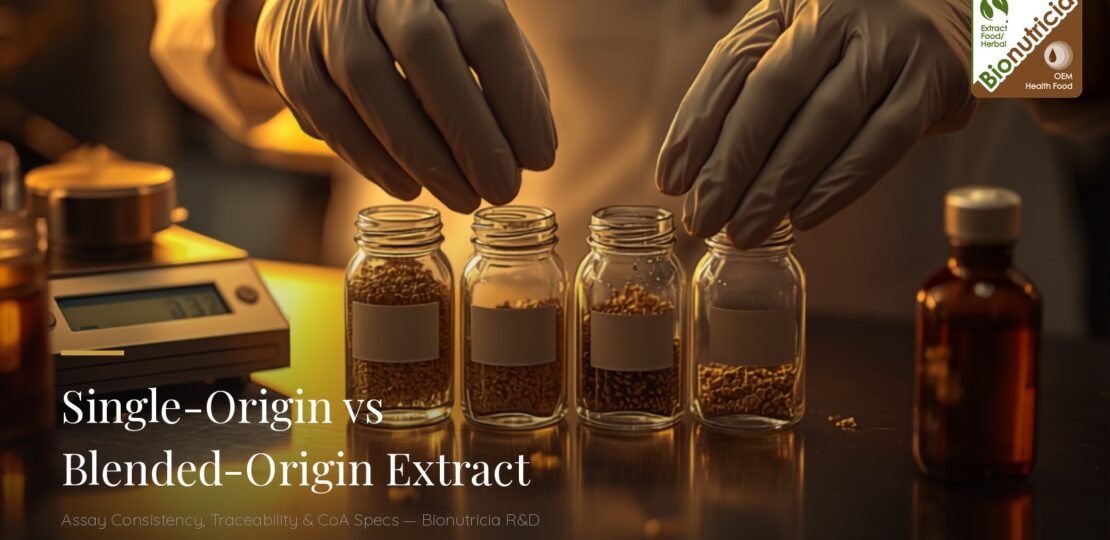
Direct answer: For most OEM brands, specify a blended-origin (multi-lot) botanical extract as your default — it lets your manufacturer hold the Certificate of Analysis (CoA) active-marker assay inside a tight, repeatable range batch after batch, which is the single biggest lever for consistent label claims, stable shelf-life data, and a formulation that doesn’t need re-validating every time a new harvest comes in. Reach for a single-origin specification only when your brand story is genuinely built around one named growing region — for example a Bentong ginger or a specific Malaysian herb estate — and you are willing to accept that the actives content will move naturally from harvest to harvest, managed through tighter incoming-lot testing and a documented in-spec range rather than a fixed number on the label. Single-origin is a marketing and traceability decision; blended-origin is a manufacturing-consistency decision. Neither is “better” in the abstract — the right choice depends on whether your SKU sells on provenance or on a guaranteed, repeatable potency number. A capable OEM should be able to quote both and show you the CoA data to support either path before you commit a formulation to production.
What’s the difference between single-origin and blended-origin botanical extract?
A single-origin extract is standardised from raw plant material grown, harvested and processed from one defined growing region or estate, typically within a single harvest window. A blended-origin extract (also called a composite or multi-lot extract) is standardised from raw material drawn across two or more growing regions, growers, or harvest lots, then combined — either before or after extraction — so the finished lot lands inside a target active-marker range.
Both are legitimate, widely used specification choices across the botanical extract industry. Neither implies a quality shortfall on its own; the difference is what each is optimised for.
| Factor | Single-origin | Blended-origin |
|---|---|---|
| What it optimises for | Traceable provenance / brand story | Batch-to-batch active-marker consistency |
| Typical assay range on CoA | Wider (reflects natural harvest variation) | Tighter (target window held across lots) |
| Supply resilience | More exposed to a single region’s harvest or weather event | Diversified across multiple qualifying lots |
| Best fit | Premium, heritage or export SKUs where the region is the claim | Formulations that need a stable, repeatable label figure |
| Documentation to request | Lot-level growing-region traceability | Blend composition + assay data per contributing lot |
Why do most OEM brands specify blended-origin extract?
Botanicals are agricultural products, and agricultural products vary. Rainfall, soil, altitude, harvest timing and post-harvest handling all move the concentration of the active compound a CoA is standardised against — sometimes by a meaningful margin between one harvest and the next, even from the same plot of land. A brand that specifies a single fixed lot for every production run is, in effect, betting that the next harvest will land in the same range as the last one.
Blending across multiple qualifying lots — all independently tested, all inside the agreed identity and purity specification — lets the manufacturer dial the finished extract to a tight target assay window before it ever reaches your formulation. That matters most for:
- Label-claim stability — the milligram or percentage figure printed on pack needs to hold true for the full shelf life of every batch, not just the first one.
- Formulation consistency — if the extract’s active-marker level swings between batches, your finished-product dose, taste, colour and stability testing can all shift with it.
- Supply continuity — a blended specification is far less exposed to a single bad harvest, a weather event in one growing region, or a grower falling out of rotation.
When does single-origin make sense?
Single-origin earns its place when the growing region is the product story — a brand built around a named Malaysian heritage botanical, a estate-identified extract for a premium or export-facing SKU, or a formulation where the marketing claim is explicitly tied to provenance rather than to a guaranteed potency figure. In that case, the trade-off is usually managed one of three ways: widening the acceptable assay range on the CoA and label so natural harvest variation stays in-spec; running tighter incoming-lot testing and rejecting out-of-range harvests outright; or accepting a documented in-spec blending range from within that single growing region across adjoining harvest windows, which keeps the provenance claim intact while still smoothing out the sharpest swings.
A single-origin claim is only as strong as the paperwork behind it. If provenance is part of your label story, ask your manufacturer for lot-level traceability documentation you can hold on file, not just a verbal assurance.
How does this affect your Certificate of Analysis (CoA)?
Whichever path you choose, the CoA is where the decision becomes concrete. A properly specified botanical extract CoA — single-origin or blended — should carry:
- Identity — botanical name, plant part used, and a confirmatory identity test (e.g. TLC or HPLC fingerprint) matching the reference standard.
- Active-marker assay — the standardised compound and its guaranteed range (e.g. “≥ X% by HPLC”). For blended-origin extracts this range is typically tighter; for single-origin extracts it should be wide enough to reflect genuine natural variation rather than papering over it.
- Microbial limits — Total Plate Count ≤ 10,000 CFU/g, yeast & mould ≤ 1,000 CFU/g, and E. coli, Salmonella and S. aureus absent per 25 g.
- Heavy metals — lead ≤ 2.0 ppm, cadmium ≤ 1.0 ppm, mercury ≤ 0.1 ppm, arsenic ≤ 1.5 ppm.
Ask for the specification range in writing before formulation begins, not after the first production run. A manufacturer that can show you historical batch-to-batch assay data for either origin strategy is giving you the clearest evidence of which one it can actually deliver consistently.
How does blending actually happen?
Blending is not a shortcut around testing — it’s an additional layer of it. Each contributing lot is independently tested for identity, active-marker assay, microbial limits and heavy metals before it ever qualifies for the blend pool. Only lots that pass the full specification are eligible to be combined, and the combination itself is calculated — not eyeballed — so the finished assay lands inside the agreed target window. The blend composition (which lots, in what proportion) is recorded and should be available to you as a buyer, even though the finished CoA reports a single combined result rather than a lot-by-lot breakdown. Some botanicals are naturally more variable between harvests than others — climate-sensitive leaf and flower material tends to swing more than root or bark material, for instance — so ask your manufacturer how variable your specific botanical has historically been before deciding how tightly to specify it.
What formats does this decision apply to?
The single-origin vs blended-origin decision sits upstream of format — it’s a raw-material and extraction specification, not a finished-product one — so it applies whichever approved OEM format you’re building toward: powder sachets, liquid sachets, gel sachets, pouch beverages, chewable tablets, or liquid bottles. Extracts can also be produced in standardised or phytosome (liposomal-carrier) form under Bionutricia’s patented enzymatic ultrasonic extraction process (MY-188945-A), and the same origin-strategy question applies before that extraction step begins.
A quick specification checklist
- Is the finished-product claim tied to a named growing region, or to a guaranteed potency figure? That answer alone usually decides it.
- Can your manufacturer show you 6–12 months of batch-to-batch CoA assay data for the origin strategy you’re considering?
- If you specify single-origin, is the acceptable assay range on the CoA wide enough to reflect real harvest variation — or has it quietly been set to match blended-origin norms?
- If you specify blended-origin, does the CoA still carry full lot traceability, even though the label doesn’t name a single region?
- Does your formulation’s stability data account for the active-marker range you’ve actually specified, not an idealised single number?
Related guides
- Standardised Extract vs Whole-Herb Powder: What’s the Difference for OEM?
- How to Read a Supplement Certificate of Analysis (CoA): A Buyer’s Guide
Ready to specify your extract?
Request a quotation → https://bionutricia.com/pricing-quotation/
See our OEM services → https://bionutricia.com/our-services/
View our certifications → https://bionutricia.com/awards-certifications/
WhatsApp +60 16-661 8510
Frequently Asked Questions
Is single-origin botanical extract automatically higher quality than blended-origin?
No. Quality is determined by identity, purity, microbial and heavy-metal testing against a defined specification — both origin strategies can meet the same quality bar. Single-origin adds a provenance claim; blended-origin adds assay consistency. They answer different questions, not a “better vs worse” one.
Will a blended-origin extract still list a botanical name and standardisation on the label?
Yes. Blended-origin only means the raw material was drawn from more than one growing region or harvest lot — the botanical identity, plant part and standardised active-marker percentage are declared exactly as they would be for a single-origin extract.
How much does the active-marker content of a botanical extract typically vary between harvests?
It depends on the species, growing conditions and the compound being measured, and can range from a small single-digit percentage shift to a much wider swing for climate-sensitive botanicals. This is exactly why the CoA’s stated assay range — not a single idealised number — is the figure to formulate against.
Can I switch from blended-origin to single-origin after my formulation is already in production?
Yes, but treat it as a formulation change: request updated stability data and a revised CoA range before switching, since the new specification may carry a wider natural variance than the one your original shelf-life testing was based on.
Does specifying single-origin extract cost more?
It can, because it typically requires tighter incoming-lot testing and a smaller qualifying pool of raw material. For exact figures for your SKU and volume, request a quotation directly.
Article by Bionutricia R&D Team — in-house registered pharmacist, nutritionist, dietitian and PhD biomedical scientist. Last updated: 4 September 2026.
RELATED POSTS
View all

Spray-Dried vs Freeze-Dried Botanical Extract: Which for Your SKU?
July 12, 2026 | by supersuper
Small-Batch vs Large-Batch Contract Manufacturing: Which Production Model Fits a Growing Brand?
August 23, 2026 | by supersuper