

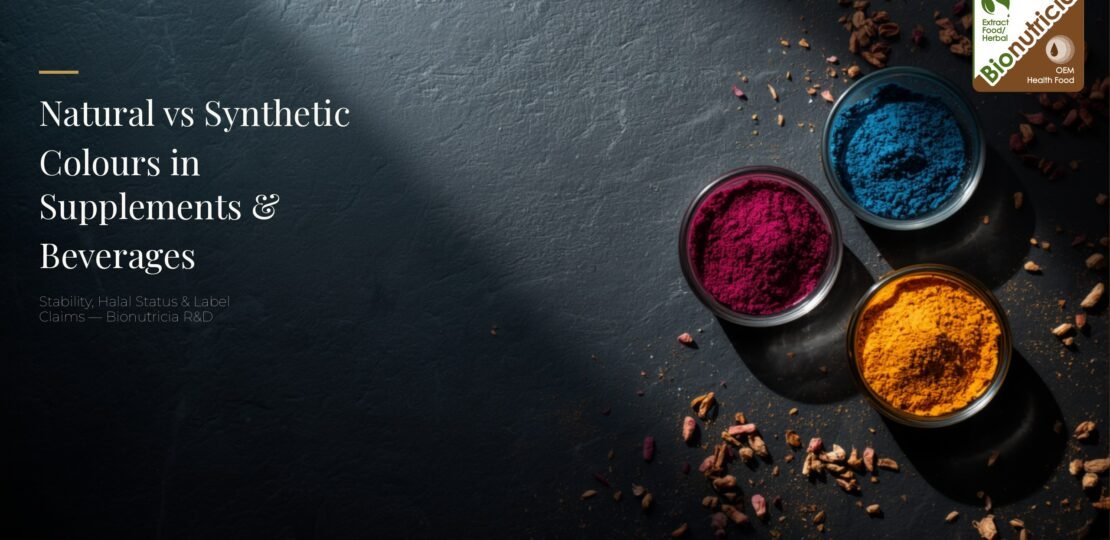
Direct answer: Natural colourants (butterfly pea anthocyanins for blue/purple, roselle/hibiscus for red, beetroot for pink-red, turmeric/curcumin for yellow, chlorophyll or spirulina for green) win on clean-label positioning and halal-by-default status when plant-derived, but lose on cost, colour consistency and stability compared to synthetic FD&C-type dyes — anthocyanin-based blues and purples are especially pH-sensitive and can shift shade or fade under heat, light or a low-pH beverage matrix in ways a synthetic dye won’t. Synthetic colours are cheaper, more stable across a wider pH and temperature range, and give a brand precise, repeatable shade control batch to batch, but they carry the “clean label” penalty with ingredient-conscious consumers and, in some markets, trigger consumer-facing warning statements on certain azo dyes. The trade-off is rarely close to 50/50 in practice: for a beverage or functional-food SKU marketed on naturalness, botanical positioning or a premium ingredient story, natural colour is close to mandatory regardless of the stability cost; for a low-margin, high-volume SKU where exact shade matching across every batch matters more than the ingredient story, synthetic remains the pragmatic default. Bionutricia formulates with its own butterfly pea, roselle and turmeric extracts as natural colourants, and can also advise on synthetic-colour stability data where a brand’s positioning doesn’t require a natural-only claim.
What “natural colour” actually means on a spec sheet
A natural colourant is a pigment extracted from a plant, fruit, vegetable, alga or (in a small number of cases) an insect origin, with no synthetic dye step. The commercially relevant natural colour families for supplements and beverages are anthocyanins (butterfly pea = blue/purple, roselle/hibiscus and beetroot = red/pink), carotenoids (turmeric/curcumin = yellow-orange, annatto = orange), and chlorophyll or spirulina/phycocyanin (green/blue-green). Each carries its own stability profile, and “natural” is not a single behaviour — an anthocyanin behaves very differently under heat and pH than a carotenoid does, which is why the colour family matters more to a formulation brief than the blanket natural-vs-synthetic label.
Natural vs synthetic: the trade-offs that actually matter
| Factor | Natural colourant | Synthetic colourant |
|---|---|---|
| Label positioning | Clean-label, “no artificial colours” claim supportable | Cannot support a clean-label or no-artificial-colours claim |
| Cost | Higher per-unit cost, especially for standardised high-potency extracts | Lower cost, widely available, stable pricing |
| Shade consistency batch-to-batch | Can vary batch to batch unless tightly standardised | Highly consistent, precisely reproducible |
| pH stability | Anthocyanins (butterfly pea, roselle) shift shade across pH; carotenoids (turmeric) are more pH-stable but heat- and light-sensitive | Stable across a wide pH range |
| Heat/light stability | Generally lower; needs formulation safeguards (antioxidants, opaque packaging, cold-chain in extreme cases) | Generally higher tolerance to processing heat and shelf-life light exposure |
| Halal/vegan status | Plant-derived pigments are halal- and vegan-by-default; carmine/cochineal (insect-derived) is natural but NOT halal or vegan | Halal-neutral (no animal origin), but not vegan-marketing-friendly due to “artificial” perception |
| Regulatory labelling | No special warning statements | Certain azo dyes (e.g. in some markets) require a consumer-facing warning statement on the label |
Why anthocyanin colours behave differently from carotenoid colours
The single most common formulation mistake with natural colour is treating “natural” as one ingredient category rather than several chemically distinct pigment families. Butterfly pea flower extract’s blue anthocyanin pigment is famous for its pH-driven colour shift — blue in a neutral or alkaline base, shifting to purple or pink as the formula acidifies, which is a feature for some novelty beverage concepts and a defect for a brand that wants a stable, predictable blue across its shelf life. Roselle and beetroot anthocyanins behave similarly across pH but in the red-pink spectrum. Turmeric/curcumin, by contrast, is a carotenoid-family pigment that holds its yellow-orange shade far more consistently across pH, but is more vulnerable to fading under prolonged light exposure and high processing heat. A brief that simply asks for “natural colour” without naming the pigment family and testing it in the actual finished-format matrix (powder sachet vs. liquid bottle vs. pouch beverage) is the single most common cause of a colour-stability complaint after launch.
The carmine/cochineal exception: natural doesn’t always mean halal or vegan
Carmine (also labelled cochineal extract or E120 in some markets) is a natural red colourant extracted from the dried bodies of the cochineal insect. It is natural by definition but is neither halal nor vegan, and its use has become a genuine reputational risk for brands that market on a “natural and halal” or “natural and plant-based” combined claim without checking the specific colourant’s biological origin. Bionutricia’s natural-colour formulations are plant-derived only (butterfly pea, roselle, beetroot, turmeric) specifically to avoid this exception — a brand bringing in colour from a third party should always confirm the biological origin, not just whether it is labelled “natural.”
Formats and how colour choice interacts with them
Colour stability risk is not uniform across Bionutricia’s approved format set. Liquid bottles and pouch beverages carry the highest stability risk for natural colour, since the pigment is in continuous contact with the liquid matrix, light and, over shelf life, oxygen — this is where pH buffering, opaque or UV-filtering packaging, and antioxidant co-formulation matter most. Powder sachets carry substantially lower risk, since the colourant stays in a dry, low-water-activity state until the consumer reconstitutes it, extending practical shelf-stability. Chewable tablets sit in between — dry storage, but often exposed to more ambient light than a foil sachet.
Making the decision: a simple framework
Choose natural colour when the brand’s core positioning is clean-label, botanical, or premium/artisanal — the ingredient story is doing marketing work that a synthetic dye would undercut, and the stability cost is worth engineering around. Choose synthetic colour when the SKU competes primarily on price and exact, guaranteed shade-matching across high production volumes, and the brand’s target consumer is not making a purchase decision based on colour origin. Some brands split the difference SKU-by-SKU within the same range — a flagship “clean label” product on natural colour, and a value-tier product on synthetic — which is a legitimate strategy provided the labelling clearly distinguishes the two so the naturalness claim isn’t accidentally implied across the whole range.
📚 Related guides
- Butterfly Pea Flower Extract for Functional Beverages: Colour & Spec
- Roselle (Hibiscus) Extract: Standardised Anthocyanin Content for Supplement & Beverage OEM
Frequently asked questions
Should my supplement use natural or synthetic colour — what are the trade-offs?
Natural colour supports clean-label and halal-by-default positioning (for plant-derived pigments) but costs more and is less stable across pH, heat and light. Synthetic colour is cheaper and more consistent but cannot support a natural or clean-label claim. Choose based on whether the brand’s positioning depends on the ingredient story, not on cost alone.
Why does my natural blue colouring turn purple or pink?
This is normal anthocyanin behaviour — butterfly pea’s blue pigment is pH-sensitive and shifts toward purple or pink as the formula acidifies. It is a formulation variable to manage (buffer the pH, test in the actual finished matrix), not a defect in the raw material.
Is all natural colour automatically halal and vegan?
No. Plant-derived natural colours (butterfly pea, roselle, beetroot, turmeric) are halal- and vegan-by-default, but carmine/cochineal is a natural colourant derived from insects and is neither halal nor vegan. Always confirm the specific biological origin, not just the “natural” label.
Which format is most forgiving for natural colour stability?
Powder sachets, since the dry, low-water-activity state limits the degradation pathways that affect colour in a liquid matrix. Liquid bottles and pouch beverages carry the highest natural-colour stability risk and need the most formulation safeguards.
Can I use natural colour on some SKUs and synthetic on others in the same range?
Yes — this is a common and legitimate strategy, provided the labelling clearly distinguishes which SKUs carry a natural-colour claim so the naturalness positioning isn’t implied across products that don’t qualify for it.
Ready to specify the right colourant for your SKU?
JAKIM halal-certified formulation with natural botanical colourants (butterfly pea, roselle, beetroot, turmeric) or guidance on synthetic-colour stability, across powder-sachet, liquid-sachet, pouch-beverage, liquid-bottle and chewable-tablet formats. Full CoA review and a free formulation consultation.
Request a quotation · See our OEM services · View our certifications
WhatsApp: +60 16-661 8510
Article by Bionutricia R&D Team — in-house registered pharmacist, nutritionist, dietitian, and PhD biomedical scientist. Last updated: July 22, 2026.
RELATED POSTS
View all

Powder Supplement vs Liquid Supplement: Which Format for Your Active?
July 6, 2026 | by supersuper
OEM vs White-Label vs Private Label: Supplement Terms Explained
August 2, 2026 | by supersuper
In-House vs Contract Lab Testing: What Should a Supplement Brand Outsource?
August 18, 2026 | by supersuper