

Black Seed (Nigella sativa) Extract OEM: Thymoquinone Standardisation & CoA Specs for Halal Supplement Formats
September 21, 2026 | by supersuper
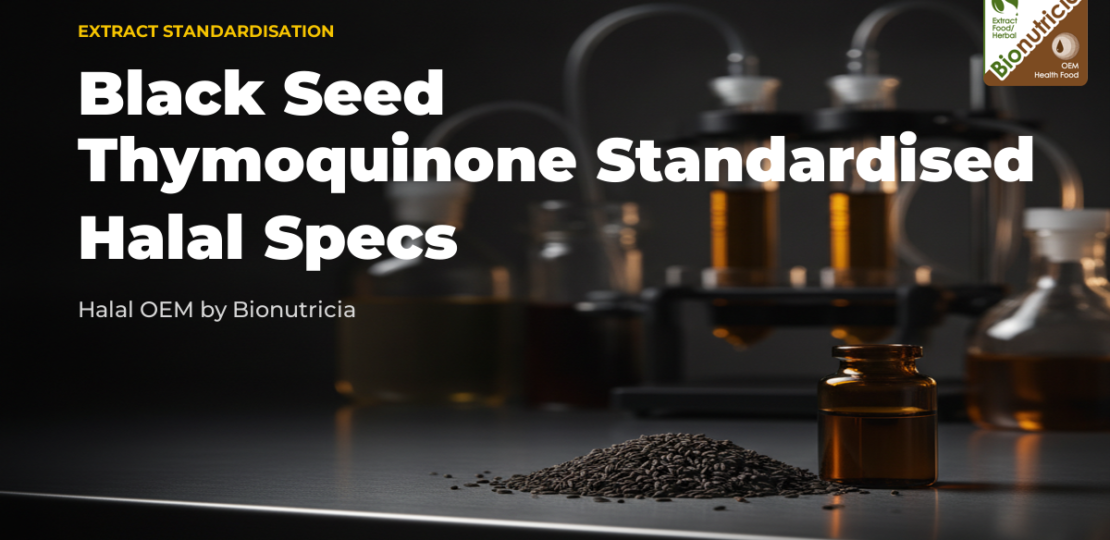
Direct answer: For OEM use, specify a Nigella sativa (black seed / black cumin) seed oil or extract standardised to a stated thymoquinone content by HPLC or GC, with the assay method and result printed on the Certificate of Analysis (CoA) — not an unstandardised “black seed oil” with no marker figure on the paperwork. Published human research has evaluated black seed oil standardised to 5% thymoquinone, which is a useful real-world benchmark to compare a supplier’s spec against. Beyond the thymoquinone assay, the CoA should also state the fatty acid profile (linoleic and oleic acid ratios, since these shift with seed origin and pressing method), peroxide value and acid value (oxidation/freshness indicators for an oil), plus standard heavy-metal (Pb, Cd, Hg, As) and microbial panels. Nigella sativa has a long traditional-use history and a growing body of human clinical research, but the evidence for any single health outcome is still developing, so on-pack claims should stay general and compliant rather than disease-specific. Bionutricia is a JAKIM-certified halal OEM manufacturing supplement and functional-beverage formats in Malaysia; a black seed oil SKU fits liquid bottle, liquid sachet, gel sachet, or powder (carrier-absorbed) formats.
What Is Nigella Sativa (Black Seed) Extract?
Nigella sativa — known variously as black seed, black cumin, kalonji, and in Malaysia and much of the Muslim-majority world as habbatus sauda — is a flowering plant in the Ranunculaceae family, cultivated for its small black seeds. The seeds are traditionally cold-pressed or extracted for their oil, which carries a distinctive aroma from a group of volatile compounds. The best-studied of these is thymoquinone, a naturally occurring constituent that is used across the industry as the primary chemical marker for standardising and comparing black seed oil batches. Habbatus sauda already has strong cultural recognition among halal supplement buyers, which makes it a natural extension category for brands already selling other traditional botanicals.
What Thymoquinone Standardisation Should You Specify?
Thymoquinone content in raw black seed oil varies considerably depending on seed origin, harvest, and extraction method, so an OEM spec that simply says “black seed oil” without an assay figure leaves a brand with no way to compare one supplier’s batch against another’s. Ask your OEM for a CoA that states:
- Thymoquinone content, expressed as a percentage, with the assay method (HPLC or GC) named on the certificate
- Batch-to-batch consistency data, not a single historical spec sheet
- Whether the figure was measured on the finished oil or on an upstream extract before dilution into a carrier
As a reference point, a randomised, double-blind, placebo-controlled human trial has evaluated a Nigella sativa oil standardised to 5% thymoquinone in relation to seasonal allergy symptoms (Majeed et al., Medicine, 2024, PMID 39121267, https://pubmed.ncbi.nlm.nih.gov/39121267/). That trial record confirms 5% thymoquinone as a real, clinically studied benchmark for what a “high-standardisation” oil looks like — it is cited here only to establish that specification point, not to claim that the trial proved a specific benefit, since no result data was available for review.
Cold-Pressed vs Extracted Oil
Cold-pressed oil retains more of the seed’s native volatile profile but typically shows more batch-to-batch variation in thymoquinone content. Solvent- or CO2-extracted concentrates can be standardised more tightly but cost more to produce. Either route is acceptable for OEM as long as the CoA discloses which method was used and backs it with an actual assay result.
Reading the CoA: Fatty Acid Profile, Oxidation Markers & Contaminant Limits
Because black seed extract is typically supplied as an oil rather than a dry powder, the CoA needs oil-specific quality markers that a dry-botanical extract CoA would not carry:
- Fatty acid profile — linoleic acid and oleic acid proportions, which should sit within the ranges typical of authentic Nigella sativa oil and flag adulteration with a cheaper carrier oil if they do not
- Peroxide value — an early indicator of oxidative rancidity; a low figure at time of testing matters more once you factor in shelf-life targets
- Acid value — a secondary freshness/quality indicator
- Heavy metals — lead, cadmium, mercury and arsenic against standard ppm limits
- Microbial limits — total plate count and pathogen screens appropriate to a liquid oil ingredient
Request all of the above per batch, not as a one-off “typical values” document — a genuine batch CoA is one of the first things worth checking when you are choosing a supplement OEM, and the same principle applies to any single-ingredient extract, not just black seed oil.
What Does the Clinical Evidence Actually Show?
Nigella sativa is one of the more researched single-seed botanicals, and a systematic review and meta-analysis of randomised controlled trials has synthesised existing RCT data on Nigella sativa’s effects on inflammatory and oxidative-stress biomarkers in humans (Journal of Food Biochemistry, 2021, https://onlinelibrary.wiley.com/doi/10.1111/jfbc.13625). That review confirms an active human-trial literature exists on this topic; the review record available for this article did not include the specific direction or size of effect, so no specific biomarker-change claim is made here.
As with most single-botanical actives, the honest summary for a brand owner is: black seed oil has deep traditional use, a real and growing clinical-trial base, and a recognised marker compound (thymoquinone) that lets you write a meaningful spec — but it does not currently support a specific disease-treatment or medicinal claim on a Malaysian supplement label, and it should be marketed as a general wellness botanical rather than a treatment for any named condition.
Approved OEM Formats for Black Seed Oil
Because Bionutricia does not manufacture capsules, softgels, or hard tablets, a black seed oil SKU is built around the formats the facility does run:
- Liquid bottle — the oil dosed directly, often blended with a food-grade flavour carrier to manage its distinctive aroma
- Liquid or gel sachet — single-dose format for on-the-go or subscription-box brands
- Powder (carrier-absorbed) — the oil spray-dried or absorbed onto a food-grade carrier for a shelf-stable powder sachet format
Whichever format you choose, the carrier itself needs its own halal documentation — a halal certificate on the black seed oil alone does not automatically cover a carrier or flavour system added around it.
Halal Certification Considerations
Black seed oil is a plant-derived ingredient, which puts it in a generally low-risk category for halal sourcing, but the full chain still needs verifying: seed sourcing, extraction processing aids, and any carrier or excipient blended in during formulation. Bionutricia holds JAKIM Halal certification alongside FSSC 22000, GMP, HACCP, US FDA registration and MeSTI, and NanoVerify for nano-processed actives where applicable — the certificate chain a brand owner should ask any OEM to show, ingredient by ingredient, rather than assuming one halal logo on a raw-material spec sheet covers the finished SKU.
Frequently Asked Questions
What is black seed oil standardised to for OEM manufacturing?
Specify a thymoquinone content by HPLC or GC, stated as a percentage on the CoA with the assay method named. A published human trial has evaluated oil standardised to 5% thymoquinone, which is a useful reference point when comparing supplier specs.
Is black seed oil halal by default?
As a plant-derived seed oil, black seed oil is generally low-risk for halal status, but the certificate should still cover the full chain — seed sourcing, extraction, and any carrier or flavour system blended in during formulation — rather than relying on a single raw-material halal logo.
What CoA tests should I request for a black seed oil extract?
Ask for thymoquinone content (HPLC/GC), fatty acid profile (linoleic and oleic acid ratios), peroxide value, acid value, heavy-metal limits (Pb, Cd, Hg, As), and microbial testing, all reported per batch rather than as a generic “typical values” sheet.
Does black seed oil have clinical research behind it?
Yes — human clinical trials and at least one systematic review and meta-analysis of RCT data exist on Nigella sativa. The evidence base is real but still developing, and it does not currently support a specific disease-treatment claim on a Malaysian supplement label.
What OEM formats can black seed oil be manufactured in?
Liquid bottle, liquid sachet, gel sachet, or a carrier-absorbed powder sachet. Bionutricia does not manufacture capsules, softgels, or hard tablets, so a black seed oil SKU needs to be built around one of these approved formats from the start.
Request a Quotation
Brand owners evaluating a black seed (Nigella sativa) extract SKU can request a formulation consultation and quotation through Bionutricia’s enquiry channels at bionutricia.com. Bionutricia’s services span formulation, standardised botanical sourcing, and JAKIM-halal contract manufacturing across the approved format range, backed by FSSC 22000, GMP, HACCP, US FDA registration, MeSTI, and NanoVerify certification.
Related Guides
- Elderberry (Sambucus nigra) Extract OEM: Anthocyanin & Vitamin C Standardisation for Immune-Support Formats
- How to Read a Supplement Certificate of Analysis (CoA): A Buyer’s Guide
- Standardised Extract vs Whole-Herb Powder: What’s the Difference for OEM?
Article by Bionutricia R&D Team. Last updated: 21 September 2026.
RELATED POSTS
View all