

Papain + Bromelain Digestive Enzyme Herbosomal® Liposomal Liquid Sachet: How a Malaysian Brand Owner Differentiates Against Standard Enzyme Supplements
October 5, 2026 | by supersuper
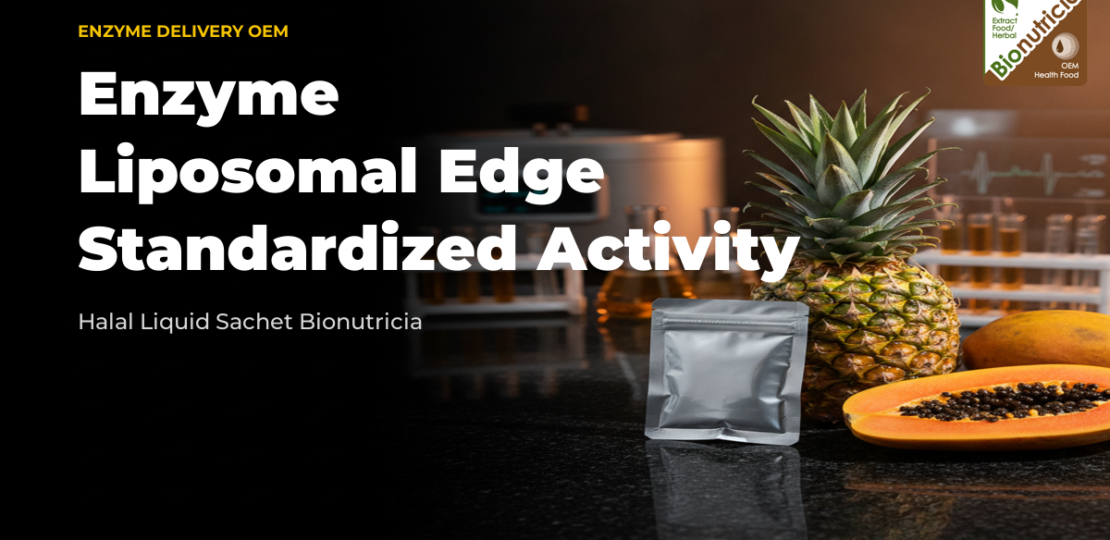
Direct answer: A Malaysian brand owner differentiates a papain + bromelain digestive enzyme liquid sachet from standard enzyme supplements by running the formulation under Herbosomal® — Bionutricia’s proprietary liposomal encapsulation and sustained-release technology (registered trademark; patent-pending PI2023005773). The differentiation is a formulation decision: the enzymes are carried in a phospholipid-encapsulated liquid format rather than a standard dry-blend powder, and the label carries the Herbosomal® registered trademark alongside the JAKIM halal certification.
Standard enzyme supplements on shelf are almost universally dry-blend powders in sachets or bulk containers, with enzyme activity quoted in supplier units that may not match the label claim. A Herbosomal® liquid sachet changes the format, the carrier and the shelf presentation — giving a brand owner a defensible position that a standard line does not occupy.
Papain and Bromelain as Proteolytic Enzymes
Papain is a proteolytic enzyme derived from the latex of Carica papaya. Bromelain is a proteolytic enzyme complex derived from the stem and fruit of Ananas comosus (pineapple). Both are cysteine proteases — enzymes that break down protein — and both are used in digestive enzyme supplements as structure-function ingredients. In Bionutricia’s papaya extract specification, papain is listed as the active compound in a 100:1 extract of papaya leaf, with a pH of 6–8, moisture of 2–8%, and heavy-metal limits of As ≤ 1 ppm, Pb ≤ 2 ppm, Cd ≤ 1 ppm, Hg ≤ 0.05 ppm.
For a finished liquid sachet, the enzyme activity — not the weight — is the specification that matters. Papain activity is commonly expressed in FCC PU/g (Food Chemicals Codex papain units per gram), while bromelain activity is commonly expressed in GDU/g (gelatin-digesting units per gram). A brand owner must require the supplier to state the crosswalk between the supplier’s U/g quotation and the label-claim units (FCC PU for papain, GDU for bromelain) on the Certificate of Analysis.
Enzyme Activity Standardisation: GDU and FCC PU
The enzyme activity standardisation process is the same whether the finished format is a standard dry-blend powder or a Herbosomal® liquid sachet — but the CoA requirements differ. In a dry-blend powder, the enzymes are added post-drying under low-humidity conditions, and the activity is assayed on the finished blend. In a Herbosomal® liquid sachet, the enzymes are carried in a liquid matrix, and the activity must be assayed in the finished liquid after encapsulation and throughout shelf life.
A brand owner should require the following on every batch CoA:
| CoA field | Papain | Bromelain |
|---|---|---|
| Activity unit | FCC PU/g | GDU/g |
| Supplier unit crosswalk | U/g → FCC PU/g | U/g → GDU/g |
| Label claim | Agreed with buyer | Agreed with buyer |
| Overage | 15% held to shelf life | 15% held to shelf life |
| Release test | FCC PU in finished liquid | GDU in finished liquid |
Enzyme activity varies from lot to lot, so the formulation must be activity-adjusted: the charge weight of each enzyme is recalculated for each lot based on the CoA assay to hit the label claim plus the agreed overage. This is true for both standard and Herbosomal® formats.
Herbosomal® as a Differentiation Lever
The differentiation between a standard enzyme supplement and a Herbosomal® liquid sachet rests on three pillars: the format, the carrier and the trademark.
Format: A standard enzyme supplement is typically a dry powder in a sachet or bulk container. A Herbosomal® liquid sachet is a ready-to-consume liquid in a single-serve sachet — no mixing, no water needed. The liquid format changes the consumer experience and the shelf presentation.
Carrier: In a Herbosomal® ingredient, the enzymes are carried in a phospholipid-based liquid matrix. The phospholipid carrier is part of the formulation, not a separate ingredient. A brand owner should specify the phospholipid type on the technical specification and confirm its halal status.
Trademark: The Herbosomal® registered trademark appears on the label, signalling a proprietary technology that no standard enzyme supplement carries. This is a marketing differentiator, not a clinical claim — the brand owner must ensure the label language stays within structure-function framing and does not attach a performance claim to the technology.
Liquid Sachet Format and Stability
The liquid sachet is one of Bionutricia’s five approved OEM formats. For a papain + bromelain enzyme combination, the liquid sachet offers a ready-to-consume format that does not require mixing — but it also introduces stability challenges that a dry powder does not face. A brand owner should verify the following:
- Enzyme stability in liquid: Proteolytic enzymes can degrade in a liquid matrix over time. The formulation must include an overage sufficient to maintain the label claim through shelf life, validated by accelerated stability testing at 40°C/75% RH for a minimum of three months.
- pH control: The liquid matrix pH must be compatible with both enzymes. Papain is stable in a pH range of 4–7; bromelain is stable in a similar range. The formulation pH should be agreed and stated on the CoA.
- Packaging: The liquid sachet must use a high-barrier material that protects the enzymes from light and moisture. Aluminium foil-based laminate sachets are the standard choice.
- Preservative system: A liquid format requires a preservative system to control microbial growth. The preservative must be halal-compliant and declared on the ingredient list.
Halal Chain and Certification
Both papain (from papaya) and bromelain (from pineapple) are plant-derived enzymes and do not present the halal-chain complexity of animal-derived enzymes. However, the phospholipid carrier used in the Herbosomal® formulation must be halal-certified — sunflower lecithin is the most common halal-compliant phospholipid, while soy lecithin may require additional certification. A brand owner should request the halal certificate for every ingredient in the chain, including the carrier, the preservative and the flavouring agents, and verify each on the JAKIM Halal Malaysia portal.
The full certification stack at Bionutricia’s manufacturing facility includes FSSC 22000, GMP, HACCP, JAKIM Halal, US FDA registration, MeSTI and NanoVerify. The NanoVerify validation is particularly relevant for a Herbosomal® product, as it confirms the nano-scale encapsulation process has been independently verified.
Manufacturing a Papain + Bromelain Liquid Sachet Under Your Own Brand
Bionutricia offers formulation development and private-label OEM/ODM manufacturing of finished supplements for brand owners and distributors. The liquid sachet is one of five approved formats — alongside powder sachets, gel sachets, pouch beverages, chewable tablets and liquid bottles — manufactured at the integrated facility in Sungai Buloh, Selangor, Malaysia. For a papain + bromelain digestive enzyme line, the Herbosomal® liposomal encapsulation platform is available, and the patented enzymatic ultrasonic extraction (MY-188945-A) is applied to the botanical extract fractions. To request a quotation, email ng@bio-nutricia.com or submit an enquiry through our enquiries page.
Frequently Asked Questions
What makes a Herbosomal® enzyme sachet different from a standard enzyme powder?
The format (liquid vs dry powder), the carrier (phospholipid-based liquid matrix vs dry blend) and the trademark (Herbosomal® registered trademark on the label). These are formulation and marketing differentiators, not clinical claims.
What enzyme activity units should appear on the label?
Papain activity should be expressed in FCC PU/g and bromelain in GDU/g. Require the supplier to state the U/g-to-FCC PU/g and U/g-to-GDU/g crosswalks on the CoA so the label claim can be independently verified.
How is enzyme stability maintained in a liquid sachet?
The formulation includes an overage percentage to account for activity loss over shelf life, validated by accelerated stability testing. The liquid matrix pH must be compatible with both enzymes, and the sachet must use high-barrier packaging to protect against light and moisture.
What halal documentation is needed for a Herbosomal® enzyme sachet?
Request the halal certificate for every ingredient: papain, bromelain, the phospholipid carrier, the preservative and the flavouring agents. The phospholipid carrier must be halal-certified — sunflower lecithin is the most common halal-compliant option.
Can a brand owner claim the Herbosomal® sachet is more effective than a standard enzyme supplement?
No. The Herbosomal® technology is a formulation and format differentiator, not a clinical efficacy claim. The label must stay within structure-function framing and must not attach a performance claim to the technology. The differentiation is the format, the carrier and the trademark — not a health outcome.
Related Guides
- Powder Sachet vs Liquid Sachet vs Pouch Beverage vs Liquid Bottle: Which Format Wins for Your Supplement Category?
- Powder Supplement vs Liquid Supplement: Which Format for Your Active?
- B2B Wholesale OEM Commercial Terms
Article by Bionutricia R&D Team. Last updated: 5 October 2026.
RELATED POSTS
View all

How to Choose a Contract Manufacturer for a Liposomal Vitamin C Supplement: A Brand Owner’s Buyer’s Guide
October 9, 2026 | by supersuper
Top 7 nutraceutical OEM manufacturers in Malaysia compared (2026)
May 26, 2026 | by supersuper
Purple Sweet Potato (Ipomoea batatas) & Ginger Extract OEM: Anthocyanin Standardisation for Functional Beverage
September 24, 2026 | by supersuper